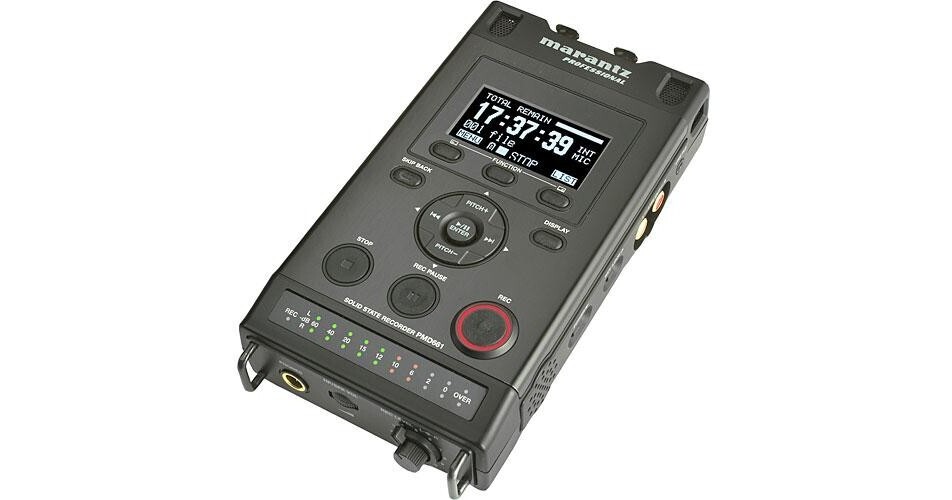
O PMD661 da Marantz é um gravador de áudio de campo estéreo com qualidade profissional que engloba ricos recursos de gravação, reprodução, e edição em um compacto e ergonômico pacote. Baseado no popular PMD660, o PMD661 incorpora uma ampla gama de recursos e avanços de alta tecnologia.
O gravador utiliza preamps internos de alta qualidade para gravar sons de alta qualidade em cartões de memória flash SD ou SDHC. Você pode utilizar os microfones embutidos ou as entradas XLR duplas para conectar microfones externos. Os jacks garantirão phantom power de +48V, permitindo que você use microfones condensadores. Você pode também utilizar o S/PDIF digital ou a mini entrada de linha de 3.5mm para conectar outras fontes de áudio. Arquivos de áudio podem ser gravados como WAV ou MP3 em taxas de até 24 bits/96kHz.
No lado da saída, você pode escolher revisar seu material através de um falante estéreo integrado ou através do jack de fone de ouvido de 1/4" com seu próprio controle de volume. Você pode ainda utilizar a saída de linha estéreo RCA para conectar a um mixer ou falantes. Uma porta USB 2.0 permite A conexão a um computador para transferir seus arquivos para edição e compartilhamento.
O PMD661 garante uma interface intuitiva com controles de fácil uso e uma brilhante e clara tela OLED. Um medidor em LED de 10 seguimentos facilita o monitoramento do nível de áudio com uma rápida olhada. Projetado para uma vida móvel, o PMD661 é construído em plástico ABS durável, e pode operar por até 5 horas com 4 baterias padrão AA.
| Tipo | Gravador Estéreo de Campo Portátil Transistorizado (Solid-State) |
| Métodos de Gravação/Leitura | WAV ou MP3 para SD/SDHC |
| Taxa de Bits de Gravação |
WAV: 16,24 bits Linear PCM MP3: 64/128/192/256/320 kbps |
| Frequência de Amostragem | 44.1/48/96kHz |
| Número de Canais | 2 (Estéreo) ou 1 (Mono Verdadeiro) |
| Resposta de Frequência | 20Hz - 24kHz |
| Relação Sinal-Ruído |
Mic: 65dB Line: 85dB |
| Faixa Dinâmica | 85dB |
| Distorção Harmônica Total (THD) |
Microfone: 0.08% Line: 0.02% |
| Entradas |
2 Microfones embutidos 2 Jacks XLR de Microfone/Linha com Phantom Power +48V 1 Entrada de Linha Estéreo de 3.5mm 1 Entrada RCA Digital S/Pdif 1 Jack DE 3.5mm para controle remoto 1 Entrada de alimentação DC |
| Saídas |
2 Falantes integrados 1 Jack de Fone de Ouvido de 1/4" 1 Saída Estéreo RCA 1 Porta USB 2.0 |
| Alimentação |
4 Baterias AA ou Adaptador AC Incluído 1 Bateria de Lítio (Bateria Reserva para relógio de tempo real) |
| Dimensões (LxPxA) | 3,7 x 1,4 x 6,5" (93 x 36 x 165mm) |
| Peso | 14 onças (410g) |
REVIEW SNAPSHOT®
by PowerReviewsPros
Cons
Best Uses
Most Liked Positive Review
"God also said - Let There Be Sound"
Firstly, buying an F1 race car will not automatically make one a world class race driver. one needs to put their back into it, sweat it out, experiment and learn along the way....Read complete review
Firstly, buying an F1 race car will not automatically make one a world class race driver. one needs to put their back into it, sweat it out, experiment and learn along the way. The same applies to the Marantz PMD 661. I felt no less than buying an F1 racer when I started using the PMD. It is a sophisticated piece of equipment. But it would be far from truth to say that sophistication would mean extreme complexity or a steep learning curve. On the contrary it has always been my experience that greater the sophistication the easier it is to use. I learned to handle the PMD661 in 10 minutes flat. No kidding. And Im not a sound guy at all. This is the first piece of sound equipment I purchased in my life. Then the mic then the cable. Connected to the xlr inputs, fiddled around with the menu options and presto, pristine sound. I think it cannot get any simpler than this.
Few days earlier when I was searching for a sound recorder over the net, and I have to admit it is a jungle out there, I too was faced with this issue of simultaneous movie and sound track recording. Believe me guys, the preamps on the DSLRs are not to be made the basis for recording good stuff. Period. Lets not have any more debate on it. I hear a lot of people say that it would be great to have movie + good sound together. And its just that "Would be great". Place it on the number 1 wish list to the manufacturer. I put forth the argument that the movie being shot on the DSLR does not go straight to the dvd or celluliod film. One has to grade it, edit it, stabilize it, add cg and what not. But sound recorded and brought in from a good external recorder requires far far less processing that the movie side of things. And people say it is a big hassle to sync up the audio. I find it absolutely blasphemic. I absolutely say it without hesitation and shame today, that I can get away with shooting a 720p footage blown up to a full HD format added with a soft diffusion effect to the entire footage to hide its softness. Ever heard of artistic freedom ? Well this is a true example of one. Its not so with with sound. If sound is not good, then not matter how hard you argue that it was artistic freedom, people will freak out and you have to face the music (pun intended).
Anyway, at first I thought I would have to burn a lot of midnight oil to conquer this beast. But my fears were misplaced. I became immediately productive with the unit out of the box. Menus, being the primary interface with the machine, are very very easy to use. To tell you the truth, I find my cellphone quite intimidating with all its infinite menus and sub menus. (Hey do you know how to switch off the Bluetooth option?). No, not with the PMD661. The pre-amps are rock, sorry titanium, solid. I viewed the wav file on my computer and had to zoom in quite a long way to see the crests and troughs of the noise pattern. Pretty amazing stuff. But there is one pitfall that I would like to mention. And this is not about the PMD661 itself but the SDHC cards. Please remember to format the cards with the SDFormatter software. It seems the operating system does not do a good job of formatting the sdhc cards. I struggled with the card side of things a bit. The PMD would hang, needing reboot and stuff. But once I put the card through the SDFormatter, everything was smooth as butter.
Now for my feature by feature goodies
-o-
The record button is pretty good when red. Looks exactly like the mother-in-law. Cannot go wrong in recognizing it from a distance. Pretty good indicator that the PMD is recording.
-o-
A single keylock slide and you have effectively fortified PMD from external stimuli whether intentional or otherwise.
-o-
I read that 24bit/48Hz is the best and film quality. But, Ms. PMD661 has some amazing figures for you to drool over. She has 24bit/96Hz. You can do some great trickery with the 24/96 thingy. Time to chew my fingers away. Please use wav for professional work. For taking notes and stuff you can use the mp3 formats.
-o-
Great oled display. Visible even in daylight. One less thing to worry about on an otherwise hectic shooting day.
-o-
The greatest feature is the D.Mono thingy. You can record mono sound simultaneously to the left and right channels. Why would I want to do that you ask? Record with different gain on each channel. Left channel has say 0db and the other channel has -12db. So what ? you say. Sheeshhhh. Gain one sucker, say the left channel, all the way up and allow it to clip as well, and gain the other one down. In post, replace what has fallen out of tune with the other channel. Really amazing for one man army recordist. Its like having an insurance policy for free for jumping off a cliff (i mean clip) on purpose.
-o-
I wish most modern software had fewer menus like the PMD661 while also getting the job done. I reiterate the words sophistication and simplicity should be synonymous. After a few iterations you are not even thinking about the menus. Click, click, click and you can go on all day without thinking what menu/submenu is next. Allow me to coin a new phrase "Muscle memory friendly".
Now I have to stop it here before you guys fall asleep. However, I have a question for the Marantz folks. "Can I use this machine to fly ?".
Lastly, I thank the B&H folks for answering me on time. They have the patience of Mother Teresa. And my patience levels can turn into lethal rage under 5 seconds flat.
Thanks guys.
VS
Most Liked Negative Review
Volume output very low
I just purchased the Marantz PMD661,have had it for two days now. Have a problem with the soundvolume. Among all the customer reviews, no one hassaid anything about the sound volume. I ...Read complete review
I just purchased the Marantz PMD661,have had it for two days now. Have a problem with the soundvolume. Among all the customer reviews, no one hassaid anything about the sound volume. I have to put the volume control to maximum during and afterrecording to hardly hear what's being recorded. And with volume to maximum with the unit speakersthe volume output is hardly noticable, you have to your ear next to the unt to understand what wasrecorded.
Reviewed by 56 customers
Sort by
Displaying reviews 1-20
Previous | Next »
Pros
Cons
Best Uses
Comments about Marantz PMD661 Professional Portable Flash Field Recorder:
perfect for film recording
Pros
Cons
Best Uses
Comments about Marantz PMD661 Professional Portable Flash Field Recorder:
I'm using this device for use in Dual-System Video shooting scenarios. I attached 2 Sennheiser Lavs to augment the audio from a Rode SVM attached to my HD video camera. I originally purchased the Tascam DR-40. The Tascam had lots of bells and whistles in terms of effects (that I don't need), but the build quality and EMI shielding were not near the level of this device! I'd give it 5 stars if it weren't so expensive!
Pros
Cons
Best Uses
Comments about Marantz PMD661 Professional Portable Flash Field Recorder:
I am a "newbie" to digital audio and am using the PMD661 for personal history interviews (capturing people's life stories & voices). I am *not* a techie, but figured this recorder out in no time! It's straightforward and well-documented. I bought Audio-Technica AT899 lavalier mics to go with it and they simply plug right in. No muss, no fuss. The sound quality is great. I'm very happy with my purchase!
Pros
Cons
Best Uses
Comments about Marantz PMD661 Professional Portable Flash Field Recorder:
i am using this product to conduct field work (i.e., research interviews and field recordings) and for home recordings (i.e., developing oral histories and other audio-based projects). i find the product easy to navigate. it's laid out quite well. i also find the product easy to use in terms of getting the tape i need and transferring it to my laptop.
Pros
Cons
Best Uses
Comments about Marantz PMD661 Professional Portable Flash Field Recorder:
I bought this recorder for pod casts and film making. I had another product the Zoom H4n which I know a lot of poeple love, but which I found to be a list-intensive nightmare. It might be my advancing years.The Marantz 661 is so simple to use that I have already figured out most of it's features.I really like how features like volume control for recording and playback are so accessible, though I do wish the record volume wheel was a little larger. The "pitch" buttons make access to all of the software extremely easy. What else could you ask for?The sound quality is extremely good, and it is so easy to set up your different mic settings whether you are using the internal mics or externals.It is also a beautiful machine.It's a beautiful machine that easy to use and gives you a professional sound.At [$] it twice the cost of the Zoom, but the 661 is 10 times eaisier to use in my opinion.
Pros
Cons
Best Uses
Comments about Marantz PMD661 Professional Portable Flash Field Recorder:
I bought this over the Zoom H4N because the controls that you use all the time are not buried in menus. The PMD661 is laid out so that all the oft used controls are not only accessible, but are in logical positions. For example, the recording level controls are at the top near the user when hung from the supplied straps. They can be operated together or separately. The headphone socket is also at the same end as is its edge wheel volume control (which also controls the integral speaker if you aren't using headphones). The level meter is just over this end on the front of the recorder, and if you lift it up horizontally to view the front, all the controls are accessible and their text is the right way up while still hanging from its straps.
The carry case that comes with the unit also has straps and you can operate the push buttons on the 661's face - without taking it out of the carry case - right through the transparent cover, while accessing switches through opening panels in the side of the case.
Another thing I really like about the 661 is that it has locking microphone sockets so your mic plugs cannot fall or pull out in use. I was also happy to see that it is designed to use Ni-MH AA batteries as well as non-rechargeables. You can select between them in the presets. (If you don't, it'll still work, but your battery indicator may not read accurately.) The unit is well matched to a set of industry standard Sony MDR 7506 headphones.
Everything about the unit suggests it was designed by experienced sound folks, not computer geeks. My only criticism is that the white on black screen is hard to read in direct sunlight, but is not enough of a con to subtract a star.
Pros
Cons
Best Uses
Comments about Marantz PMD661 Professional Portable Flash Field Recorder:
I use this recorder for separate system sound for video.
It is an excellent recorder and the sound quality is very good.
For everyone thinking about getting an H4N - stop - you maybe happy with what you get but you can dramatically improve a production if you can have good sound.
This recorder has excellent pre-amps. Whereas on an H4N I would have to turn the record level all the way up for interviews. With the PDM661 I can stay comfortably at about half. Which leaves you with a low noise floor and plenty of headroom.
If you don't have 2+ grand for a Sound Devices 7 series get this Marantz.
Pros
Cons
Best Uses
Comments about Marantz PMD661 Professional Portable Flash Field Recorder:
I love the fact that this thing uses SDHC cards vs compact flash- cheaper and smaller.
The flexibility of the input options is great, and the internal mics aren't *too* bad.
The menu system is a little odd, but it doesn't take that long to figure out.
One thing that I did notice, though, was that if there is a single phantom-powered mic plugged in, and the recording is set to "Stereo", the phantom power causes a lot of noise in the right channel. This happens whether that's the side the mic is plugged into or not. This isn't an issue, though, as if you're using a single mic, you should plugged into the left channel and recording to either mono or d.mono. As long as two mics are plugged in for stereo recording, the noise goes away completely.
Pros
Cons
Best Uses
Comments about Marantz PMD661 Professional Portable Flash Field Recorder:
Nice price and quility
Pros
Cons
Best Uses
Comments about Marantz PMD661 Professional Portable Flash Field Recorder:
I am using the PMD661 recording sound for film, down-stream from a 6-channel field mixer.
It is very easy to use: the LCD screen is large and all info is easy to read, it is easy to switch in and out of preview, record, play, and stop modes, and you can assign 3 separate settings preset files.
It takes 4 AA batteries which helps with endurance if 48V phantom power is used.
I am now very pleased with this recorder.
I took off 1 star because of a few minor, easily corrected software problems.
First, the kit came from B&H with a Sandisk 16GB SD card, which could not be used under the firmware version on the 661 when it was delivered. This caused the recorder to simply stop recording after about a minute, which was not appreciated on set, I had to fall back on my previous recorder until I discovered that a newer firmware release addressed this problem. So make sure your firmware is at least release 2.03, or you will not be able to use many larger capacity SD cards.
Second, when I tried to upload my clips to my Mac, the folder window showed "0 Items" !! It turns out that by default the Marantz was writing to a folder with a leading "." in it's name, like ".clipfolder" The Mac will not display these folders, but they are actually there. You have to rename the folder in the Marantz to remove the leading ".", and select it as the current output folder. Also, when you format an SD card in the Marantz (you must do this!) it defaults to creating whatever folder name was last selected. So make sure the output folder on your newly formatted SD card is the one you want.
After a frustrating day or two dealing with these issues, the PMD 661 has performed flawlessly, and I am very happy with it.
Pros
Cons
Best Uses
Comments about Marantz PMD661 Professional Portable Flash Field Recorder:
Is an excellent product, very solid, battery last 5 to 6 hours is user friendly.
Sound quality is for professional use,
Pros
Cons
Best Uses
Comments about Marantz PMD661 Professional Portable Flash Field Recorder:
I bought this to replace a Zoom H4N that had died. The PMD661 turns out better sound quality, but equally important are operational features. It has a 1/4" headphone jack, so no mini plug to worry about breaking. It has brackets for attaching the included neckstrap, so the soundman can wear the recorder and easily see the meter and gain knobs.
It has real gain knobs for independent channel adjustment, or they can work together. If you use the D-mono mode, plug your XLR into Channel 1, it sends the same signal to Channel 2 but down by -20db. This eliminates the need for a Y-adapter to accomplish the same thing.
Probably the most important operational feature is single touch recording. Press the record button once to record. It'll run for up to 5 hours on 4 AA batteries, up to 3 hours when using phantom power. The big OLED display doesn't pull much power at all. It has a 1/4"-20 threaded adapter so you can mount it on your DSLR rig. It's about an inch wider than the Zoom H4N, a little thicker and maybe half an inch longer. A bit heavier but still very compact. It costs about twice as much as the Zoom H4N or Tascam DR100 but for me it's worth the price.
I also like the way the XLR cables go out the back of the unit. The neckstrap attachment and gain adjustment knobs are on the front, or facing the operator if it's mounted on the camera or worn around the neck. The meters are set on a beveled edge, so they are readable from the top or end, a very nice touch. When mounted on a camera rig, the XLR cables hang naturally and out of the way. When worn by the neckstrap, they hang from the bottom, also out of the way. Overall, the design of this recorder has been quite well thought out. I don't have any negatives.
Pros
Cons
Best Uses
Comments about Marantz PMD661 Professional Portable Flash Field Recorder:
The reviews speak for themselves, but this is really a beautiful device with excellent sound quality and is very simple to set up and use.
Pros
Cons
Best Uses
Comments about Marantz PMD661 Professional Portable Flash Field Recorder:
This is used by to record closed meetings, so no fuss is a must. straight forward control panel.
Pros
Cons
Best Uses
Comments about Marantz PMD661 Professional Portable Flash Field Recorder:
Firstly, buying an F1 race car will not automatically make one a world class race driver. one needs to put their back into it, sweat it out, experiment and learn along the way. The same applies to the Marantz PMD 661. I felt no less than buying an F1 racer when I started using the PMD. It is a sophisticated piece of equipment. But it would be far from truth to say that sophistication would mean extreme complexity or a steep learning curve. On the contrary it has always been my experience that greater the sophistication the easier it is to use. I learned to handle the PMD661 in 10 minutes flat. No kidding. And Im not a sound guy at all. This is the first piece of sound equipment I purchased in my life. Then the mic then the cable. Connected to the xlr inputs, fiddled around with the menu options and presto, pristine sound. I think it cannot get any simpler than this.
Few days earlier when I was searching for a sound recorder over the net, and I have to admit it is a jungle out there, I too was faced with this issue of simultaneous movie and sound track recording. Believe me guys, the preamps on the DSLRs are not to be made the basis for recording good stuff. Period. Lets not have any more debate on it. I hear a lot of people say that it would be great to have movie + good sound together. And its just that "Would be great". Place it on the number 1 wish list to the manufacturer. I put forth the argument that the movie being shot on the DSLR does not go straight to the dvd or celluliod film. One has to grade it, edit it, stabilize it, add cg and what not. But sound recorded and brought in from a good external recorder requires far far less processing that the movie side of things. And people say it is a big hassle to sync up the audio. I find it absolutely blasphemic. I absolutely say it without hesitation and shame today, that I can get away with shooting a 720p footage blown up to a full HD format added with a soft diffusion effect to the entire footage to hide its softness. Ever heard of artistic freedom ? Well this is a true example of one. Its not so with with sound. If sound is not good, then not matter how hard you argue that it was artistic freedom, people will freak out and you have to face the music (pun intended).
Anyway, at first I thought I would have to burn a lot of midnight oil to conquer this beast. But my fears were misplaced. I became immediately productive with the unit out of the box. Menus, being the primary interface with the machine, are very very easy to use. To tell you the truth, I find my cellphone quite intimidating with all its infinite menus and sub menus. (Hey do you know how to switch off the Bluetooth option?). No, not with the PMD661. The pre-amps are rock, sorry titanium, solid. I viewed the wav file on my computer and had to zoom in quite a long way to see the crests and troughs of the noise pattern. Pretty amazing stuff. But there is one pitfall that I would like to mention. And this is not about the PMD661 itself but the SDHC cards. Please remember to format the cards with the SDFormatter software. It seems the operating system does not do a good job of formatting the sdhc cards. I struggled with the card side of things a bit. The PMD would hang, needing reboot and stuff. But once I put the card through the SDFormatter, everything was smooth as butter.
Now for my feature by feature goodies
-o-
The record button is pretty good when red. Looks exactly like the mother-in-law. Cannot go wrong in recognizing it from a distance. Pretty good indicator that the PMD is recording.
-o-
A single keylock slide and you have effectively fortified PMD from external stimuli whether intentional or otherwise.
-o-
I read that 24bit/48Hz is the best and film quality. But, Ms. PMD661 has some amazing figures for you to drool over. She has 24bit/96Hz. You can do some great trickery with the 24/96 thingy. Time to chew my fingers away. Please use wav for professional work. For taking notes and stuff you can use the mp3 formats.
-o-
Great oled display. Visible even in daylight. One less thing to worry about on an otherwise hectic shooting day.
-o-
The greatest feature is the D.Mono thingy. You can record mono sound simultaneously to the left and right channels. Why would I want to do that you ask? Record with different gain on each channel. Left channel has say 0db and the other channel has -12db. So what ? you say. Sheeshhhh. Gain one sucker, say the left channel, all the way up and allow it to clip as well, and gain the other one down. In post, replace what has fallen out of tune with the other channel. Really amazing for one man army recordist. Its like having an insurance policy for free for jumping off a cliff (i mean clip) on purpose.
-o-
I wish most modern software had fewer menus like the PMD661 while also getting the job done. I reiterate the words sophistication and simplicity should be synonymous. After a few iterations you are not even thinking about the menus. Click, click, click and you can go on all day without thinking what menu/submenu is next. Allow me to coin a new phrase "Muscle memory friendly".
Now I have to stop it here before you guys fall asleep. However, I have a question for the Marantz folks. "Can I use this machine to fly ?".
Lastly, I thank the B&H folks for answering me on time. They have the patience of Mother Teresa. And my patience levels can turn into lethal rage under 5 seconds flat.
Thanks guys.
Pros
Cons
Best Uses
Comments about Marantz PMD661 Professional Portable Flash Field Recorder:
As many of the other reviews explain the technical qualities of the 661 I will simply say it functions very well in the field. It responds fast, the menus are well laid out and the controls/buttons are all easily accessible. I could operate it from the front of a thinktank multimedia 10 with the camera on my shoulder. You can tell by feel which buttons are which.
Like many photographer's transitioning to video I have been slowly building my kit since the 5D came out. I had a zoom H2 that I bought previously to help me with learning another language, at the time it was a budget decision. But the menus on it have always been complicated and slow to get through and some of the other reviews of the newer models lead me to think Zoom was still the same. That is what drew me to the 661 and it has performed beautifully. It was extra money well spent.
After shooting 7 days straight with the 661 on a TV pilot I've picked up the remote but haven't field tested it yet. I want to mount this on the redrock somewhere close to the camera's record button to just make it that much faster. I have tried a configuration where I used the 661 as an additional rear counter weight, back and to the side to balance my shoulder rig. It works but I'd have to twist my neck or lower the camera to start the recording, so now with the remote I can simply start it ( assuming the levels are good).
I'm not sure if this review will say anything that new but I have found the reviews sections so helpful in my purchases that I feel I must contribute.
Pros
Cons
Best Uses
Comments about Marantz PMD661 Professional Portable Flash Field Recorder:
Great machine and great support from Marantz [...] I was getting a terrible hum. [...] we thought we ruled out the mic so I sent machine to Marantz. Marantz were great from the initial phone call to returning my machine. Turned out the PMD661 was not the problem. I contacted Countryman, and they knew they had a bad batch of B3 lavaliers, the real source of my hum. Countryman is also excellent about standing behind their products.The only caution is that PMD661 is really not suited for a hard core amateur. It is too much money for features that a total amateur will never use. For the pro, or prosumer like me, it is a thing of beauty and a joy forever.
Pros
Cons
Best Uses
Comments about Marantz PMD661 Professional Portable Flash Field Recorder:
A friend recommended this for a dual audio set up for my Panasonic GH1. I recorded a VO using the pre-amps and a Sennheiser ME64 and the sound was good.
I haven't used it enough to give it 5-stars, but expect it meet my requirements.
Pros
Cons
Best Uses
Comments about Marantz PMD661 Professional Portable Flash Field Recorder:
I chose this recorder based on a seminar I went to and research I did on the internet. I know the Zoom H4n is the "it" recorder for a lot of people shooting with DSLR, but I really like this recorder. It's VERY straightforward to use. The controls are all right there, not buried in menus, which I like a lot. The sound quality is awesome- very nice! It's a very solid piece of machinery. Also, places like Oade Brothers will upgrade the machines (if you buy them from them) for improved sound, although the recorder is great as is.
Pros
Cons
Best Uses
Comments about Marantz PMD661 Professional Portable Flash Field Recorder:
I just purchased the Marantz PMD661,have had it for two days now. Have a problem with the soundvolume. Among all the customer reviews, no one hassaid anything about the sound volume. I have to put the volume control to maximum during and afterrecording to hardly hear what's being recorded. And with volume to maximum with the unit speakersthe volume output is hardly noticable, you have to your ear next to the unt to understand what wasrecorded.
Displaying reviews 1-20
Previous | Next »