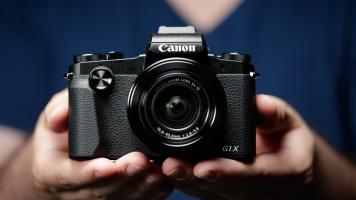
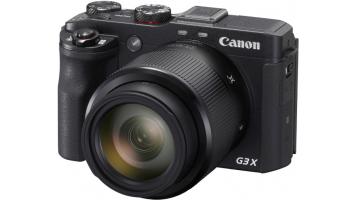
Canon PowerShot G1 X Digital Camera
The new Canon PowerShot G1 X offers advanced technologies that make this camera behave like it’s much larger than it really is. The compact G1 X is armed with a new 1.5-inch High Sensitivity CMOS sensor, which is larger than a 4/3" sensor, and nearly as big as the APS-C-sized sensors found in professional DSLRs.
This gives you a light-sensitive area which is nearly 6.3 times larger than the last generation of G-Series digital cameras, and delivers a quality level that’s unheard of in a compact, pocket-friendly camera.
The lens on the G1 X was designed to take full advantage of its oversized 14.3-Megapixel sensor. And a powerful DIGIC 5 Image Processor has been employed to improve noise reduction, allowing this little camera to achieve an ISO up to 12800, ultimately enabling you to photograph in low light with less blur and shorter exposure times. The f/2.8 lens has 4x optical zoom, which utilizes Canon’s UA Lens technology to suppress aberration throughout the zoom range. With a 35mm equivalent focal length of 28-112mm, this lens will capture any scene, from portraiture to landscapes.
Whether you’ve been photographing for years and desire a compact camera that doesn’t compromise on image quality and features, or you’re a beginner who needs an excellent camera that can be used immediately and with which you can grow, the new Canon PowerShot G1 X is a formidable and exciting new option. There’s a lot more to dig into on this camera: full 1080p HD video with a dedicated movie button and stereo sound, an optical viewfinder, a variable-angle 922,000 dot 3-inch LCD screen, 14-bit RAW shooting, HDR, tracking auto focus—and a heck of a lot more.
When I was given the chance to take at look at Canon’s latest permutation in the PowerShot lineup—the G1 X—I jumped on it. I immediately went to work, soaking up everything I could about the camera in order to tell you what’s new, what’s improved, and why the
G1 X is the pinnacle of the PowerShot lineup. I’m happy to report that there’s plenty of excitement to be found in Canon’s latest baby. All the features and enhancements I’ve written about here are exciting on a number of levels—but really, they all go back to what it’s all about, which is making the resulting image better.
One of the first things to note: this camera has heft. Not that it’s heavy, but when I picked it up I could tell I was holding a well-made camera. The feeling is sort of like when you pick up a crystal goblet after holding a simple flint-glass tumbler. The camera’s lines are smooth and elegant, not comically rounded or intentionally futuristic. Basically, it looks the way a camera should and that’s a very good thing, indeed.
I noted that the G1 X now has a 1.5” 14.3Mp CMOS sensor. It’s nearly the same size as an APS-C DSLR sensor and it dwarfs the 10Mp chip in the G12! That is quite a significant bump in performance. Additionally, this sensor is hooked up to Canon’s new DIGIC 5 image processor. Some of this dynamic duo’s highlights: speedier image processing, greater flexibility in difficult lighting, a higher noise floor for better handling of low light/high-ISO scenarios, faster shooting capability and multi-area white balance adjustments. Working in tandem, this sensor/processor combination is the foundation for Canon’s HS System. One additional tech-speak point of interest: the G1 X features 14-bit signal processing, the same as found in an EOS D-SLR. While 12-bit processing is standard fare for most cameras, and it is certainly capable of producing fine images, 14-bit processing does provide an edge that can make a huge difference in the final product. The additional data from those extra 2 bits provides smoother tonal gradations, greater detail in both highlights and shadows, and a more pleasing and natural looking edge-to-edge rendering of every image. With an ISO ceiling of 12800, and all that refined processing behind it, Canon really hit the ball out of the park here!
The LCD appeared to be slightly larger that the one on the G12 as well, so I got out my trusty ruler. This new Vari-Angle LCD measures a sweet 3.0 inches. Now the difference between this and the G12’s 2.8-inch screen might seem trivial, but in practical use it’s a pretty significant change that you have to see for yourself. The screen swivels and rotates, and it also tilts up/down. This means you can pull off hail-Marys or worm's-eye shots with ease, not to mention the inevitable self portrait.
Gaining a huge pixel-count bump, the G1 X’s LCD boasts a whopping 922,000 pixels. Having written such praise, I have to admit that I prefer to use an optical finder. Well, guess what? The G1 X has one! And while I prefer composing through a finder over on an LCD, having both is pretty sweet. Plus, the optical finder zooms in/out along with the lens, so what you see is in fact what you get!
Navigating through the menus, while reading some of the official literature on hand, I found that there’s a wealth of shooting modes that span the steps from fully automatic to fully manual. The G1 X has a brain, and it’s one smart camera too! It can recognize 32 shooting situations and it automatically optimizes the in-camera settings for the highest quality images possible. Being somewhat on the move most of the time, this is a huge bonus. But wait—there’s more! I can still put my foot down and tell the camera what I want it to do, which is another huge plus. Sometimes it's good to blow out a highlight or to bury distractions in a shadow.
You know what else I really like about this brand new powerhouse from Canon? The full-res high-speed burst that delivers 6 fps. Let's not forget that regular continuous shooting is pretty speedy also, at 4 fps. Capturing fast-breaking action with a point-and-shoot? Definitely!
Video. Ah,video. Yes, there’s plenty of video capability to be found in the G1 X also. Most of the time I think in still-image mode, but for those YouTube moments, the G1 X can record Full HD movies in stunning 1080p at 24 fps, or 720p at 30 fps; both with stereo sound. There’s a new, and very conveniently placed, button on the back of the camera—a dedicated movie button that enables you to instantly shoot movies without having to set anything else. Just press to start recording. Brilliant!
Late-breaking news! There’s an electronic wind filter, and you can rack the lens across the entire zoom range when you’re shooting a video! Awesome!
Now, on to the lens: the integral 4x f/2.8 optic starts at the wide end at 28mm (35mm equivalent) and it’ll reach all the way out to a spectacular 112mm (also 35mm equivalent). For me, this is a perfect range; wide enough for dramatic breadth and scope, long enough for intimate portraits or compressing perspective. By incorporating Canon’s UA lens technology, lens aberration is suppressed and image quality is constant across the entire zoom range. Zooming the lens is smooth and predictable; there were no fast spots, or any of that jerky hesitation that drives photographers crazy. Moving from wide to tele went quickly, and the motor hummed effortlessly and without distraction.
For those moments when additional stability is needed, Canon’s newest version of its legendary Optical Image Stabilization—Intelligent IS—saves the day. It analyzes the camera’s movement and it then applies the best shake correction for the situation. There are several modes to select, depending on whether you’re shooting stills or video.
Like its predecessor, the G1 X is also compatible with the range of Speedlite flashes, making every shooting experience one you can tailor to your own needs. You’ll be happy to know that the optical viewfinder, the dual top dials, front dial, diopter adjustment, hot shoe and the myriad shooting modes and photo effects didn’t go anywhere either. With nothing lacking and much gained, the G1 X is definitely a camera that’s an improvement over what was already great! Whether you’re a PowerShot devotee, or new to the series, the G1 X has much to offer you—pro, amateur, or anywhere in-between. So, hats off to Canon, and enjoy all the new technology that's packed into this little beauty.
| Resolution | Effective: 14.3 Megapixel, Actual Pixels: 15.0 Megapixel |
| Sensor | 1.5" CMOS |
| File Formats | Still Images: JPEG, RAW - Movies: MPEG-4 AVC/H.264, MOV - Audio: Linear PCM |
| Max Resolution | 14.3MP: x |
| Aspect Ratio | 1:1, 3:2, 4:3, 4:5, 16:9 |
| Image Stabilization | Optical |
| Lens | EFL: 15.1-60.4mm (35mm equivalent: 28-112mm) Aperture: f/2.8 (W) - 5.8 (T) |
| Zoom | Optical: 4x - Digital: 4x |
| Focus Range | Normal: 1.3' (0.40 m) - Infinity, Normal: 4.3' (1.31 m) - Infinity, Auto: 7.9" (20.07 cm) - Infinity, Auto: 2.8' (0.85 m) - Infinity, Macro: 7.9" (20.07 cm) - 2.3' (0.70 m), Macro: 2.8' (0.85 m) - 5.2' (1.58 m) |
| ISO Sensitivity | Auto, 100-12800 |
| Shutter | 60 - 1/4000 sec |
| Exposure Metering | Center-weighted, Evaluative, Spot |
| Exposure Modes | Modes: AE Lock |
| Compensation: -3EV to +3EV (in 1/3EV steps) | |
| White Balance Modes | Auto, Cloudy, Daylight, Flash, Fluorescent, Fluorescent H, Tungsten, Underwater 2 |
| Self Timer | 10 Seconds, 2 Seconds |
| Built-in Flash | Yes: Auto, Flash On, Off, Slow Sync |
| Effective Flash Range | 1.6 - 23' (0.49 - 7.01 m) |
| External Flash Connection | Hot Shoe |
| Memory Card Type | SD, SDHC, SDXC |
| Video Recording | Yes |
| Audio Recording | With Video |
| Viewfinder Type | Optical |
| Screen | 3.02" LCD (922000 pixels) |
| Connectivity | AV Output, HDMI C (Mini), USB 2.0 |
| Operating/Storage Temperature | Operating - 32 to 104 °F (0 to 40 °C), Humidity: 10 - 90% |
| Battery | NB-10L Rechargeable Lithium-Ion Battery Pack |
| AC Power Adapter | CA-PS700 (Optional) |
| Dimensions (WxHxD) | 4.6 x 3.2 x 2.5" / 116.84 x 81.28 x 63.50 mm |
| Weight | 17.3 oz / 0.49 kg |
Comments
Wow!! This is great.. I'm now really totally in love with Powershot Canon G1x camera
Thanks for the Review!
Totally Amazing
When do you expect to have the camera in hand?
Hello,
Canon USA has encouraged its dealers to accept advance orders so as the camera becomes available, these orders will be filled before the camrea is made available to our inventory. Its hard to say when the camera will be in house and shows "In Stock". We will post any updated availability we learn on our web site.
I pre-ordered the camera from you some time ago. I was wondering when mine will ship. I can order the camera from Crutchfield as they have it in stock. I would rather get it from you.
Also do you have any idea when the canon 250d filter will become available again?
Thanks,
Bp
I too was really disappointed that there's no mention of the shutter-lag problem. I own a G10 [for 3 years now] - and love it! However, the most notable down-side is the shutter-lag, esp. when taking indoor pics. (And, it caught my attention that many of you also are concerned about this short-coming, given the comments in response to this review.) I would have hoped that if the "actual" measurement wasn't know, was there at least a "sense" that this problem has been addressed and eliminated in this new G-series product? (To me, it's the most critical decision as to whether I purchase the G1 X.) I know B&H keeps saying that they only had this for a short time - but, the shutter-lag problem is huge for a lot of potential buyers and should have jumped out to the reviewer IF the problem was still there or is significantly better. Now, some of us will have sit and wait [until we get our answer somewhere] BEFORE committing to buying this or pre-ordering it.) Outside of this... thanks for the review of this camera.
- Paul
To get the best from this camera in terms of speed.
What would be the best memory card type & speed to use?
I want to get the max from the camera but think 600X cards would be over kill.
I am a father of two young children and by no means a professional photographer. I am considering the folllowing 1) T2i , 2) T3i and 3) now the G1x. Speed is important to me to catch the family in action. What are the thoughts between these choices to meet my situation?
Hello,
One the biggest factors affecting a cameras performance speed is the type of auto focusing system it uses. P/S's like the G1x use Contrast Detection which is slow and cannot handle effectively moving action. SLR's like the Rebels you mentioned use a much faster process called Phase Detection which is cabable of focusing on a moving subject.
hello,
canon remove remote camera controle using PC software on G11 and G12 but leave this functionnality on all canon EOS including the cheapest
this G1x is a powershoot ... but with same sensor as a EOS
is it possible to remote controle the G1x from a computer (PC / LINUX / MAC)
Hello,
The PC control on the G series cameras was a great feature, but we do not see Canon adding it back to the the G1-X.
I am in a quandry between this fine camera, I am a Canon shooter, and the Lumix GX1 with it.s array of interchangable lenses. in particular the 40/1.7.
I am a rough shooter and have scratched my G9 lens renderigthe camera unusable. Changing lenses would be sweet.
Thoughts?
Leland
What to the scratches on your G9 lens look like? Are they short, generally centered and aligned with the direction of the lens cover retracting? I had this problem with both a G10 and G11 and both times Canon replaced the lens with no questions asked. FYI Mark
I have the same problem with my G11, could you share who you contacted and how I go about getting similar replacement for my camera.
Thanx
Pam
I have a Panasonic GF1 and find the manual focus really useful for macro shots when the autofocus tends to focus on the wrong part of tthe image (or the background rather than the leaves). Do you know if the G1X has a manual focus option?
It would be too much to hope that it automatically zooms the centre of the image to check focus when in manual focus mode....
The camera does have a manual focus feature to it. It is not done via the lens such as with an SLR lens, but rather via a dial on the camera and a menu on the LCD screen.
Basically you would select a distance range and a magnified view of the area you are focusing on will appear on the LCD screen so that you can better see what is being focused upon. Once you set it to the position your happy with you may depress the shutter button half way down to fine tune the focus.
Below is a link to a PDF copy of the instructio manaul for the camera where it details how this is done and shows image examples of the process.
http://bit.ly/yWLwKg
Anybody know the coverage of the optical viewfinder?
Thanks
Werner
The camera has an optical tunnel viewfinder. The viewfinder is correlated - so when you zoom in and out the view changes accordingly with the lens, however what you are seeing in the viewfinder is not displaying 100% exactly what is captured through the lens. Canon does not indicate a percentage of difference between the viewfinder and composing on the LCD screen (image on the LCD screen is 100% of what the lens captures). Its worth noting you would likely never notice any differences in what you saw in the optical viewfinder versus what the camera would capture. The only time it may become an issue is if you were taking close-up macro shots and trying to use the optical viewfinder. That would be a situation where using the LCD would be key.
The camera has an optical tunnel viewfinder. The viewfinder is correlated - so when you zoom in and out the view changes accordingly with the lens, however what you are seeing in the viewfinder is not displaying 100% exactly what is captured through the lens.
Canon does not indicate a percentage of difference between the viewfinder and composing on the LCD screen (image on the LCD screen is 100% of what the lens captures). Its worth noting you would likekly never notice any differecnces in what you saw in the optical viewfinder versus what the camera would capture. The only time it may become an issue is if you were taking close-up macro shots and trying to use the optical viewfinder. That would be a situation where using the LCD would be key.
How much video can be recorded? Maximum video file? ect.
Hello,
I found this chart on Canon USA's web site.
Scroll down to the Time of Recordable Movies chart.
Regarding the viewfinder coverage question: the Canon's user guide for the G10 says (page 43) "the viewfinder has a field of vision of approximately 77% of the actual shooting image." I assume this is an area measurement, meaning that the amount of coverage in each dimension (horizontal, vertical) would be about 88%. (Since .88 X .88 = .77.) For comparison, Fuji says the viewfinder in the X10 camera provides about 85% coverage (or 92% in each dimension).
Anyhow, I find the optical viewfinder coverage in the G10 to be better than nothing, but just barely. The optical VF in the X10 is much better (more coverage and easier to see through as well). I have not yet seen a downloadable user guide from Canon for the G1X where the viewfinder coverage for the new G1X will hopefully be specified. I good guess would be that it is similar to that of the G10/G11/G12.
I didn't see a user guide on Canon's website but under Specifications for this camera it says this- Optical Viewfinder Real-image zoom viewfinder That seems like it might be 100% or something close. We'll see.
A User Guide for the G1X has been posted to the Canon UK web site. The link is http://gdlp01.c-wss.com/...6817/01/PowerShot_G1_X_CameraUserGuide_EN_v1.0.pdf.
According to the User Guide, optical viewfinder coverage in the G1X is 77%, as was the case with the G10/G11/G12 models. The guide also says "the area visible in the optical viewfinder may differ slightly from the image area in your shots." Slightly is an understatement. (And if you are not shooting with a 4:3 aspect ratio, the dimensions of what you see in the viewfinder will not be quite the same as what you are shooting either.) In my opinion the severely cropped image you get with such a viewfinder is practically useless for photo composition, especially for applications such as landscape, though I suppose it at least allows you to see what you are pointing the camera at.
The above direct link to the User Guide on the Canon UK site doesn't seem to work any more. Here is a link to the page where you can download the User Guide:
http://www.canon.co.uk/Support/Consumer_Products/products/cameras/Digital_Compact/Powershot_G_series/PowerShot_G1_X.aspx?DLtcmuri=tcm:14-902292&page=1&type=download
I think the G1x would be a great camera at $499. But it is way too little, way too late, and given its price point, I think it will not be a success for Canon unless the IQ is far better than I expect it to be. Worse, I think it is another example of how Canon has competely lost their way in the market.
For $899, assuming you don't want to carry a full size DSLR, you are firmly in mirrorlesss DSLR territory. This camera cannot compete with a mirrorless DSLR with it big (enough) sensor, interchangeable lens, great IQ, and parallax-free viewfinder; or no viewfinder at all if you want minimum size. Check the DxoMark ratings, you will find the 4/3 system and Sony Nex sensors are quite good even when compared to Canon's low and mid range (ie 60D) APS DSLRs - and there is no way Canon will cannibalize their DSLR market by putting better IQ in the G1x than they have in a 60D. Even the new Nikons test fairly well (web blabber notwithstanding) if you are willing to give up a stop of low light performance due to the smaller sensor. And those small sensors allow a tiny camera - with the 30mm (equiv) lens the J1 is smaller than a lot of compacts, anf even with the 30-90 zoom lens the V1 will fit in a jacket pocket. And once Panasonic gets the IS firmware right, the new 14-42PZ collapsible pancake lens (28-84mm equiv) on a DMC-GF3, with 24/30/60 FPS 1080p, is going to blow the G1x out of the water.
I see this camera as a designed-by-committee knee jerk reaction by Canon in an attempt to stop the onslaught of mirrorless systems from eating further into its market share - of not just high end compacts, but of DSLRs as well.
Canon has gone this route before. They were very late to the game with HD video in their compacts, not for any techinical reason, but because it would have eaten into their low end camcorder sales. Until last year the best they offered on most of their compacts was 640x480 with an ancient MJPEG compressor, while the competition went to 720p and then 1080p with H.264 AVCHD. That plan backfired and the low to midrange camcorder market still tumbled - so you would think they would have learned. Like it or not, mirrorless systems are here to stay. Canon can either make a camera cheap enough to be competitive, like the old G12, or take the leap the way Nikon just did, or they can sit back while their middle market evaporates. The mass market will always choose lighter-smaller-cheaper, even at the cost of some image quality. Sure, Fuji sell the X10, but they don't sell many of them.
Until then, I'm going to pass. If they keep this up they might even turn me into a Nikon guy :-)
The recent g cameras have a dial to change to iso which is really useful when playing with different shots. I cant see one on this camera. Does anyone know how to change it quickly?
Hello,
On the back of the camera, the thumb wheel has an ISO button that you press to adust the ISO via the LCD display.
I have bought and still use the G10 and G12, and I am happy for the one with 14 MPX.. I will def have one as soon as it is in store!
Take look freehand from Stough Canyon, Burbank
Thanks!
I just received my S100 from you yesterday as a backup and backpack option to my 5D, should I return/exchange it and get this little monster, or is it too large to be used for that?
Too bad it does not have a small internal memory. Very useful to download and separate some files.
I own a G12 and love it for what it is. It affords a nice option in terms of manual adjustability and I can get get great quality 11X14 prints. It works well for one such as myself who is an amateur and loves photography as an art hobby. What I have longed for in the same size camera is a significanlty bigger sensor, more fstop options, and EVF such as found in the NEX-7 or less so in GH2. I get most of what I was looking for but still long for the EVF where I can get good manual focus and control information when the sun is glaring. For someonen not wanitng a big DSLR with big bulky lenses the G1X offers a lot. There are tradeoff's for everything and this is getting closer to my particular niche. Still, something like the NEX-7, although wonderful in so many respects, is still way to big and bulky for someeone wanting to avoid lens changing and likes a verstatile zoom range. For now, the G1X will work well for me.
no 1080p 25fps? I'm out!
What is the minimum/smallest f-stop of this lens?
The minimum f-stop on the Canon Powershot G1X is f/16.
I am going to be buying a P&S for an upcoming trip when I don't want to lug my backpack full of gear around with my SLR, and the other day I was browsing and noticed an ad for the Fuji Finepix F770 EXR.
After comparing this new Canon and the Fuji, I am torn. I love the idea of a nice rugged Canon, and I know the optical quality of Canon, but for an extra $400 is it worth the massive sacrifice to camera features to get it? The Fuji is packed with features and specs that I am looking for - plus it shoots RAW, which is a big plus. The focal length is amazing and its image stabilization and advanced anti-blur technologies make it look very attractive.
But I've never shot Fuji before, so I'm not sure if they are any good. I just can't see the extra $400 being worth it.
can the lens zoom while doing the video? Because for G12 once in video mode its zoom is fixed.
Canon lists under the Features tab on the Canon Powershot G1X webpage that, unlike less sophisticated point-and-shoot cameras, the PowerShot G1 X lets you use the full range of optical zoom when you're shooting a video.
Dear BH
Looks very interesting. Does the G1x, like the old G cameras, allow for automatically taking a shot eg. every 60 seconds during some hours or a night. Would be fine for time lapses etc. ?
I am sorry I do not know the name of this setting.
Best regards
Michael
While full details cannot be fully gleaned from the Specifications alone, Canon does list under "Self Timer" under Shooting Specifications on the Canon Powershot G1X webpage that there is a Custom setting under the Self Timer setting. This is followed by an asterick and the following:
* Delay time (0 - 15 sec. (in one-second increments), 20/25/30 sec.) and number of shots (1-10 shots (in one-shot increments)) can be specified.
While I cannot be certain until more information is released about the camera or until we have the camera in-hand for testing, this appears to denote that you would be able to have interval timer capabilities under the Self Timer allowing for up to 10 shots at delayed intervals. We will either have to wait for the camera or the instruction manual to be released for full explanation on this feature.
What is the AF speed and tracking like?
Unfortunately, as the camera has just been announced recently and we had limited time to work with the camera, we do not currently have all the necessary information.
We will post them as soon as we get more info.
Any word on expected availability? Canon seems to imply February 2012.
Comments: Larger sensor is just what Canon's G-series needed!
However.... my old G10 has a 5x zoom f2.8-4.5. New G1X has a 4x zoom f2.8-5.8, pretty dim at the telephoto end despite shorter zoom range. It's disappointing to gain a better sensor, yet lose lens speed. I'd prefer a faster lens like the original G1 (3x zoom, f2.0-2.5).
Also, note that G1X battery life (250 pictures) is a lot shorter than the G10 battery life (400 pictures), so a spare may be advisable.
My progression: G1 -> G10 -> probably G1X
I am a little sad at this announcement as I have the G12. I would have loved for that to be close to an APS-C Sensor. I think I will wait for a G2X or G3X at this stage as its such an expensive camera I couldn't update so quickly. The G12 is a lovely camera but I was always disappointed with image quality. It didn't compare at all to an APS-C sensor. It is good but not good enough. I love the minature mode but would like the quality to be better. $899 is a huge price for the new G1X , it would have to really be very good to justify that. You'd have a iPhone for much less than that (Which has much lower quality but is quite fun to use with all the different iPhone Apps available. I know video is not the most important thing but I would love 60FPS or 120FPS on a G1X even at a lower quality than full HD. Only Casio seem to do this in the past but super slow motion is visually great.
You lose the lens speed and the zoom range BECAUSE of the larger sensor, which requires a larger lens for the same equivalent field-of-view. Consider that a DSLR lens of the same range probably will be even slower at the wide end (f3.5 vs 2.8).
A spare battery is always advisable, as is a spare card. I shoot a few pictures at horse shows. (In 2011, I took only 66,150 photos at horse shows; I'm not a pro.) At nearly every show, I have run into someone who is frantically trying to delete stuff from their card so that they can take more photos and videos. (I'll loan a SD card to those I know well.) Often, someone gets upset because the camera's battery is dead. (I've also loaned batteries, though that's more problematic than SD cards.) Never go to any event where you want to be sure to get photos and videos without both a spare (charged!) battery and a spare (empty!) card. (Obviously, I carry a lot more--usualy 40-80 GB in CF for the 50D & 30D and 24-40 GB for the G9 I mount on the 50D to take videos along with photos, plus 2 extra sets of batteries with me, with more in the car.)
"You lose the lens speed and the zoom range BECAUSE of the larger sensor, which requires a larger lens for the same equivalent field-of-view."
Why not have a slightly larger lens? It's a design choice.
Anyway, it is what it is, but it could have been a bit faster zoom, e.g. not much slower than the G12 with f4.5 at the telephoto end. That's about a full stop faster.
Canon's original G1 was f2.5 at the telphoto end -- faster by 2.5 stops. In other words, you need at least ISO 2000 with the G1X where ISO 400 would do with the original G1 (which Canon built over a decade ago). Hmmm....
I have a few questions:
1. Does the lens retract completely back into the camera, safely covered/protected (Someone mentioned a lens cap)?
2. Does it have a manual zoom and/or focus ring?
3. Is it small enough to fit in a shirt pocket like the S90 and S95?
4. Does its surface feel "slip-free" and are there decent "grips" on the front and back to hold it firmly while shooting with one hand if necessary?
5. Is the pop-up flash placed where it won't interfere with your left hand fingers when holding it with both hands?
I like the idea of its larger sensor, tilt screen, viewfinder (unless it's only 77% as someone stated), and ability to give you decent bokeh in your images. Sure, I'd prefer 24 on the wide end and maybe a 200 zoom, etc., but at least on paper it sounds like a great compact cam.
I'm not sure this is addressed here, or even needs to be, but is there a delay on the shutter like on a lot of p/s? I have DSLRs, and this looks really good.
thanks
dk
Unfortunately, as the camera has just been announced recently and we had limited time to work with the camera, we do not currently have shutter lag measurements.
We will post them as soon as we get more info.
Does anyone have an idea what the adjustment ring on the lens barrel does? It would be brilliant if it provides the manual zoom like the Fujifilm x10 does. The motorized zoom mechanism of the G-series doesn't work to well for me although it is industry standard...
Hello,
It does have texturing like a focusing or zooming ring but is only a removeable cover that hides a bayonet mount, to which the Canon's macro flash light system is attached.
I hope there is some way to protect the lens. I have a G10, which I love dearly, but because there is no way to protect the lens, I now have a scratch. Did you know that there is NO way to get the scratch fixed? Unfortunately, I do.
The Canon press release (conveniently posted in this section) states, "...The camera has a brand new, large 1.5-inch (18.7 x 14mm), 14.3-megapixel High-Sensitivity Canon CMOS sensor..."
If the sensor is 18.7mm x 14mm, how are they coming up with a "1.5-inch" sensor? It is certainly not the diagonal measurement. It is not the area of the listed specs. It seems that they are using the "old" way of measuring the diameter of the image at the sensor plane, not the actual sensor size (ala 2/3", 1/3", etc). That would explain only seeing 77% of the image in the optical viewfinder. Why do they feel it necessary to do this? They don't do it for DSLRs. Or am I wrong?
Google "camera sensor measurements" to get more info about this topic. Pretty interesting, to me anyway.
Interesting history: The nomenclature 1.5" sensor apparently dates to early-1950s era TV camera vidicon tubes, where a nominal 1" tube had a 5/8" image scan diameter. So, a 1.5" tube would have 15/16" scan diameter -- which closely matches G1X sensor diagonal of 23.4mm = 0.92".
Okay, nevermind about the 77% of the image in the viewfinder. I don't know where those previous posters got that info. I went back and looked at the review and specs and can't find anything about 77%. It wouldn't sense with my speculation anyway.
Is the OVF similar to the one found in the G12? I found that really horrible to use and therfore ended up always usin the LCD. Is this any better?
Although we have yet to have seen the camera and only have the information listed online, from the specifications listed online, the camera is using a similar tunnel optical viewfinder as found on previous G-series Powershot cameras and does zoom with the lens and have an adjustable diopter. The optical viewfinder should still be recommended for use in bright light situations, but the LCD provides 100% viewing with no parallax error, and is recommended when you must ensure that what-you-see-is-what-you-get.
Do you know if the G1X has a sound memo feature? This is really useful for travellers who are taking hundreds of photos of sites and want to remember what they are when they come home. This feature was last present in the G10 and was dropped in the G11 and G12 models. Since the manual is not yet online I haven't been able to find out if this has been added back in.
Hello,
According to spec's, the camera only records Audio with Video. The is no Audio annotation function.
Will this have the built-in lens cap like the G10 or a seperate lens cap? My G 10 cap would scratch the lens when it would open and close. I am hoping that this problem has been fixed. Will my G10 adapter for filter mount on this too? I think the camera looks awesome and look forward to getting one.
The Canon PowerShot G1X front element is too large for an automatic lens cover like the one built into the Canon Powershot G12. The camera comes with a clip-on lens cap, which has a lanyard that stays connected to the camera strap stud on the G1X.
The Canon LA-DC58K Lens Adapter used on the Canon Powershot G10 cannot be used on the Canon Powershot G1X, as there are no wide or telephoto lens adapters currently offered for the G1X. Also, althogh the camera does not have filter threads, the new Canon FA-DC58C Filter Adapter will adapt 58mm filters onto the G1X. You can also use the Canon LH-DC70 Lens Hood designed for the camera on the lens, but the filter adapter and lens hood cannot be used concurrently.
Is the remote control for a G-11 compatible with the G-1?
Yes, the Canon RS-60E3 wired remote release is compatible with both the Canon Powershot G11 and the Canon Powershot G1X.
The discussion about video needs further clarification...
24 FPS is indeed the industry standard, so that is the best single choice for 1080p HD (versus 30 PFS). However, it would be cool if it could shoot at 48 or 60 FPS at 1080P, for slow motion. In fact, I'd like to see these cameras have even more frame rate options, including undercranked.
This all being said, this camera won't catch on as a serious compact DSLR video camera, IMO, since it doesn't have interchangeable lenses. The Sony Nex 5N is a superior choice for this reason, as well as the fact that it shoots 60 FPS in 1080P.
This seems like a great camera to stick in your pocket to take stills with. The only lens that really works well for the Nex 5N in this regard (i.e. compactness) is the 16mm Sony pancake (or a non-Sony toy lens).
One subject that nobody is addressing is the very unnatural look of a lot of the DSLR video being shot...due to too short a shutter duration. Most of the moving objects (especially people) in DSLR shots seem to be moving in a stiff, jerky manner. Film cameras usually had a 180-degree mirrored shutter that gave an exposure of 1/48th of a second at 24 fps. The motion-blur of the moving objects at that exposure is what gave movies their smooth motion. There are rare instances when you might want to shorten the shutter duration (explosions, moving water in commercials), but always remember to allow motion-blur in your shots to keep the motion smooth.
-a retired award-winning D.P.
Good point. I think this afflicts people who don't know what they're doing (which is most people... lol) They simply shoot in auto mode (or Aperture Priority) and the camera sets the Shutter speed to something that is usually off (too fast or slow).
On most of the good DSLR's (Canon, Nikon, GH2, Nex 5N, etc.), you can set the shutter speed manually to 1/50 fo a second for 24 fps, which gives the right look. If you want to shoot wide open in daylight, you need a ND filter...
Your statement, "24 FPS is indeed the industry standard" begs the question, "What industry?" Film-yes, TV-not so much. As far as I know 24fps was initially featured in video cams to make the transfer process cheaper for indie filmakers since projectors run at 24fps.
Actually a good majority of TV programs shoot in 24p. Almost every one that I've worked on in the last 5-6 years has :)
That said, there are a number of things that don't, such as sports, and probably news.
Really we should refer to it as "an industry standard option", rather than just plain "standard"
Maybe you meant to say 'A good majority of TV programs [I've worked on...] shoot in 24p'. Actually, the vast majority of programs broadcast today are broadcast in 60i.
Specifically regarding this camera's thread, the reality is that even if you shoot in 24p, you are not going to get a true 'film like' effect, because that effect is based to a much greater degree on aspects of the camera other than 24p. Some of those aspects are lighting, optics, cinematography, and the physical size of the image target. This camera does not have a 35mm sensor, and it does not have the optics necessary to shoot with the kind of depth of field that a camera designed for cinematography does, nor does it have the numerous options for gamma curves and film-stock matching that a true cinematography camera does.
Unless you're using it to intercut with other material to use in a film because it's a cheap throw-away or small, concealed camera and you're planning on doing a lot of post production work to try to do the best you can to match the rest of the footage shot with a true cinematography camera, then there's no real point in using this camera for 24p. You're better off either shooting with a 35mm DSLR in 24p or a camera actually designed for electronic cinematography, like for example the Sony PMW-F3 with proper lenses.
I have worked at one of the 3 original US television networks for the past 35 years and before that I designed circuitry for broadcast television cameras. For the first half of my career I worked as a design and installation engineer, I am an EE, have been schooled in optics and lenses at Canon, Fujinon and Schneider. I am also a professional photographer. For the second half of my career I have worked in engineering-intensive aspects of production, specifically with new technologies, HD and ATSC. We have a few units at our network that shoot material in 24p (mostly for 'magazine' shows) and I am still mildly amused that this goes on, because even though they're shot in 24p, and sometimes edited in 24p, by the time they get to the user at home they have been converted to 60i because that is what our owned and operated stations broadcast and what we distribute to our network affiliates, so all that work they go to to achieve that 'holy grail' of 24p is completely lost to the end user.
I can tell you for certain that the vast majority of material that is shot for broadcast is shot in 60i, even the little that is shot in 24p is converted to 60i by the time it is broadcast, regardless of the fact that ATSC is capable of supporting 24P and 23.976P, they are not implemented by the broadcast community in the US.
Not to mince words, having the capability of shooting 24p with this camera is akin to putting lipstick on a pig. It will never be a cinematography camera because the lens, sensor, processing electronics are not sufficient to provide a true, film-like effect. I think the camera has great potential for a photographer to carry for those times when he can't carry a real camera. I wish it shot 30p.
Okay, I agree that this camera is not a good tool for motion picture versus the good DSLR options... The fact that you're stuck with that one lens is a deal-breaker. A better option for compact video is Sony's Nex 5n, offering interchangeiblity of lenses, a compact size like this, and different frame rate options, including 24p, 30p and 60p all at 1080p.
How something is ultimately broadcast doesn't necessarily mean that it's a waste to shoot at 24 fps... I shoot TV commercials at 24 fps on 35mm film, as do most high-level commercial directors... ultimately, it gets kickecd into the digital world via telecine (and a 3:2 pull down) and broadcast at 60i, as you say... but it still looks much better when it's broadcast.
I think you missed the point...a little. If you are using 35mm film, which of course, is shot at 24fps, it is the characteristics of; the film, large image size, equipment, skill of the crew, etc that make film look so good. It is not the frame rate.
"Actually a good majority of TV programs shoot in 24p" Really? Which ones and why? I sincerely doubt that "a good majority" of shows are shot using 24p. There might be a few but a majority?
I've worked on a few reality shows in the past few years and not one of them was shot in 24p. Why would they? None were slated to run through film projectors. It doesn't provide any kind of "look" that can't be duplicated in post. If there is a good reason to use 24p for video used strictly for TV or the Internet I would like to be better informed. Please enlighten me.
24 frames per second has been the film industry standard since the 1930's and has nothing to do with Indie Filmmakers trying to save money. That statement is laughable.
Most TV that has high-production value and shot by good DP's is shot on 24P (if film isn't used and transferred to video later).
Live TV programming -- like news and sports -- are better served to be shot in 30 FPS, as they always have been.
Some reality TV (not all) are shot in 30 FPS, I suspect because they don't know any better. The TV show "The Bachelor" for example looks like it's shot 30 FPS, and looks like crap IMO... However, a lot of the reality shows on Bravo are shot in 24 FPS, and look better overall due to a more sophisticated camera approach.
24 frames per second has been the film industry standard since the 1930's and has nothing to do with Indie Filmmakers trying to save money. That statement is laughable.
Most TV that has high-production value and shot by good DP's is shot on 24P (if film isn't used and transferred to video later).
Live TV programming -- like news and sports -- are better served to be shot in 30 FPS, as they always have been.
Some reality TV (not all) are shot in 30 FPS, I suspect because they don't know any better. The TV show "The Bachelor" for example looks like it's shot 30 FPS, and looks like crap IMO... However, a lot of the reality shows on Bravo are shot in 24 FPS, and look better overall due to a more sophisticated camera approach.
You have to read what I wrote. Okay, I could have written it better. I should have said that 24p was put in as a feature in video cams to serve a market of film makers who wanted a less expensive process to get their movies to a screen. It wasn't to make video look better. The engineer below does a great job in explaining the issue of using a video cam to shoot 24p for tv. Thanks to him. The characteristics of film are what make film look good, not 24fps. However, since film is such an expensive medium to use, most TV shows are shot using video and don't benefit by using 24p.
I'm sold. When can I actually buy one?
I can't see any mention of shutter type or maximum flash synch speed. Does this camera allow high speed synch without having to resort to the HSS setting on EX Speelites? Flash synch at all speeds - like my LX3 - would be very welcome.
It would also have been nice if Canon had included in-camera remote flash control, rather than having to rely on a master EX Speedlite or a ST-E2 controller.
According to the preview listed on DPReview.com, the Canon Powershot G1X's maximum shutter sync speed for the built-in flash is 1/2000 second; the external flash maximum shutter sync speed is 1/250 second; the external flash maximum shutter sync speed when using Canon's High Speed Synchronization is 1/4000 second.
Unfortunately, Canon has not built in-camera remote flash control inside the Canon Powershot G1X, however, the Canon ST-E2 Speedlite Transmitter or a Canon Speedlite Flash with Master control capabilities can be use to trigger Canon-capable E-TTL II flashes wirelessly.
The author mentions HDR but then does not elaborate. I wonder what is included with that feature?
Under the Features tab on Canon's website for the Canon Powershot G1X, it does state "Under High Dynamic Range* the camera will shoot three different exposures in a succession (underexposed, overexposed and normal) and then merge them into a single image. Underexposed areas are combined with the overexposed and vice versa, resulting in an evenly detailed image with flattering shadows and highlights." The process is all done in-camera, and Canon recommends using a tripod when the HDR mode is selected to ensure no motion or camera movement occurs during the three-exposure photo set. As it is accomplished in-camera, nothing is included with the feature; you would simply select the feature in the from the camera's menu and follow the instructions listed in the instruction manual to photograph an HDR image.
Probably similar or identical to the HDR mode of the G12, in which three exposures are taken and merged together internally to produce an HDR image. It's a neat feature, but much better results can be achieved in computer software.
One question I have is why only a 4x zoom and 4x digital zoom and really no one uses the digital zoom. The Nikon P7000 had at least a 7x zoom (28-200) I had a Canon G4 that had a 4x zoom and that was like 8 years ago and it was a fantastic camera till I droped it and it broke. I would think if I was going to spend $799 on a camera I would get a little more zoom out of a P&S. Any one have a clue what they were thinking?
In answer to your question, no...I have no idea what Canon was thinking with the 4X optical zoom, but when I was looking for a point-and-shoot and it came down to the G12 versus the S95 (which I actually preferred because of its size), I ended up choosing the G12 because the S95 (3.8X) was just too zoom-impoverished for me.
As it is, the G12 turned out to exceed my expectations in almost every respect except lack of zoom in macro mode...which is the principal mind-numbingly idiotic deficiency of the G12. I mean, even my old Pentax Optio 550 (which was a nice, feature-rich camera in its day, but had horrifying low-light performance) had optical zoom in macro and super-macro mode.
The exclusion of macro-mode zoom in the G12 is another one of those "What were they thinking?" questions that is bound to have me looking elsewhere for my next point and shoot.
Anyhow, I can't tell from the specs whether Canon has addressed the lack of macro zoom in the G1 X, but it seems likely they'd mention it if they had included it.
"...I have no idea what Canon was thinking with the 4X optical zoom..."
Read my previous answer. You both seem to think that the G1 X is just like any other point-and-shoot camera. Read the article: the G1 X sensor is almost as big as a APS-C DSLR's. (The author points that out several times.) It's MUCH bigger than a typical point and shoot's sensor. This is one reason that it can easily go to high ISO. (The pixels are bigger, so they can gather more light.)
The easy way to show this is through the Field of View Conversion Factor and 35mm/full-frame equivalent focal lengths:
S95: 6.0-22.5mm (28-205mm equiv), FOVCF = 4.67
G12: 6.1-30.5mm (28-140mm equiv), FOVCF = 4.59
G1 X: 15.1-60.4mm (28-112mm equiv), FOVCF = 1.85
DSLR: 17.5-70mm (28-112mm equiv), FOVCF = 1.6
Notice that the G1 X's lens has to be almost 2.5 times as long as the G12's to get the same 35mm equivalent focal length. It's almost as long as a DSLR's. (The numbers for the DSLR are a hypothetical lens that would have the same equivalent focal length range as the G1 X. There actually is a 17-70mm Sigma lens.) This means that it also has to be much larger in diameter to get the same aperture. A 5x lens would be even bigger. If you don't believe that, look at the difference between the Canon 18-55mm kit lens (3.06x) and the older 17-85mm IS lens (5x):
18-55mm f3.5-5.6 IS: 2.7"D x 2.8"L, weight 7.1 oz.
17-85mm f4-5.6 IS: 3.1"D x 3.6"L, weighs t 16.8 oz -- more than twice as much--about the same as the G1 X, just for the lens, and it's slower than the G1 X's lens at the wide end.
For 5x, the G1 X would have to be 15.1-75.6mm. The closest DSLR lens would be the Canon 15-85mm (5.7x), which weighs over 20 oz--more than the G1 X, and it's not f2.8 but f3.5 at the wide end.
What is amazing, to me, is that Canon has gotten 4x in such a small package, considering the size of the sensor. To go to 5x would have increased the size and weight, or they would have had to use a smaller sensor and lost the high ISO capability.
"I mean, even my old Pentax Optio 550 (which was a nice, feature-rich camera in its day, but had horrifying low-light performance) had optical zoom in macro and super-macro mode."
According to all the information I can find, the Pentax Optio 550 has zoom in macro mode but NOT in super-macro mode. See the review at Imaging Resource, for example. Perhaps you mis-remembered. Even most DSLR "macro" zooms don't zoom in macro mode.
Great reply with great info!
The G1 X is not a "normal" point-and-shoot camera. The 4X zoom is probably because of the much larger sensor, which requires a physically larger (longer focal length) lens. The lens on the G1 X is 15.1-60mm (28-112mm 35mm equivalent). The lens on my SD4000 has almost the same 35mm equivalent range (28-105mm), but is only 4.9-18.6mm. Thus, the G1 X's lens is more than 3x as long and thus a lot larger. The 6x lens on my G9 is 7.4-44.4mm (35mm equivalent 35-210mm), so the G1X's lens is more than 2x the focal length--and is wider.
To put things into perspective, the 18-55mm kit lens on the Rebel DSLRs is only 3x (29-88mm) and isn't as fast on the wide end (f/3.5 vs f/2.8).
Yes I agree - the zoom range is pretty poor for a 2012 P&S camera. My only real complaint with my P7000 is the inconsistent close-up focus performance.
Looks gorgeous and I'd love to upgrade from my G9. However, $800 is DSLR territory and it's simply overpriced. Shame it only has 4x zoom (it's 6x on mine). Aye, when the price comes down to $500 (like previous cameras on this line) I'll take a serious look at it.
Love to see some sample portraits at 2.8 and the resulting depth of field.
Nice to see this with 24P video, I'm sure it's a great camera.....but the NEX7 if and when it's available will, with a cheap adapter, let me use my old Nikon fast primes, shoot 24P, does that great Sony Sweep mode, has HDR....
Lots of us really just want good imagers to shoot 24p video, set up on a rig, do all the b-roll or even prime scenes...and still have a nice still camera that's smaller then a DSLR. It's cameras like the NEX7 that make me wonder if I'll even bother to stay in the DSLR area, I don't shoot sports, mostly slow, controlled things that I set up.
seems like when you get into the price range that this is coming in at for a few hundred more you get more then twice the capability. Not going to go down the rat hole of MP size, not the issue, but I think the Canon is just getting to the point it should have gotten to already....but still it is a bit on the large size.
The big minus for this class of cameras is that the viewfinder shows only about 77% of the image. Has Canon upgraded the viewfinder to 100% with paralex correction and thus be a useful feature. The Fuji X10 has a true optical viewfinder and I wonder if Canon is matching the feature.
The review above says that this camera has an optical viewfinder. Where did you get the info about "77%?"
The optical viewfinder with only 77% coverage is the deal breaker for me. It's next to useless. Canon should
have taken a clue from Sony Olympus and Nikon and incorporated an electronic viewfinder or at least
designed the optical viewfinder with 95-100 per cent coverage. But then there's the parallex problem.
They almost had me. Too bad.
Nice camera, nice review. NOT a word about dreaded P&S shutter lag so I can only assume it has shutter lag. We've come too far for shutter lag to STILL be an issue with P&S cameras.
Unfortunately, as the camera has just been announced recently and we had limited time to work with the camera, we do not currently have shutter lag measurements.
We will post them as soon as we get more info.
I have a G9 and the shutter lag is very small. Suspect the new one would be fast or better.
An impressive write up and camera. But why would someone spend $799.00 for a point-and-shoot when for just a few dollars more could get an APS-C DSLR camera kit with 1-2 lenses on promotion?
Is size and handiness that valuable when there are other choices?
Buying a camera is one thing, buying value is another. (Yes, I'm a Canon owner {2 models})
I take a lot of shots WHILE skiing. That is different than taking pictures OF skiing. Of skiing I am using my DSLR with the 70-200f4L (with snow fast lens is not the problem, so f4 is great). WHILE skiing, even though I am an expert skiier, I don't think I could ski and shoot a DSLR. I do have some great action shots, while sking of other skiiers (family, etc) that no way could I have gotten them with the amount of time to whip out a DSLR. Not to mention skiing while looking into a viewfinder would likely be lethal...
Also, I do a fair amount of international travel for business, and I don't mind throwing my G9 into my laptop bag for the rare afternoon I am off, so I can tour around. The screen is cracked and is infiltrated by sand from the desert from riding racing camels, but still works like a champ. I am strongly thinking of this camera as a replacement for the 9. That is different from a vacation, where I lug all the gear, and have spectacular safari shots, etc from my DSLR...
as a pro let me first say to all the gearheads...cameras dont take great pictures, photographers do. No matter wha guiar i owned i wouldn't play like clapton, so why should a fancy camera make me take better pictures?
that said, before you gear heads all go off on me...
i guess when a pro talks about lenses we're usually refering to L series lenses. (at least canon using pros) the stock lenses that come with canon kits are poor quality. if you are used to using good lenses like 70-200F2.8 or 50 and 85mm 1.2 lenses, you would not go back. none of the lenses (or the camera) you advise would meet the standard that i, or my clients would accept. they are good walk about prosumer lenses, but not for the discerning professional.
I'm presently on a 3 month shoot in Asia - includes fashion shoots, landscapes, underwater, and travel mag style shots. I have 2x5dMk2 and 2x60d with me as backup. lenses =70-200 f2.8IS, 24-70 f2.8, 50mm f1.2 85mm f1.2 10-22mm (on a 60d- not L series, but very sharp, and a favourite lens) and a whack of flashes, and transmitters underwater strobes and 2 ikelite housings as you see, not everyone will get by with a t2i
the specs on the gx1 though appear to be good for a fun holiday camera. or even a handy photojournalism camera, for some users. and i suspect in the right hands could (and likely will) take some award winning pics.
I held back buyng the G12 because I knew the next gen will be announced soon. What I foresee will happen for me.
Now:
On very casual days, its either my 5D MkII or 1D MkIV with my trusty EF24-70mm f/2.8L with the Speedlite 580EX.
On more serious days, both cameras with addition EF8-15mm Fisheye f/4L, EF16-35mm f/2.8L and EF70-200mm f/2.8L II with the Speedlite 580EX.
Not mentioning real serious days here.
After G1X's launch:
On my very casual days, it will be just G1X.
More serious days, either one DSLR body with the same set of lens (minus the 24-70mm) + G1X.
I believe Canon is not positioning this camera for beginners but for photogs who want off days but not caught dead without a camera with manual controls. Its the bulk and weight, not the cost comparisons.
Just my humble opinion.
+ 1 I totally agree. this camera is not for beginner but pro who are tired to bring their heavy expensive camera anywhere and want something smaller and efficient enough.. This camera is perfect for me...
You could get a very entry level DSLR with a bad kit lens for less. But they're two different markets. The G series has always basically targeted the traditional rangefinder niche... and this is the most significant upgrade in some years.
Obviuosly, some viewed the pro rangefinders only as an evolutionary step on the way to SLR. But the idea of a small, stealthy, even pocketable camera that is not a significant compromise over an SLR in image quality has never gone away.
I have two DSLRs and a big bag of lenses, primes and zooms, great system. But for some years I also had a totally pocketable Panasonic TZ5, following the truth that the best camera is always the one you have with you. Sure, this was a very noticable compromise over my Canons, but miles beyond that other alternative, the cellphone camera.
The Panny effectively died last year, dropped at a rock concert. I decided to replace it with an Olympus PEN E-PM1. That's the real competition with Canon's G series today, and certainly why they had to grow the sensor. With a Panasonic 20mm f1.7 lens, this is jacket pocketable, even possible with the kit zoom, collapsed. The pixel size is actually just a hair larger than those of my 60D.
Just like the pro/prosumer rangefinder, these are for taking with, always. Shooting quietly, without being noticed. Travel situations that make the full system impractical (I bought that TZ5 for a two week backpacking trip, originally.. pack weight being a critical thing).
WHAT DSLR with TWO lenses are you talking about? The lenses your refer to must be really crappy, maybe some manual focus lens you got on eBay. To get a Canon DSLR that also does 1080p video and goes to ISO 12800, you're looking at a Rebel T2i. With the cheapest kit lens (18-55mm, full-frame equivalent 29-88mm), it's $799.95 here on B&H--the same price as the G1 X. However, that lens doesn't cover as wide a range of focal lengths nor is it as fast at the wide end (f/3.5 vs 2.8). To get a lens that covers the same focal length (28-112mm full-frame equivalent), you'd need 17-70mm or thereabouts. iS/OS lenses are not cheap. Here are a few possibilities to add to the $584.95 T2i body:
- Sigma 17-70mm f2.8-4 Macro OS HSM $469 (faster at long end)
- Canon 17-85mm f/4-5.6 IS USM $499 (not as fast at wide end)
- Canon 15-85mm f/3.5-5.6 IS USM $659 (not as fast at wide end)
The cheapest of those, plus the T2i body, would be $1053, considerably more than the G1 X. That combination would weigh about 38 oz, vs 17 oz for the G1 X. (The T2i body and the Sigma lens each weigh more than the G1X.) The camera also wouldn't shoot as fast, 3.7 fps vs 4 fps regular, 6 fps burst.
As for why someone who already has a DSLR (or two) might get this, consider what I do with my Canon G9. When I'm traisping around doing nature shots, I usually have a Sigma 120-400mm lens on my 50D. Rather than carry another lens (e.g., my 15-85mm), I'll often take the G9 (equivalent to 22-131mm on the 50D). It weighs about 12 oz; the 15-85mm lens weighs 20 oz. Plus, it's quicker to drop the 50D on the strap and grab the G9 than to change lenses. To cover wider shots, I may carry a Sigma 8-16mm or 10-20mm lens.
I also use my G9 with a tripod-screw-to-flash shoe adapter and mount it on the 50D's hot shoe. (The G9 actually weighs LESS than a 580EX flash with batteries.) That way, when I'm shooting at a horse show, I can use the G9 to take videos while taking photos with the 50D.
The big advantages for me of the G1X over my G9 would be the high ISO capability and higher fps for stills. (The G9 has a wider focal length range, mostly at the upper end.) The ability to use optical zoom while taking a video would also be nice. (My ancient S3 and less-ancient SX20 both allow that, but the G9 does not.)
I assume most photographers know the difference of lugging around a big case full of a big body or two and a few lenses as compared to slipping a little camera in their pocket.. I own a 5D and some lenses and sometimes I'd rather just slip a camera in my pocket and still expect to get better than instamatic results.....the big image sensor will help with this.....nice lack of deapth of field..
Amen, my 50D with 24-70 f2.8 is too bulky to carry around and too expensive, and both the kit lens and the 17-85 suck, I prefer to carry the G12 around most of the time.
New Toy.. My G7 survived an inebriated swim session, with the housing nearly closed and 3 years on it's still in service having seen off 2 DSLR kit upgrades (1Ds-5D's), but I think I've found the replacement.
Best accessory ? Leather retro case.
" Goodbye M9, but your were never really mine"
Finally, something worthy to replace my PowerShot G1.
What about shutter lag? Light, compact, and no shutter lag. That's what I crave.
Iʻm a still photographer and this is also my biggest concern. All the talk about video and the different video resolutions. If people want to shoot video, they should buy a dedicated HD video camera.
Unfortunately, as the camera has just been announced today and we had limited time to work with the camera, we do not currently have shutter lag measurements,
We will post them as soon as we get more info.
What will be the price ?
$799
At this price this is an absurdity.
This is the introductory price. If you can hold out for a few months, it will likely drop. The G12, for instance, started somewhere between $500 and $600 (If I remember correctly), but now sells for $399.
The final price for Canon seems to be 75 to 80 percent of the first price. So maybe $600 to $650.
An absurdity vs what? A DSLR with similar capabilities (e.g., Canon T2i) and a lens with a similar range (NOT the kit lens!) would cost more.
Cost may be a little more, but if you're going to spend $800 on a camera that doesn't have all the specs a dSLR has (not to mention the fact that this new Canon has a fixed lens), then I would spring the extra $100 or $200 and buy the Rebel or even the 60D if it came on sale (I paid $999 for my 60D last year on sale). I would have considered this camera at $400 or maybe $500, but not $799.
The new Fuji compact boasts way more features and a longer focal legnth (480mm), better burst speed (8fps), and 3D and panorama modes, and tons more for only $379. Not to mention it has a higher resolution (16MP). For just a nice camera to take photos when you don't want to lug your SLR and gear around, I'll take the Fuji and save the $400 extra for some SLR gear.
where's the onboard flash...??!!
or am i missing something?
Yes, the Canon Powershot G1X does have a built-in flash.
it's there, check out dpreview
In the specs:
Built-in FlashYes: Auto, Flash On, Off, Slow SyncEffective Flash Range1.6 - 23' (0.49 - 7.01 m)
Any idea what the full aperture range of this camera is? Having f2.8 on the open end is great, but I have been very disappointed with the G9 that I bought my wife a few years back, only to discover that the maximum you could stop down to was f8. Why don't these supposed "semi-pro" quality cameras have a lens that will stop down to at least f16, preferably f22? I have owned a number of good, small film cameras that had better aperture ranges than what is now available. Maybe there are technical issues here that I don't know about? When I contacted Canon about this no one there seemed to even understand my question!
I believe that the physical size of any given aperture is directly related to the true focal length of
the lens (not the 35mm equivalent). In the past I assumed that the focal lengths of these lenses
was so short that the physical size of the aperture would be so tiny beyond f/8 that the image would be
significantly degraded by diffraction. The true focal length of this camera is in the 15-60mm range
however (as allowed by the larger sensor), so maybe more range is now available.
The diffraction effect is also a function of the pixel size. That means, for example, that the Canon 50D, with 15 MP on an APS-C sensor, is more limited by diffraction than a 30D with only 8 MP on the same size sensor.
According to Canon's press release (link below), the aperture range of the lens in the Canon Powershot G1X is f/2.8 to f/16. In basic terms, aperture range is limited to the size of the lens used and the size of the media it is recorded on. As the sensor in most of the point-and-shoot cameras are MUCH smaller than the size of 35mm film or the size of the sensors in larger DSLR cameras, the apparant aperture range is much smaller with the smaller sensor cameras. One of the benefits of the Canon Powershot G1X having a larger-than-normal sensor compared to previous point-and-shoot cameras, almost being equivalent in size to APS-C sensors used in DSLR cameras, it is capable of having a much larger aperture range.
Canon Press Release
F/8, for small-ish sensor cameras is a good compromise, as they have increased depth-of-field anyway, when compared to larger format sensors such as full-frame e.g. 35mm.
Moreover, due to the small sensor size, optical diffraction begins to manifest itself in something like the G9, at f/4.0 or so. In that, a smaller f-stop like f/5.6 actually yields less overall sharpness, than f/4.
Thus, you have to change your way of thinking as regards to high f-stops and depth-of-field, with regards to these sorts of cameras, because you gain nothing and actually begin giving up image quality.
Just adding something to an already excellent answer:
Previous G series cameras (don't know about this one) had a way to allow photography in just-too-bright situations, without requiring a smaller than f/8 aperture. Of course I'm talking about the internal ND filter. So no need to "smaller-than-f/8" apertures here, lol. Regards!
I've always felt the g series was a ripoff - a relatively bulky camera ending in a tiny sensor. With a NEARLY aps-c size sensor it is starting to walk the walk but - despite a veiled reference to nex- i seriously doubt it comes close to the Sony's performance. (heck - the sony sensor and image iq is better than any of the canon aps cameras).
There is an innate conservatism to these cameras that reminds me of a little girl playing dressup - let's pretend we're a film camera. (at least a good as the crystal goblet reference , but kind of a mess). The pen has shown there's a market for this type of thing - but it's not my taste and the IQ suffers relative to more modern offerings
So this is a day late and a dollar short as opposed to the prior model which was truly treading water. Horses for courses I guess.
I have asked Canon to cram the 5D Mark II features into a G10 frame. I would be happy, if not giddy, with that. Canon's response: Size is the problem; buy a 5D Mark II. My response: Size is the problem. I want a lot that works fast stored in a little. That is all I need and want.
There's good reason why most pros prefer Canon and Nikon cameras over Sony and all the rest. Durability and Robustness are some but IQ is what makes it all click. Canon has done an excellent job with their G series little beasts and in many examples, these little cameras have matched or surpassed some entry level SLRs in overall IQ. Only thing really holding them back was high ISO performance and some dynamic range limitations. This new sensor looks to be Canons answer to that. As an amateur/semi pro I found the price point of the previous G series cameras reasonable my only concern is that the new G1 X will be priced a bit high for my puposes but somehow I don't see this stopping our pros or mega enthusiasts.
Re. price:
I bought the first G-1, and the G-6, ...both when fairly new to the market.
If you compare their newly-released prices with the G1 X, in terms of today's USdollars, I think you will find the G1 X is a relative bargain, when all features and improvements are considered.
My quick check on the relative values of the release date dollars, then vs. now, indicate the G1 X would cost over $1000US if priced the same as the older models.
Comment or corrections welcome.
I love the G series. I bought the first one made and still use it at the beach (old cameras get relegated for beach work). It still functions great. I hav a G10 which has given no problems, and we used it for hd video alot. This new one looks interesting and tempting.
I wasn't really commenting on its durability.
Do you know if it has GPS like the new S100? That's one of my favorite features of the compact and I'd love to see it on this midrange camera as well. (And, of course, for it to finally migrate up into the dSLRs)
Unfortunately, no, the Canon Powershot G1 X does not have built-in GPS capabilities.
Looks good. I had a G9. It developed the dreaded "lens error". I finally totally dissected it to determine the cause. Deep inside the zoom mechanism were many little pins that fit into slots that shift the lens elements. All were stainless steel except for one row of near-microscopic plastic ones. Of course one of these broke, jamming the lens. And it happened barely out of the warranty period. So I'm going to steer clear of cute little Canon cameras.
Mine also had that error! I managed to reset it by pulling the battery out and back in, as in a "hard reset". It came back to life afterwards. Mind you, this was years ago and I still have the same camera. :)
I have used a G9 for years, and miles and miles of travel. I've zoomed that baby out and back countless times with no problem. I'm very excited about the new G1, hope to try it out soon.
Best not to dis the entire line of cameras when you've had a single, bad experience. Tho I certainly understand your frustration.
I have friends using all sorts of canon cameras (I own about 5), and several of them got the error. Not dissing the entire line. But I can see why someone will avoid them.
It sounds like a great camera, but I am very disappointed that it will only do 24 fps in 1080p video. I thought this might be a good point and shoot for when I don't feel like lugging around my 5D MII. But the 24 fps in 1080P video kills the deal for me. I would have thought with Digic 5 it would have supported this.
This is a typical answer by an amateur specification hog who, unfortunately, does not even have the competences to realize that it actually supports the industry standard. Please seek knowledge about the topic in which you want to challenge a specification before doing so, instead of nagging about something that purely stems from lack of knowledge.
Thanks
The word is competence hotshot. Their is no such word competences.
don't you mean "there".......?
spot on mate!
I find your reply distasteful. Even though 24 fps is considered a standard in the film industry, there are many reasons for this, and many do not have to with any perceptual advantage. There are already leading cinematographers and directors who are embracing 48 fps as the new standard. With more and more theaters installing digital projectors, there is no reason to shoot 24 fps. 24 fps was always a compromise due to the technology of the time.
I admit that I've not looked into the technology for a few months, but I'm unaware of 48 fps being embraced. Having consulted for several smaller productions on various workflows and formats including Red, thompson viper, as well as cine-alta, panavision, and both 16mm and 35mm film, I find this news surprising. I know more filmmakers are using 360° shutter for action, but film (unless over or under-cranked for effect is always 24 fps for normal cinematic release. I know of several deceased filmmakers that would haunt you for your statement. If your next statement contains "film is dead", then you are truly misinformed... besides, if you're going to pus*y your opinion, have the wherewithal to use your name, and not anonymous... Oh, and for many of us, 24fps isn't a compromise, it is an aesthetic...
Anonymous on Mon, 2012-01-09 15:51, what's with all the hostility!? either you're really trying to imply you have pseudo intellectual tech knowledge or just a plain angry person. please don't try to one up my post and waste any more pixels with any more replies here. nobody has benefitted from any of your rant. you've helped no one. oh, and before you wonder or accuse, yes I am a professional photographer.
If your specialty is photography, perhaps you should then refrain from commenting on video. It appears your knowledge is lacking where your arrogance abounds. An ounce of humility would do you well. If you have to be condescending, keep your comments to yourself or use it with your family -- as I'm sure they must be used to it. I'm a pro videographyer. 24fps often produceds noticeabley more strobing when the camera is moved. 30fps progressive provides many of the good parts of the film look and is more forgiving with motion artifacts. Frame rate is often an artistic choice. Your logic and poor cited opinion shows a lack of understanding of the topic. It would be comparable to telling everyone they should always shoot with a 50mm lense on a still camera and nothing else.
wow, that is indeed an incredibly agressive person.
I'm always puzzled by angry and frustrated people who aggress others, that they know or not.
but don't take it personally, it's his/her problem with life. good luck to him. cheers to you !
Yes, agreed! Unfortunately the internet is just so full of Trolls who disguise themself under the hood of anonymity! Most of them even lack the guts to sign their names. Regards!
There is no debate, or at least there shouldn't be. Whether 24fps (which all films, and many tv shows shoot at), or 30 or 60 fps for news, sports, or home video, they all have their place. It truly depends what you are shooting and why. Tv shows like 24 have used the 5D and 7D to shoot, and lucas has used them in his new film Red Tails. Those are professional productions. This camera is geared toward the amateur/semi-pro market.
No. I am quite familiar with the 24 fps vs 30 fps debate. I am not trying to create video with some old nostalgic Hollywood film look. TVs and computer screens in the US all have refresh rates that are a multiple of 30. So if you record at 24 fps and plan on playing back on a TV or Computer in the US it gets converted to 30 FPS. Most good TVs today will interpolate to 120 FPS to smooth motion. You should keep in mind that it took Canon over a year before they bent and gave into the 24 fps crowd and added support for 24 FPS in the 5D MII. I guess you are calling the engineers at Canon amateurs? I am sure they are befuddled by this group of people that enjoys listening to old 12” vinyl records and pretending they are Hollywood film crews shooting video at 24 FPS. The preferred HD format for sports is 720P @ 60 FPS, this high frame rate is required if you want sharp frames and smooth looking video. You are an arrogant fool for making the post you did without even understanding what I am using the video for.