Celestron

Our sun, the star at the center of our Solar System, is a fantastic subject for both viewing and photographing and humans have been viewing it since the beginning of time. A special form of solar viewing is the solar eclipse. There are few experiences in nature as awe inspiring as an eclipse—solar or lunar—when the Earth, sun, and moon align. If you want to observe and study the sun, B&H has what you need to do it safely and do it

Binoculars make great gifts. Regardless of who you are shopping for, or what their hobbies are, a nice pair of binoculars can be appreciated and enjoyed by just about anyone. If you think about it, almost all of us find ourselves out in the world wishing we could have a closer view of something almost every day.
Now that I have convinced you to gift a beautiful pair of binoculars, you’ll click through to the binocular section of the B&H website

The landing of the Apollo 11 lunar module, Eagle, on the surface of the moon on July 20, 1969, and the first steps of a human on another celestial body, represent one of the most remarkable achievements in the history of mankind. B&H Photo is helping to commemorate the milestone anniversary of NASA astronauts Neil Armstrong, Buzz Aldrin, and Michael Collins’s great journey to the moon and back with several special-edition telescopes from Celestron that ship with a commemorative Apollo 11 50th anniversary coin and

It should come as no surprise to anyone that cold weather results in diminished battery effectiveness. Unfortunately, you likely learned this from the experience of having a dead car battery on a bitter winter morning or just through the rapid decline of your smartphone’s battery as the temperate starts to drop. There are some steps you can take to help yourself—and your batteries—make it through brutal winter days.
Keep Batteries Warm
One of the simplest ways to improved battery performance in cold weather is simple: keep them warm. Going

The holidays are here, which means it’s time to unfurl those shopping lists, unfreeze your credit cards, and cast aside any concerns about cost or consequence. However, if you’re not feeling so cavalier with your capital—fear not. We’ve compiled a list of 50 great gifts, all under $50. We’re talking stocking stuffers, high-quality bargain-buys, and all-around great gear for a price that won’t cause your credit score to V-fib.
Nothing’s worse than your phone (or tablet) dying while you’re out and about. That’s why the
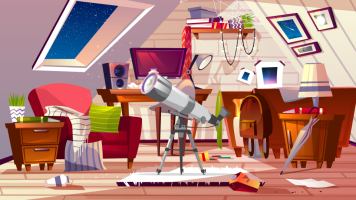
From personal experience, whenever I try to describe to someone who’s never seen what the rings of Saturn look like through a telescope or how a sunspot moves and changes shape as it transits the chromosphere over the course of weekend, there is definitely something lost in the telling. Wouldn’t it be great if even a novice astronomer with just some basic gear and knowledge could capture their own images of heavenly bodies to post on social media or (to go old-school) print them and hang on a wall?
Well, wish no more, dear reader! We live in
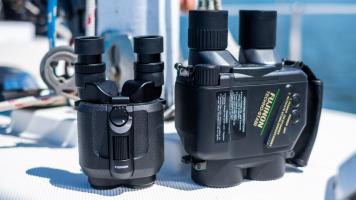
In my years at sea on merchant ships, warships, and sailboats, I spent a lot of time looking through binoculars. After a weekend on the water and on land with a pair of Fujinon Techno-Stabi image-stabilized binoculars, the 14x40 TS1440 and the

For the second installment of our series on holiday lighting displays, we feature light shows in the states of Illinois, Kansas, Kentucky, Louisiana, Maine, Maryland, Massachusetts, Minnesota, Nebraska, New Jersey, and New Mexico, to aid you in capturing photogenic moments that convey the spirit of the season.
As noted in Part 1, operating hours, dates, and admission costs for each venue vary widely, so please check event websites for specifics before planning a visit. As for cost, many of the venues have a primary goal to raise money for

My car companion for the last two hours, and B&H Social Media Manager, Michael Hollender handles our SUV deftly around a bend in the dry dirt road. As we clear the hill, we see the recently vacated cow pasture below us. Nestled in the desert valley is a colony of dedicated workers frantically erecting stages, scaffolds, and tents of all sizes. The gentle whir of a generator can be heard across the field.
Above photograph © Michael Hollender
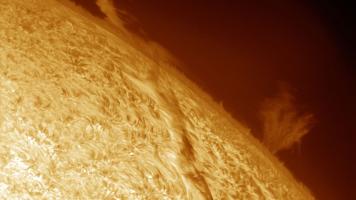
If you have an interest in astronomy, chances are that you’ve heard of the upcoming North America Eclipse, in August 2017. And if you have a conventional telescope, you know the problem is these telescopes are all made for nighttime use so, to use them for solar and solar eclipse viewing, you need special filters to protect your instrument and (more importantly) your eyes. Luckily, we here at B&H have you covered, with filters to adapt your telescope for viewing the sun in general, and the solar eclipse, in particular.
First Things First

The scientific community in general, and astronomy in particular, is all abuzz these days as the hype builds for the upcoming North American Eclipse, happening on August 21. Between my position here at B&H and my personal interest in astronomy, I’ve been talking about this event for almost a year to my friends and colleagues, and I’ve found that people have a lot of questions about solar eclipses. Sure, we’ve all heard about solar eclipses, but how many of us have actually done research on them? I’m thinking that the answer is “not many.”

A great deal of mystery and misconception surround the topic of observing the sun and solar eclipses, and while you should absolutely not look directly at the sun without proper protection, we here at B&H have got you covered on how to enjoy viewing the sun and, later this year, the solar eclipse. Read on to see what’s available for you, if you’re interested in investing in a dedicated solar telescope.
White Light or Narrow Band?
Right out of the gate, you need to decide: White light or Narrow-band (Targeted) viewing? For specifics about
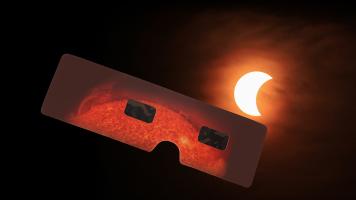
If there were ever an event that the entire family should enjoy together, it is the rare majesty of a solar eclipse. Solar eclipses, be they partial, annular, or total, are not entirely rare events, but, before 2017 it had been almost 100 years since the last total eclipse transited North America from coast to coast, and it had been almost 40 years since the last time a total eclipse could be viewed from the United States. In fact, most of Earth's citizens have never witnessed a total solar eclipse.
Let's talk about how to view a solar eclipse
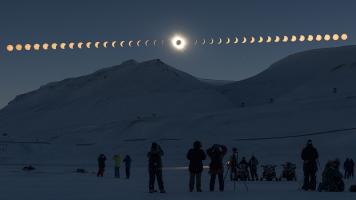
Are you planning to photograph an amazing solar eclipse? Here are some frequently asked questions about taking photos of one of nature's most incredible events. If you have more questions, please feel free to drop them in the Comments section at the end of the article!
Q: Why do I need solar viewing glasses if I am just going to be photographing the eclipse?
A: To aim your camera, you will need to look toward or at the sun. You will not want to do this with your naked eye, even with sunglasses.

When the moon passes directly between Earth and the sun, those on Earth are treated to one of nature’s greatest spectacles—a total solar eclipse. It is a phenomenon that almost every observer would like to capture in a photograph.
Due to the rarity of the event, the short duration in which to capture it, and the dynamic nature of the subject, it is one of those photographic opportunities that requires the proper gear, setup, planning, and practice.
Eclipse and solar