Mamiya

0 Plays ·Posted
On today’s episode of the B&H Photography Podcast, we talk to an old friend about a new book―two-time past guest Amy Touchette joins us to discuss her book of street portraits. She also brings a friend with her, none other than photographer Larry Fink. Is it fair to call Fink a photo legend? We think so, and clearly the people at the Center for Creative Photography seem to think so

Since its debut in October 2015, the B&H Photography Podcast has offered weekly conversations with insightful and entertaining guests, on topics most important to the contemporary photographer—from gear and technique to history, science, and art. To commemorate Black History Month, we present to you this compilation of episodes celebrating photographers of color who have appeared on our show.
Photograph "Looking Out" (detail) © Earlie Hudnall Jr., Courtesy PDNB Gallery,

0 Plays ·Posted
On this episode of the B&H Photography Podcast, we are thrilled to help celebrate the first anniversary of Black Women Photographers. Founded in July 2020 by Polly Irungu, the mission of Black Women Photographers is to “disrupt the notion that it is difficult to discover and commission Black creatives.” And toward that goal, BWP is now a global organization of more than 600 members, and as an online directory, has become a home
Join us for a B&H livestream event: "The City That Finally Sleeps: An Interview with Mark Seliger in Partnership with Sony."
Mon, 07/19/2021 - 23:00
Add to Calendar
2021-07-20 03:00:00
2021-07-20 03:00:00
The City That Finally Sleeps: An Interview with Mark Seliger in Partnership with Sony
In the grips of the COVID-19 lockdown, New York City transformed from a city known for its unrelenting energy to a ghostly display of architectural
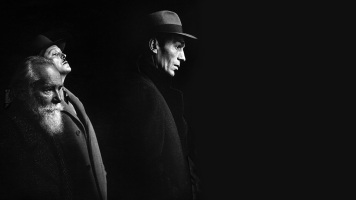
Photographers are formed through myriad forces—formal schooling, technical mastery, or an empathetic connection to the people around them being just a few. This latter circumstance fueled the vision of photographer Clemens Kalischer and was likely seeded by a profound awareness of human nature he picked up as a child, observing his father at work.
Sometimes referred to as the invisible photographer, Kalischer possessed great empathy and a deep interest in the human condition. “He spent so much time with people when he photographed them, he was

0 Plays ·Posted
Making photographs about the important social issues of our day should not be only in the hands of photojournalists working for large news organizations. Greg Constantine and Monica Lozano, our guests on this week’s episode of the B&H Photography Podcast, as well as past guests of our program, distribute and exhibit their work outside the familiar “news” outlets. Both use their photographic work to address the stories of migrants, and both have spent the last two years documenting

As she approached her 40th birthday, Jennifer McClure decided to take stock of her life, using photography as a vehicle to explore why things had never really worked the way she thought they would.
Her previous work with self-portraits offered a basic framework for making the pictures, yet nothing could prepare her for the discovery she would make from the photographs themselves, which was the opposite of what she had expected. “I was just shocked,” she admits. “I didn't know self-portraits could take me there.”
Photographs © Jennifer McClure

The In-Sight Photography Project has provided photographic instruction and camera gear to rural youth in and around Brattleboro, Vermont, since well before the dawn of digital, making it the Grande Dame of Youth Photography not-for-profits. The organization’s pay-what-you-can motto, paired with its four-tier payment system, encourages community support while also insuring that no student is turned away.
For this fourth story in our series, we spoke with In-Sight’s executive director, Victoria Heisler, and program director A. Hanus, about the

You’re probably aware that film has been making a comeback in recent years, but let’s be honest with ourselves. Did it ever really go away? Sure, it may have seen a dip in popularity at the dawn of the digital age, but many serious enthusiasts never stopped using it. Just ask the experts here at B&H! In fact, we asked some long-time film shooting experts here, “What’s your favorite film/camera combination and why?” Below, you’ll find their answers

0 Plays ·Posted
On this week’s episode of the B&H Photography Podcast, we welcome photographer Matthew Franklin Carter to the program. Like many photographers, Matt Carter wears a lot of hats. In his case, literally and figuratively, but his photography work blends documentary, editorial, and portrait work and reflects the place he calls home—Greenville, South Carolina. He shoots for regional and specialty magazines and does corporate work and
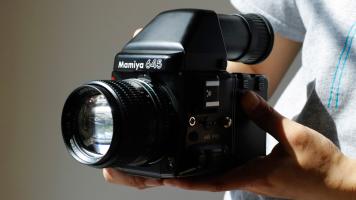
Over the years, I’ve dabbled with many cameras and many film formats. I’ve used pretty much everything from 8 x 10" view cameras to half-frame 35mm cameras and ended up settling on 6 x 7 for the majority of my work. Somehow, though, after all of this time, I managed to skip the 645 format entirely. I didn’t do this intentionally; it just never seemed to fall into place. The cameras and lenses are larger than those for 35mm, but the film format is smaller than 6 x 7. It’s either a happy medium or an awkward compromise, depending on how you look
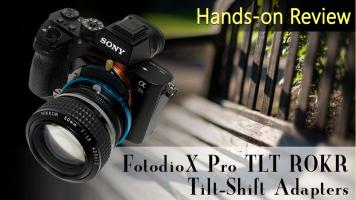
When it comes to corrective and/or creative image control, nothing beats the swing-and-tilt controls of a view camera. Tilt movements enable you to alter the orientation of the plane of focus (PoF) relative to the image plane, i.e., the film or camera sensor. Tilting the PoF of a lens enables you to extend or reduce the depth of focus of the image. Shift movements, in which the PoF remains parallel to the image plane, enables you to reposition your subject within the frame lines without having to change your camera position. When photographing
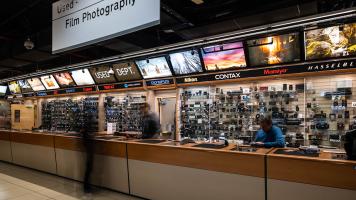
Did you know there is a virtually separate camera store that lives inside the B&H Photo SuperStore, in New York City? The B&H Used Department can be found at the top of the staircase leading to the second floor of B&H Photo’s expansive showrooms or online! There you can sell your used gear, or you can purchase used gear in great condition. Not only does it have a selection of
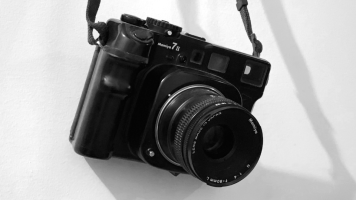
The Mamiya 7 II is the best camera ever made. At least I think so, and I know I’m not the only one who thinks this. It is the perfect mixture of form and function; uniquely precise and casual at the same time. Its system contains some of the finest lenses available during the film era, many of which are still likely optically superior to lenses being developed today. It is a 6 x 7 format film camera—dubbed “the ideal format,” by Mamiya—and this aspect ratio is by far my favorite due to its not-too-long, not-too-squat shape. And, of course, the
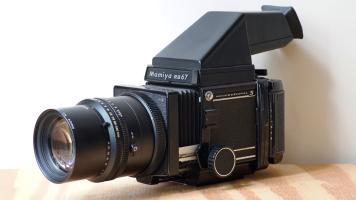
The Mamiya RB67 Pro-S is the first camera I bought. While the Canon AE-1 was the first camera I ever owned, that camera was a hand-me-down. The RB67, on the other hand, signaled a change for me and represents the moment I began to take photography more seriously. I saved my money from caddying for an entire summer to purchase my RB67 Pro-S kit with 90mm f/3.8C and 180mm f/4.5C lenses, two 120 film backs, and a waist-level