Photographers' Formulary

Despite photography taking mainly a digital form nowadays, there is still immense value in the tactile side of photography, especially in regard to teaching photography. With education being based more in the home at the moment, it can be the perfect time to introduce someone to photography using the simplest and most basic tools. Pinholes are of the most primitive examples of photography but are also some of the most perfect tools with which to teach the basics of exposure without needing to complicate it using abstract modes, shutter speeds

The earliest photographers faced a dilemma spurred by the near-simultaneous invention of two very different kinds of photographs: daguerreotypes and salted paper prints. Daguerreotypes were cherished for their extraordinary detail and beauty but lacked the ability to be easily reproduced. Alternatively, many copies could be made from a single paper negative but the resulting prints lacked the exacting resolution of daguerreotypes. Paper would eventually become the standard for pre-digital photography, but refinements to Talbot’s process were
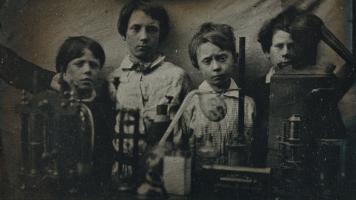
Not since the 19th century has the tintype enjoyed the level of popularity to which it has risen today. Safer to create than the daguerreotype and more impressive to hold than paper prints, the tintype—and close relative, ambrotype—offer an attractive middle ground for photographers wanting to create unique photographic objects steeped in the medium’s history.
Ambrotypes are extensions of the wet collodion process invented by Frederick Scott Archer, in 1848. While Archer was the first to experiment with the technique, the American James

William Henry Fox Talbot was no artist. While on his honeymoon in Italy, the English inventor famously attempted sketches with the aid of a camera lucida, a drawing device used by travelers to record landscape views. His confession of failure has become legendary in histories of photography:
One of the first days of the month of October 1833, I was amusing myself on the lovely shores of the Lake of Como, in Italy, taking sketches with Wallaston's camera lucida, or rather I should say, attempting to take them: but with the smallest possible

In the grayscale days of early photography, the cyanotype was a splash of electric blue. Today, this alternative process continues to attract the curious and experimental, seduced by its simple development and distinct aesthetic. The origin of the cyanotype dates to the formative years of photography and one of the medium’s most important—if underappreciated—contributors, Sir John Herschel. Despite being cast in the shadows of Daguerre and Talbot, Herschel was one of the most important scientists experimenting with photochemistry at the time.
Summer is the time of the year when kids are off from school, the sun is shining and outdoor activities abound. It is the perfect time to stimulate a child’s interest in photography as an aside to their already active schedules. Additionally, it is the perfect time to capture images of your children out and having fun in the warm weather.
Alternative Process Printing
For a physical activity that still meets the requirements of photography, sun printing is a unique way to create beautiful, deep blue cyanotypes in a very simple manner.