Waves

So, you’ve recorded a killer podcasting session but aren’t sure how to take it from raw to ready? We get it—there is a lot to take in. But editing is undoubtedly one of the most crucial aspects of the production process when making a podcast. We know editing a podcast can be intimidating and overwhelming at first, and that’s why B&H is here to run through some of the basics and get you producing polished, engaging, professional-sounding content.
In this article, we’ll walk through the essential techniques of trimming, adding effects
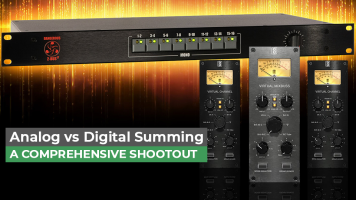
There I was, three years of audio digital engineering to my name and wondering why nothing I bounced ever sounded as good as what I heard in the session itself. Inside my DAW, the mix would feel wide and sound impactful. Then, I’d render the track, and find myself gut-punched by the washed-out sound of the finished product. Lifeless. Harsh. Unacceptable.
What is a summing mixer anyway?
A neophyte still—and banging my head against the digital wall of fixed-point architecture, where harsh digital clipping can be an immutable problem—I called up

Waves has an exciting new product out for vocal performers and music producers of every stripe. It’s called OVox Vocal ReSynthesis, and it works on both vocals and instruments to transform the mundane into the spectacular! Add vocoder and talk-box effects to your voice, or place the processor on any instrument to create cool, synth-like, gating effects. With multiple sounds and multiple kinds of modulation, the software will allow you to achieve an esoteric, wholly individual sound.
The synth has been optimized for real-time performance, and

Perhaps you've read the previous article on equalization in the mastering process and find yourself a glutton for punishment. If not, welcome anyway! Please, feel free to read these articles in any order—you ostensibly have free will.
We're here to talk about compression, and what it can do for you in the mastering process. This article is going to assume a basic knowledge of dynamic compression on your part. If you're not familiar with what compression is, or how it works, then I recommend brushing up on these videos on various aspects of

With so many types of synthesis technologies available, it’s hard to know which way to turn for a specific sound. Wavetables synthesis was designed to produce natural tone-like sounds and was one the first commercially available instruments to harness the power of digital sampling. In this article, we’ll explore the ins and outs of wavetable synthesis and discover why, after all these years, anyone would still want to use wavetable synthesis.
History
Wavetable synthesis has a rich history and was the first “computer-” based synthesizer and the

Designed specifically for mastering engineers, Apogee has announced its forthcoming 2x6 Special Edition AD/DA module for the flagship Symphony I/O MKII audio interface. The 2x6 SE takes advantage of the latest advancements in the digital audio technology, such as line level inputs with 124 dB(A) of dynamic range and a THD+N of -116 dB, while the line level outputs boast a dynamic range of 131 dB(A) and a remarkably low THD+N of -118

Once upon a time, a decent plug-in for pro audio purposes might set you back more than a couple of hundred bucks (to say nothing of software bundles, which could easily run you into the thousands). But we’ve seen a drastic reduction in price for stellar software over the last few years—even from companies that used to charge in amounts heretofore measured in bodily appendages. Since you no longer need to spend an arm and a leg for excellent audio processing, we think the time is right to compile a list of plug-ins now suitable to present as
So, you want a new audio interface, eh? It’s not like the old days when there were only a few options. Now, there are a bunch of brands such as Apogee Electronics, Antelope, Audient, Focusrite, MOTU, PreSonus, Universal Audio, and Waves, and each manufacturer normally has several interfaces in its product line. You don’t want to buy something that will be insufficient for the work you do, nor do you want to spend too much money on something that is far more than you need. So, how do you pick one? It all starts with asking yourself the right

When considering a new gear purchase, it’s easy to get caught up in extravagant equipment and overlook things that would ease the pain of daily audio life. There are routine processes that can be simplified, common problems that can be more quickly solved, and significant sonic improvements that can be made if you have the right tools. I’d like to share six audio tools that can easily become irreplaceable pieces in your arsenal. Manufacturers such as Audioengine, dbx, Galaxy Audio, Little Labs, Phonic, Pyle Pro, Radial, Sonarworks, and Waves

Here’s what you need to know right off the bat: Mixing vocals for podcasts is quite different from mixing vocals for music, where the trend is to impart sheen, sparkle, luster, and other trebly adjectives. A simple A/B test between any Gimlet podcast against any Justin Bieber song will prove the difference: What constitutes a solid, pro sound in the podcast world is a meatier affair, and an altogether different target.
Yes, your podcast vocals do need to be present. But, quite often, vocals are not the main attraction in a podcast—they’re the

Hi, my name is Nick, and I have a problem. To fix the problem, I need to take certain steps, the first of which is to admit that I am powerless—specifically, I am powerless over my sensitivity to sibilance.
I’m an avid listener to radio, records, singles, and podcasts, so it can be a burden: If those esses haven’t been tamed, I wince with every offending syllable. And when I listen to an old project of mine and notice an unruly ess, I hang my head in shame, since the difference between balanced, silky vocals and insufferable sibilance is a

As mixing engineers, one of our biggest challenges is communicating width and depth in a stereo track. It’s tricky for loads of reasons. For one, what we’re doing is essentially a fiction: When you listen to Beethoven’s Ninth Symphony on an iPod, you are not at the Philharmonic—yet it’s often the engineer’s job to create the sound of the orchestra, from left to right, front to back, and in the appropriate environment.
Furthermore, the technical concepts we employ to achieve this fiction (dispersion relations, the Haas effect) can be difficult

The renowned plug-in company Waves, and digital console manufacturer DiGiCo, have teamed up to craft a modular solution for tying together headphone amplifiers, audio interfaces of various channel