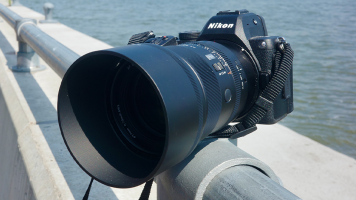
Nikon D800(E) SLR Digital Camera (Body Only)
With the announcement of the Nikon D800 and the D800E, you might wonder which camera is best for you. This article is intended to highlight the crucial differences between the two cameras and ultimately help you decide which camera better suits your needs.
The Nikon D800 and D800E DSLRs are both highly capable cameras featuring a 36.3-megapixel FX format full frame CMOS sensor. They both support full HD video recording at 1080p and have extensive low-light sensitivity to ISO 25600 in expanded mode. Both also have a fast 51-point autofocus system and support up to 4 frame-per-second continuous shooting.
These cameras are identical in most regards; however, there is one notable difference between them that should be a factor in deciding which model is the right one for you. Let’s look at the way in which images are captured to help outline the major differences between these two Nikon cameras.
All Nikon DSLRs incorporate an optical low-pass filter (OLPF) in front of the imaging sensor that blurs the image very slightly to help reduce false colors and moiré patterns. These artifacts are an inherent consequence of digital imaging and are most commonly seen when photographing very finely detailed patterns. Moiré is created because of the manner in which images are recorded by the imaging sensor; each individual pixel conveys information that has passed through a patterned system of three filters (red, green and blue) to render the image as a digital file. During the exposure, each pixel is exposed to only one of the three color channels, and the remaining visual information is interpolated by the camera. A moiré is the result of this interpolation being depicted with such density that the camera is unable to properly resolve it.

Moiré is commonly countered by the OLPF, and the blur that it causes breaks up this density of visual information, allowing for smooth representation of patterns with natural colors—but at the cost of a slight reduction in sharpness.
The D800 makes use of this OLPF and produces images that have a high resistance to moiré and color shifting. This OLPF also acts as an anti-aliasing filter and helps to reduce aliasing that is caused when photographing hard-edged subject matter. Similar to the way moiré patterns are caused, aliasing occurs when photographing tight patterns and skewed lines that are difficult to render due to their visual frequencies. The filter scatters the light rays and breaks them down by defocusing slightly. This minute decrease in sharpness can give a more natural and fluid appearance, with longer tonal gradations. When an anti-aliasing filter is not used, the camera’s sensor sometimes records gradients in a way that makes them appear a bit more choppy and truncated.
The D800E is able to produce images with slightly higher sharpness and resolution.

An example of moiré and false color can be seen in the kimono fabric in the image that was captured with the D800E.

The D800E differs from the D800 by incorporating optical glass between its OLPF substrates that eliminates the blurring effect of the OLPF. This optical glass reorganizes the path of light reaching the sensor and essentially un-polarizes it, causing it to strike the sensor in a straight path. By eliminating this effect and straightening the path of the light, images are recorded with higher sharpness and resolution.

The idea of increased sharpness and resolution sounds like an ideal consequence, but the risk of spatial aliasing, moiré and color shifting is certainly increased. The D800E does not provide an in-camera solution for anti-aliasing, so it is specifically designed for photographers who can effectively control their lighting situations and are more apt to spend time correcting images during post processing. The benefits of the D800E are also most noticeable when working with the RAW (NEF) file format.
When photographing in JPG or TIFF formats with the D800E, in-camera image processing dramatically reduces the efficacy of any subsequent alteration of moiré patterns in post production. Because of this automatic image processing, moiré patterns are essentially fixed into the file and dramatic pixel manipulation will be required to remove them during post production. By contrast, with the D800, your workflow can be the same whether you’re recording RAW (NEF) or JPG or TIFF files.
It should also be mentioned that while the moiré patterns will be more prevalent in images captured with the D800E, image processing tools such as Nikon’s Capture NX 2 and Adobe Lightroom 4 now feature plug-ins to simplify the removal of aliasing. This addition to your workflow could prove to be quite a chore when bulk-editing files, but these tools are promising solutions for moiré elimination.
Some points to take away when considering which model is most appropriate for you:
With this difference aside, it should be noted that both cameras are highly capable of recording outstanding imagery. While the D800E could be perceived to be the better camera, this is certainly not true for everyone. You should make a careful consideration of your personal needs and shooting styles before determining the best model for you.
| Nikon D800 | Nikon D800E | |
| Optical Low Pass Filter | Reduces aliasing, moiré and false colors | Rendered ineffective due to optical glass between filter layers; aliasing, moiré and false colors are more likely |
| Sharpness | OLPF slightly blurs light before reaching sensor, resulting in a slightly less sharp image | No diffusion of light reaching filter, subsequent images are the sharpest possible |
| Post-Production Workflow Adjustments | Not necessary | Might have to correct for moiré or false colors during post production |
| Ideal Shooting Situation | Appropriate for use in all situations | Appropriate for use when lighting can be controlled or altered easily; camera should be held as steadily as possible for best possible results (i.e. use of a tripod or the ability to shoot at 1/125 second or above) |
| Ideal File Formats | Any file format | RAW (NEF) file format |
| Ideal Aperture Range | Any aperture can be used for optimal results | Middle apertures should be used |
| Intended User | Anyone | Studio or commercial photographers who are able to compensate for moiré via lighting adjustments and manipulating images in post |
| Pros | Elimination of moiré and false colors at shooting stage | Maximum sharpness and definition |
| Cons | Slightly less sharp images compared to D800E | Increased occurrence of moiré and false colors compared to D800 |
Comments
One more question...Can I use Photoshop CS6 to decrease moire?
Thanks!
Hello,
No sorry. Nikon's Capture NX2 or Adobe's Lightroom 4.1 have moiré removal tools.
Hi,
I'm looking to D800/D800E to upgrade from my D90. I mainly shoot landscape so I prefer D800E. But I'm still in hesitation to choose between these two. I know how to gain the super sharpness from D800E by using lens recommended, f/5.6-f11, tripod, high shutter speed if handheld, shooting raw, etc. In most situation, I can follow these rules. But there is a chance that I can't follow these rules strictly. I may shoot f/2.8 or f/14. When the light is good and I don't care about the image quality that much, I may shoot landscape without a tripod. I may shoot people at 1/80s-1/100s when tripod is not acceptable. Would you please tell me, in all these situations above, when moire and false color are excluded, will I get the identical image quality as an D800 from a D800E or actually the quality is worse then D800?
Thanks!
Hello,
A Bayer pattern sensor is essentially a grid or pattern that captures patterns, for example blades of grass or stitching in fabric. Subjects that contain a fine regular pattern such as a woven textile, fine pieces of hair, or scenes containing repetitive details, such as strong vertical lines in architecture, will more commonly experience moiré. Likewise, false colors are artifacts and can occur randomly.
How and when this happens, no one can tell.
Nikon has more info on this here: Moiré & False Color
Hi,
I am trying to decide between the D800, D800e and the D4. I think that the D800s might be better because they are smaller and I can rent the D4. Do you think that makes sense? What would be better for me the D800 or D800e?
I shoot portraits and fashion. I always shoot RAW and use Lightroom 4 (and photoshop) and am confident with my post production workflow. I shoot on location with lights or just a bounce and then also in the studio. My concern about the D800 is the necessary tripod use. For fashion I can shoot in low light sometimes and am moving around quite a bit.
What do you recommend?
Thanks.
Hello;
Because the D800+D800E can capture so much detail, tripods are recommended because the cameras can capture and render the slightest camera shake. Nikon recommended shooting the D800E no slower than 1/125th of a sec handheld. YMMV
If a tripod is not to your liking, you may want to consider a mono pod to aid in keeping the camera steady.
The Manfrotto 682B is a three-section monopod featuring three retractable legs, sure rubber grip, wrist carrying strap, quick action lever leg lock system with 45° flip, large 2.3" camera/head platform with plastic cover and dual 1/4-20" - 3/8" camera screw.The included 234RC swivel-tilt head was designed specifically for monopods. The head with quick-release features a one-axis movement which allows the positioning of the camera for a vertical format with the Monopod in the upright stance
Thanks for the recommendation Chuck. I actually have that Monfrotto and I love it. But which camera do you recommend? The D800 or the D800e or the D4?
Hello,
Tough choice and sadly, I have not had the chance to use the D800E personally (D800 is assume BTW). My only concern is how bad moire issues would negate the increase in image quality (should they occur) and with regards to fashion detail in the clothing. The D4 is supposed to be superior especially in low light shooting due to the larger pixels.
I'm having trouble deciding whether to opt for the D800E or D800. I do a lot of product photography in the studio, mainly shoot all types of fine jewellery and watches. I'm thinking the D800E is the way to go but I am worried about moiré and colour shifting affecting my work flow. Could you reassure me which camera you think would best fit the bill?
The D800e is provided with special software for correcting the moiré issue that occurs when capturing images with it. If you are comfortable with your current workflow it should not be much trouble adding that program to the flow. By this point the D800e has been out long enough that you should be able to find any of several rental houses that you could rent one and take it for a test drive. If you’re not happy with the results or workflow then you could always opt for the D800.
I am switiching from D70 to Nikon 800/800e I usually do medical facial photography and some out door and family photos what is your advise which one to buy the 800 or the E thanks for the reply
For your stated usage, the Nikon D800 DSLR camera would be my recommendation for your needs.
I plan to purchase a Nikon DSLR for underwater photography. I currently have a sealife camera. What Nikon is would you recommend for best results underwater? I am considering the 7000 and the 800.
Hello,
For image quality, the larger D800 sensor would be the better choice. I just want to point out that with regards to lens ports, you have more DX (aka D7000) lens port options especially wide angle than FX.
Excellent article: it helped me make my final decision for the D800. I shoot architecture professionally where I control the supplemental lighting and shoot tethered from a tripod. I always shoot in the middle apertures on my lenses to provide the best depth of field. I've also had experience removing moire from images. All of those indicate the D800E would be my logical choice. But I also shoot exteriors where the light is not controlled and often I have to make do with what the subject presents to create a worthwhile image. I'd rather not have to go back and reshoot because of a blurred image or a bit of moire that I can't fix in post. I've compared D800 and D800E images of the same subject side by side and yes, at 100%, I could see a difference between them with the 800E providing greater sharpness. But the gamble on uncertain exterior subjects was too great to risk, so I chose the D800.
I currently shoot a Nikon D3 tethered in studio (via Lightroom) approx. 50% of the time. The other 50% of the time, I shoot on location for food photography sessions usually in a restaurant where even though I augment lighting with strobes and modifiers, it can still vary tremendously in terms of lighting and overall environment. I like the D3 but considering I'm shooting food, I would like the extra level of detail the D800 could possible provide to get me closer to the Medium Format results that can be seen in Bon Appetite Magazine, etc. I am considering the D800/D800E and am having a difficult time choosing. This camera will also need to be a general all purpose camera that can be used on location for architectural and even head shots as well. What is your recommendation? Thanks!
If you need the camera to be a general all-purpose camera, then the Nikon D800 would be my recommendation. Only if you are familiar with handling and processing morie, and/or have used medium format cameras that do not have anti-aliasing filters would I recommend the Nikon D800E DSLR camera. Repeating patterns that occur in architecture and not being able to fully control the lighting/shooting conditions would lead me to recommend the D800 over the D800E. Simply by the increase of resolution with the D800/D800E would assist in increasing the image quality and resolution sharpness compared to the D3 if you are using Nikon's professional lenses (which I assome from the equipment you already own). As it seems you have used your equipment for awhile and if you are willing to learn to handle shooting with morie, my recommemndation would be to simply rent both cameras and shoot with them in various conditions, then view the images at 100% and decide based on how each camera performs. Working with morie can be learned, but based strictly on your above statements, my recommendation would be for the D800.
I currently have two D700's. I shoot mostly high school sports and family photos. The sports are in side, outside, both in day light and at night under the lights.
Sounds like the D800 would be better than the 800e? Or should I look at the D4.
Nikon takes OUT a filter on the d800e and charges more for the camera it make no cense
Yes, the Nikon D800 would be recommended over the Nikon D800E for your stated needs. However, if the camera is needed for speed, while your D700 cameras have a continuous frame rate of 5 frames per second (fps) and the D800 is increased to 6 fps, the D4 is currently Nikon's fastest camera at 10 fps. It would simply depend on your budget and needs as to if you need the faster D4, or if the slight increase in speed of the D800 would be sufficient for your needs.
Hi....for D600 and D800...which one you more recommend?
Both models are recommendable depending on your budget and application. Let us know what type of work you are purchasing a camera for and the price range you would like to stay within and we can make a focused recommendation for you.
Which would be better for aerial photography/large prints?
D800 or D800E
The Nikon D800 would be my recommendation for aerial photography.
Questions- Which is better for shooting architecture? Will i be able to print the same size with the D800 as D800E? Will the D800 print museum quality 24x36? What about bigger?
Both are well suited for architecture. Depending on how you like to shoot and what type of work flow and post production you are more interested in would determine which would be best for you. I more commonly recommend the D800 to users, this is the model Nikon really anticipated the wider user base to flock to.
The D800E is an ideal camera for photographers who can very precisely control their shooting situations (i.e. studio and commercial setups). This involves control over the lighting, a steady camera (often with the use of a tripod), the ability and desire to photograph with middle f/stops (roughly f/5.6 to f/11), photographing only in RAW (NEF) file formats and a post-processing workflow that allows for the removal of moiré and false colors. If you think that's you, go for the D800e, otherwise go with the D800.
Both can yield museum quality 24x36" prints and larger depending on the quality of the file. This is the first full-frame DSLR who's quality has been compared to that of a medium format digital system.
Hi,
After reading a lot of comments on this page, I have the feeling that the D800E is meant to be used in the same environment as the old and famous Kodak SLR/N was to be (well controlled environment, studio, etc...).
Would you agree with this statement?
Thanks in advance!
Yes, the Kodak SLR/N model would be a similar comparison in that it also lacked the Low Pass Filter and had moire issues as a result, and thus was more widely used for studio/landscape work where one has control over the subject and lighting characteristics (so as to avoid compositions where moire was more likely to occur).
Thank you very much for your prompt reply.
In photography, I would say that I am doing 30% in a controlled environment (products photography) and the remaining 70% is spread between landscape, portraits, architecture and wildlife.
Due to the fact that I still own a Kodak SLR/N (yes! only 10K actuations), that I use for my products photography, would you recommend, according to my usage, that I should get a D800 rather than a D800E?
I would definitely recommend getting the D800 or if possible, prior to purchasing one rent one and give it a test drive. You may actually find it's suitable for the work you've been using your Kodak DSLR for, and if not, you still have the Kodak for that work and the D800 for the rest of your work.
I've purchased a D800E and wonder if i have made the wrong choice now, after reading your comments. I do a lot of wildlife and macro. If i continue to doubt my choice what do you think are my chances of flipping the D800E to a D800? Is it worth the hassle?
Both model cameras have excellent sharpness and image quality, however the D800e model is ideal for situations where ultimate sharpness and detail are needed (keeping in mind that more work in post process would be required for it to achieve that potential. If video is your main use for the camera the D800e is not optimal as there is no means of removing the moire patterns in post process (due to its lack of the Optical Low Pass Filter).
The D800e is ideal for studio work, landscape work and any other situation where the photographer has control of the subject matter and lighting situations. If your shooting sports or events or weddings etc, the D800e would not be as useful due to the constant variance in subject matter and composition. Overall the D800 (non-E) is the recommended model for most photographers.
Your post didn't indicate if you had just recently placed your order for the camera or whether you have received it already. If you have only placed your order and are reconsidering, you can contact our Customer Service Dept at cs@bhphotovideo.com. If you have received the camera already, our normal return policies dictate that you have 30 days from the date it ships out to you to return/exchange the camera with us (the camera cannot have taken more than 200 actuations/shutter firings). If you have had the camera past 1 month or have taken more than 200 actuations with it, you could opt to trade it in for credit towards a new D800 and then place a new order for the D800.
I may find the answer if I read all the comments here now but hope you don't mind I ask Is the D800 a good outdoor choice?? My main use is for wildlife and I read a couple forums where folks were saying the 800's are best used indoors (studios). I use a D300 at this time.
The Nikon D800 would be recommended for outdoor photography and wildlife usage, and would work similarly to the D300 you currently own.
I currently use a Nikon D90 and just placed an order for the D800. I was wondering if it will be an easy conversion and what differences I will find. Thanks!
one of two things. Either you do not have a good fiandutoon in basic photography and/or either your friends or a salesman has fed you a line based upon opinion, not experience.And NO, the Nikon SB-600 will not fully function on a Canon camera. First because Canon lacks the radio control system that operates the Nikon SB-600 and SB-800 flash units and secondly because the trigger voltage on the Nikon flash is 12v . twice the voltage the Canon uses without the risk of damage to the Canon's electronics. High trigger voltages void the warranty on any DSLR.
The benefit of Nikon keeping the F-mount is all lenses you currently own will fit the Nikon D800. If they are full-frame lenses, they will fit your camera, but appear much wider than it does on the D90. If you own DX lenses, they will fit and work in DX crop mode on the D800, but it will crop the image sensor down to 15.4 megapixels. The camera will have better low-light performance compared to the D90, as it is more similar to the D7000's low-light performance. The camera will be slightly faster compared to the D90, and the file size will be much larger due to the higher resolution, so you may need to invest in larger memory cards and larger storage capacity for the images. The D800 does have many more focusing points and is much faster at achieving autofocus. In regards to exposure bracketing, the D90 could shoot up to 3 framed bracket set up to one full f-stop apart; the D800 can shoot up to 7 frames up to one full f-stop apart. As well as the SD and SDHC cards used by the D90, the D800 also excepts the 64GB and larger SDXC memory cards and CompactFlash cards. The battery life is better on the D800, and the camera is weather-sealed, unlike the D90. The D800 will also be compatible with the USB 3.0 system, which, with compatible devices, can be up to 10x faster than USB 2.0. The D800 would also have more custom functions available in the camera, and would also use Nikon's more professional accessories, using their 10-pin connector system. As it is still a Nikon camera, the controls and interface will be similar, so while there may be a slight learning curve, you should not have a problem transitioning to the D800 from the D90.
Thanks for the quick and helpful reply. Now I just can't wait for the D800 to get here! Thanks again!
I have the Nikon D800E loving it! Just upgraded from the D700,
I have the D700 as well. Was it worth the money to upgrade? What is the biggest difference you noticed. What is the coolest difference? JP
I am interested in getting some advice for which camera to order. I have ordered the D800 E because I am switching over from a Mamiya 6x7 format and I print 30x40 so I need maximum sharpness. But I also like to work in low light situations and play with natural light a lot so I'm worried the Moire pattern may be a problem. Should I switch my order to the D800? Will it make a difference at 30x40?
Your comments are appreciated!
And, has anyone got their camera yet? I'm still waiting...
I recently purchased a D7000 from B&H and have a couple of lenses. The one that I'm worried about is my Tokina 11-16mm. If I purchased a D800 would the image quality be effected either positively or negatively? Or would I basically have to upgrade this lens?
The image quality of a lens will not change from camera to camera. However in this instance you would be mounting an APS-C format lens onto a Full-frame format camera which has a bigger sensor. When doing this the D800 will crop its sensor size down to that of the APS-C format, and will decrease its pixel count down to 15mp. For that matter its really not worth using the lens on the D800..your better off keeping it on your D7000 or buying a lens such as a 17-35mm f2.8 for the D800.
plz i need more explaination d800e,,,,,??????
The D800E is meant for those who must have the ultimate in sharpness possible in this format. However, the D800E, if not handled careully, can introduce unattractive moire patterns. Therefore it requires extra care in lighting and attention to any patterns being photographed. Then in processing, extra attention must be given to eliminating any remaining moire patterns.
I am looking for a camera for two purposes. 1) large prints (I also shoot 4x5 film, and would like to have better resolution out of my dslr) and 2) for timelapse, including astro timelapse.
It seems like the 5D mark III is kind of the go-to camera for timelapse, because you can lock the aperture via the lens twist technique, and it also performs well at high iso settings (3200/6400).
Would the D800 make a good timelapse camera? Can the aperture be locked? How many brackets will it do? Can the mirror be locked up for say 700 exposures, or does it need to come down each time like my D7000?
Thanks.
If you use either Aperture-Priority or Manual mode, the apeture of the camera will be whichever aperture you select. The Nikon D800 can take up to nine (9) shots in increments from 1/3-stop to 1 full stop. Nikon has a Time Lapse mode built into the D800 allowing you to choose the interval time and the shooting time while the camera performs the rest of the work with the settings you select. You would have to contact Nikon directly by calling 1-800-645-6687 and inquiring about the length and limitations of mirror lockup. While the D800 does have mirror lockup, it does not state or list a particular exposure count, and this would have to be addressed to Nikon Technical Support.
I've had my microphone for a colpue months now, and really find that I like it a lot. The on-board microphone on the Nikon D3s isn't bad, but I wanted something in close to what I was recording, so this is great for interviews. Regarding someone's comment that the mic picks up camera noise, I don't generally attach it directly to my camera, and instead use a series of very good quality stereo audio cables to get sound. The cables aren't that spendy (even though these are the gold-tipped type). I spent maybe 3 dollars for each 6 foot section of cabling, and I've been able to use three at a time without getting nasty background distortion. A little foresight will save you a potential headache. FYI, there is a mounting screw hole on the bottom of the mic and I found that it fits quite well on the top of one of my lighting stands, if you need a fixed place for the mic when it's on (an) extension cable(s).
I'm really impressed by the reviews of the D800 so far. The question I have is, I'd like to do a little astrophotography/night time shots as well as normal daytime stuff. Will the D800 cope well with that or would the Canon 5D Mk II be a better choice all round?
You can use the Nikon D800/D800E, along with most all current/discontinued Nikon DSLR cameras for astrophotography. While Canon has been more proactive for releasing cameras specifically designed for astrophotography, such as the Canon EOS 20Da, released in 2005, or the Canon 60Da, announced/released earlier this year, in which they have improved the hydroden-alpha sensitivity that occurs at the 656.5nm wavelength (and I know of no Nikon cameras touted with this attribute), both Nikon and Canon cameras can be used for astrophotography and normal daytime photography. (For the record, the Canon EOS 5D Mark II does not have the improved hydrogen-alpha sensitivity as the 20Da and 60Da, and would perform more similarly to the Nikon cameras without the extra sensitivity). As the current generation of DSLR cameras are much better in regards to handling low-light noise, I would recommend either of the cameras to work for your needs. In photographic astronomy circles, there are more software vendors that cater to and have earlier support for Canon cameras due to Canon's earlier specialized implementation of cameras, although they have begun to have more support for Nikon DSLR cameras as of late.
At the end of the day, it will depend more on your expertise and technique and post-production (shooting in RAW is highly recommended) to get the best images, but cameras from both brands are sufficient, with the exception of the Canon EOS 20Da and 60Da, which are more specifically designed for your stated needs. While I have not received confirmation if the alteration to the Nikon D800E's Optical Low-Pass Filter will increse the sensitivity in capteruing red emission nebulae, there are a few images online that have been taken by owners of the D800 and D800E for astrophotography. While I think both cameras will suffice for astrophotography, with the D800E, you will run the same caveat of obtaining moire and false color for your stated normal daytime stuff, depending on what you are photographing. However, as most items in outer space is not based on repeating patterns, there should not be an issue for astrophotography. Both the D800 and the Canon 5D Mark II should be able to equally be used for both normal daytime stuff and astrophotography, with similar results (though I would hypothesize that there may be a slight performance difference with Canon's image quality due to the larger individual pixel size and low light performance - however, only side-by-side testing will tell definitively).
I am still trying to determine on which model I should get. At first I wanted the d00e, but am wondering if the other is better for my needs. I shoot in all conditions, video, macro, studio, mostly nef images. Though I am also interested in the extra sharpness for the potential of printing poster sized fine art prints & extreme crops. Is there really that much of a difference between the two?
Due to the fact you state you shoot in all types of conditions and shooting scenarios, and as the D800E is designed for specialty controlled shooting scenarios or for photographers used to using larger medium-format digital cameras without anti-aliasing low-pass filters, I would recommend the standard D800 for your stated shooting needs.
I currently use a 3-4 year-old D-300 with an incredible Zeiss 25mm manual lens. I'm hoping to get a new camera body and possibly 1-2 new lenses soon. My concerns are:
Can I use the 25mm on a new d800? Also... I have heard the D800/D800 E will give superior quality images, but only with a limited number of high-end lenses. And, the new entry-level, 24+ megapixel D3200 could give me the large, professional-quality images I'm looking for, but at a much better price point -- and with a greater selection of lenses.
Any advice appreciated.
Thanks for the advice. Still trying to decide on best "bang for the bucks."
At 12+ megapixels, would the D700 (full-frame) get me better large prints than my current D300 (DX)?
Or would D7000, a DX model at 16+ megapixels ( and cheaper) work better? I know good glass will also make a difference in results.
Again, thanks.
JC
While slightly off-the-subject of the above article, and for in-depth assistance with the above I would recommend e-mailing prophoto@bhphotovideo.com for assistance, to answer your question, the Nikon D700 would provide better enlargements compared to the Nikon D300, and the D700 would be better in low light in regards to image quality and noise compared to both cameras. The D7000 does have more dynamic range, and comparing it to the original D300, the D7000 would produce better images compared to the D300. The D700 still comes out on top in regards to image quality in large prints, followed by the D7000, followed by the D300.
As all current Nikon DSLR cameras still use the standard Nikon F-mount bayonet lens mount system, includingthe Nikon D300, all lenses that fit the Nikon D300 will fit the Nikon D800. As with all cameras, using the best lenses possible will yield the best results. This is especially true with the increase of the sensor's resolution. That is not to state you cannot use the entry level or third-party lenses on the camera; it simply means you obtain the best optical performance from both the lens and the sensor when using the best lenses you can afford (such as the Zeiss lens you own). Also note, while the NIkon D3200 does have an increase in resolution, the resolution increase is made on a sensor that is smaller than the full-frame sensor in the D800, also meaning each individual pixel is smaller and not gathering light as efficiently as the D800's full-frame sensor. Whle the D800's resolution has been increased, the individual pixels are almost identical in size to the Nikon D7000's pixels on its 16.2 MP sensor, which is why Nikon touts both cameras as having similar low-light performance and similar high ISO noise, as the individual pixels are the same size. The pixels in the D3200 are smaller, which would have a different look in low lighting situations, especially if you must use noise reduction with higher ISO settings. If you typically shoot at low ISO settings and/or have a good noise workflow, then the D3200 can present itself as an economical alternative to the D800; however, the results would not be identical simply because the resolution has increased. Also note, the sensor size difference will create a different viewing angle/perspective for your lens. As you are currently using the D300, the D3200 has the same size sensor, so the 25mm lens you own will look like a 37.5mm lens on a full-frame camera; the 25mm lens will look like a 25mm lens on the D800, so you will have a wider angle of view compared to what you currently have. I hope the above helps with your decision.
Great information here, thank you all.
I shoot 95% of my images underwater with stobes, using a D300. For example, with my 17-55mm 2.8 lens, my sweet spot is f8 1/200 for subjects at 3 feet away ( I don't shoot my stobes on full power settings). But I often, at depth, use shutter speeds in the 1/30 to 1/125 range for ambient light, so my subject is getting the light from the strobes, but my backgound is open for ambient light. On the opposite end, shooting upwards with the ball of the sun in the frame, and capturing the sun rays, I'm at 1/320.
So, I have situations from both worlds - shooting in 'controlled lighting' with smaller subjects using only the strobes (D800E), or quite variable in my settings for larger animals/deeper conditions/reef scenes (D800).
Would appreicate some input from you all before I decide.
Thanks.
Hello,
My guess is like with fabric, anything with a pattern say an Emperor Angelfish for example may show moiré patterens.
what is the "e" stands for?
Hello -
We believe the "e" represents "enhanced" - as in enhanced sharpness.
Is this a joke ?
Doesn't make sense release 2 products with this minimal difference.
Nikon need provide the best solution for the customers and for the $$ difference this solution is 800E model.
What's happening with this company ?
OMG...
lol you typed it so right.
Does the D800E configuration change the longer wavelength red reduction that is prevalent in most DSLRs?
This is a big deal for astrophotographers who are looking to maximize the hydrogen alpha intensity at 656nm, being one of the main wavelengths in emission nebulae.
No, it does not.
I was thinking back to when I use to encounter lots of moire. It was when I was doing lots of scanning of my large format negatives from 96-02 with my flat bed UMAX. I realize the fundamental principals of light and space are a lot different. Scanning the grain at really high resolution produced crazy moire patterns. I know the soft wear was calibrated to eliminate a lot of this but if it did not it was extremely had to get rid of in other programs. I was wondering if there was any similarities to this with the D800E & the newer technology. Also how is this viewed in relationship to shooting really small objects with the D800/D800E. With film grain is obviously flat and has a man made design. Thank you for you insight or ideas on this.
Honestly, I still see moiré being hard to correct due to the nature of what moiré is... It is false information that occurs due to how an analog item is sampled and converted into a digital form. Moiré and aliasing can occur with both images and even with musical transfers sampled at a rate slightly different from the original signal, which creates unnatural harmonic tones that must be filtered out, just as visually aliasing creates unnatural visual patters and false color that does not exist in the original product. As you mention, scanners are prone to aliasing, depending on the resolution you choose when importing your work, patterns on the image on the film, and the angle in which it is scanned and converted to digital. Thinking moiré is something that can simply be "fixed in post" by people who have not experienced it is the reason we wrote the above article, as more people concentrated on the extra sharpness given by the D800E and ignored the moiré issue. This is why I've stated that unless you have dealt with moiré in the past and know how to correct for it, or unless you mainly shoot in controlled environments in which you can manipulate the lighting, camera positioning, steadiness of the camera, and so forth, then the D800 would be just as good as a camera, as they are identical except in regards to the Optical Low Pas Filter's orientation which gives better sharpness. However, software fixes normally use a combination of blurring, contrast changes, and color changes to adjust for moiré, and the blurring part negates the extra $300.00 paid for the D800E if you purchased it thinking the images were inherently going to be much sharper simply because the camera was more expensive and slightly altered.
In response to your inquiry about the similarities to the previous software you have used to correct moiré and the software Nikon has created in Capture NX2 to deal with moiré, unfortunately, I have not had a chance to see the new Nikon software at work and I cannot say fully how it fares, and without using the software you originally used (it was not named above), I cannot compare the two directly. I am sure as more D800 and D800E cameras are shipped, we will start to see more testing and results between the cameras, but until then, I cannot state how it will compare with your previous software. As you have shot large format photography, which does involve in controlling your environment, and you have both converted/scanned negatives into digital files and have dealt with moiré, I would say the D800E is still a good candidate for your style of work, as you can also simply look through your archives and view the images you had issues with moiré with, and see what moiré presented itself on and know when shooting these items, simply watch out and be aware of the possibility, and if possible, shoot tethered so you can view the images at 100% and correct on the fly instead of correcting in post. Without digressing, I hope that answered your inquiry. Good luck in your endeavors.
Thank you so much for your response, I do think both the D800 and the D800E are going to be amazing cameras. I view them as different tools for slightly different jobs. The D800 is definitey the most forgiving and will be better suited to most photography jobs. On the other hand the D800E could be just the right tool when you have a specific type of image in mind. I think we will see a lot of great new cameras from Nikon this year. I will most likely end up with both and others. I can't wait to see what new updated software Nikon has. & What others will do with both of these new cameras. I do agree with what you said about Moiré, is very difficult to get rid of once it is in an image file. sharpen, unsharpen, contrast, changing scanning settings, RGB, CMYK, dpi. So on, and on and on,. Binuscan & Adobe Photoshop, hours and days sometimes then cut and layer, and so on. Scanning different medium and large format transparency, and negatives might offer some insight into this issue, for post shooting and per-press. It might also be a mute point, better just to eliminate errors when shooting. Controlled light and tethered to the computer and Monitor with the D800E is key when approaching a subject that might give off aesthetically unpleasing data. It is always better to make the best possible image, so good per-visualization and experience. Thank you so much for you help,
I understand the D800 is not supported yet in Lightroom 4... Big Problem. Does Nikon offer a software solution? My Clients need screen feedback to photograph well.
Jules
According to Adobe, Nikon D800 and D800E will have support in Adobe Lightroom 4.0 and the updated 4.1 software, as well as Adobe Photoshop CS5 with ACR 6.7 (Adobe Camera Raw), though I do state read the information at the link provided above. Also, Nikon Capture NX 2 RAW conversion software should also provide support for Nikon D800 and D800E files, as indicated on Nikon's website's compatibility section.
I just changed my order from the D-800E to the D-800.
I mostly shoot outdoors with available light, but hand-held, and with minimal chance to tend to settings. Quite a bit of "on the fly" stuff. Also a fair amount of event photography with flash and under mixed lighting. And when I travel, (and this will replace my D-700 as my "big" travel camera) I shoot indoors under available light a lot.
While I like the extra sharpness of the E, and I do a a fair amount of cropping and enlarging where the extra sharpness would be good, I get the feeling that even daylight shooting in the "grab" mode that I shoot in could be iffy.
I also shoot a ton of shots covering events, and documenting a trip, and find dealing with RAW files a real chore - so I rarely shoot in RAW mode.
You are correct. For the style of shooting you describe, I would recommend the D800 for your needs. As you currently have the D700, you will not have to alter your shooting style at all, and you will still gain all the improvements the Nikon D800 brings to the table. I think you will be very satisfied with your choice, and I wish you the best in your photographic endeavors.
What type of post processing is effective in correcting any aliasing, moiré and false colors. . ..?......
Nikon states that in the Nikon Capture NX2 software there will be a way to correct the false color moiré in images. Otherwise, you will have to use the standard blurring, brightness, contrast, and color adjustments found in the post-processing photo software of your choice to manally adjust for moiré and false color issues.
I have ordered the D800E. I currently shoot landscapes with a linhof 4x5 and a Linhof 617SIII, always on a tripod, typically evaluate color temp and make mural size enlargements (6 feet commonly and up to 12 feet) following high res oil mount drum scans. The D800E seems like an inexpensive (guess that is relative) way to try jumping to digital without the expense of most of the available medium format digital backs and getting the most sharpness possible out of this camera. Do you disagree with any of my reasoning and if so is your opinion any different than what has already been posted. Thank you for all of the information, it has been extremely helpful albeit making me second guess my choice!
I agree with your reasoning. From the few things you have mentioned I would put you in the category of someone who likely is a good candidate for the D800E model. The manner in which you shoot with your large format cameras is basically the same type of work approach that is recommended for the D800E.
I might agree if the use of stopping down for depth of field wasn't so important for a lot of landscape image capture. With most MF, including the 617 mentioned, their longer FL lenses require more flexabiilty in using f stops to achieve greater depth of field. The f stops required for optimum results using the "E" version limit its advantages in landscape shooting regardless of ones MF experience. Using PC or TS lenses could help. Your previous advice regarding a more controlled environment for the "E" should not be forgotten here.
"I have ordered the D800E. I currently shoot landscapes with a linhof 4x5 and a Linhof 617SIII, always on a tripod, typically evaluate color temp and make mural size enlargements (6 feet commonly and up to 12 feet) following high res oil mount drum scans. The D800E seems like an inexpensive (guess that is relative) way to try jumping to digital without the expense of most of the available medium format digital backs and getting the most sharpness possible out of this camera. Do you disagree with any of my reasoning and if so is your opinion any different than what has already been posted. Thank you for all of the information, it has been extremely helpful albeit making me second guess my choice!"
Hello:
With regards to your reply to the above reader's question: Why would shooting landscapes be comprable to the work approach that is recommended for the D800E, since the chart states that the D800E is best used in situations where the "lighting can be controled or altered easlily"?; not something you generally have control over in landscape shooting.
Neither the Leica M9 nor various medium format backs (Leaf, Hasselblad, Mamiya, etc.) employ an anti-aliasing filter. They are used quite successfully for all types of photography in all kinds of locations under a wide variety of conditions. The use of tripods, higher shutter speeds, and middle apertures are excellent recommendations for maximizing image quality with any camera system. Is there something fundamentally different about the D800E vs Leica M9/Leaf/Hasselblad/Phase One/Mamiya cameras/digital backs that make it more susceptible to moiré, aliasing, and false colors?
All of the cameras listed above (with the exception of the Leica M9) are usually used in studio photography or under controlled environments, and usually are shooting in studio environments or using controlled or strobe lighting (which assists in freezing the subject and movement), which are the same situations the Nikon D800E is designed to be used under. That is not to say the cameras are never hand-held or use natural lighting; it is simply stating the norm these cameras are used in, and they are used by photographers who have dealt with, and learned to compensate or overcome moiré and false color issues.
To get to the heart of your question, the difference between these cameras come to sensor size, resolution, and more importantly, individual pixel size/pitch and their arrangement on the image sensor. With the exception of the Leica M9, the above camera backs (Hasselblad, Leaf, Mamiya, Phase One) all have a sensor surface size over twice the size of the full-frame 35mm sensor in the D800E. While these cameras have higher megapixel counts, due to the size of the sensor, the individual pixels are much larger than the pixels on the D800E. Hasselblad's 50MP digital back has a pixel pitch of 6 microns; the Mamiya Leaf Aptus-II 12 Digital Back (80MP) has a pixel pitch of 5.2 microns; the 18MP Leica M9, which uses the same size 35mm full-frame sensor as the D800E (but lower resolution) has a pixel pitch of 6.9 microns. The D800E's pixel pitch is 4.7 microns. While all cameras without an anti-alisiang filter can cause moire and false color, the sample rate used at the smaller individual pixel size makes the sensor more susceptible to diffraction, moiré, aliasing, and false colors. However, the same techniques used to reduce or eliminate moiré and false color applies to all above cameras.
Thanks, this is the first answer i finally understand why there is a fundimental difference, and why the 800E is more susceptible
I do a fair amount of studio work, always shoot RAW, and have a handle on workflows during post and while shooting that makes the moire a non-issue, hence why I ordered the E as I would prefer the increased sharpness in ideal situations. For a sensor of such a high resolution, I feel that the removal of the anti-aliasing filter will be a big plus. However, I also shoot action sports, and plenty of outdoor work where F11 or 1/125th isn't the best choice - not to mention the times where I shoot at 2.8 in studio because I need shallow depth or actually prefer a models skin to be slightly blurred.
My confusion comes in where the D800 is suggested to work with all apertures while the D800E is suggested to "ideally" work with only the mid range of a particular lens. I understand that most lenses are at their sharpest at the middle apertures, but this chart seems to suggest that the D800E won't work as well with wide open apertures. Is it the case that the D800 will actually perform better than the D800E at wide open apertures? This doesn't make logical sense to me as at these softer apertures, both cameras should produce nearly identical results since the lens won't be at its peak sharpness anyway and the blur effects of the filter on the D800 wouldn't be noticeable.
Is the chart more of a "For Best Results with the D800E" or is it truly, suggesting that the 800E won't perform as well as the 800 in certain situations? Aside from the moire and false color issues, are there common cases where the the resulting image from an 800E would actually be worse quality than an 800? I realize the sharpness I'd expect at F11 wouldn't be the same as what I would get at 2.8 with the 800E, but if I compared files from both cameras shot at 2.8 (or shot handheld at 1/30th) would the 800 file actually be better than the 800E file?
Sorry for the long post - due to the email and article, something that went from a very quick and easy decision for me has now become second guessed by things I can't seem to rationalize.
You're thinking is on the right track, just needing a slight nudge, so to speak. As I've stated earlier, the D800 and the D800E are essentially the exact same camera in every regard and specifiation with the exception of the Optical Low-Pass Filter in the D800E, and that singular change gives you the benefit of slightly increased sharpness (as the OLPF is not slightly blurring the image). Gained sharpness is the main benefit of the change with the D800E; the downside is increased occurance of moiré and false color, items that require finesse before shooting and/or increased workflow in post-production. Otherwise, the two cameras are identical. Remember that point.
That being said, and jumping to the bottom of your message and putting aside moiré and false color issues, results from the two cameras would be virtually identical, with increased sharpness noticed when using proper shooting technique. At f/2.8, if proper shooting techniques are used (solid tripod, reducing camera movement, etc.), the "in-focus" focus plane of the image will still be sharper than with the D800; with inproper technique, the results between the cameras should be more similar in appearance, negating the benefit of the clarity promoted by the D800E. As we have put aside the only negative difference between the cameras, and all other aspects of the cameras are identical, your results would be similar using regular technique, and you would get improved clarity and sharpness using all the tehchniques at your disposal to create the optimal image. It is not that the D800E would perform worse than the D800; you would simply have paid $300.00 more to get the same quality as the D800 (still ignoring moiré and false color). If we stop ignoring moiré and false color, then you are paying more for the D800E to get similar results AND increasing your workflow by worrying about the effects of moiré and false color. That is the message we are trying to convey. As the point of purchsing the D800E is for the benefit of the increase in sharpness, the recommendations for the camera's optimum use is to assist in obtaining the sharpest possible file; otherwise, you would have similar image quality with the D800 with a financial savings and no changes to your current workflow.
As stated, you seem to have a good grip on the logic, just needing a slight nudge on the right path. For your stated shooting style, while the D800E may not be the best camera for sports (especially with some of the material used in some jerseys), for all other items you mentioned, the D800E may very well be the right camera for your needs. I would just caution to understand more on moiré and false color, and realize you may not notice them until you view your image at 100% maximum magnification, which is why most photographers using cameras with altered/bypassed/removed Optical Low-Pass Filters usually shoot in controlled environments and shoot tethered, so they can see their image on a larger screen and check (and correct) for moiré during the shooting process. For the sake of the above arguement, it is okay to ignore moiré and false color, but do not forget about it. Otherwise, happy shooting!
I have same questions. Would B & H or/and Nikon answer this question?
If I am reading this article right, it is saying the D800E is not ideal for shooting HDR images. I always shoot HDR from a tripod with my D300, but my shutter speeds cover the range from 1/500 up to 15 seconds. That would put most of my HDR frames out the the shutter speed range B&H recommends. That puts me in the market for a D800 instead of the D800E. Am I reading this correctly?
While the Nikon D800E can be used for HDR photography, the D800 may be the better choice, depending on your subject and shooting situations. As the D800E is a speciatly camera, it works best under certain conditions, whereas the D800 would perform similar to the camera you are most likely currently using for HDR photography, simply with higher resolution and autofocus power. If you typically shoot your HDR images using middle apertures (around f/8 - f/11), using Nikon's professional-grade fast glass, using a heavy tripod to reduce vibrations, using Mirror Lockup or Live View to reduce blurring from the recoil of the internal mirror, and you can control your lighting, then the D800E could be used. If any of the above is not the case, however, then the benefits of the sharper in-camera image is negated as not following the above can cause blur that effectively removes the benefit of the sharpness you paid for.
In response to your inquiry about the shutter speed range you typically need for your HDR series shots, you could use a higher ISO setting to increase the shutter speed range of your HDR sequence, but this may cause amplified noise to appear in the image. To obtain the most sharpness, it is also recommended to either have the High ISO NR set to OFF or LOW, which would then cause you to increase your workflow to include reducing or eliminating high ISO noise during post-processing.
The Nikon D5100 brings the high qultiay 16.2 megapixel sensor, great low-light performance, and full HD video capability with all the frame rate options from the popular pro-sumer D7000 to the enthusiast level model and then includes a fully adjustable side-mounted rotating screen to boot. The D5100 should prove to be an excellent option for new dSLR users plus those experienced enthusiasts wishing to upgrade their D50, D60, or even their D3000 to gain additional megapixels, shooting and processing speed, video, and an improved rear LCD screen. The variety of features and functions offered on the various Nikon dSLR cameras might make it difficult to choose between them, but there are some important differences. The new Nikon D5100 sits just above the D3100, a bit below the aging D90, and several steps below the fully-featured and highly customizable Nikon D7000. The D5100 boasts a 16 megapixel image sensor (just like the D7000), shoots 4 frames per second in continuous mode, has HD video capability at 24, 25, and 30 fps, and includes the fully rotating rear LCD screen improved in flexibility from the screen of the D5000. Generally as the cameras increase in price and capability from the entry level model to the enthusiast pro-sumer model they gain more sophisticated autofocus and exposure metering systems, shoot faster (more frames per second) in continuous shooting mode, have more controls and buttons for changing settings on the camera body, and offer more menu and custom function options. Sensor and Image Quality: The sensors of the D5100 and D7000 are greatly improved over the older D90 in a couple of ways. The D5100 and D7000 have 16.2 megapixel sensors, where the D90 has 12.3 megapixels. The relatively new D3100 has a 14.2 MP sensor. This increase in resolution allows for more intrusive editing of the files in Photoshop, the ability to crop a picture and still obtain an image with high enough resolution for printing or display, and allows for larger prints. In addition, the improved sensor results in better performance at high ISO settings and in low light, better dynamic range, tonal range, and color sensitivity. Have a look at the dxomark website to compare the sensors. Exposure Metering: The D5100, while sharing a similar sensor to the D7000, does not have the same advanced metering system. It shares the less sophisticated 420 pixel RGB metering sensor of the D3100 and offers matrix metering, non-adjustable center-weighted, and spot metering modes. This system may be more than sufficient for many users, especially those not intending to adjust their exposure settings and dig into their menus in reaction to complex lighting situations. But if your shooting demands require more precise exposure metering and control over the size of the areas being metered, you need to consider the D7000 or D90. The 2016 pixel RGB metering sensor of the D7000 is also improved compared to the D90, and will result in more accurate metering performance of straightforward and complex lighting scenes and situations. Both these cameras offer matrix metering, center-weighted, and spot metering modes. With center-weighted metering on the D90, you can select the size of the center-weighted area to be a 6, 8, or 10mm center circle, and the D7000 adds a 13mm circle option. Autofocus: The autofocus systems of the D3100, D5100, and D90 all have 11 autofocus (AF) points with the center one being a more accurate cross-type. These AF systems may be more than sufficient for most users, and they can successfully track moving objects in the frame such as athletes, performers, or animals. However, if you specialize in sports, action, wildlife, or bird photography, you are going to want to consider the much more sophisticated, accurate, and customizable AF system of the D7000. The D7000 boasts a significantly improved AF system of 39 AF points with 9 of them being cross type. The AF system of the D7000 allows for you to use these points in various ways including automatic AF point selection, single point AF, and dynamic area AF using your choice of 9 points, 21 points, all points, or all points with 3D-tracking. It is important to note that the D5100 and D3100 do not have an autofocusing motor built into the body so you have to be sure to purchase lenses with built-in AF motors. For example, the Nikon Nifty 50 50mm f/1.8 will not autofocus with these cameras. The D7000 and D90 have the built-in motor. Body, Construction and Size/ Weight: The D5100 is just slightly larger and a tiny bit heavier than the D3100, both weighing just over one pound. Both have plastic bodies and more limited buttons and controls that the higher end models. Many users should find its size and weight great for using and carrying around, though some prefer the ergonomics of a larger body. The D90 and D7000 appear very similar at first glance, but the plastic body of the D90 has
I understand the need for rock-solid when shooting HDR to get a "perfect match" between the multiple frames and to eliminate motion blur.
I use Nikon's best glass and a heavy Gitzo tripod to shoot 5-9 HDR frames per image, but my D300 does not allow me to lock the mirror up for bracketing multiple frames. If the D800E allows me to lock the mirror up or use live view to eliminate shutter movement during bracket shooting, then I can meet that condition.
That leaves me with this illusive "control your lighting" variable. What exactly does control your lighting mean?
I am doing HDR in the first place because the subjects have a higher EV range than I can capture in a single image. Does this high EV range mean that I do not have control over my lighting and will suffer less sharpness in my images than I could have gotten with a D800 even if I meet the rock-solid requirements?
For a studio photographer using the D800E for example, "controling the lighting" would suggest that the photographer is strategicaly placing his lights/strobes in such a manner to obviously A) accent his subject to his liking, but also B) (through a bit of trial and error) positioning them to be optimal with their relation to the camera.
For a landscape/HDR photographer, controling your lighting would more commonly occur through various types of filtration on the lens (gradient Neutral Density filters for when you have those times of the day when the sun may be too bright in one portion of your composition than others for example) as well as through critical metering (think Zone System here).
Think for a moment about using a large format film camera and shooting slide in it. The discipline it takes to achieve a proper exposure is a similar type of shooting dicipline that the D800e requires.
I agree with Manzell that the D800 would likely be more beneficial to you in the longer run (the use of the AA filter is not to suggest that the images will not be sharp), the point I think we all are trying to impress is that with the D800e you should plan on a more disciplined/critical shooting style, and more post-production work to process your images than you are likely already used to.
This is still a difficult choice for me. I do not do any studio work. I shoot mostly wildlife under a variety of conditions. I would hate to limit myself the 'the middle apertures" On the other hand, who wants to sacrifice image sharpness under any circumstances?
The example of moire artifact in the image from the D800E is compelling. I use NX2 to process my images, but I have no idea how much extra work it would be to fix artifacts like those shown in the example. It is also hard to determine just how often the artifacts would actually crop up.
I think it is helpful to answer the question: "Do previous generation cameras from Nikon (such as the D2x, D3, D3X, D5000, D7000, D700, D300, etc.) use the same anti-aliasing and anti-moire technology that is used in the D800?
The answer is stated in the article: "All Nikon DSLRs incorporate an optical low-pass filter (OLPF) in front of the imaging sensor that blurs the image very slightly to help reduce false colors and moiré patterns."
This gives an idea as to how much sharpness we might be giving up by choosing the D800 over the D800E, because of the familiarity we all have with earlier generation Nikon DSLRs. The answer is probably not very much!
Speaking for myself, the list of shortcomings for Nikon DSLRs I have owned has never included lack of sharpness as an issue.
If anyone can see a flaw in my reasoning for choosing the D800 over the D800E, please speak up before it's too late to change my choice!
First of all, no one really says analog. That's just a lame, fad term that hipsters started using after digital cameras became popular. If you mean film, then say film photography or simply FILM.I use almost entirely film for my pictures now, and for several reasons. For one thing, it's just a lot more fun and challenging to use film. Also, I can get much better quality pictures with a film camera with manual exposure than the cheap point and shoot digital cameras that most people use. Another reason is because film has much better archival properties. My parents still have the original negatives from pictures that they took when I was a kid in the 80 s and 90 s. I can get re-prints of the pictures right now, and they will look as good as the day they were taken.A little over a year ago, I learned how to develop my own black and white film and prints. I set up a darkroom in the garage. My mom has a bunch of old negatives from when she was young, in the 50 s and 60 s, and she asked me to develop the pictures from them. They came out great. After 40 or 50 years, the pictures still came out. Now does anyone really think that digital images are going to last that long? Hard drives fail. CD's suddenly stop working. Some of the CD-R's that I burned about 10 years ago, when I first started using recordable CD's a few of them have already stopped reading. I've tried them on several different computers and they won't read. Thank God I didn't have anything really important on them.If you really want to save your photographic memories, then you HAVE to get them printed. Wouldn't it be a shame if one day you lost all those pictures of your family and friends? Sure, you can keep transferring your image files to new hard drives, CD's, flash drives, whatever. But there's always a chance that you'll forget something. Then years later, you'll find a CD stuffed behind a couch or something and you'll try to open it oops, it doesn't read! Any pictures on it are gone. No thanks. I love computers and I've been around modern technology my whole life. But for my really important photographic memories, I use FILM and I get real prints made. (That means REAL silver halide photographic prints, NOT ink jet!) And then I keep my pictures in acid-free, archival photo albums.By the way, you CAN get real (silver halide) photographic prints made from digital files. So I recommend everyone to do that, whether you use film or digital.
To answer your question, yes, all previous Nikon DSLR cameras use the same anti-aliasing and anti-moire technology that is used in the D800, using the Optical Low-Pass Filter design shown in the first image in the above. Paraphrasing what Nikon has stated on their website, for the vast majority of photographers who shoot a wide variety of subjects, shoot hand-held as well as with a tripod, use a selection of NIKKOR lenses and shoot at all aperture settings, the D800 and its 36.3MP using the OLPF will be the ideal choice. For a few specific types of photographers—studio, commercial and still life—who have used medium or large format cameras and have working knowledge of dealing with moiré and false color, the D800E would be a better option. Wildlife photography varies in lighting conditions, causing you to use a larger range of apertures, ISO settings, and shutter speed settings to obtain a proper exposure, all while photographing moving wildlife in their habitat. You are not controlling your environment; you are controlling the camera settings based on the decisions you make in the environment in which you are photographing. As such, the D800 would be the camera recommended for your needs.
To quickly address your comment about [QUOTE] "who wants to sacrifice image sharpness under any circumstances?" [END QUOTE], as previously stated, all previous Nikon DSLR cameras use the same anti-aliasing and anti-moire technology that is used in the D800, therefore, by no fault of your own, you have always sacrificed some sharpness, which is a reason sharpening is a necessary part of digital photography workflow, both in RAW file conversion, and often as the last step before finally saving the image file. You must understand, however, the "sacrifice" of sharpness has gained you an image file usually free of false color and moiré, saving minutes to hours of post-editing time. As many photographers who shoot in controlled situations use medium or large format cameras that did not have an optical low-pass filter, they are used to the extra workflow and know tricks using distance, shooting angle, and camera rotation to eliminate moiré/false color. These are not adjustments you normally would want to think of and make in the field when shooting something as responsive (not controlled) as wildlife photography. The D800 would be my choice for your needs.
How about the video function? Go by this article, it seems D800E's video function can't be used....
You can still record video with the D800e, the important point to consider is if you do shoot in an environment or deal with subject matter that will cause the moire effect, that you would not be able to remove or edit the effect out in post production. Most users purchasing either for video would be best advised not to consider the D800E.
I am a buyer if the D800/e will approach medium format results, mostly shooting from a tripod at f16-32 and 1/8th to 1/30th sec. Most of what I would be shooting is landscape and architecture. I would then post process and print to 16x20, up to 20x24. I like lots of detail and can post process. Which is best; D800 or D800E????
As both cameras largest native resolution is 36.3 megapixels, or 4912 x 7360, both have more than enough native resolution to print to the sizes you state above. At 300 DPI with no interpolation, you could print a 16.4 x 24.5-inch print, and at 200 DPI with no interpolation, you could print a 24.6 x 36.8-inch print. Therefore, both cameras have the necessary resolution for your needs. As you state you will be shooting at f/16 - f/32, I would recommend the standard Nikon D800, not the Nikon D800E. The D800E works best at mid-apertures, or apertures usually aund 3 stops down the lens' maximum aperture, normally around f/8 - f/11, depending on the lens. As using small apertures similar to f/16 - f/32 most often cause diffraction, which reduces sharpness, it in turn negates the entire reason of purchasing the D800E, which is to increase sharpness.
Good article explaining the differences. Also, I want to Thank BH for sending out the email to make sure that I ordered the right camera. I did order the right camera, the D800E...just hoping that I will get it soon.
So I have my order in for the D800E because I take pictures of wildlife, clocktowers, as examples, and when I crop and blowup the element of the image I'm interested in many cases I'm disapointed in shapeness. But if I need to control light and only use a tripod maybe I'm better off changing order to D800 and buying longer lens. I'm also begining to hear you don't want to shoot video with the D800E. Any thoughts?
As I have stated in earlier replies, I do not recommend the D800E for wildlife photography, simply because to obtain the slight increase in sharpness, you must be able to control your shooting situation, have a stable platform to shoot on (good tripod/VR lenses), control your working distance in relation to your subject, use the best optics available from Nikon, and use the middle aperture ranges on the lenses. WIth wildlife photography, as you are shooting in different conditions, you may need to use different aperture settings that do not fall into the middle ranges that give you the benefit of sharpness you purchased the D800E to obtain. Also, you may want to purposely shoot with a wider aperture to separate your subject from the background, or you may not be able to slightly adjust your shooting angle, especially if you are tracking an animal you cannot get too close to. The D800 would be my recommendation for your stated needs.
I also think I made the correct decision
Could someone please explain how this would relate to portraits? I had ordered the 800e but shoot children and use natural light (thus my conditions are NOT controlled) but I shoot RAW... i'm thinking i should switch to the 800... thoughts please?
While the D800E can be used for portratiure, I would recommend the standard D800 for your shooting needs for a few reasons. Although you state you shoot in RAW, which is a good thing and highly recommended, 1) You are not shooting in controlled situations; 2) You are shooting children, who can sometimes be unpredictable (depending on the age braket); and 3) The children will be wearing clothing, which certain patterns, weaving, and/or materials can be supseptible to moiré and false color. Some of the reasons most studio photographers use medium format cameras without low-pass filters is because they can control the lighting and environment, they know how to look for moiré and how to correct for it with camera angle/tilt/distance, and they are usually shooting tethered. A big reason for tethered shooting is it is hard to see moiré on your LCD screen (or in general) unless the image is viewed at 100% magnification. As such, if you shoot children, hand-holding, movement, and aperture selection can reduce the apparent gained sharpness the D800E is to offer, and you may not notice moiré unless you are pausing between shots to review and enlarge your images to look for moiré, which would interrupt the flow of your shooting session (or if ignored, would require more post-production work in trying to remove the moiré artificats). So although you are shooting in RAW, as you are not shooting in a controlled environment, my recommendation would be the D800.
I shoot portraits too. And I ordered the 800E. I have shot children professionally as well. And they are a handful. Always changing expressions and moving their bodies and hands about. If you are shooting natural light, combined with faster shutter speeds - to compensate for children's perpetual movement, FOM (fear of moire) will require you to double check your work constantly at high magnification in the LCD. And even then, there's no guarantee it won't show up after you upload.
I am now shooting only adults. In my own studio setting with multiple strobes. On a tripod with chromakey. Sometimes natural light. But it's pretty controlled. I am also a heavy post production person: photoshop, lightroom, nx. Since I am a lifelong medium format (6x7) and large format (8x10) photographer, it means I will only need 2-3 good shots out of a session, as oppose to the machine gun approach by digital rambos.
I would go with the 800 if you are shooting children. If you haven't seen extreme detail (meaning pores at a near molecular level - 8x10 low speed film with APO schneider lenses) the difference in sharpness between the 800 and 800E is not worth the headache when Moire does show up.
However, If you were one of the first to order the 800E from B&H and now want to change your selection to a regular 800 model … you will lose your “place in the pre-order line” and go to the rear of the 800 line … meaning it will be months before you get a camera. At least that is what your CS rep told me … I assume that is correct?
If your order consisted only of the D800E and you're swapping to the D800 you will not lose your spot in the queue. If your D800E order also included other in-stock items which we've shipped we may have to jigger your order to retain your spot. Please be specific when talking to customer service. We will certainly do whatever we can to retain your spot no matter what the particulars of your transaction happen to be.
-- Henry Posner / B&H Photo-Video
What does the removal of OLPF have to do with shooting on a tripod or at speeds above 1/125th of a second? Isn't the reason Nikon suggests a tripod or fast shutter speeds because of the high pixel count causing an increasing noticeablity of camera shake? If so, it would seemingly apply to both the D800 and the D800e that it's better to use a tripod or shoot at high speeds.
The D800 and the D800E are essentially the exact same camera in every regard and specifiation with the exception of the Optical Low-Pass Filter in the D800E, and that singular change gives you the benefit of slightly increased sharpness (as the OLPF is not slightly blurring the image). Gained sharpness is the main benefit of the change with the D800E; the downside is increased occurance of moiré and false color, items that require finesse before shooting and/or increased workflow in post-production. Otherwise, the two cameras are identical. Remember that point.
That being said, as the ONLY benefit is a slight increase of sharpness, to gain the benefit of the extra sharpness, there are certain shooting recommendations to get the most sharpness from the camera. If anything causes a blur or softens the image, the sharpness benefit (and the extra $300.00 in price) is negated. Yes, you are correct that shooting on a tripod or hand-holding at speeds above 1/125th of a second (which varies, depending on the lens you are using) is good advice for both cameras. However, where not using a tripod or hand-holding at slower speeds is not a deal-breaker with the D800, not doing the same with the D800E and introducing blur negates the benefit and $300.00 cost of the camera, as you no longer see the extra sharpness you paid for.
Remember, the cameras are the same in all other regards, so if you take away the sharpness benefit, you're essentially getting a similar image as produced by the less-expensive D800, which is why it is even more-so recommended for the D800E to use good shooting techniques. In addition, you would still have to deal with any occuring moire that would have been taken care of by the OLPF in the D800; essentially creating more work at more of an expense to you. The following below is taken from the D800/D800E Technical Guide listed on Nikon's website:
"While its high pixel count of 36 megapixels gives the D800/D800E resolution unrivalled by previous digital SLR cameras, a side eff ect is that bokeh and blur are made that much more obvious. Realizing the full potential of a camera with over 30 million pixels involves a thorough appreciation of bokeh and blur, careful selection of settings and of tools (such as lenses and tripods), and working with the best possible subjects." (page ii)
"The superior resolution of the D800/D800E makes small amounts of focus blur more obvious. Select a shutter speed slightly faster than you would choose when photographing the same subject with other cameras." (page 9)
We are not debating that using a tripod and hand-holding at faster shutter speeds is not good information for both cameras; we are simply pointing out that it is in your best interest to get your money's worht and fully recognize the increased sharpness of the D800E by using good technique. Otherwise, it is more economical and easier on your workflow and current shooting style to simply go with the D800 and save $300.00.
I have same questions, any one can answer this?
Also why Middle apertures should be used ??
The following is from page 13 of the Nikon D800/D800E Technical Guide listed on Nikon's website:
[QUOTE] "With cameras like the D800E, which are suited to visually complex subjects, it is important to get as much sharpness from the lens as possible. Contrast at the periphery of the image can generally be increased by choosing an aperture two or three stops from the maximum, although results will vary from lens to lens." [END QUOTE]
Without delving into the technical definition of diffraction, for the time being, simply understand that light passes through a lens and its aperture. While closing the aperture is known to increase depth-of-field and apparent sharpness, there is a point where a reduction in aperture causes light to bend in a way that actually reduces the image clarity and resolution/sharpness, which is called the lens' diffraction limit. Once the diffraction limit is passed, further reduction of the aperture actually blurs fine detail in the image, reducing sharpness.
As the main benefit gained from purchasing the Nikon D800E is the slight increase of sharpness, anything retracting from that sharpness no longer remains a benefit. The effects of diffraction are partly influenced by the size of the pixels in the camera image sensor. While the diffraction limit differs from lens to lens, with the D800/D800E’s high resolution the effects generally become noticeable around f/11. The sweet spot for Nikon's better lenses tend to be around f/8 - f/11. Apertures smaller than this result in blurring of the image, which is what we don't want to do. As an example, on page 9 and page 13 of the Nikon D800/D800E Technical Guide listed on Nikon's website, there is an image that was taken at f/8 which rendered details clearly, but you can notice a reduction of detail of the same image in the same situation simply taken at f/11 and smaller. It is due to this counteractive blurring caused by diffraction that causes both B&H and Nikon to recommend using the middle apertures, or to test your lens to find the sharpest optimum aperture and to find your lens' diffraction limit.
hi
i want to shoot x rays films mounted on a viewer (transilluminator) in a dark box when the camera is mounted on tripod. i need sharpness and minimal iliasing . which camera is more suitable to my job?
thank you
I would recommend the Nikon D800 for your stated needs.
Hello,
In my opinion, Nikon is cautioning end users againt anything that can cause a decrease in image quality. Using my Rollieflex along side my D5000 you see what we take for granted using a DSLR's. I regularly shoot at a 1/30th of a second with my SLR's or M6. I've learned to avoid this practice with the Rollie. It picks up details that I did not see on the ground glass and I suspect the D800E having the high resolution capture capabilities will yeild similar results.
Excellent analysis. I now feel confident in my selection.
So for landscape photos.....you are suggesting the D800 or the D800E ? Portraits out of the studio have varying lighting so the D800 would be optimum from what I am reading.
Both the D800 and D800E would work for landscape photography. I stated in an earlier reply that the benefit of extra perceived sharpness gained when using the D800E is when using Nikon's best optics, using the lens' middle aperture for maximum sharpness, and when shooting on a tripod for stabilization. Using mirror lockup and Live View also helps obtain the sharpest possible image. The above situations are conducive for landscape photography, as most landscape images are of still, static subjects, and you can use camera distance, camera angle and rotation, lens/aperture selection, and time to obtain the best possible image. Portraits can also be shot with the D800E, if studio controlled and shot on a tripod, and if you understand some clothing can cause moire and false color and do not mind the extra time needed to adjust and correct the issue before-hand or try to fix it afterwards in post-production. Personally, however, if you shoot most of your portraiture outside the studio and you hand-hold your camera and often use wider apertures to separate your subject from the background, then I would recommend the D800 for both of your needs.
Agreed. :)
I wish I knew, if birdfeathers or butterfly scales are as prone to moire as textiles. I would love D800E for landscapes, but worry about these two motifs (that I do even more than landscapes). I always shoot RAW, so the tools in the new CNX2 are available to me, but how efficient are they and how often would I need to use them?
Also some of my butterflies I can do in f/16 or f/22, where diffraction would somehow substitute for the blurring of the AA filter, maybe the sharpness of D800E at f/16 would then be same as f/8 for D800? With better depth of field...
Unfortunately, the answer to your question is "it depends on the pattern and how it is photographed." Moiré is caused by the pattern of the sensor's pixel arrangement sampling a particular pattern or texture at an angle that does not quite match the sensor's pattern. This most often occurs on textiles, weaves, or items that have repeating patterns. Nature does not often have patterns that repeat so exact, but that is not to say that a particular angle you photograph the butterfly or bird feathers cannot also produce moiré. At that point, it depends on the particular circumstances at the time, which is why the D800E is designed for studio, commercial, and still life use, as you can control the environment. Medium format photographers who have been photographing without optical low-pass filters in their cameras know how to compensate for some moiré, either by tilting or rotating the camera slightly, changing camera distance or lens choice, or altering camera position. As moiré can only truly be seen at 100% magnification, they also are normally shooting tethered or wirelessly transferring their files to a larger computer monitor for critical viewing. This is also the reason I do not recommend the D800E for much field work or hand-held use in uncontrolled situations. It is possible to obtain decent images with the camera, but as the only difference between the D800 and D800E is the change to the optical low-pass filter, giving you slightly sharper images, but also more easily-occuring moiré and false color, I recommend using the D800 for these situations, as you would basically get the same image quality without the expense of moiré. To answer your question about the efficiency of the moiré correction in Nikon NX2, as the cameras have only begun to ship and I have not seen it in use in real-world situations, I cannot speak on its effectiveness, nor how much more it adds to your workflow.
You are correct in stating that shooting at a smaller aperture on the D800E would use diffraction to slightly blur the moiré you would get on your image (which is actually another technique used by pro photograhers and also stated on Nikon's webpage about Moiré). However, the whole point of the D800E is for the slight better sharpness you receive from the change in the optical low-pass filter. The blurring from diffraction exactly negates the benefit you paid $300.00 for sharper images, and is the reason Nikon states in its D800/D800E Technical Guide that they recommend using the middle apertures and to not stop down when using the D800E for best performance. So yes, you can reduce moiré by stopping down, but then you will essentially be getting the exact same quality of image from the D800.
Please clarify: let's assume for the sake of argument that even landscape photography sometimes involves moire conditions (barn shingles in the Tetons, tight wave patterns on sand dunes, etc.), and that the maximum DOF demands of landscape photography may require apertures at f/11 or smaller, where diffraction is likely to set in. I've read many places, including in this thread, that stopping down beyond the point of diffraction negates the added sharpness value of the D800E. But doesn't that loss of sharpness compound with the loss of sharpness from the OLPF in the D800? So, strictly comparing the two cameras, wouldn't the D800E stopped down to f/16 still produce a sharper image than the D800 stopped down to f/16? This is not merely an academic question, as I shoot primarily landscapes, on a tripod, where maximum depth of field is required, and I'm wondering, if the small-aperture diffraction can help eliminate moire, wouldn't the D800E still be the better choice for sharper images compared with the D800? Thanks for the input.
I tend to agree. Though moire and false color will be an issue in some situations, with the D800E you will still have the increased sharpness in all other situations. Your toolkit is thus expanded. Though more complex and time-consuming, in some ways, moire issues are no different that other post-processing tasks (especially given the available tools mentioned above and the likelihood that future CNX releases will improve upon them). And, if the field situation at hand requires working at smaller apertures, so be it. There is no disadvantage to the D800E in that circumstatnce, just a loss of D800E potential with results that are no different than they would be with the D800. Again, when not in that circumstance, you have a higher precision level available to work with. The choice is about being aware, preparing for the eventualities, and deciding if the $300 is worth the difference. For me, it would be, (thus my decision to go with the D800E). Early reports from a very few who have used both cameras side by side, are not showing any material advantages/disadvantages let alone practical visual differences. I think learning to more effectively use sharpening tools in post will also mitigate (not eliminate) some of the issues being discussed. My photographic practice is mainly in landscape and nature photography rendered as fine-art prints. Both of these cameras open up opportunities for an increase in print quality and enlargement without heavy rendering in the wall-art market sector. Worst case, the D800E gives me some grief, I sell one of the kids and use the proceeds to buy a D800 to take up the slack.
I shoot wildlife and landcape outdoors. I do not shoot patterns or textiles. I place high value on sharp resolution in my images. I pre-ordered the D800E. Did I make the right choice?
The benefit of extra perceived sharpness is gained when using the D800E is when using Nikon's best optics, using the lens' middle aperture for maximum sharpness, and when shooting on a tripod for stabilization. Using mirror lockup and Live View also helps obtain the sharpest possible image. The above situations are conducive for landscape photography, as most landscape images are of still, static subjects, and you can use camera distance, camera angle and rotation, lens/aperture selection, and time to obtain the best possible image. However, wildlife photography often involves movement or tracking your subject, and varying shooting conditions requiring a wide use of aperture needs, not just being able to stay within the middle aperture range. Also, many wildlife photographers prefer to shoot with wider aperture settings to separate their subject from its background, and you are not optimizing the sensor's sharpness at the wider apertures. While the D800E would be good for some landscape photography, but not wildlife photography, the regular D800 would be good for both, and would be my recommendation for your needs.
Excellent analysis, and I thank you. My decision to go with the D800, for me, has been confirmed with your missive. Thanks again!!
I gather from all the above advice that somewhat more care by way of shutter speed, using middle apatures, tripod, etc. is needed in order to realize the resolution advantage of the D800E. One could conclude from this advice that using, with the D800E, the lesser degree of such care that would be adequate for the D800 would produce results that would at least equal the quality of the D800. In other words, aside from the moire issue, is it correct to assume the D800E user would be no worse off than the D800 user? Hence the advice of being "better off" with the D800 refers to situations where there is no D800E resolution advantage and there is the possible moire disadvantages. The D800E suits my purposes if I could use the D800E in its optimum settings (I am willing to deal with moire) and still use it to no less or not much less advantage than the D800 in other settings. Aside from the moire issue, if the D800E would perform less well than the D800 in some settings, could you suggest how much less/what compensations would have to be made to equal the the performance of the D800.
I really appreciate you helping us with this decision.
David Gray
Simply put, if your subject matter is static (i.e. studio portraits/landscapes) and you don't mind a bit of extra post production work, than the D800E is for you. If you shoot sports, wildlife, weddings, journalism etc, or have any use of Jpeg files, the D800 is highly advised.
Thank you, but can you say if the D800E is any worse than the D800 in those situations aside from the moire issue?
David Gray
There is a massive dfneirefce in the quality of photos and video when you compare compacts with fixed lenses (regardless of price or brand) and dSLRs. The main reason is the image sensor size not the pixel count.You can ignore pixel counts because they don't mean better quality images. A 10 megapixel compact and a 10 megapixel dSLR are very different. The image sensor in a compact is so small, that it would take 12 or more of them to cover the image sensor in an entry level dSLR.That larger image sensor has less noise, can take cleaner shots in low light, has better dynamic range, detail, color and contrast when compared to the tiny sensor in a compacts, or the even smaller sensors used in cell phone cams.You can also get compact-ish cameras with large image sensors like the Sony NEX line, 4/3rds cameras from Olympus and Panasonic and the new 1 series from Nikon like the J1. So you are paying for the image sensor, that's the big dfneirefce.So if video and photo image quality, speed etc is your top priority go with any kind of camera with a large image sensor. If compact size and low cost are your priority, just get a cheap compact.
Aside from the moire issues and lack of the AA filter, the cameras are technically the same in every other respect. Moire issue asside they would perform the same.
OK. So, for example, using a wider (not optimal) apature to blur the background, for example, would result in not optimizing the D800E's resolution but would still yield results as good as the D800 aside from moire?
David Gray
Having taught carmea courses, I question the reason that you want film over digital SLR. 1. What makes you think that cost is more expensive for digital over film?You must consider the total cost of ownership. Beginners make lost of mistakes and need to burn a lot of film to learn. Film cost money. Film development takes time and money. Time lost from something like nature shoot may not be recoverable. 2. What makes you think that Film is better for begineers than digital?Learning how to correct for exposure or framing mistakes takes time and practice. Practice takes film. Film takes money. Learning how to correct for lighting takes practice and film film takes ..Let's take a practical example:Film Camera:Canon EOS Rebel 35mm film with 28-90mm lens. $ 200.00Digital Camera:Canon EOS 350 Rebel with 17-85mm EF-S lens. $ 700.00Film costs (film + developing):35mm Kodak MAX 400 ASA 36 exposure rolls. Wholesale 50-pack = $ 87.00developing costs for 1800 pictures locally = $ 324.00Average Beginner will need to shoot between 5000-7500 shots while learning. total learning film costs $ 1143-2286.Digital Film costs:2 2GB compact flash cards = $ 98.00Total cost of Film education = $ 2586.00 max ($ 1343.00 min)Total cost of Digital education = $ 798.00 maxdigital savings $ 1788.00So which is really cheaper?
Correct.
What are your thoughts about D800 vs D800E for architectural photography as well as day/night city scapes? Yes, I use a good tripod most of the time as well as shutter release and high-end lenses. Thank you in advance.
I'd say for your age and your budget to get a brgide. That is, a halfway point camera between the compact point and shoot casual cameras and more professional single lens reflex sorts. They're usually listed under regular digital cameras in stores, but sometimes people will try to put them with the SLRs to get the feeling of professional'. They're a great step up and aren't awfully hard to use. And they are much cheaper than a SLR too. The Nikon P90 would be a good one by Nikon, and I know Canon makes a few nice ones too. The big thing you can tell if they're a brgide is they're much smaller than professionals and don't have a detachable lens.
As architecture and cityscapes are often composed of repeating patterns, which is a major culprit of morie issues, I recommend the Nikon D800 for the above usage.
I think the core issue is one of design (or lack thereof).
With all of Nikons engineering expertise, couldn't they have figured a way to allow for the AAF to be inserted into, or removed from, the optical path via a user control, rather than produce two separate cameras? This "best of both worlds" design would have guaranteed the D800 a spot in the DSLR Hall Of Fame.
Thx for all the advice and insightfull comments here!
Now having shot both the D800 and D800/E
and after reading this whole thread.
Personally if you do not apply the best shooting technique along with the best lenses on either camera you are wasting your money.
To make the statement you will get better results with a D800 not using any of the above is absolutely not true.
If you are not willing to use a tripod, LV, MLU with delay, i would not purchasae a D800 or D800/e
I would purshse a D4, or a D3s,
The D800 series is so demaning on the photographer, you better have your sh....t together or forget about it.
This whole discussuion about getting the best result from a D800/E requires a controlled environemt is BS in my opinion, the D800's require the same thing, and neither camera is "more" forgiving.
Granted I I was a wedding or portrait photographer the D800 is no doubt the way to go over a D800/E
I think for wild life or any moving subject the D800 is not the way to go.
Just my 2 cemts.
Your quote above "To make a statement you will get better results with the D800 not using any of the above is absolutely not true" may have been misinterpreted. I won't reread this whole thread but the impression I got over and over again is that any advantage to the E is negated if not using the best shooting practices thus wasting your $300. Other than possible moire´, more PP and the added expense I do not recall any advice stating that the D800 would be better.
Since you have shot with both I would be curious as to why you don't think a controlled environment is advantageous. One cannot judge effectively for moire´ through the LCD. Saying for anything moving the D800 is not the way to go has got me thinking. Quite a definitive opinion. Why would the E be all that much better? Possibly for needing to shoot at high shutter speeds to stop the action, I might understand your thinking on this, just as long as you use the sweet spot aperture setting for the lens. But again, not much of an advantage to the E even if that was all one shot. Or were you just stating you wouldn't recommend either of the D800's for action.
Your emphasis of proper technique for both is dead on.
B&H, spell check would be handy. I'm not seeing it.
Can you tell me what are the must have lenes that work best with the d800? travel, event and head shoots.
If you are going out to do pro level travel, event and head shoots
with the D800, I would say the must have zooms are the AF-S Nikkor 24-70mm f/2.8G ED Autofocus Lens (Black) and the AF-S Nikkor 70-200mm f/2.8G ED VR II Lens. If you can, also get the Super Wide Angle AF-S Zoom Nikkor 17-35mm f/2.8D ED-IF Autofocus Lens.
If you have further questions, please come to B&H Live Chat or e-mail us. E-mail: sales@bhphotovideo.com