Video
- Recently Added
- Popularity
- Name
About 313 filtered results
Posted
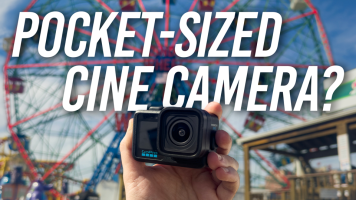
GoPro's Mission lineup aims to pack cinema camera specs into a pocket-sized action camera. Today, we're testing out the GoPro MISSION 1 PRO, and what better way than with the rides at Coney Island?
0:00 - Test Footage
0:26 - GoPro Mission 1 Pro Specs
0:55 - Sensor (Low Light, Open Gate, Frame Rates)
1:58 - LCD Screen, Battery Life, Buttons
3:04 - Internal Mics & Test
3:39 - New GoPro Wireless Mic & Test
4:11 - Photography Specs
4:23 - Patrick's Thoughts
Sponsored by

Posted
People have been sleeping on the RED DIGITAL CINEMA V-RAPTOR XE. It's more than just a full-frame version of the KOMODO-X. Nick shares where this cine camera sits in RED's lineup and gets hands-on in for outdoor and indoor locations.
0:00 - Sizzle Reel
0:30 - Intro
1:53 - V-Raptor XE Specs
4:08 - Autofocus
5:03 - Dynamic Range & Low Light Performance
6:16 - Concurrent Pro-Res Proxy Recording
6:58 - Ergonomics
7:48 - File Sizes
9:10 - 2.2.1beta Firmware Updates
9:38 - Upgrade Program
10:04 - Takeaways
Sponsored by

Posted
What is open gate, and how can it streamline your video production? Doug will show you how to get the most out of open gate, such as cropping from horizontal (16:9) to vertical (9:16).
0:00 - What Is Open Gate Video?
0:42 - Why Use Open Gate?
2:17 - Advantage 1
3:07 - Advantage 2
3:53 - 3x2 and 4x3
5:08 - Why Is It Called Open Gate

Posted
Do your outdoor portraits suffer from a well-exposed subject but blown-out background? A strobe light is key in that situation, and Godox's AD800Pro flash is here to help. Join Juan for an outdoor portrait photoshoot to showcase how, with just one light, you can transform your portraits.
0:00 - Intro
0:22 - Outdoor Portrait Samples
0:51 - Flash vs. No Flash
1:42 - Who Is This For?
2:29 - Studio Lighting Outdoors
2:49 - Recycle Time
3:12 - Battery Life/Power
3:55 - Miscellaneous Specs
Sponsored by

by Zack Young · Posted
On-camera monitors continue to grow in popularity with filmmakers and photographers wanting a bigger, better view of their image than a flip-out LCD can provide. The Desview R5II 5.5" touchscreen monitor is, on paper, a great offering: lightweight, affordable, versatile, and bright. It even comes with useful accessories like a swivel-and-tilt shoe mount, a sunshade, a USB drive for loading LUTs, and a couple variations of HDMI

Posted
Now that the hype surrounding Nikon’s acquisition of RED and the launch of the ZR cinema camera has settled, we’re finally putting it to the test on set. Nick combed through FAQs gathered from our YouTube comments, our website, and Reddit, and he’ll be tackling them all in this video. You'll also get his honest opinion on the best features and the quirks. This hands-on experience is truly a deep dive (especially since Nick read all 120 pages of the user guide).
0:00 - Today's Video
0:53 - Key ZR Specs
1:42 - Nick's Initial Thoughts &

Posted
An instant camera that also shoots video? With inspired effects from the 1930s to the 2020s, this one’s an easy add to cart. Get our team’s first impressions of the FUJIFILM instax mini Evo Cinema Hybrid Instant Camera.
0:00 - First Impressions
1:32 - Decade-Inspired Effects
3:28 - Microphone & Printing
5:22 - Adjusting the Decade Effects
Sponsored by

by Zack Young · Posted
It’s been six years since GoPro launched the original MAX 360 action camera, so its long awaited follow-up, the new MAX2 360, feels less like a sequel and more like a reinvention, capturing 8K 360° video that’s far sharper and more detailed than anything the original MAX could produce. It’s clear GoPro is trying to match or exceed the specs of competitor cameras that are many more than two

Posted
Sony's new PXW-Z300 3-CMOS XDCAM Camcorder is perfect for camera operators looking to capture high-quality video in the field, or someone looking to add a camcorder to their existing Sony ecosystem. Join Sidney to learn this camcorder's specs and see the test footage he shot!
0:00 - Sample Footage
0:39 - Digital Signatures
1:13 - Sensor & Video
1:32 - Lens
1:42 - AI-Powered AF
2:05 - LCD Monitor
2:27 - Power
2:37 - V & Cold Shoe Mount
2:59 - Buttons & Ports
3:33 - S-Cine Tone Gamma Curve
4:14 - Who Is This Camcorder For?

Posted
Depending on what you're recording, there's a GoPro Action Camera our there for you. Which models can shoot in RAW? Which offer 360-degree video? Which performs best in low light? Patrick breaks it all down, comparing specs and testing the HERO, LIT HERO, HERO12 Black, MAX 260, and MAX2 360.
0:00 - The Very First GoPro
0:28 - Hero Action Cameras
1:16 - Hero13 Black
1:50 - Max Series
2:31 - How Do You Choose?
3:12 - Spec Comparison Charts
2:25 - Patrick's Pick
Sponsored by

by Zack Young · Posted
Coming four years after the release of the FX3 and three years after the FX30, Sony’s new FX2 digital cinema camera surprised a lot of people who expected a successor to the existing FX models, not an entirely new offering that sits somewhere between the two. A true hybrid capable of stunning (though slightly cropped) 4K60p video and sharp 33MP stills, the FX2 is a unique proposition in a market crowded with

by Zack Young · Posted
While the internals of a smartphone continually become more filmmaking friendly, the externals and ergonomics still hew toward strict minimalism and compactness. Because of that, most creatives find there are at least a few additional accessories they need to add to their phone for it to be capable of robust video streaming or capture. SmallRig is attempting to kit all of the necessary components together and make them as universal as possible with the new

by Zack Young · Posted
Matte boxes have become an increasingly common part of camera setups even for smaller crews, but there still exists a large gap between classic high-end offerings and newer budget-friendly variations. Kondor Blue is attempting to bridge the gap with their well-built but still affordably priced 4x5 Matte Box System. The Base Kit comes with the front unit hood, top flag, and 95mm clamp-on lens adapter, while the

by Zack Young · Posted
Tube lights have become a ubiquitous part of the modern video lighting kit. Handy as a fill, hair, rim, or accent light, LED tubes have a small form factor, solid output, and are highly modular, meaning you can combine them in nearly countless ways. Drawing on all these strengths, Nanlite has a new PavoTube II 6XR 8-Light kit consisting of eight 10” tubes, a custom charging case, grids, clips, baby pins, iron plates, and

by Zack Young · Posted
What does a battery need to bring to the table in 2025? High capacity, flexible outputs, easy charging, yes, but what’s the special sauce that can elevate it above hundreds of competitors? SmallRig has been putting that question to the test, releasing batteries of all shapes, sizes, and specialties. Even looking exclusively at their 99Wh V-mount offerings, you have a standard