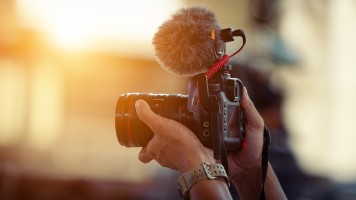
I recently tested out a handful of on-camera microphones with a video-enabled DSLR camera. In this post I share my thoughts on the sound quality of each microphone and point out their pros and cons. I took a series of photographs so you can compare the size and shape of the microphones and see how they sit atop the camera.
I used a Nikon D300s to test these microphones. Like the Canon 5D mkII, 7D and T2i, The D300s features a 3.5mm mini-plug input for an external microphone. Please keep in mind that not all video-enabled DSLR cameras have a microphone input. If you're looking for an external mic for your camera, it's a good idea to make sure your camera has the proper input first.
I'd also like to preface this review by reminding you that mounting a microphone to the top of your camera isn't the best way to capture good audio in every situation. If you're shooting footage with a subject speaking to the camera, it's a better idea to use a boompole or a pistol grip. I explain how to use an external mic on a pistol grip when shooting video in this B&H inDepth post.
Compared to the built-in microphones on your camera, using an external microphone will drastically improve the audio quality of your footage. Having one of these mics in your bag (with the proper wind protection for shooting outdoors) is a really good idea if you want the freedom to impulsively shoot HD video in the field with clean, usable audio.

Pros
1) It has a really nice sound
2) It comes with softie windscreen (a critically important accessory for any on-camera mic)
3) It has a solid construction
Cons
1) It's a pretty large microphone
2) It's a bit heavy for an on-camera mic
I find that microphones tend to sound like what they look like, and that theory was really reinforced in this test. The Rode Stereo VideoMic had a very big, full sound (which outshone the more compact stereo microphones that I auditioned). The obvious downside of this mic's big sound is its large size.
The Stereo VideoMic seemed to have a little more "reach" than a typical on-camera stereo microphone. It's not a shotgun microphone, so it's not ideal for shooting video with people speaking to the camera. But it did a fairly good job of grabbing sounds from directly in front of the lens.
The Stereo VideoMic requires a 9-volt battery to operate, and features a low-cut switch. The low-cut switch removes low frequencies from the audio. Why on Earth would you want to do that? Low frequencies can be really distracting for a lot of video work. You pick up rumble from passing vehicles and footsteps, and a lot of ugly sounding handling noise. The low-cut switch gets rid of a lot of these unwanted sounds. A few of the other mics in this post feature a low-cut switch as well.

Pros
1) It's an exteremly compact shotgun microphone
2) It sounds pretty good
3) I has a solid construction
Cons
1) Compared to some larger microphones, the MKE 400 sounds a little thin
2) Without its separately available softie windscreen, it picks up a lot of wind noise
The Sennheiser MKE 400 is a really good little microphone. It's the smallest shotgun microphone on the market, and it picks up pleasing-sounding audio. If the MKE 400 was the only external microphone that you ever heard, you'd probably be happy with its sound. But, if you listen to an MKE 400 through a DSLR camera for a few minutes, and then swap it out for any of the other microphones in this post, you'd hear that the MKE 400 has a relatively thin sound. What's interesting is that even though its sound is thin, it's an appealing sort-of thinness that suits video. In short, its sound makes the human voice stand out.
I tried using the MKE 400 outdoors with the Nikon D300s, but I found that it was the very susceptible to wind noise, even on a calm summer evening. Additional wind protection is always a must-have item when you use any microphone outdoors, and the MKE 400 is no exception. Sennheiser sells the MZW400 windscreen separately in a kit that includes an XLR adapter. Rycote makes a dedicated windscreen for the MKE 400 as well.
This microphone features a low-cut switch, but instead of labeling it as "low-cut," there is just a small illustration of the a mic on a stick beside the switch. The MKE 400 has two volume settings—low and high—and comes with a AAA battery, which is required to power the mic.

Pros
1) It has a nice, even stereo sound
2) Perfect physical design for on-camera use
3) It has a solid construction
Cons
1) It requires a small watch-style battery to operate
If you're looking for a tough little microphone to stick in your camera bag and use when inspiration strikes, the Audio Technica Pro-24CM is a great option. It's important to note that this is a stereo microphone, not a shotgun mic. It will do a much better job of capturing ambient environmental sounds, as opposed to picking up the speaking voices of people in front of the camera.
Of all of the microphones that I tested, the Pro-24CM had the best design for mounting to a camera. The partially coiled cable is the perfect length, and its shockmount is compact and pleasantly simple. The included foam windscreen did a decent job of blocking out wind noise, but you really need additional wind protection for outdoor use. The separately available Windtech MM1 softie fits snugly over the included foam windscreen and makes for a great combination for outdoor use. It's a very tight fit, but that's what you want with a softie windscreen. The biggest drawback of the Pro-24CM is that it needs a small LR44 watch-style battery to operate. It comes with this battery, but it's so small that it's easy to miss it when you open the packaging.
The Sony ECM-CG1

Pros
1) Lightweight
2) Nice, full sound
3) Doesn't require a battery to operate
Cons
1) Requires "plug-in power" from the mic input to operate
2) Does not come with a shock mount
You don't really hear about the Sony ECM-CG1 on-camera shotgun very often in the DSLR video community, so I was really curious to test this one out. When I first took it out of the box, I was a little taken aback by its lightweight, plastic-y feel. However, it turns out that the lightweight aspect of its construction is a great virtue. It helps to keep the overall weight of your camera down.
The ECM-CG1 doesn't require a battery to operate; however, it does need to receive "Plug-In Power" from the microphone input. Plug-In Power is very similar to phantom power. The external microphone input on a camera sends out a little charge to the connected microphone, which powers the microphone's capsule. Not all cameras feature Plug-In Power. Most Sony cameras have it, and I was happy to discover that the Nikon D300s I was using provided Plug-In Power as well.
I thought that this was a very decent sounding shotgun microphone. Obviously, if you were using a professional field mixer or a Camcorder XLR Adapter with a professional shotgun microphone, you could get a better sound. But for what it is, I thought the ECM-CG1 sounded impressive. The camera shoe mount that comes with the mic doesn't have suspension, so I would advise using this mic with a shock mount like the Pearstone DUSM-1. It also only comes with a foam windscreen, so for outdoor use you would need an additional softie.
The Rode VideoMic

Pros
1) Good sound with an impressive amount of reach for an on-camera shotgun
2) I gotta say it... the industrial design looks really cool
Cons
1) The shock mount suspenders cause the microphone to wobble
There's no doubt that the Rode VideoMic is a great way to improve the audio quality of a video-enabled DSLR. It does a really nice job of capturing dialog, and (like all of these mics) it can be used as an all-purpose microphone as well. It comes with a foam windscreen, but unlike the Stereo VideoMic, it doesn't come with a softie. For outdoor use you need to purchase the humorously named Rode Dead Cat separately. Rycote also makes a Mini Windjammer that's compatible with the VideoMic.
The VideoMic has an integrated shock mount, which mounts to the shoe of a camera, or to a boompole or a pistol grip. The elastic suspenders of the shock mount have a little less resistance than usual, which causes the microphone to wobble around when in motion. Some people find this very distracting, others don't mind. I personally didn't find it very distracting, but would have preferred if it wasn't an issue. This microphone requires a 9-volt battery to operate and features a low-cut switch.
Thanks for checking out this B&H inDepth post! If you have any questions about any of these microphones, I'd be happy to answer them in the Comments section below.
Comments
I also forgot to mention that I use a fujifilm hs25 XCR(don't know if it had a jack plug, forgot to look before posting)!!!
Hi James -
It appears that the Fujifilm HS25 XCR camera has no external microphone input port.
Please contact us via e-mail if you have additional questions: AskBH@BandH.com
Hi, great reviews!
I film railways and are thinking about filming some gigs but don't have a mic, what would you recommend? I am also on a really tight budget but want good quality sound!!!
Cheers
Hi James -
For a relatively low cost of ownership - The Rode Stereo VideoMic Pro features a matched pair of 1/2" cardioid condenser capsules, mounted in a coincident X/Y position for accurate stereo imagery and detail. The microphone's small, ergonomic footprint features an integrated shock mounting system for superior isolation from vibration and mechanical noise. The multi-strand output cable is terminated with a 1/8" (3.5mm) output connector and delivers significantly lower noise transference than traditional audio cable. This is a great little mic for ambient sound recording. For outdoor use I recommend using the Rode Dead Kitten Artificial Fur Wind Shield. It's specially designed with artificial fur that minimizes high-wind noise, while also remaining acoustically transparent.
Please contact us via e-mail if you have additional questions: AskBH@BandH.com
Hi there, great article, thanks for all the info. I recently bought an audio bundle for my DSLR and was going to get the rode stereo mic you mentioned first. They ran out of stock though!
So for the same price they gave an NTG2 mic, with the bundle, they said it was a better mic so no worries.
The only thing is, is has an XLR output, but they said not to worry, they would put a xlr to 3.5mm adapter in with the bundle. I am now panicking because I don't fully understand all this phantom power business. will it work for me?
I have a 650d/t4i. All I want is an external mic I can sometimes put on the end of a boompole that I can record directly to cameras microphone/memory with.
I'm aware I won't be able to monitor with headphones this way.
Thanks for any help!
Hi Ciaran -
Not to worry! The RODE NTG-2 microphone is designed to work via +48 volt phantom power OR with a 1.5 volt AA battery. You will use the mic with the battery inserted since your camera cannot supply phantom power.
NOTE:It is recommended that you remove the battery from the NTG-2 when the microphone is not in use as current is drawn whenever a battery is installed.
This is a common and often used solution employed by thousands of our customers and other "shooters" around the world.
Please contact us via e-mail if you have additional questions: AskBH@BandH.com
absolutely brilliant, thanks for quick response!
Sam; what's the best "mini mike" for the SONY RX1?
Thanks!
Due to the size of the camera I would recommend the Que Audio DSLR Video Microphone as it is a smaller form factor, great quality shotgun mic.
Hey Sam I am looking for a good quality mic that will be used to record standup comedy. I have a Nikon D5100 and I need to record video and audio of some of our shows. The audio should pick up the comedian clearly but I also want to pick up crowd laughter. Would you suggest the Rode for this or another microphone?
Thanks
Hi Roadcomic -
The comedian's dialog will be projected from some kind of PA system or speakers so they should be plenty loud for a decent shotgun mic like one of the Rode series. The Rode Stereo VideoMic Pro offers remarkable stereo reproduction, sound quality and ergonomic design. The Stereo VideoMic's capsule feature a matched pair of 1/2" cardioid condenser capsules, mounted in a coincident X/Y position for accurate stereo imagery and detail. The microphone's small, ergonomic footprint features an integrated shock mounting system for superior isolation from vibration and mechanical noise. The multi-strand output cable is terminated with a 1/8" (3.5mm) output connector and delivers significantly lower noise transference than traditional audio cable.
Please contact us via e-mail if you have additional questions: AskBH@BandH.com
Hi. Quick question. I found your article extremely informative, but I have a particular question that wasn't addressed either in your narrative or in the comments.
I am fortunate to have a daughter that enjoys acting, singing and dancing. I take many photos and video of her on stage with my Nikon D7000. I want to get an external microphone to enhance the quality of the video I've been taking.
I have the following situations to consider:
1. Video of her and other cast members singing on stage -- usually most are in the camera's frame. Keep in mind that the orchestra pit is usually in front of the stage and is pretty loud. The performers' voices are usually electronically amplified. I'd like a quality recording of the entire song.
2. Video of her singing solo and a cappella (without accompaniment). I'd like to reduce ambient noise and focus only on her singing.
3. Video of her singing solo at a recital with (usually) a piano accompaniment. I want to record the music as well as the vocal, but the vocal is the focus of the recording and it's not likely that the piano will be in the frame of the camera -- and maybe several feet away even.
Obviously, I want versatility. Any suggestions?
Thanks for your help.
Hello JRG -
Using an on-camera microphone presents certain compromises in terms of sound pick-up that need to be understood so your expectations correspond with the recorded results. From a distance, as in shooting from the audience or another off-stage location, with a shotgun mic will generally result in a very "boomy and cavernous or "down in the well" effect The microphone is gathering sound that is reflected from throughout the space, walls, ceilings, floor, etc. and essentially will hear everthing you do and sound just awful for the most part. So the rule of thumb is to to mic your subject as closely as possible. In your case, have your daugter wear a wireless lavalier microphone and transmitter body pack - the wireless receiver would be mounted at your camera.
The Sennheiser ew 112-p G3 Wireless Portable Microphone System is intended for portable wireless operation, such as video and field recording applications. This camera-mountable system includes a UHF diversity receiver, bodypack transmitter and ME2 lavalier microphone. The SK 100 G3 bodypack transmitter and EK 100 G3 receiver synchronize channel and frequency at the touch of a button.
An optional rechargeable battery pack allows you to charge batteries while they remain inside. The receiver includes the CA2 shoe mount adapter, for easy installation onto a camera shoe. A back-lit display allows for easy operation under dimly-lit conditions and its user friendly menu makes operation quick and easy.
If this scenario is not possible, a stereo shotgun mic may be the next best option: The Rode Stereo VideoMic Pro offers superb stereo reproduction, sound quality and ergonomic design. The Stereo VideoMic's capsule feature a matched pair of 1/2" cardioid condenser capsules, mounted in a coincident X/Y position for accurate stereo imagery and detail. The microphone's small, ergonomic footprint features an integrated shock mounting system for superior isolation from vibration and mechanical noise. The multi-strand output cable is terminated with a 1/8" (3.5mm) output connector and delivers significantly lower noise transference than traditional audio cable.
Please contact us via e-mail if you have additional questions: AskBH@BandH.com
Hi there,
I'm looking for a microphone mainly for interviews and home studio. However I also want to do videos outside like visits to places. I have a Canon Rebel T4i DSLR. Which mic is best for me?
My main issue with the onboard T4i stereo mic is that it picks up loads of background noise. No air con, no noise but when I playback the video I hear a loud hissing sorta noise.
Thanks.
Hello -
For ambient recording choose a stereo microphone. The Rode Stereo VideoMic Pro builds on the success of the Rode VideoMic Pro & Stereo VideoMic with improved stereo reproduction, sound quality and ergonomic design. The Stereo VideoMic's capsule feature a matched pair of 1/2" cardioid condenser capsules, mounted in a coincident X/Y position for accurate stereo imagery and detail. The microphone's small, ergonomic footprint features an integrated shock mounting system for superior isolation from vibration and mechanical noise. The multi-strand output cable is terminated with a 1/8" (3.5mm) output connector and delivers significantly lower noise transference than traditional audio cable.
The included shoe mount features an integrated shockmount system for even further protection against handling noise. The Stereo VideoMic features a high pass filter switch at 75Hz for minimizing low frequency noise, and a -10dB Pad for maximizing headroom for capturing loud signals without distortion. The +20dB level boost switch is specifically designed to provide a higher quality signal with DSLR cameras. When activated, camera preamp level is reduced, resulting in a lower noise floor and much clearer recording.
Please contact us via e-mail if you have additional questions: AskBH@BandH.com
hello, I am looking for a microphone to capture better audio than my canon dslr does, planning to use it for short films and skateboard edits mostly.
Out of the mic's you tested which would you recomend most highly ?
thanks
For film work and skate videos I would recommend the Rode Videomic Pro
A broadcast quality condenser microphone in a compact form factor that works well when used on DSLRs and smaller form factor cameras.
I am considering using my Shure SM81 on a shock mount thru an RM333 on a Nikon d600. Would this be a good set-up?
Thanks
Hello Yamon -
Excellent choices all around!
Shure SM81-LC - Cardioid Instrument Condenser Microphone
juicedLink RM333 Riggy Micro Low-Noise Preamp
Nikon D600 Digital Camera with 24-85mm f/3.5-4.5G AF-S ED VR Lens Kit from B&H
Please contact us via e-mail if you have additional questions: AskBH@BandH.com
Hi, I have the original Rode Videomic and a Canon T2i. I just got it recently, and ran some tests with it. I noticed that the sound with the mic plugged in was much more noisy (background hiss) than it was with the camera's audio. This was very strange to me. I was not running it through any other device like a Zoom to control levels. Is there a way to make the sound clearer when plugging straight into the camera? I couldn't figure out any ways in-camera to mess with audio.
Also, I'm wondering what the low-pass filter switch does and when I would want to use it.
Thank you.
Hello,
The "more noisy (background hiss)" you are hearing is due to the cameras Audio Gain Control which is not adjustable on the T2i.
The BeachTek DXA-SLR Active Audio Adapter is designed to provide professional audio signal to the increasing number of DSLR cameras used to shoot video. The DXA-SLR is powered with a 9V battery, and its active electronics feature 2 balanced XLR preamplifiers with a mic/line level input switch, AGC (Automatic Gain Control) disable, and +48V phantom power to condenser microphones.
A Low Pass filter will help when recording low rumbles like that from a running air conditioner.
Hi,
We are preparing to shoot an ultra-low budget feature film on the Canon 5D mark ii. We will be shooting mostly indoors in small rooms or in a car, with no more than three people to a scene. Only one person to operate the camera and sound so it would be preferable to have it mounted on the camera for our purposes. If we can only afford one mic for our feature, what would you recommend?
Thank you
The VideoMic Pro from Rode packs the audio quality and features of the popular VideoMic into an ultra compact and lightweight design that's ideal for use with HDSLR cameras, camcorders, and audio recorders. The microphone has a broadcast-quality condenser capsule with a supercardioid pickup pattern to capture audio from the front, while minimizing pickup from the sides and rear. An integrated shockmount and foam windscreen minimize handling and wind noise to keep your recordings crystal clear. http://bhpho.to/hGizjV
Hi,
Thanks for the review. I hope I can trouble you for a little more information to help me decide on what mic/mics I need to consider.
I video in three different environments. The first is in a small office where it is just me at a relatively close distance. Sometimes there is noise outside of my office, which I would like to minimize.
The second is at trade shows. There is A LOT of ambient noise that overwhelms onboard mics.
The last is at shooting ranges where there are guns being fired at various distances from the camera.
Is there a single mic that would be good for all of these situations? Most likely not, so what would you suggest for each of these environments?
I'd consider lav mics, but for the trade show that would be less convient than having some type of mic mounted to the camera.
Your suggestions are greatly appreciated!
Richard
Hello -
First off - there is no single microphone that can be considered to be a "Swiss Army knife" solution where it will offer satisfactory performance in such diverse situations. In environments where there is high ambient noise, your mic will need to be positioned as close to the audio source as possible. So for trade shows, a lavalier or head-worn condenser microphone may be the way to go. A shotgun mic may be the right choice for the office however. For the office or where the camera can be positioned very tightly to the subject (to minimize the ambient) consider this:
Rode VideoMic Pro Compact Shotgun Microphone
For the trade show environment:
Sennheiser EW122-p G3 Camera Mount Wireless Microphone System
A headworn mic for the wireless:
Countryman Isomax Headset
if you have additional questions please email us at: AskBH@BandH.com
Hi,
I am using a Nikon D3S for online journalism that includes interviews in sometimes loud or hard room situations. What one mic can I keep in my bag that would provide better quality than the built-in mic.
Thank you.
Hello Keith -
Although no single microphone is the perfect choice for all situations, I would recommend the Rode VideoMic Pro Compact Shotgun Microphone as a basic, on camera, shotgun mic.
This microphone has a broadcast-quality condenser capsule with a supercardioid pickup pattern to capture audio from the front, while minimizing pickup from the sides and rear. An integrated shockmount and foam windscreen minimize handling and wind noise to keep your recordings crystal clear.
On the rear of the mic, you'll find a 3-way level control that offers -10dB, 0dB, and +20dB modes. There is also a 2-step high pass filter with 0 and 80Hz settings, letting you minimize the impact of low frequency hum, camera motor noise, and similar distractions. The mic has a standard camera shoe and a 3/8" threaded mount for easy attachment to cameras and boom poles. The 3.5mm plug is compatible with a wide variety of different cameras and audio devices. The VideoMic Pro operates for up to 70 hours on a single 9V battery, allowing you to work in the field without constant replacements. If you have additional questions please e-mail us at: AskBH@BandH.com
Hi,
I have a Canon 7D and I recently started filming live band performances in various locations, such as in retail stores, restaurants, outside (with environmental noise) and in small, quiet spaces. From your article, it seems like a Rode Stereo Videomic or just a Rode Videomic would be my best option. But, which of the two do you think would be better considering I will be shooting in a variety of locations to include both inside and outside?
Thanks!
Hello Ruth -
The Rode Stereo Videomic is better suited for recording live music. If shooting outdoors the Rode - Dead Kitten Artificial Fur Wind Shield is highly recommended to attenuate wind noise.
Hey Mike what would you suggest for a fireworks show, I will be about 150ft to 200ft from the launch pad. I was hoping to make good use of my sub on playback.
Hello Bob -
This is a challenging distance for any microphone. My best recommendation in this category would be the Rode Stereo VideoMic PRO+ Dead Kitten Windshield Bundle. The windshield is essential for attenuating the wind noise encountered during an outdoor shoot.
I use a D90 and a Sony A35 (Minolta lenses are much cheaper). Trying to video birds, or more accurately, bird songs. I can't see the birds but I can hear them. What mic would you recommend, please? For the Nikon, it's the 80 - 200, for the A35, it's the 'beer can' and the AF mirror. Thank you.
Hello A:
For most ambient recording applications where the sound is not localized I recommend a stereo microphone for the best results. The RODE Stereo VideoMic PRO is an excellent choice. If you encounter wind noise you may wish to add a "furry" windshield as well.
Thanks Mark S, will order one from the bhphoto site soon.
Hello,
I was wondering, based on your opinion after testing all these mics which one would you say would be the best for recording inside me talking to the camera.. Of course it needs to have the best sound quality... Thank you so much!
-Sam
Hello -
Of the mics reviewed here, I recommend the Rode VideoMic. It offers the most "bang-for-the-buck"performance in its class. A new, upgraded and smaller, more compact version from Rode is now being offered. Check out the Rode VideoMic Pro as well.
I'm planning on shooting a doc on my 5D and was wondering which would be a good mic for out in the field. As a still photographer this is a new world for me and I'm trying to collect as much info as possible. I'd like something lighter weight as I'll be carrying all the gear while hiking.
Hello -
I suggest considering the Rode VideoMic Pro. It is small, light, smartly designed and delivers outstanding, broadcast quality performance from it's compact form factor. It will not weigh you or let you down!
Hello, im using a Canon Rebel T2i. Im curious ad to know what mic you would suggest works best when video recording vehicles...car revs, take offs, etc...i do alot of recording of automotives but im never able to have that crisp clean sound. so which mic would you feel to be the best...especially since more of it is outdoors? Thanks :)
Hello -
The Rode Videomic Pro and it's companion accessory, the Rode DeadCat VMP Wind Muff for VideoMic Pro should work well with your camera for this outdoor application.
Hi Mark S, I have a Canon Rebel t2i,need to take an outdoor shooting.An interview with group of people upto 5 or 2.want to get a clear voice,for this which mic would be cheap and best? Thanks Vikas.....
If your subjects will be facing the camera or all in the camera frame as you are shooting from a distance of less than 12 feet away - than the Rode Video Mic should get the job done for you at a very low price:
http://www.bhphotovideo.com/c/product/363083-REG/Rode_VIDEOMIC_VideoMic_...
Since you will be shooting outdoors - you will also require a Rode Dead Cat Wind Muff to reduce outdoor wind noise:
http://www.bhphotovideo.com/c/product/392861-REG/Rode_DEAD_CAT_Dead_Cat_...
Please contact us via e-mail if you have additional questions: AskBH@BandH.com
Thanks a bunch, I'll have to give them a try. :)
Hi,
I am interested in buying a mic that I can use for on location interviews outside of a studio setting. I have a Canon Rebel t2i and am not sure if a lavaliere mic or a shotgun mic would be more appropriate. I would like to keep costs down.
Also, I would like a mic that automaticlly syncs with my video. I noticed that a few people on the message board said that depending on the mic, the video and audio will not necessarily sync.
Thanks.
Hello -
With a microphone connected directly to your camera the audio will be synced. You may be concerned about syncing recordings made with an external recorder. In that case synching can be easily achieved with software.
A lavalier microphone would do the best job of isolating your subject and minimizing unwanted ambient sound. Consider using additional wind protection when recording outdoors as well.
im quite new to videography. So I am using this firmware that allow me to record 1080p video with my 50d. But it can't record sound. The only option is using an external mic. What mic would you recommend me to use for environmental purpose. Such as gig and stuff. Is the audio technica suitable. Thanks.
Hello,
The Rode Stereo VideoMic delivers true stereo X/Y recording in a compact, camera mountable microphone. The Stereo VideoMic accurately captures stereo ambiance while exhibiting excellent off-axis rejection and signal-to-noise ratio. The small, light weight profile allows quick and unobtrusive mounting on DV and HDV cameras without appearing in the frame.
1) I regularly film bands at gigs using my DSLR, and was wondering what mic (from those reviewed) would be best for something like that?
2) The Rode Stereo VideoMic sounds really good for what I'm after, but I was concerned/confused by the "it's not ideal for shooting video with people speaking to the camera" comment. Why is that, exactly?
Thanks for your time :)
Luke.
Hello
The Rode Stereo VideoMic is best for recording over a wider area - like a musical venue, orchestra, choir, band. The Rode Stereo VideoMic features true X/Y stereo pick up for accurate ambiance reproduction - It's pick-up pattern is not front - directional enough for the very best single point vocal pick-up. That said, if this mic is being used at a relatively close distance to the speaker, in an environment that does not include alot of ambient sound to the sides and rear of the camera, it should do a moderate job of recording single point audio of people speaking directly to the camera, as in a "man on the street" interview situation.
Rode advises:
"The Stereo VideoMic is an ideal microphone for capturing environmental and ambient sounds, as well as live music. For dialogue and directional applications the RØDE VideoMic and VideoMic Pro are recommended."
That totally makes sense now. Thanks so much for your thorough explanation. The Rode Stereo VideoMic sounds like the mic for me :)
So what would you recommend in the end for a proffessional use. I'm pretty much a begginer and I was wondering what the pros use, like those ones that a person holds above people during a scene. Thanks.
For DSLR videography, the audio is usually recorded separately due to the limitations of the cameras and then synced with the on-camera audio in post.
I would recommend The Tascam DR100: http://bhpho.to/s1IkjZ
with the Rode NTG2 boom kit
Total newbie here - waiting for my T3i... I've been reading all about mics and the various options. This type of recorder was recommended. Here's what I'm wondering - I plan on recording primarily interviews. Am I right that one txfrs the audio and video separately and then edits/syncs it all via computer? If so, is it difficult to sync the audio to video? Thanks!
Hi A couple of points may help you. If you are using a camera mounted mike, make sure it is a shotgun or unidirectional mike... Designed to pick up what is in front of the camera... Ie your interviewee. Don't go for an 'ambient', cardiodal or omnidirectional mike. You do not have to sync later if this mike is on your camera. You only have to sync is the audio is recorded using a separate mike recorded on another device. I suggest you wiki microphone types. This will all make sense! Good luck. Adam.
Hello;
You are correct, audio and video are recorded separately and joined in Post Production. Since DSLR’s do not use time code, software is used to sync the audio with video. Singular Software's PluralEyes for Final Cut Studio (as well as Media Composer, Premier Pro, SONY Vegas Pro) that automatically syncs all of the audio tracks.
http://www.bhphotovideo.com/c/search?Ntt=PluralEyes&N=0&InitialSearch=yes
Do any of these have headphone outputs so toubcan monitor what's being recorded? Or How do you do that
Thanks
David young
Hello,
You cannot monitor the mic directly. The JuicedLink DS214 DSLR Camera Headphone Amp, Meter & AGC Disabler is a comprehensive and versatile audio preamp with AGC (Automatic Gain Control) disabling for use with DSLR cameras such as the Canon T2i / 7D. The JuicedLink DS214 features a stereo 1/8" (3.5mm) mini input, capable of handling 2 discrete audio channels (requires a Y cable), a headphone output and level control for each. The DS214 will bypass the DSLR's noisy AGC circuit and establish, clean stable audio signal from external shotgun microphones, lavaliers, wireless microphone receivers and more. The unit also features comprehensive, accurate stereo metering.