Rokinon

Let’s face it: cinema lenses aren’t cheap, and for good reason. Cinema lenses are, generally, superior to conventional “non-cine” lenses in almost every regard. They’re more durable, offer better control, produce superior image quality, and so on. The only downside is the price you pay for the privilege of their performance; a top-tier cine lens can easily run you thousands of dollars.
But don’t reach for your

Welcome to Filmmaking 101, where we offer some tips on how to go about creating your movie masterpiece. Read on to discover suggestions for your pre-production, production, and post-production phases.
Pre-Production
Scriptwriting
You have your idea for an arthouse masterpiece or an action-based blockbuster; now how do you translate that into a script―the backbone of your production? You can use MS Word, Google Docs, or another document program. But using dedicated screenwriting software provides the standard formatting, outline tools,

When it’s time to step up the look of your digital film production and you are upgrading to a full-frame or Super35 cinema camera, shooting with a new mirrorless full-frame camera, or just seeking that film look, buying or renting the right digital cinema lens requires research, patience, and, most importantly, visual meditation. Whether you’re shooting 8K large format, full frame, anamorphic, or Super35, there’s a cine lens out there that’s just right for recreating
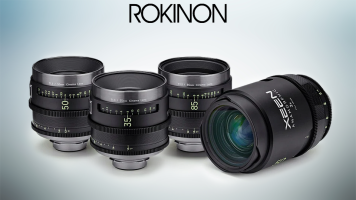
NAB 2022 – Rokinon steps up its game with the Meister Professional Cinema Lenses and Xeen Anamorphic Pro Full-Frame Cinema Lenses. At T1.3, the spherical primes are fast—very fast—for full-frame lenses and they use 13-blade irises to provide not just excellent low-light performance, but pleasing bokeh for natural-feeling out-of- focus highlights. Rokinon's X-coatings provide good contrast and help control flare and internal ghosting,

Rokinon and Samyang have modernized their already modern autofocus Sony full-frame E-mount AF 35mm f/1.4 FE lenses, launching the Rokinon Series II and Samyang Series II versions that add the ability to customize settings, as well as being weather sealed.
Sony E-Mount 35mm f/1.4 Lenses
Externally, the new lenses feature a two-

Whether you want to photograph your pets, pamper them, study them, or memorialize them for eternity, B&H has a wide array of gifts that will appeal to animal enthusiasts. Let’s have a look at a few possibilities.
Fisheye Lenses
Not for fish, but perfect for taking fun pictures of your dog, cat, or bunny rabbit. Extreme wide perspectives from a fisheye lens create pet portraits with exaggeratedly long noses and elongated whiskers. They are also great for capturing action shots, like a dog in mid-frisbee jump. Check out these screw-on

I can picture the eyerolls after reading that headline, and I totally understand. Will the cinematography departments of digital films now utilize autofocus in their carefully planned, meticulously lit, and choreographed productions? No, and for many reasons other than to keep focus pullers employed. But, using AF technology in smaller films, documentaries, reality shows, sporting events, and streaming productions can benefit greatly by the use of autofocus for their shots, so the camera won’t lose focus when a compact crew is busy juggling

Filtering ultra-wide-angle lenses, which are generally defined as lenses with diagonal angles of view of 90° or greater, can be challenging. And the greater the AoV, the more challenging filtering can become. The big problem has to do with vignetting, which in the case of filtering ultra-wide-angle lenses means seeing the edges of the filter in the corners of the frame.
In the case of full-frame cameras, this is seldom an issue with lenses in the 18mm to 21mm range (approximately 90° to 100° AoV) assuming you are using threaded, thin-mount

Let’s face it: Shooting film and video isn’t just a job for most of us, it is something we love. Everything that we do contributes to creativity of the images that we make. But the toll the day-in and day-out work can take on our creativity can be devastating. Sometimes you just need a break, something to reinvigorate you, like a fun, non-professional optic. Sometimes you need a different challenge, working with a different set of limitations; experiment, explore, create without having to worry about others judging or the consequences of
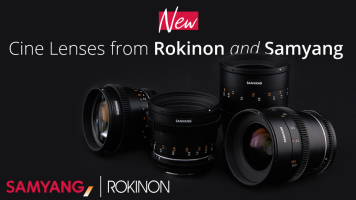
Banish those end-of-summer blues by treating yourself to some new cine-style lenses from Rokinon and Samyang! These Rokinon T1.5 DSX High-Speed Cine and Samyang T1.5 VDSLR Mark 2 lenses will be available soon at B&H Photo in 24, 35, 50, and 85mm focal lengths with a 14mm version due early in 2021. Designed to cover full-frame sensors, these primes are compatible with a wide range of cine-style, DSLR, and mirrorless cameras.
Choose from Rokinon Cine DSX Canon EF,
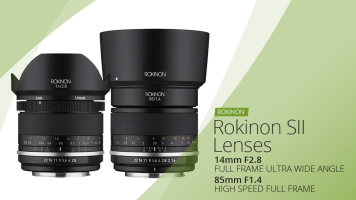
After refining a pair of trusted primes, Rokinon has just announced its Series II lenses, and the 14mm f/2.8 and 85mm f/1.4 lenses are the first examples. These familiar focal lengths have been in Rokinon’s stable of lenses in various iterations over the years, but the updated versions today revolve around streamlined exterior designs and improved optics. Both lenses have manual focus designs, are weather-sealed, and both are available for Canon EF-M, FUJIFILM X, Micro Four Thirds, or Sony E mirrorless mounts, or Canon EF or Nikon F SLR mounts
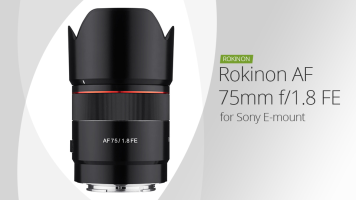
It's not often that a prime lens with a unique focal length is announced, but Rokinon has just announced the AF 75mm f/1.8 FE lens for Sony E-mount cameras. More than just an eyebrow-raising number, the 75mm focal length is an interesting one because it sits in that sweet spot between 50mm and 85mm, similar to how the now-popular 40mm or 45mm lens strikes an agreeable balance between normal and wide-angle. Besides its particular field of

Everyone loves a nice 24-70mm or a simple 50mm lens, but nothing generates instant intrigue and interest more than a unique focal length or lens design you’ve never seen before. Whether it’s an ultra-wide-angle lens, impressively fast design, or it just has some kind of distinct trait that separates it from the norm, unique lenses are a sure way to add some character to your imagery. Despite 2019 being a foundation-building year for many manufacturers, with many lens releases focusing on core sets of standard primes and zooms, here’s a look at

Even with DSLRs declining in popularity and prominence, development of new lenses continues for these tried and true cameras. While production has slowed in the last few years, optics manufacturers are still working on putting out new glass to make the most of updated sensor designs and pushing the boundaries of how well a lens can perform, how compact and lightweight a lens can be, and filling in the gaps of desired focal lengths.
Pentax
Perhaps the most notable of DSLR stalwarts, Pentax continues to champion the history, reliability, and
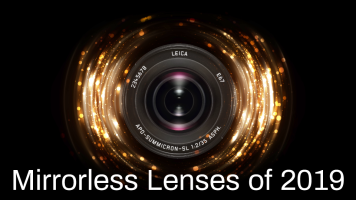
Lens development for mirrorless cameras has been in full force throughout 2019, with more lenses from more manufacturers being released than ever before. With many new companies focusing on building new full-frame camera systems, along with the introduction of a few new lens-mount types, brands are chugging along at adding everything from the necessary staples to any well-rounded lens system to even beginning to add some more niche and exotic glass for those special circumstances. Here’s a look at some of the mirrorless lens highlights from