Samyang

Let’s face it: cinema lenses aren’t cheap, and for good reason. Cinema lenses are, generally, superior to conventional “non-cine” lenses in almost every regard. They’re more durable, offer better control, produce superior image quality, and so on. The only downside is the price you pay for the privilege of their performance; a top-tier cine lens can easily run you thousands of dollars.
But don’t reach for your

As the holidays quickly approach, the pace of new product launches slows but it doesn’t stop. This week, we have a good lineup for video production to highlight. A couple of cine lens lineups are getting tweaked this week, with Tokina revealing a new character-filled version of its full-frame cinema primes, the Vista-P series, and Samyang/Rokinon adding a

When it’s time to step up the look of your digital film production and you are upgrading to a full-frame or Super35 cinema camera, shooting with a new mirrorless full-frame camera, or just seeking that film look, buying or renting the right digital cinema lens requires research, patience, and, most importantly, visual meditation. Whether you’re shooting 8K large format, full frame, anamorphic, or Super35, there’s a cine lens out there that’s just right for recreating
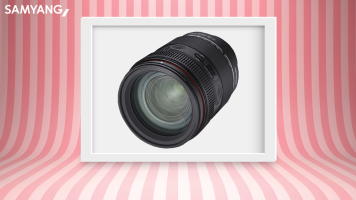
Samyang has announced a new AF 35-150mm f/2-2.8 FE Lens for Sony full-frame mirrorless systems. This all-in-one lens is designed to toggle the five main focal lengths (35/50/85/135/150) quickly, making it a great option for photographers looking to swap lenses less often.

Rokinon and Samyang have modernized their already modern autofocus Sony full-frame E-mount AF 35mm f/1.4 FE lenses, launching the Rokinon Series II and Samyang Series II versions that add the ability to customize settings, as well as being weather sealed.
Sony E-Mount 35mm f/1.4 Lenses
Externally, the new lenses feature a two-

Filtering ultra-wide-angle lenses, which are generally defined as lenses with diagonal angles of view of 90° or greater, can be challenging. And the greater the AoV, the more challenging filtering can become. The big problem has to do with vignetting, which in the case of filtering ultra-wide-angle lenses means seeing the edges of the filter in the corners of the frame.
In the case of full-frame cameras, this is seldom an issue with lenses in the 18mm to 21mm range (approximately 90° to 100° AoV) assuming you are using threaded, thin-mount
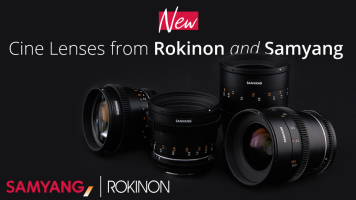
Banish those end-of-summer blues by treating yourself to some new cine-style lenses from Rokinon and Samyang! These Rokinon T1.5 DSX High-Speed Cine and Samyang T1.5 VDSLR Mark 2 lenses will be available soon at B&H Photo in 24, 35, 50, and 85mm focal lengths with a 14mm version due early in 2021. Designed to cover full-frame sensors, these primes are compatible with a wide range of cine-style, DSLR, and mirrorless cameras.
Choose from Rokinon Cine DSX Canon EF,

0 Plays ·Posted
On this week’s episode of the B&H Photography Podcast, we welcome Kevin Rickert, who is a camera and lighting Senior Sales Trainer for B&H. Rickert teaches and updates the Pro Photo staff on all the features and specs of new cameras and often gets these cameras in his hands well before anyone else. Could there be a better guest for this episode, in which we discuss the many recent camera and lens announcements from the major manufacturers?
Much of the chatter in new

Have you ever wondered why the design, specs, and selling prices of Rokinon, Samyang, and Bower lenses seldom differ from one another? This is because nameplates aside, they’re one and the same. Why? It all has to do with regional distribution agreements. In North and South America, a company named Elite

I’m not a stranger to wide-angle lenses. If anything, I’m partial to them. In my book, a 24mm lens is a normal lens, and I can’t tell you how many times I shot my way out of tight spaces using a 15mm rectilinear lens. The Samyang XP 10mm f/3.5, which boasts a 130° horizontal viewing angle, is just shy of the horizontal viewing angle of our eyes (approximately 135° AoV). Though I’ve never been intimidated by ultra-wide-angle lenses,
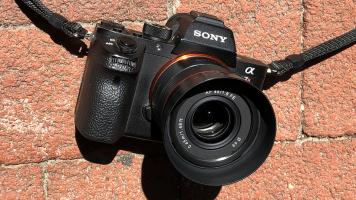
The Rokinon AF 45mm f/1.8 FE lens for Sony E-mount cameras is one of those truly extraordinary lenses that I get to use on a regular basis (I even own a few!). It’s always a treat when somebody hands me a lens that turns out to be something better than anticipated, and the Rokinon AF 45mm f/1.8 FE is right up there in that category.
About a year ago, Rokinon introduced the first of three compact autofocus lenses dedicated for Sony E-mount

The year 2018 has been a banner one for mirrorless cameras, and there has been no shortage of lenses to go along with them. The following is a bevy of new mirrorless lenses introduced over the past year to complement the cameras in this growing category. For the sake of brevity, unless noted otherwise, all the following lenses feature 9-bladed diaphragms for “natural-looking out-of-focus highlights,” i.e., “nice bokeh.”
Canon
To go along with its new

And, at last, we have Park Photos (Tests 9-12) of the light-pollution filters, and my conclusions. To return to the first part of the article and the City Photos (Tests 1-5), please click here. To view Town Photos (Tests 6-8), please click here.
TEST 9A: From the park, a wide-
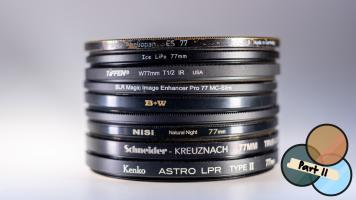
Here we have Town Photos (Tests 6-8) of the light-pollution filters. To return to the first part of this article, please click here.
TEST 6A: Backyard wide-angle photo with the house, pool, lights from the neighbor and nearby hospital.
Fujifilm X-T2; Samyang 12mm f/2.0 NCS CS lens; 30 seconds, f/2.8; ISO 3200
TEST 6B: Same as Test 6A, with WB at fluorescent.
Fujifilm X-T2; Samyang 12mm f/2.0 NCS CS

Light pollution sucks. Thanks to the electric light, humankind's view of the cosmos is in a steady decline. Dark skies are a thing of the past for most of us. Is there a way to combat this? Many filter manufacturers offer lens filters that claim to reduce light pollution in your photographs. Not only are they all unique in their specifications,