| |
< Product Resources < Lighting Resources
Introduction to Lighting
Part: 1 2
3 4 5
6 7
What Is Light?
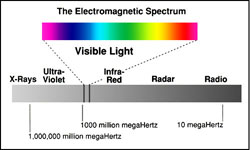
Essentially, light is made up of wave-particles called photons. Visible light falls in the Electromagnetic Spectrum, between approximately 400 and 700 nanometers (1 nanometer = one billionth of a meter). White light consists of all visible colors combined. The color of visible light changes in respect to its wavelength. Red, being the longest wavelength and violet, the shortest. A rainbow or light passing through a prism demonstrates white light being separated into its component colors.
The Electromagnetic Spectrum
Light Measurement
There are many ways to measure the quantity and quality of light. Of course, a unit of measure is essential. Don’t be intimidated by the technical jargon. Unless you’re a physicist, odds are you will not be familiar with all terms listed, nor do you have to be. A good light meter will provide you with all the information you need. You may see light specifications described in one of the following terms:
Candela
The candela (abbreviation, cd) is the standard unit of luminous intensity in the International System of Units. Originally, luminous intensity was measured in terms of units called candles. This was based on the approximate amount of light emitted by a candle flame. Late in the 20th century, the current definition and terminology was adopted to allow for consistent and repeatable measurements of light. The term candela also refers to candle power, 1 candela = 1 candlepower.
|
Candela is formally defined as the magnitude of an electromagnetic field, in a specified direction, that has a power level of 1/683 watt (1.46 x 10⁻³ W) per steradian at a frequency of 540 terahertz (540 THz or 5.40 x 10¹⁴ Hz). |
Foot-candle
The Foot-candle is the measurement of light output in candela per square foot. The Foot-candle is used frequently to quantify the amount of light present in a given area. In the B&H Web Site, many of the lights will list the photometric data next to the light. The unit the light is measured by is in foot-candles. The photometric data will enable you to compare the performance of the products you may be interested in.
|
The Foot-candle is a standard reference unit used to measure the illuminance on a surface that is everywhere one foot from a uniform point source of light of one candle and equal to one lumen per square foot. |
Foot Lambert
The Foot Lambert is a unit of luminance equal to the luminance of a perfectly diffusing surface that emits or reflects one lumen per square foot.
Lux
Lux is a unit of illumination equal to the direct illumination on a surface that is everywhere one meter from a uniform point source of one candle intensity or equal to one lumen per square meter.
Lux is a term commonly used to show the minimum amount of light needed for a video camera to function. Many video cameras are so sensitive, that they require small amounts of light to function properly, and are referred to as “low Lux cameras”.
| One lux is the equivalent of 1.46 milliwatt (1.46 x 10³ W) of radiant electromagnetic (EM) power at a frequency of 540 terahertz (540THz or 5.40 x 10¹⁴ Hz), impinging at a right angle on a surface whose area is one square meter. A frequency of 540 THz corresponds to a wavelength of about 555 nanometers (nm), which is in the middle of the visible-light spectrum. |
Lumen
A unit of luminous flux equal to the light emitted in a unit solid angle by a uniform point source of one candle intensity.
Note: The most commonly used terms used in lighting are the foot-candle, and lux.
Watt Second
This standard is used to measure the total power potential of electronic flash power packs. One watt second is a measurement of stored energy equal to one joule per second.
Many factors affect the actual light reaching the subject and must therefore be considered. The flash systems power pack simply stores the energy in capacitors that, when triggered, release this energy through the flash tube. Different flashes of similar energy storage capacity will produce different amounts and qualities of light.
Choosing equipment solely on its watt second rating will not give a true representation of its light producing capability. The quality and optimization of the design of the flash tube and reflectors contribute significantly to a system’s overall performance.
It is impossible to accurately assess the quantity and quality of a system until the stored energy in its capacitors are converted to usable light in the flash tube and focused by the reflector on the subject. The narrower the angle and the more polished the reflector, the more light will be directed toward the subject.
When comparing products you must take into account variations in manufacturer specs. Reflector angle, reflector finish, flash tube color temperature, flash to subject distance, ISO etc., must all be equal before comparing specs.
Guide Number
Electronic flash units with fixed reflectors are usually rated with a guide number for a specific ISO (usually ISO 100). The guide number is used to calculate the lens f/stop setting for a good flash exposure when both the ISO rating of the film and the distance from the flash to the subject are known.
To determine the f/stop needed, divide the guide number by the distance. To determine the distance that can be illuminated, divide the guide number by the f/stop.
When working with guide numbers, be sure to use the same units of measurement in your calculations (meters or feet) as specified by the guide number.
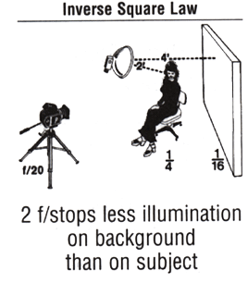
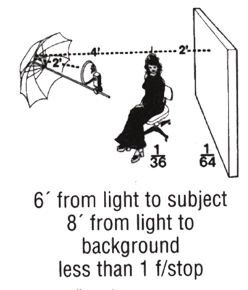
Illustrations courtesy of Norman Enterprises, Inc. |
Inverse Square Law
This is an important law that governs light intensity as a function of distance. The law states that the quantity of light is inversely proportional to the square of its distance.
Examples:
A light is placed 1 foot away from the subject. If the distance is doubled to two feet, the square of its distance is (22) or 2x2=4. The inverse of 4 is ¼. Therefore, the quantity of light at 2 feet from the subject is ¼ the amount of light at 1 foot. If the light is moved to a distance of 8 feet, the square of its distance is (82) or 8x8=64. The inverse of 64 is 1/64. The quantity of light at 8 feet from the subject is 64 the amount of light.
 Back to top Back to top
|