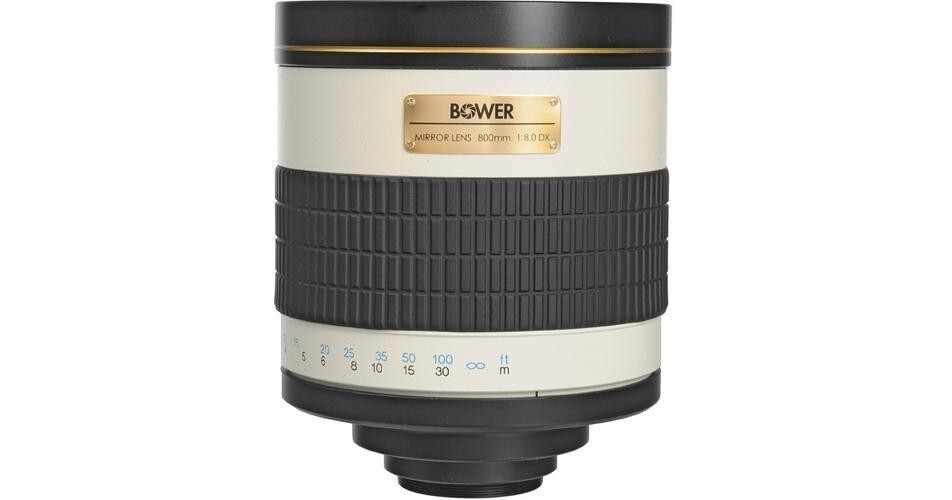
This mirror lens works on both "full frame" cameras, like Nikon's film cameras or the D700 digital SLR, as well as their "APS-C" style DX digital SLR cameras. However, in every cases the fixed f/8.0 aperture is not communicated to the camera body. As such, you can only use the camera in the "M" manual exposure mode or the "A" aperture-priority mode (if your camera is so equipped).
This lens, at 4.4 x 5.2" and just over 2 pounds, has a broad diameter and stocky build. It is a bit easier to handle than a normal 800mm refractor lens, but it is still a super-telephoto in any case (you should use a tripod/monopod in any case for best results). It also has a much different rendering of out of focus areas than a normal lens; highlights will be doughnut-shaped rings with more saturation and contrast on the edge of the ring than on the center.
This lens is an ideal candidate for astrophotography use when mounted to a Vixen GP2 Photo Guider (or other motorized equatorial telescope mount).
Displaying reviews 1-2
Pros
Cons
Best Uses
I purchased the Bower 800mm f/8 Reflex Mirror Lens looking for an inexpensive 'recording' telescope for remote inspection and industrial photography. For the price this lens is hard to beat. It isn't the same as a [$]refractor telephoto- for one thing it's around [$]… it's also a lot shorter and lighter. It IS a cheap lens, completely manual, fixed aperture, lots of plastic, screw mount with adapters, somewhat 'soft' without any really absolute sharp focus and f/8 so it's dark in the viewfinder.When I started in photography most of my lenses had some of these attributes so I'm fairly good at 'follow' focus and have made some nice, very usable images handheld at 50-100 yards with this lens. From a tripod with a D3 back at high ISO settings and 'live-view' focus magnification I've produced usable images from typical room lighting and had better results outdoors. This is what revealed the limits of focus quality however- at very high focus magnification the limits of resolving power of this lens is evident.So it's not a lens for fine art or serious wildlife photography but within the limits of price and materials incorporated in its construction this lens is well engineered. For its size and weight it's a good addition for anyone wanting extreme telephoto capability on a budget.
Pros
Cons
Best Uses
I used it with a Nikon D3 for some very very simple nature photography and not only the manual focus is somewhat cumbersome but the actual tmount has a little play which greatly interrupts focusing even further. It is well constructed itself but found more usefull for creating out of focus art shots than anything that would normally consider an 800mm for.
Displaying reviews 1-2