Recording media is not included, be prepared - always carry extra media.
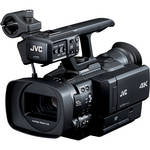
The groundbreaking JVC GY-HMQ10 4K Compact Handheld Camcorder is a one-of-a-kind camera that employs 4K imaging. It features the Falconbrid high-speed processor for advanced video applications. There's one Falconbrid engine for de-matrixing raw data in real time, while another handles H.264 encoding and formatting into the required MPEG4 format. The GY-HMQ10 uses a single 1/2.3" CMOS 4K sensor, which provides 3840 x 2160 images that are four times the resolution of Full HD cameras and monitors. With single sensor sensitivity, the camera works well over a wide range of lighting conditions. It also simplifies the optical design, which results in more precise images with minimal aberration. Plus, the 3840 x 2160 resolution supports a widescreen 16:9 aspect ratio as well.
The GY-HMQ10 uses 4K progressive recording at 144Mbps in the MPEG-4/H.264 format. 4K recording separates the image into four different quadrants and then each quadrant is recorded onto its very own SDHC memory card. After you've finished your shot, all four memory cards are accessed in sync so you can view back your footage in the ultra high-resolution 4K mode. You can also use the software to combine the four separate quadrant files into a single file that is compatible with 4K editing systems. Ideally, you want to play back 4K footage on a native 4K monitor or projector. There are even a few LCD panels that support 3840 x 2160 resolution through 4K inputs.
Usually, 4K monitors have four inputs - one for each recorded quadrant. The GY-HMQ10 conveniently features four HDMI ports for connecting to the 4K monitor's four HDMI inputs. If you only have a Full HD 1920 x 1080p monitor to view your footage, then the GY-HMQ10 sends a down-converted HD signal via a single HDMI interface. The nice thing about having such incredible resolution is that you can window off sections of the image on your screen and blow them up to Full HD resolution with incredible detail. This function is called Full HD trimming because you're cutting out a window of 1920 x 1080 footage to blow up and display on your HD monitor.
The camcorder itself supports both 4K recording and AVCHD 1920 x 1080p recording for more flexibility. While you're shooting, the GY-HMQ10 has a 3.5" LCD touch panel display to frame you shot or you can use the 0.24" viewfinder as you shoot. Both have a 16:9 aspect ratio. For professional audio, the GY-HMQ10 records two channels of 16Bit audio sampled 48kHz. In 4K mode the camera uses the AAC format, while the HD mode uses the AC3 format. To facilitate external connections, the GY-HMQ10 is equipped with dual balanced XLR ports that support 48V phantom power as well. There's also a built-in stereo microphone. Since achieving exact focus in 4K mode is very critical, JVC included a Focus Assist function, which turns focusing into a fast, easy and accurate process.
| Image Sensor | Back-Illuminated 1/2.3" CMOS 4K Image Sensor |
| Resolution | 3840 x 2160 |
| Active Pixels | 8,300,000 |
| Frames Per Second (FPS) | 60p / 60i 50p / 50i 24p |
| Aspect Ratio | 16:9 |
| Processor | Falconbrid High-Speed Picture Engine (40nm) |
| Recording Format | MPEG-4 / H.264 (Encoding) AVCHD Progressive (1080/60p Playback) |
| Recording Mode | 4K Mode (3840 x 2160p) Progressive Recording 144Mbps (36Mbps x 4) |
| Recording Method | 4-Quadrant (Each Quadrant Records to a Separate SDHC Card) |
| Memory Card Slot | SD/SDHC Quadrant Memory Card Slot x 4 |
| Focal Length | 0.26 - 2.6" (6.7 - 67mm) |
| F Number | F / 2.8 - 4.5 |
| Recording Time | Up to 2.0 Hours (32GB SDHC x 4) |
| HDMI Output | HDMI V 1.3 (Type A) Full-Size Outputs x 4 |
| LCD Display | 920K Touch Panel - 3.5" (8.9cm) |
| Viewfinder | 260K Color Viewfinder - 0.24" (0.6cm) |
| Frame Integration | Trimming Function (Trim Full HD 1920 x 1080 Window for Display) |
| Video Modes | 60p Mode: VBR (max) 27Mbps - 1920 x 1080p UXP Mode: VBR (max) 24Mbps - 1920 x 1080i XP Mode: VBR (max) 17Mbps - 1920 x 1080i SP Mode: VBR (max) 12Mbps - 1920 x 1080i EP Mode: VBR (max) 5Mbps - 1920 x 1080i |
| Audio Modes | AC3: 2-Channel 48kHz / 16Bit AAC: 2-Channel 48kHz / 16Bit |
| Audio Connectors | Balanced XLR x 2 (48V Phantom Power) |
| Microphone | Stereo Microphone (Integrated) |
| Dimensions (WxHxD) | Not Specified by Manufacturer |
| Weight | Not Specified by Manufacturer |
Reviewed by 2 customers
Sort by
Displaying reviews 1-2
Pros
Cons
Best Uses
Comments about JVC GY-HMQ10 4K Compact Handheld Camcorder:
The camera is a great new tool I will soon have. After playing around with this for a week after a friend lent it to me and once I recieve it I will be filming a B movie sitcom with this bad boy and it's performance in low light and the sharpness of the images are amazing and thats without evenin viewing my footage on a 4k TV. This camera is for definately for the pro's as the automatic settings are really terrible.
Pros
Cons
Best Uses
Comments about JVC GY-HMQ10 4K Compact Handheld Camcorder:
This camcorder is in the prosumer form factor and has some features important to both consumers and professionals. I am a private videographer who makes video for personal use so this review will be from that perspective.
The GY-HMQ10's size is somewhere between a modern consumer and modern pro camera. If one wants to use its internal stereo mic, the mic boom/handle attachment can be removed making it even smaller. That could make it harder to carry, though, because it doesn't come with a shoulder strap nor any way to attach one. It is somewhat heavy and is solidly constructed.
Instead of using one very fast and expensive memory chip, it uses four SDHC or SDXC memory cards at once. It records a total of 64GB/hour at a per pixel rate that is 28% higher than AVCHD. Its native 3840x2160 (24p, 50p, or 60p) video looks great with good color, dynamic range, and sharpness. I didn't see any compression artifacts. I plan on using my 'Q10 to record scenic landscapes.
It's not as great a camera for indoor use as it needs an extra f-stop of light. This isn't a camera to record birthday parties or indoor weddings.
Being a prosumer camera, it has dedicated controls for manual overrides and a viewfinder. The viewfinder's image, however, is a bit weak in both contrast and saturation. The camera's touch screen LCD, however, is quite sharp and looks better. It's menus include several pro options including gamma and color matrix choices.
Connecting the camera to a 4K monitor, when they are available, is a bit complicated requiring four standard HDMI cables. If one cable is connected to a standard HDTV that set will display very sharp HD video down converted in the camera.
4K video is useful for editing since it's better to capture in a higher resolution than final rendering. Manufacturers also plan on making 4K standard for the larger consumer TVs. At the moment (Apr 2012) there is utility to join the four cards' MPEG4 files into a single 4K MPEG4 file. JVC does supply a Macintosh utility that can convert the four files into a Final Cut ProRes editing file.
This (semi) affordable 4K camcorder was released years early (even my computer can't display 3840x2160 video), but I'm glad JVC released it this year. I can get a head start on capturing my vacations in the next generation video format.
Displaying reviews 1-2