Estimated arrival at B&H is 6-10 weeks. Your order will only be charged at time of shipment.
International orders*A lens and recording media are required but not included with this item. Please be sure to purchase the lens and recording media that best suit your needs.
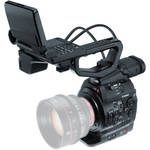
The Canon EOS C300 Cinema EOS Camcorder Body (EF Lens Mount) takes what professionals love about DSLR filmmaking – access to a vast selection of widely available lenses, a large sensor that facilitates a shallow depth of field, and portable operation with a modular, compact camera – and addresses its shortcomings. That means that unlike DSLR cameras, this Cinema EOS camcorder is designed inside and out for professional cinematographers capturing motion pictures that will stand up to rigorous post-production processes.
The EOS C300 features an EF mount for compatibility not only with Canon's existing broad range of DSLR lenses, but also with the burgeoning line of EF Cinema Zoom and Prime lenses. These lenses are designed to match up perfectly with the 3-perf Super 35mm-size CMOS sensor that Canon developed for this camera. Like the camcorder, these lenses (sold separately) were developed specifically for digital cinema, with engraved markings on angled surfaces in meters and feet and uniform front diameters for easy lens switching without having to reconfigure a matte box or follow focus gearing.
The Canon Super 35mm sensor is paired with the Canon DIGIC III image processor, which uses an innovative method of breaking out red, green, and blue data to enable color performance on a level that would otherwise require three separate chips. Recording HD formats to CompactFlash cards as the XF codec – at the highest level a 50 Mb/s, 4:2:2 MPEG-2 format – the C300 records motion video that reduces the jagged edges and Moiré patterns that can plague video with 4:2:0 chroma subsampling and lead to post-production challenges.
Moreover, the files' MXF wrapper brings together video, audio, metadata, and timecode in a package that enjoys robust support from all professional NLE programs. The EOS C300 is designed to capture footage that thrives in the post-production suite. To that same end, the camera also offers Canon's Log gamma mode, which results in excellent tonal reproduction in the highlight and lowlight regions of an image, and a greatly expanded dynamic range.
The exterior of the camera is as unique as its innards. Featuring the expected HD-SDI output, timecode I/O, and genlock input BNCs, the body is a modular creature that can either be stripped down completely, or be built up to host the included handle, 4" rotating LCD unit with full controls, grip, and thumb rest. With accessible buttons and ridges dividing them, the C300 is physically designed not for still photography but for the craft of digital cinema.
| Image Sensor |
1x CMOS sensor, equivalent to 3-perf Super 35mm 24.6 x 13.8mm effective size (6.4 x 6.4µm pixel pitch) |
| Effective Pixels | Approx. 8.29 Mp (3840 x 2160) |
| Total Pixels | Approx. 9.84 Mp (4206 x 2340) |
| Scanning System | Progressive |
| Filter | RGB primary color filter (Bayer array) |
| DSP | DIGIC DV III |
| Lens Mount | EF |
| LCD Screen |
4" diagonal, 1.23 megapixel color 16:9 rotatable LCD 100% field of view Adjust brightness, contrast, color, sharpness, and backlight (normal or bright) A total of 27 display functions can be turned on and off |
| Viewfinder |
0.52" diagonal, color 16:9 LCD, 1,555,000 dots +2.0 to -5.5 diopter eye adjustment 100% field of view Viewing angle can be adjusted up and down 60° A total of 27 display functions can be turned on and off |
| Signal System | NTSC/PAL |
| Compression | 8-bit MPEG-2 Long GOP (Canon XF codec) |
| Color Space | 4:2:2 at 50 Mb/s recording |
| File Format | MXF (OP-1a) |
| Recording Formats |
50 Mb/s (CBR) 4:2:2 422P@HL 1920 x 1080: 59.94i/29.97p/23.98p; 50i/25p; true 24p (24.00) 1280 x 720: 59.94p/29.97p/23.98p; 50p/25p; true 24p (24.00)
35 Mb/s (VBR) 4:2:0 MP@HL
25 Mb/s (CBR) 4:2:0 MP@H14 |
| Recording Media |
CF Card (Type 1 Only): 2x slots (Movie files); UDMA supported SD Card: 1x slot: still images, custom picture data, clip metadata, and menu settings 1 Please Note:Custom picture data and settings are not compatible with data from other Canon models close |
| Recording Time |
With 64 GB CompactFlash (CF) card (greater capacity is possible when both card slots are used):
25 Mb/s: 310 min |
| Audio Recording | Linear PCM; 2-channel; 16-bit; 48 kHz |
| Built-In Microphone | None |
| Audio Inputs |
2x XLR inputs (auto and manual level settings), switchable between mic/line -12, -6, 0, or +12 dB XLR trimming 1x 3.5mm microphone jack |
| Channel Selection | 2-channel recording |
| Recording Levels | -∞ to +18dB |
| Phantom Power | Available: +48V |
| Headphone Output Level | 16 settings; volume is muted at lowest setting |
| Tone | 1 KHz tone available; -12, -18, or -20 dB |
| Focusing System | Manual; autofocus system not available |
| Iris Control | Iris dial located on camera body for use with EOS EF lenses with electronic iris control |
| Exposure Modes | Manual |
| Gain | Manual: Normal setting -6 dB to 30 dB |
| Shutter Modes | OFF, Speed, Angle, Slow Shutter, Clear Scan |
| Shutter Speed |
59.94i/59.94p: 1/60 to 1/2000 in 1/4 or 1/3 stops; SLS: 1/4, 1/8,
1/15, 1/30; CS: 59.94-250.70 Hz 29.97p: 1/30 to 1/2000 in 1/4 or 1/3 stops; SLS: 1/4, 1/8, 1/15; CS: 29.97-250.70 Hz 23.98p/24p: 1/24 to 1/2000 in 1/4 or 1/3 stops; SLS: 1/3, 1/6, 1/12; CS: 23.97-250.70 Hz 50i/50p: 1/50 to 1/2000 in 1/4 or 1/3 stops; SLS: 1/3, 1/6, 1/12 1/25; CS: 50.00-250.70 Hz 25p: 1/25 to 1/2000 in 1/4 or 1/3 stops; SLS: 1/3, 1/6, 1/12; CS: 25.00-250.70 Hz |
| Shutter Angle |
59.94i/59.94p: 360, 240, 216, 180, 120, 90, 60, 45, 30, 22.5, 15,
11.25 29.97p: 360, 240, 216, 180, 120, 108, 90, 60, 45, 30, 22.5, 15, 11.25 23.98p/24p: 360, 345.6, 288, 240, 180, 172.8, 144, 120, 90, 86.4, 72, 60, 45, 30, 22.5, 15, 11.25 50i/50p: 360, 300, 240, 180, 150, 120, 90, 60, 45, 30, 22.50, 15, 11.25 25p: 360, 300, 240, 180, 150, 120, 90, 75, 60, 45, 30, 22.50, 15, 11.25 |
| ISO Range | 320 to 20,000, 1-stop or 1/3-stop |
| Built-in ND Filter | Mechanical ND filter system with option of clear or 2, 4, or 6 stops |
| White Balance | Auto, manual, 2 custom (2000-15,000K in 100K increments), daylight (5400K), tungsten (3200K) |
| Exposure & Focus Aids |
Peaking (2 types), Zebra Pattern, Magnify, Edge Monitor Focus Assist, Black and White Mode
2
Please Note:Zebra can be output via the SDI or HDMI jack (HD only) close |
| Playback |
Index Displays: Index Display, Normal, "OK Mark" Index, "Check Mark" Index, "Shot Mark" Index, Expand Index, Photo Index Clip Playback: Forward Search (5x, 15x, 60x), Reverse Search (5x, 15x, 60x), Forward Frame Advance, Reverse Frame Advance, Record Review, Clip Jump (Forward and Backward), Skip Playback Playback Functions: Inter-Media Copy (Single Clip, All Clips, Last Clip); Clip Delete (Single Clip, All Clips, Last Clip) Still Image Playback: Index, Single Playback, Erasure, Protect |
| Frame Rates |
50 Mb/s: 1920 x 1080 Record Rate: 1-30 fps (Playback Rate: 29.97p/23.98p/24.00p) Record Rate: 1-25 fps (Playback Rate: 50i/25p) 50 Mb/s: 1280 x 720 Record Rate: 1-60 fps (Playback Rate: 59.94p/29.97p/23.98p/24.00p) Record Rate: 1-50 fps (Playback Rate:50p/25p) 35 Mb/s: 1920 x 1080 Record Rate: 1-30 fps (Playback Rate: 29.97p/23.98p/24.00p) Record Rate: 1-25 fps (Playback Rate: 50i/25p) 35 Mb/s: 1280 x 720 Record Rate: 1-60 fps (Playback Rate: 59.94p/29.97p/23.98p/24.00p) Record Rate: 1-50 fps (Playback Rate:50p/25p) 25 Mb/s: 1440 x 1080 Record Rate: 1-30 fps (Playback Rate: 29.97p/23.98p) |
| Interval Recording |
Interval can be set in 25 levels ranging from 1 second to 10 minutes (1/2/3/4/5/6/7/8/9/10/15/20/30/40/50 sec; 1/2/3/4/5/6/7/8/9/10 min)
NTSC 59.94i/29.97p/23.98p/24.00p: Selectable between 1, 3, 6, 9 frames NTSC 59.94p: Selectable between 2, 6, 12 frames PAL 50i/25p/50p: Selectable between 2, 6, 12 frames |
| Frame Record |
NTSC 59.94i/23.98p/24.00p: Selectable between 1, 3, 6, 9 frames NTSC 59.94p: Selectable between 2, 6, 12 frames PAL 50i/25p/50p: Selectable between 2, 6, 12 frames |
| Pre-Record Buffer | 3 sec cache (video & audio) |
| Still Capture | 1920 x 1080 images captured to SD card |
| Custom Picture |
23 custom picture settings A total of nine 9 customized pictures are available in the camera and up to 20 can be saved to an SD card Custom pictures CP7, CP8 and CP9 ship with the following preset: C7: Video.C - Intended for recording media for playback on consumer TVs. The setting minimizes noise in the dark areas and improves contrast by tightening up on black C8: Cine.V - Suited for giving recorded media a film tone C9: Cine.F - Used for when recorded media will be transferred to film |
| Custom Function | 9 total functions available |
| Assignable Buttons | 15; can be assigned from among 30 functions |
| Color Bars | Color bars compliant with SMPTE, EBU, or ARIB standards can be selected |
| Dynamic Range | Up to 800% with Canon Log gamma and ISO 850 (+2.5 dB) and above |
| Minimum Illumination | Full Auto Mode: Not specified by manufacturer Manual Mode: Not specified by manufacturer |
| Illumination Correction | Compensates for each light fall-off of each lens. Lens-specific data stored in firmware |
| Video Outputs |
HD/SD-SDI: 1x BNC (output only), with embedded audio HD 4:2:2 (YCbCr) 1920 x 1080: 60i/50i, 1280 x 720: 60p/50p SD 4:2:2 (YCbCr) 640 x 480: 60i/50i NTSC 480i/PAL 576i: Compliant with SMTPE 259M Embedded Audio: Compliant with SMTPE 272M Time Code Standard: (VITC/LTC) SMTPE 12M HD-SDI: (Compliant with SMTPE 292M) 1080i/720p: Compliant with SMTPE 292M Embedded Audio: Compliant with SMTPE 299M Time Code Standard: (VITC/LTC) SMTPE 12M
Composite: 1x BNC (same as above) HDMI: 1x Type A |
| Headphone Connector | 3.5mm stereo mini-jack |
| Genlock |
BNC (input only) Adjustment Range: -1023 to +1023 |
| Timecode |
BNC (input/output) Drop Frame (DF) and Non-Drop Frame (NDF) Time Code Modes: Regen, Record Run, Free Run, and External Source 3 Please Note:Drop Frame works with NTSC modes only and is not available in 24p close |
| Sync |
BNC connector (output) HD tri-level signal (HD Sync) HD-Y signals (HD-Y) Black Burst signal Composite |
| Remote | 2.5mm LANC-compatible terminal |
| Wi-Fi | WFT terminal for compatible Wi-Fi accessory |
| Power Supply | 7.4V DC (battery pack), 8.4V DC (DC input) |
| Operating Temperature |
Performance: 32 to 104°F (0 to 40°C), 85% relative humidity Operation: 23 to 113°F (-5 to 45°C), 60% relative humidity |
| Dimensions (WxHxD) |
EOS C300 + Thumb Rest: 5.2 x 7.0 x 6.7" (133 x 179 x 171mm) EOS C300 + Grip: 6.9 x 7.0 x 6.7" (174 x 179 x 171mm) Camera + Monitor: 7.3 x 9.8 x 7.4" (185 x 249 x 187mm) Camera + Handle + Monitor: 7.3 x 11.2 x 11.9" (185 x 284 x 301mm) 4 Please Note:Not including lens hood, eyecup, or grip belt close |
| Weight (without Lens) |
EOS C300: 3.2 lb (1.43 kg) Grip: 8.1 oz (230 g) Monitor Unit: 1.4 lb (620 g) Handle Unit: 6.3 oz (180 g) Thumb Rest: 0.35 oz (10 g) BP-955 Battery: 7.8 oz (220 g) Attachment Fitting: 0.32 oz (9 g) 2x CF Cards (not included): 0.63 oz (18 g) Measure Hook: 0.11 oz (3 g) Body Cap, Camera Cover (either type): 0.63 oz (18 g) EOS C300 with Grip, Monitor, BP-955 & 2x CF Cards: 5.6 lb (2.52 kg) EOS C300 with Grip, Monitor, Handle, BP-955 & 2x CF Cards: 6.0 lb (2.70 kg) |
REVIEW SNAPSHOT®
by PowerReviewsPros
Cons
Best Uses
Reviewed by 5 customers
Sort by
Displaying reviews 1-5
Pros
Cons
Best Uses
Comments about Canon EOS C300 Cinema EOS Camcorder Body (EF Lens Mount):
When Canon announced the C300, I'll admit I was on the fence, debating between this and a Scarlet. On paper, the Scarlet is the clear winner. Then in February I was invited by Canon to go to a C300 showcase they were having here in MN, and wow! After seeing four short films that were shot on the camera, I was sold. On the big screen they looked incredible, and when you factor in the amazing low light capabilities of the camera, it really knocks everything's else out of the ring. I got my first one two weeks ago now, and I love it! If you have any doubts, just go for it. You won't be let down.
Pros
Cons
Best Uses
Comments about Canon EOS C300 Cinema EOS Camcorder Body (EF Lens Mount):
This camera lives up to the hype. I've used it on 3 doc shoots so far and a day of lit interviews, and the images it puts out have been awesome. I've pushed the ISO to 5000 without seeing obvious detriments. 10,000 may be as far as I'm comfortable, I feel anything higher is for emergencies only. The 24-105mm IS lens covers action fine running and gunning, and the 70-200mm is great for interviews. Color and contrast reproduction are very accurate and forgiving of slightly mixed color temps. Canon Log indeed allows for impressive dynamic range, and can be corrected with FCP filters if you don't have time to take it into Color. The 50Mbps compression actually looked slightly cleaner in tests than ProRes recorded to an external recorder, which suggests to me a great internal processor. Don't think that this is a noise-free camera. It's not noise-free, but it is true that the noise is fine and granular, and (like film grain) is much more pleasing to the eye than what we're used to from video cameras. Plus there are none of the blocky compression artifacts. I saw no moire/aliasing in any of my shoots, which was great. There is still some jello wobble when the cam is in motion, but not as bad as the 5DMII.
A few small negatives: balance was not fully thought out because when you put a shotgun in the mic holder, the camera tips over (when a Manfrotto plate is on the cam and you put it down). Also, you have to enter the menu to route mic inputs to channels - on many cameras that is quickly and easily done via external switches. And lastly, the control dial on the body is tied to the control dial on the handgrip. Were they separately programmable, you could control iris with one and ISO with the other. Something to work into a firmware upgrade, Canon.
Pros
Cons
Best Uses
Comments about Canon EOS C300 Cinema EOS Camcorder Body (EF Lens Mount):
In repose to the review posted by the person that reviewed the camera without using it. according to tests done by the ASC. A panel of career cinematographers were unable to tell the difference between 5k and 2k. To put in in simple terms, the human eye cannot physically tell the difference between the two. So unless you plan on animating a million orcs, or painting all the actors faces blue, or transform cars in to dancing robots there is no reason to shoot in 5k. And if you do have the time and money to work on a project that requires 5k usually some one else is paying and you rent an ALEXA. For the rest of us who use cameras we own everday on a varity of projects, built in ND and compact flash cards are pretty convenient.
Pros
Cons
Best Uses
Comments about Canon EOS C300 Cinema EOS Camcorder Body (EF Lens Mount):
Overall I was more impressed with this camera than I thought I would be. I went into it thinking "why not 4k?" But some of my favorite cinema camera's on the market are 2k or below (arri alexa, Sony F3). The menu's are going to be really familiar to those who have used canon's xf camcorders. Within 10 minutes I knew everything needed on how to control it.The iso performance on this guy is a beast I don't think there is even the closest competition at the moment. Comparing it to the F3, C300 is significantly lighter than the F3 for portability and hand held.My only complaint about this unit is the fact that at [$] I would love 10bit 4:4:4. I recommend this camera to those looking for cinema quality and performance under the $18k price tag.And for those ready to compare this to the scarlet feel free to do so.....when you get it two years from now.
Pros
Cons
Best Uses
Comments about Canon EOS C300 Cinema EOS Camcorder Body (EF Lens Mount):
I'm a Red lover, but let's be fair here.
The Scarlet doesn't record at 5K - only a 12 frame burst for photographic possibilities. It does shoot 4K, but only up to 30 frames.
This camera has 48 bit to 8 bit conversion which still looks very good.
Noise level is exceptional. While it is only 1080P, for most tv doc guys etc., it'll be quite nice. The editing workflow of this camera works just as well as the previous XF series which it is was based on.
They both share the same lens system, but enough said.
While I don't agree with the price point of this camera (it should have been closer to $12,000), this seems like a nice camera system and I will use it.
Displaying reviews 1-5