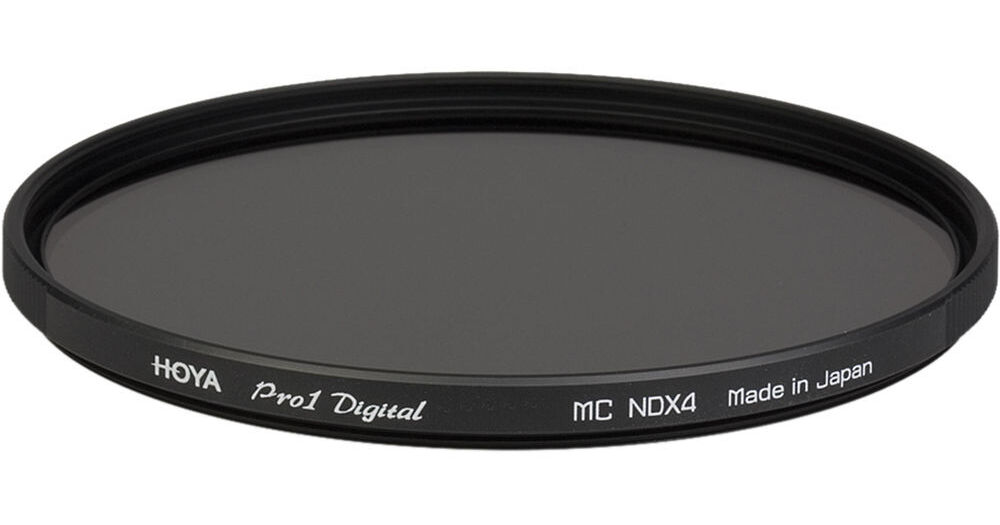
The Hoya 55mm Neutral Density (ND) 0.6 Pro 1 Digital Multi-Coated Glass Filter has several uses, and offers the possibility to achieve otherwise unachievable results. ND filters appear grey, and reduce the amount of light reaching the film. They create a darkening of the entire image, allowing you to photograph with a wider aperture or slower shutter speed without overexposing your image. By slowing your exposure time, you can create motion blur for special effects or to convey a sense of movement. Opening your iris allows you to create shallow depth of field, which can help isolate your subject. ND filters have no effect on color balance.
Note:
Pro 1 Digital filters are ultra thin, but have a front thread.
Digital Multi-Coated
Digital multi-coated filters greatly reduce the appearance of lens flare and ghosting caused by reflections
Black Almite Frame
Filters feature a black matte aluminum, satin-finish almite frame, which reduces reflections
Black Rimmed Glass
These filters are equipped with black-rimmed glass to reduce the chance of light reflecting off the edge
Low Profile Frame
Ultra-thin filter frames, which help to avoid vignetting on super wide angle lenses, are also designed to hold a lens cap
Knurling Edge Frame
These filters are equipped with a straight knurling edge for non-slip, easy attachment and removal
UV Protected Case
Filter cases are UV protected, which further lengthens the life of filters
Neutral Density Filters have four main uses:
- To enable slow shutter speeds to be used, especially with high-speed films, to record movement in subjects such as waterfalls, clouds, or cars
- To decrease depth-of-field by allowing wider apertures to be used, which helps to separate subjects from their background
- To decrease the effective ISO of high-speed film (above ISO 400), and allow it to be used outdoors in bright situations
- To allow cine and video cameras (which have fixed shutter speeds) to film subjects such as snow, sand or other bright scenes, which could cause overexposure
Neutral Density Factors
- 2x = ND 0.3 (exposure adjustment = 1 stop, reduces ISO 1/2)
- 4x = ND 0.6 (exposure adjustment = 2 stops, reduces ISO 1/4)
- 8x = ND 0.9 (exposure adjustment = 3 stops, reduces ISO 1/8)