We are not accepting orders at this time. Online ordering will resume Monday, May 28th at 9:45PM EDT. Our SuperStore and offices are currently closed and will reopen on Tuesday, May 29th at 9:00AM EDT.
We apologize for any inconvenience and appreciate your patronage.
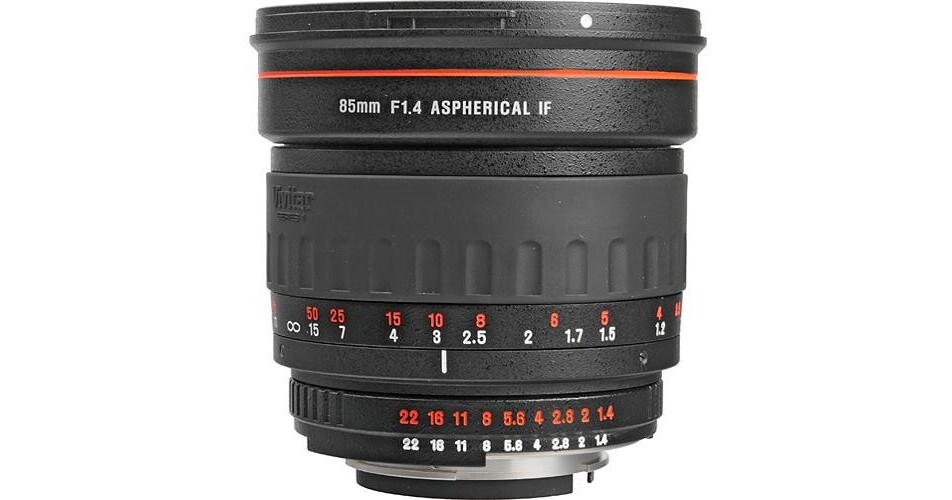
The Vivitar 85mm f/1.4 Series 1 Manual Focus Lens is an ultra-bright lens with a maximum aperture of f/1.4. Although you can only use this lens in manual focus mode, it is fully compatible with the automated features available with digital SLR cameras. It is compact and lightweight, and offers the ideal focal length and bright aperture for use as a portrait lens.
| Performance | |
|---|---|
| Focal Length | 85 mm |
| Aperture |
Maximum: f/1.4 Minimum: f/22 |
| Camera Mount Type | Nikon F |
| Format Compatibility |
Nikon FX/35mm Film Nikon DX |
| Angle of View |
28.3° APS-C Picture Angle: 18.8° |
| Minimum Focus Distance | 1' (30.48 cm) |
| Magnification | 0.08x |
| Maximum Reproduction Ratio | 1:12.5 |
| Groups/Elements | 7/9 |
| Diaphragm Blades | 8 |
| Features | |
|---|---|
| Image Stabilization | No |
| Autofocus | No |
| Tripod Collar | No |
| Physical | |
|---|---|
| Filter Thread | 72 mm |
| Dimensions (DxL) | Approx. 2.80 x 2.99" (7.11 x 7.59 cm) |
| Weight | 2.00 lb (907 g) |
REVIEW SNAPSHOT®
by PowerReviewsPros
Cons
Best Uses
Reviewed by 4 customers
Sort by
Displaying reviews 1-4
Pros
Cons
Best Uses
Comments about Vivitar 85mm f/1.4 Series 1 Manual Focus Lens:
I took delivery of this suprise package from B+H just a few days ago and have just completed my initial testing and first portrait job with this remarkable lens. This lens is absolutely tack sharp and renders colors faithfully and in fact, actually outperforms many of what I thought were my best f2.8 pieces of Nikon glass. This lens will resolve every single hair and even the slightest detail when used on high resolution FX and DX Nikon bodies. Focus is precise and accurate, a precision that reminds me of Zeiss and Leica optics and can be uncomfortable to get used to as any softness is a weakness in your discipline and ability. Autofocus is a waste of time in the application I use it in so is not a consideration Build quality is equivalent to my f2.8 Nikon lenses costing thousands, like a tank, but smaller and lighter than the Nikon f1.4 The aperture ring can be a little awkward being small diameter and width and so close to the camera body but you get used to it pretty fast and the work simply flows.
Lens was purchased for use where the risk of damage is high, better to lose a cheap lens than a couple of grand. After using this lens, loss is not acceptable and it is now considered a mainstream part of my kit!
Pros
Cons
Best Uses
Comments about Vivitar 85mm f/1.4 Series 1 Manual Focus Lens:
Believe or not, I bought this lens for my Panasonic GF1, with an adapter, this lens really shines. It produces edge to egde sharpness on the entire image even at wide open, stop down to 2 or 2.8, it even beats my expensive Nikon glasses. I pushed the envelope a little bit more last week, attached it to a Nikon TC201 to shoot an indoor school concert, sat at 5th row, 20 feet from the stage, handheld, and the results really impressed me. Since there is no fast telephoto MFT lens available, this lens is a must have for low light condition photography. I don't recommend it for sports and wildlife since manual focusing is very hard on this lens because of the extreme shallow DOF. Also, use it with a EVF for better results. Lens is on the heavy side comparing to the small body, but I was use to the weight of nikkor 80-200mm f2.8, so that is not the problem for me. With this price tag, this is a no brainer.
Pros
Cons
Best Uses
Comments about Vivitar 85mm f/1.4 Series 1 Manual Focus Lens:
If you're in the market for a Nikon F-mount 85mm lens, you have many choices, over a truly wild price range:* $1700 gets you Nikon's flagship 85mm f/1.4G ([...]);* $1000 gets you Nikon's older 85mm f/1.4D, Sigma's new 85mm f/1.4 HSM, or Zeiss's 85mm f/1.4 planar;* 450 gets you Nikon's old (but well regarded) 85mm f/1.8D* [$] gets you this (or its Rokinon, Bowar, Polar, ProOptic branded cousins--they're all made by Samyang optics).And let's not forget that in many ways, much of what gets done by an 85mm prime can be just as well accomplished by a pro f/2.8 telezoom--say Nikon's own $2400 70-200 VRII, or its $1000 80-200 f/2.8D.Choices, choices. How to narrow it down--and why have I put the Vivitar on top?If you can buy only one lens and you're comparing 85mm f/1.4 or f/1.8 primes with pro f/2.8 telezooms, there's no contest: the pro telezooms are far more versatile tools. And both of Nikon's offerings are mechanically excellent and optically superb all the way to f/2.8--there's no real optical advantage to shooting one of these primes at comparable apertures. (The primes are lighter and a bit more economical with your bag space, though with hoods deployed, perhaps less than one might suspect.)That said, there's sometimes no substitute for the incredible subject isolation and bokeh 85mm can deliver at wide apertures. This special effect is something the telezooms can't quite deliver. Nor, by the way, can the Nikon 85 f/1.8D--at least not in the same league as the f/1.4 offerings.In narrowing down the 85mm f/1.4 choices, if you were presented with a group of portrait shots from these competing lenses, all shot at f/1.4, would you be able to tell which lens shot which portrait?I approached this question with a scouring of Flickr, and I came to a profound conclusion: *no*!In fact, the more images I reviewed from this group of lenses, the more I noted that simply hitting or missing the focus at the razor-thin 85mm f/1.4 depth of field made the most discernible difference in image quality. And I noted something else: the autofocus lenses--the Nikkor 85G, 85D, and Sigma--tended not to have more sample images in focus than the Zeiss or the Vivitar (Samyang). Quite to the contrary: the Zeiss and Vivitar groups had a far better "hit" rate.Really, I'd known this before--that tack-sharp portraiture with an 85mm f/1.4 shot wide-open is a manual focus activity best performed with your camera's Live View zoomed into your target so that you can actually see your focus. AF--even the $1700 Nikon 85mm f/1.4G's AF--just isn't good enough on most bodies.If you're still with me, then you can already see why the Vivitar is a complete no-brainer purchase: it has optical quality you can't distinguish from the competition costing $1400 (!!!) more, and it isn't any less convenient to use for its intended purpose. Honestly, the Bokeh might be the smoothest of the bunch. Maybe the 85G (or others) start to pull away from the Vivitar at narrower apertures? Who knows: I didn't buy an 85mm f/1.4 to shoot at f/8.How about build quality? Honestly, the lens itself appears constructed with the same internal focus design and engineering plastic-over-metal substructure that Nikon uses with the 85G. Plastics are the same solid, dappled-texture as the 85G's. Weight and "feel" is the same. The focus ring throw is *superb*--well dampened, smooth, even. The aperture ring clicks with authority--also smooth and even. It's an absolute pleasure to use. My only gripe: the front and rear caps, which are cheesy and side-pinched (as if from the Canon FD school of thought), so the $1400 Nikon premium gets you more, there. Just get a pair of Nikon caps to go with it.In any case, if you go shooting portraits with this among friends that splurged for any of the other 85s on this list, they will hate you quickly. You'll have images that are at least as sharp and smooth, but you'll also have more than $1000 in your pocket.
Pros
Cons
Best Uses
Comments about Vivitar 85mm f/1.4 Series 1 Manual Focus Lens:
I use this lens with the Letus Extreme adapter.
Displaying reviews 1-4