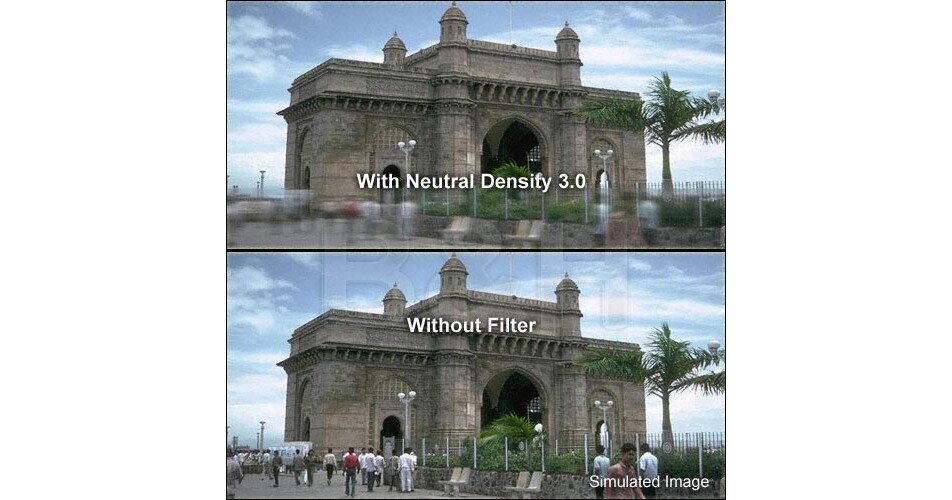
A B&W 67mm #110 Neutral Density 3.0 Filter has several uses and offers the possibility to achieve otherwise unachievable results. ND filters appear gray and reduce the amount of light reaching the film. They have no effect on color balance.
Neutral Density filters enable the shooter to adjust exposure without affecting color balance. ND filters appear gray and reduce the amount of light reaching the film. Neutral density filters are available in 1, 2, 3, or 4 stops to suit individual situations.
Determining which neutral density filter yields ideal results for any given lighting situation takes knowledge, experience and a collection of such filters. Speaking generally, the 2-stop value (ND 0.6) effectively compensates average situations.
The filter ring is made from brass yielding a stronger product. Brass filter rings are also less prone to jamming. In addition, the seal between the glass and filter ring is exceptionally strong giving the filter added strength and durability. The excellent Schott Glass used in the manufacturing of this filter is legendary and synonymous with the highest standards of filter production. It comes with a solid 10-year warranty.
The reputation of B+W's Schott glass is world renowned. The high production standards combined with a sturdy brass filter ring make B+W filters hard to beat. These filters have a "heft" to them that is impressive. They may feel heavier but the benefit is in the construction and results. Not only is the glass exceptional but so is the seal between the ring and glass. Schott Glass used in the manufacture of this filter is legendary and synonymous with the highest standards of filter production. It comes with a solid 10-year warranty
| Type | #110 Neutral Density |
| Size | 67mm |
| Grade | 3.0 (exposure adjustment = 10 stops, transmits 0.1% of light) |
| Filter Factor | Approx. 1000 |
| Multi-Coated | Not Applicable |
| Rotating | Not Applicable |
| Effect | Reduce the amount of light reaching the film |
| Application | To use high speed films in bright sun |
| Color Temperature | No change |
| Construction | Schott Glass |
| Front Filter Thread Size | 67mm |
| Front Lens Cap Size | 67mm |
REVIEW SNAPSHOT®
by PowerReviewsPros
Cons
Best Uses
REVIEWS
Reviewed by 9 customers
Sort by
Displaying reviews 1-9
Pros
Cons
Best Uses
Comments about B+W 67mm #110 Neutral Density (ND) 3.0 Filter:
The ND 3.0 filter is used to dicrease the light so you can take pictures with long exposures in daylight. Therefore, water will look foamy or misty while everything that doesn't move will be perfectly clear.
Everything is top quality as we expect from a leading brand as BW, optically and mechanically.
Comments about B+W 67mm #110 Neutral Density (ND) 3.0 Filter:
This is a good-quality ND filter. Thanks to the fact that it is very dark, you can achieve long-exposure shots in the middle of the day. Be aware, however, that you cannot see through the viewfinder once you've attached the filter (due to how dark it is).
Pros
Cons
Best Uses
Comments about B+W 67mm #110 Neutral Density (ND) 3.0 Filter:
Truly a great filter. I've been very happen with the results shooting along the ocean and movement of clouds. The other reviews are right about a magenta hue on your images, but that's any fix in the digital world. I find it pretty easy to screw on and off, so that's no problem at all. ... I'm excited about the ideas I have for it in the future.
Pros
Cons
Best Uses
Comments about B+W 67mm #110 Neutral Density (ND) 3.0 Filter:
I recommend to everyone who would like to add wonderful effect to their works.
Due to you can not see antything after fixing this filter on your lens it is better to adjust your camera in aperure priority mode without filter. then change the settings to manual focus and manual exp mode. calculate shutter speed 10 times slower than your first value. you need cable and good tripod of course.
you will satisfy with the results:)
Pros
Cons
Best Uses
Comments about B+W 67mm #110 Neutral Density (ND) 3.0 Filter:
I use this filter for long exposures for seascapes. It gives me a beautiful, silky surface. I'd like to try it on a field of waving grass, but I live in an urban area, so that will have to wait.
The only downside, is that the filter is really dark, and you have to take it off the camera, frame your shot, and put it back on. It's a pain, but the result is worth it.
I read that this filter is designed for taking pictures of molten steel and sun spots. I don't do much of that work, but I sure have fun with it taking pictures of water and sunrises. I'm thinking of getting a couple more for my other lenses.
Pros
Cons
Best Uses
Comments about B+W 67mm #110 Neutral Density (ND) 3.0 Filter:
I researched for a while on what neutral density filter i wanted to buy, and what strength. If you are looking to do extra long exposures during the day this filter is perfect. i can get at least 30 second exposures in the middle of the day! i was worried it might be a bit too strong, but it ended up being perfect, i could even go stronger if i really wanted to. this is a great filter i would recommend to anyone who likes to do long exposure photography, i love it especially for seascapes. also the construction is fantastic, which is what i have come to expect from b+w. any other brand of filter seems flimsy in comparison to these fantastic filters
Pros
Cons
Best Uses
Comments about B+W 67mm #110 Neutral Density (ND) 3.0 Filter:
This is the best lens filter I have so far !!!
Pros
Cons
Best Uses
Comments about B+W 67mm #110 Neutral Density (ND) 3.0 Filter:
I use this filter to get long exposures in bright light. Great for removing people from a location, as long as they are moving.
Pros
Cons
Best Uses
Comments about B+W 67mm #110 Neutral Density (ND) 3.0 Filter:
I bought this filter to take long exposures during brighter hours of the day and, to that end, it works wonderfully. I'm able to take 30 sec. or longer exposures in the middle of the day and I get the effect I'm after.
It's a B+W filter, so you get great construction and consistent effect from the center to edge of the shots.
There is no real downside the lens, per se. It does what it's designed to - block out light - my D80 has a hard time auto-focusing with such little light hitting the sensor, so I'm forced to either focus manually (which is almost impossible with the filter on) or auto-focus with the filter off and attach it after focus is acquired. Again, no fault of the filter, itself.
Displaying reviews 1-9