
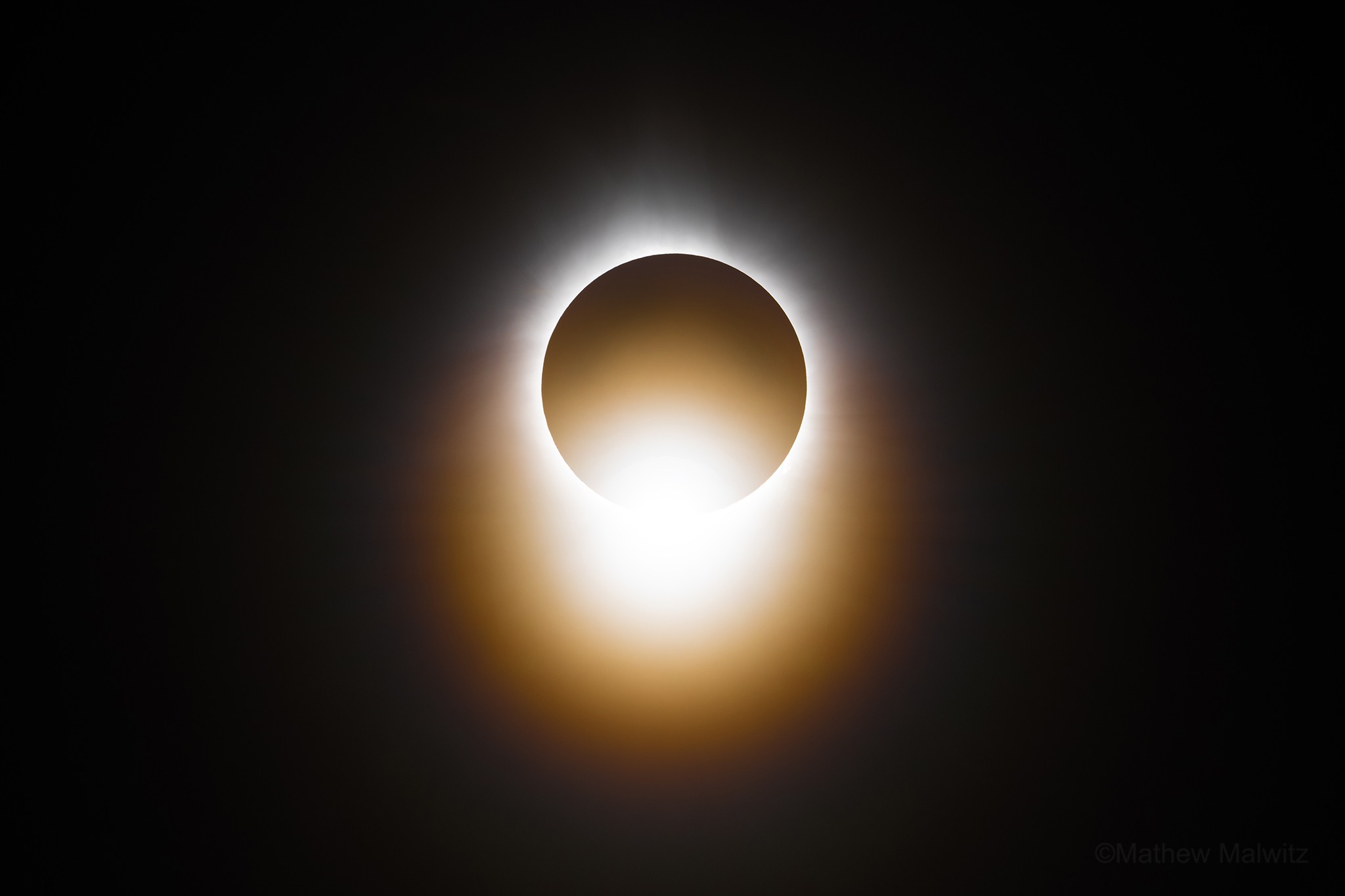
Solar eclipses are awesome spectacles of nature that are irresistible to photographers. Besides eclipses, the star at the center of our solar system is an amazing photographic subject—even when it is not being partially or totally blocked by the moon. If you want to photograph a solar eclipse, or just photograph the source of our fragile planet’s warmth and light, you need a solar filter for your lens. Let’s look at the different options available to photographers.The challenge when pointing your camera directly at the sun is that the bright, focused light from the sun can burn a hole straight through your shutter blades. Not ideal to say the least.
If you want to photograph a solar eclipse or just photograph the source of our fragile planet’s warmth and light, you need a solar filter for your lens. Let’s look at the different options available to photographers using mirrorless or DSLR cameras.
Above Photograph © Mathew Malwitz
Safety
Before we begin…
WARNING!
Do NOT look through the OPTICAL VIEWFINDER of a camera when the lens is NOT protected by a filter that is specifically designed for SOLAR VIEWING.
Do NOT wear solar observing glasses and look through the OPTICAL VIEWFINDER of a camera when the lens is NOT protected by a SOLAR VIEWING filter.
These warnings are for OPTICAL VIEWFINDERS and do not apply if you are using a mirrorless camera’s electronic viewfinder, digital camera LCD screen, or Live View on the LCD screen on a DSLR.
All solar filtration, with the exception of H-Alpha filters and drop-in solar filters, should be mounted at the front of the camera’s optical system. If using an H-Alpha or drop-in filter, an IR/UV Cut filter at the front of the lens is recommended.
For more solar viewing and solar eclipse safety tips, please click here.
Types of Solar Lens Filters
Solar Neutral Density Filters
ND filters simply darken an image. The advent of mirrorless cameras and has made the ND filter one of the most viable tools for solar photography, so long as you’re using an electronic viewfinder or rear LCD screen. You can use these on an older DSLR, but DO NOT use the optical viewfinder.
For solar photography, you should use, at the minimum, a 15-stop ND filter, though these come in values up to 20 stops. Photographers often ask if they can stack multiple less-than-15-stop ND filters to create a single 16-stop+ setup. The answer is, “Yes.” But, for every piece of glass you place between the sun and your lens, image quality gets degraded. We recommend using a single 16-stop+ ND filter for, and we repeat, NON-OPTICAL viewfinder solar photography.
NiSi’s Solar Filter Pro Nano UV/IR Cut ND offers 16.5 stops of darkening while delivering additional protectional via the UV/IR cut design. This is sometimes added to solar-viewing setups to help reduce the amount of UV or IR radiation that reaches the H-Alpha filter and camera sensor to improve sharpness and detail retention.

Additionally, NiSi offers both square and magnetic filter types for varying shooting situations. Both of these systems better suit landscape shooters or those who quickly wish to change out or remove some filtration while keeping other photography filters, like a circular polarizer, in play. The JetMag Pro 82MAG FS Solar filter maintains many of the traits of the standard UV above, but with the added advantage of swapping it out quickly.

Square solar filters, like their mainstream square photo filter compeers, require a special filter holder to secure them in front of the lens. If you already have a square filter system, adding square solar filters to your quiver might make good sense. Haida’s 20-stop Red Diamond Filter provides a substantial light reduction with an antireflective nano coating on both sides; plus, it’s relatively inexpensive and shows no significant color cast.
Universal Solar Filters
At first glance, these filters don’t look like heavy hitting photography equipment. They’re inexpensive, typically made of cardboard, and they might just be the best purchase you make for your solar viewing. What makes these filters especially practical is their universal design, which allows them to fit camera lenses, binoculars, and scopes, depending on size of course.
The cardboard only accounts for the holder, with Thousand Oaks SolarLite film being the real star of the show. As one of the industry’s’ most highly regarded films, Thousand Oaks Solar Film blocks 99.999% of visible sunlight, plus 100% of harmful IR and UV radiation, all while meeting the required light transmission requirements for photography.
The Solar ND filters mentioned above are designed for specific filter thread diameters, whereas DayStars Universal Filters are available in sizes ranging from 50mm to 109mm external diameter. This is the perfect solution for those looking to travel light or needing to accommodate multiple lens sizes or multiple optics (telescopes, camera lens, etc.). Just be aware that some vignetting may occur with lenses pushing the maximum diameter in the filter’s size range.

Film Solar Viewing Filters
Solar film, like that made by Mylar® is advantageous choice. But wait, did we hear that right? Mylar, the polyester film that has dozens of uses, from wrapping Pop-Tarts to insulating spacecrafts to party and large balloons to… solar photography? Yes, their specialized solar film is quite common in photography filters and solar glasses alike. Mylar® film solar filters are perfect for solar photography and solar viewing with a telescope.
The solar film solution can be used in a myriad of ways, either by cutting an ample sized piece from an individual sheet and jerry rigging a custom frame (we’ve seen it done) or by purchasing a specialized holder like those made by MrStarGuy. These can be found in lens thread diameters of 52m up to 95mm in both natural light and white light filter types.

When shopping (or owning) a filter made with solar film, you will see that the surface of the filter may be wrinkled. To a photographer, photographing through a non-uniform surface seems like a horrible idea, but these particular wrinkles will NOT affect image clarity, and they are intentionally engineered into the film to reduce distortion.
Stay Safe
The opportunity to photograph a solar eclipse is one to be cherished. That said, it’s imperative that you remain vigilant and stay safe while doing it, as any misstep, and you and/or your gear can suffer preventable consequences. Remember to wear your eclipse glasses when viewing with the naked eye and keep your gear safe by using one of the aforementioned photography filters. In case we didn’t say it enough, watch those optical viewfinders!
This has been an equal parts filter guide/ what not to do when photographing solar eclipses guide. We hope you’ve enjoyed and take away some important info to help you photograph the next solar eclipse. If you’d like to learn more about filters and all things photography, check out our other guides and articles on the B&H Explora site!
