
Have you ever wondered how B&H manages to sell fresh rolls of film in spooled sizes that were discontinued by Kodak (and everybody else) 20 years ago? Me too; so when I found out we were purchasing the film from one of, if not the last guy re-spooling film for long-gone film formats, I knew I had to meet him.
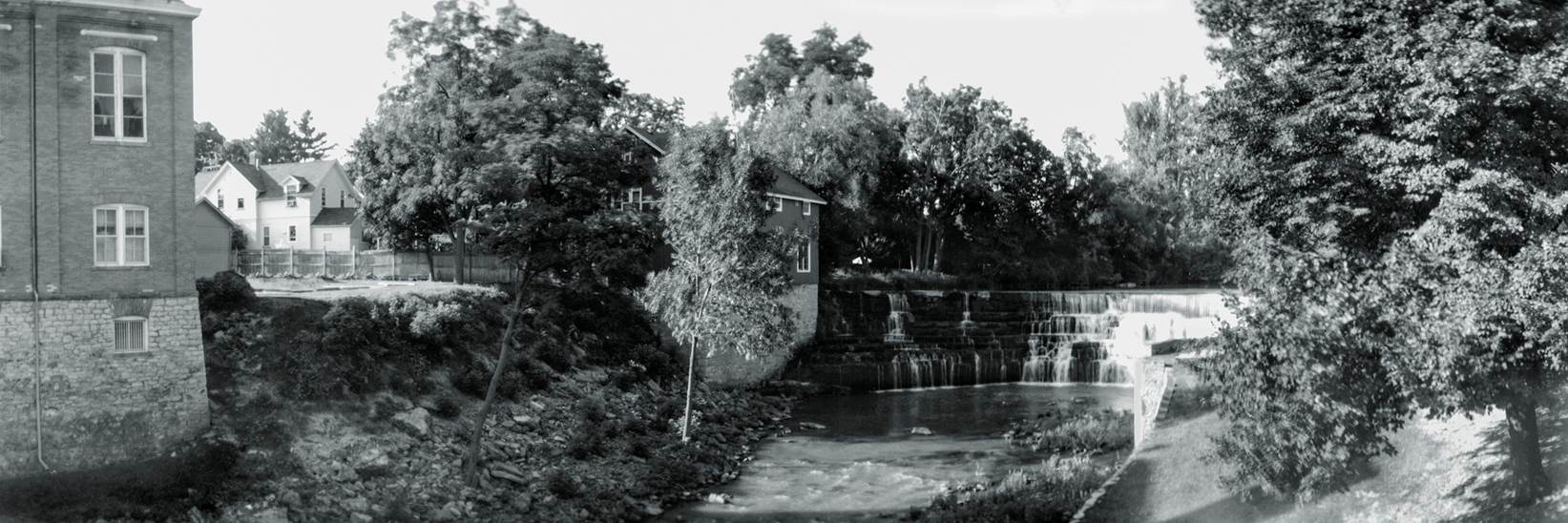
Honeoye Falls (pronounced HON-ee-oye) is located about 20 minutes outside Rochester, New York, the birthplace of photography in the United States. A block off the main drag—just across the river that meanders through town—sits a former saw mill, dating back to 1815. Stream-powered by the waterfall that flows alongside the structure, the original mill burned to the ground in 1845, was rebuilt, and continued as a sawmill until 1920, when it transitioned into a gypsum mill.
In later years, the building housed a successful heating and plumbing supply shop, and a cabinet manufacturer. After being purchased by Dick and Joan Haviland, in 1999, it ultimately became a combination living space and the home of Film for Classics.

A Milwaukee native, Dick Haviland started taking pictures when he was about 12 years old. He was crowned the official family photographer because he was the only one who could take a picture without cutting everybody’s head off. He remained photographically active through high school, where he photographed sporting events and other school activities.
During his college days, Haviland’s interest in photography gave way to an alternate career path, but even as a Professor of Speech Pathology at the State University at Geneseo, New York, he maintained an ongoing interest in the medium.
In 1987, on the occasion of the 100th anniversary of Kodak, he was at a meeting of the Photographic Historical Society when the Society’s president, Robert Navias, urged everybody in attendance to take up a photo-related project to mark the occasion.
Accepting the challenge, Haviland decided he was going to kick-start production of discontinued film formats, including 620, 828, 116, 616, 122, and 127. Despite being advised by veteran “Kodakers” against throwing his hard-earned cash into a logistical and technical nightmare, Haviland started Film for Classics.

In 1990, Haviland was able to talk Kodak into selling him rolls of opaque backing paper that he could cut to size. Lacking a truck and forklift, his contact at Kodak arranged to have “the boys” deliver the rolls to his shop. The good news was that, because they couldn’t figure out a way to bill him personally, he could have the paper free of charge. The bad news was that this most likely would be the last roll he would receive, since Kodak would no longer be making backing paper for medium-format roll films.
He was fortunate to find a firm in nearby Rochester that could precisely slit the backing paper to size, along with a local screen printer who could print the backers using artwork Haviland designed for the project.

Early on, Haviland sold film directly to individuals, but over time he found it difficult to keep up with orders. His wife Joan suggested he limit sales to a handful of established dealers, which simplified things and returned the concept of free time to his life. He currently works with three dealers across the country, the largest being B&H, which Haviland readily credits for driving his business over the years.
The Havilands’ process starts with obtaining large rolls of 46mm to 5-inch-wide film from Kodak and Ilford. Working in the dark, the film is cut to the proper lengths and widths for each respective film type. From there it is matched to a precut paper backing, wound onto a spool, wrapped in foil, and labeled which type of film it is, the format size, and an expiration date.

With the exception of cutting the large rolls of film down to size, much of the process takes place in a dark box, making it possible to work in standard room light. Depending on the format, about 10 to 15 rolls of film can be cut, spooled, and labeled per hour.
Nostalgia plays an important role in Haviland's business. Many of his customers purchase his film “to see if that old camera my Uncle Joe gave me when I was 10 still works.” Other inquiries are far more interesting.
The Chicago Field Museum once placed a large order for 122-format film for a Kodak 3C Folding camera the museum had used decades earlier on a research mission, to Machu Picchu, in Peru. The museum was planning on returning to Machu Picchu and wanted to use the same camera from the original venture. Film for Classics filled the order.
Another time, Haviland had a request for 127-format film from an individual whose uncle had fought in Europe during World War II. This soldier was a photo enthusiast who documented what seemed to be every street corner he visited, accompanied by copious notes as to when and where each photograph was taken. Decades later, the nephew planned on retracing his uncle’s footsteps using the photo diary and the very same camera used to photograph Europe during the war.
Washington, DC-based photographer and folk artist William Christenberry ordered batches of 620-format color film for an older camera he used to document the neighborhoods of his youth as they changed over the course of the years.

Haviland readily admits it’s getting harder to carry on with business, mostly due to the increasing scarcity of raw materials. Kodak has dramatically cut back on film production and availability, and Ilford is down to a single production run per year to supply obsolete film widths for those who still “roll their own.”
He occasionally gets calls out of the blue, from people in possession of surplus rolls of obsolete film they no longer need that they are looking to unload. A retired photographer in Chicago once called about ten 500-foot rolls of Panatomic X fine grain black-and-white film that was stowed away in his freezer. The film hadn't been made for years and Haviland was more than happy to take it off his hands.

Many of the supplies, such as backing paper and film spools, are becoming increasingly difficult to acquire. Kodak halted production of backing paper years ago, and third-party paper backings are not as reliable. Given these challenges, Haviland invested in an injection-mold machine that enables him to replicate increasingly hard-to-obtain metal spools in plastic. With the exception of Kodak Medalist cameras, which seem to prefer the original metal spools, the injection-molded spools have proved to be camera-worthy.
Despite the growth of digital imaging, interest in film photography and older cameras has gained momentum and, although this seems to have peaked about three years ago, according to Haviland, film sales have held their own since.
Films and formats currently available from Film for Classics include Kodak Tri-X, T-Max 100, T-Max 400, Portra 160, Fujifilm Provia 100f, and Fujifilm Velvia 100F in 620 format, as well as Kodak Tri-X and Portra 400 in 828 format. Ilford HP5 is used for 127-format film, and an occasional run of 116- and 616-format film.
At this point in time, the Havilands outsource most of the film-cutting, backing-paper prep, and spooling work to other individuals in the area. As for the future, Dick Haviland would be delighted to pass the baton to someone possessing the drive and enthusiasm he had when starting Film for Classics 25 years ago. “I’m truly pleased it has lasted as long as it has, and if it collapsed tomorrow, it wouldn’t owe me anything,” he says.
Have you had any experiences using cameras with hard-to-find, older film formats? Share them in the Comments section, below.
