
Stealing the hearts and minds of photographers everywhere are mirrorless cameras, now emboldened with a series of fresh releases that have elevated their stature into the professional realm. This has made them prime targets for photographers new and old, with dreams of picking up a new camera soon. Here is a quick list of what B&H customers want most from the mirrorless world.
Sony Alpha a7S II

The most recent full-frame model from Sony, and a much-anticipated update, the Sony a7S II adds internal UHD 4K recording, S-Log3 gamma, and a Display Assist function that take the already excellent video-centric model to a new plateau. Also, it continues to leverage the low-light capabilities of the 12.2MP CMOS sensor for sensitivities up to ISO 409600, and manages to squeeze in both 5-axis in-body stabilization and an upgraded AF system with 169 contrast-detect AF points.
Sony Alpha a7R II

Revolutionary in so many ways, the Sony a7R II took mirrorless a step further, with a world’s-first full-frame back-illuminated sensor that packs 42.4MP resolution, a 399-point phase-detect AF system, and the ability to hit ISOs up to 102400 into a relatively compact camera. It also upgraded the video features of its predecessor in a major way by adding internal UHD 4K recording and the S-Log2 Gamma. Lastly, the a7R II redesigned the body with a more natural shutter release, a heftier grip, and an incredible EVF with a 0.78x magnification, as well as 5-axis in-body image stabilization.
Panasonic Lumix DMC-GH4
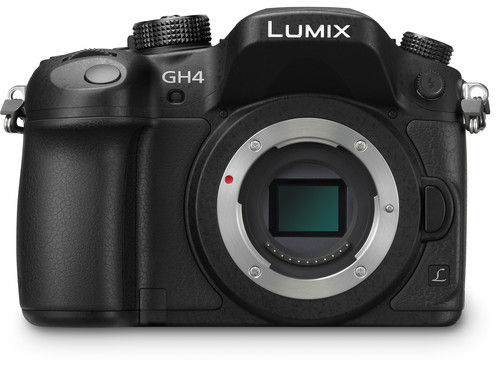
Arguably the most well-rounded Micro Four Thirds camera available, the Lumix DMC-GH4 appeals to both videographers and photographers by offering fast 16MP still imaging, as well as internal DCI 4K video with an ergonomic, yet portable design. Tried and true, the GH4 stands as one of the most reliable and well-put-together systems, benefitting from the plethora of available Micro Four Thirds glass and accessories, such as the YAGH Interface Unit, which adds to the GH4's recording capabilities.
Sony Alpha a7 II

Lacking the fanfare of its two companions, the Sony a7 II is still a very compelling full-frame option for those looking to delve into the mirrorless market, especially due to its well-rounded feature set and more affordable pricing. This model also became the first full-frame mirrorless with 5-axis in-body image stabilization and redesigned a7-series body, for more ergonomic control. The a7 II also finds a balance between the other a7 options, offering middle-of-the-road 24.3MP resolution, with Fast Hybrid AF, and great Full HD video capabilities.
Sony Alpha a7S

Managing to hold its own, even with a newer model just out, the original Sony a7S is a spectacular low-light stills and video camera that, while lacking the latest tech, still manages to offer capabilities unmatched by anything except its direct successor. Known for its astounding maximum ISO of 409600, the 12.2MP a7S is perfect for those shooting in difficult conditions and with minimal lighting. Also, the optimized resolution results in superb internal Full HD video capabilities, as well as the ability to output UHD 4K video with no pixel binning to an external recorder.
Sony Alpha a6000

At the top of Sony’s APS-C lineup, the Sony Alpha a6000 hits a sweet spot with both cost and capabilities, providing a lightning-fast 179-point phase-detect AF system with a 24.3MP image sensor in a compact, affordable body. Speed is a banner feature for this model in more ways than focusing, with 11 fps continuous shooting and the ability to record high-bit-rate AVCHD video in Full HD at 60 fps. And, to top it all off, it has an integrated OLED EVF for natural composing of images and a tilting 3.0" LCD.
Canon EOS M3

Deciding to jump back into the mirrorless game here in the USA, the Canon EOS M3 is a worthwhile upgrade from its predecessor, offering a hefty grip, a 24.2MP APS-C sensor, and a notable performance boost with the DIGIC 6 processor. Of course, the main reason this model has made it onto so many wish lists is the compatibility, via adapter, with Canon EF and EF-S mount lenses, making it a terrific small second camera for Canon DSLR shooters.
Fujifilm X-T1

The latest and greatest from Fujifilm, the Fujifilm X-T1 finds its way into many photographers’ bags, with its retro-styling and high-performance 16.3MP APS-C format X-Trans CMOS II sensor that produces astounding image quality with faithful color rendition. Utilizing the EXR Processor II, the X-T1 is able to reach sensitivities up to ISO 51200 and achieve a continuous shooting rate of 8 fps. Along with this, it has an Intelligent Hybrid AF system, using both contrast- and phase-detect-based points, and a familiar body design with a 2.36m-dot OLED EVF and 3.0" tilting LCD.
Panasonic Lumix DMC-GX8

Loved for its rangefinder-inspired form factor and tilting OLED EVF, the Panasonic Lumix DMC-GX8 also manages to adapt a 20.3MP Live MOS sensor, a first in the Micro Four Thirds world. Not content to just offer a bump in resolution, the GX8 also features a revamped DFD AF system, in-camera image stabilization with Dual I.S. technology, and 10 fps continuous shooting with single-shot AF. Furthermore, it has UHD 4K recording built in and the ability to capture 8MP stills at 30 fps using the 4K Photo Modes.
Leica SL (Typ 601)

A true contender for the professional market, the surprising full-frame Leica SL (Typ 601) takes a no-compromise approach to mirrorless design, eschewing common ideas and diving headfirst into creating a capable camera that will satisfy the most demanding of users. Offering a full-frame 24MP CMOS sensor and the Maestro II processor, the SL delivers highly detailed images at up to ISO 50000 and up to 11 fps, with an exceptionally fast contrast-detect AF system, as well as the ability to capture DCI 4K and UHD 4K video. It also has excellent handling with a large grip, weather-resistant construction, and a solid aluminum build that incorporates a 4.4MP EyeRes EVF with 0.8x magnification. Finally, it manages to pack in a 3" touchscreen, dual SD card slots, Wi-Fi, and GPS, among a variety of other features that target professional workflows.
