
To test the new features of Nikon’s D7200 DSLR and show off its abilities, I took two simple strolls from the B&H SuperStore, at 9th Ave and 34th Street, around our West Side neighborhood, finishing one walk atop the Empire State Building, just four bustling blocks from our offices, and the other on the Highline Park as a lovely spring day was coming to a close. What could I find interesting to photograph in just four blocks, you say? Well, this is New York City, so plenty!
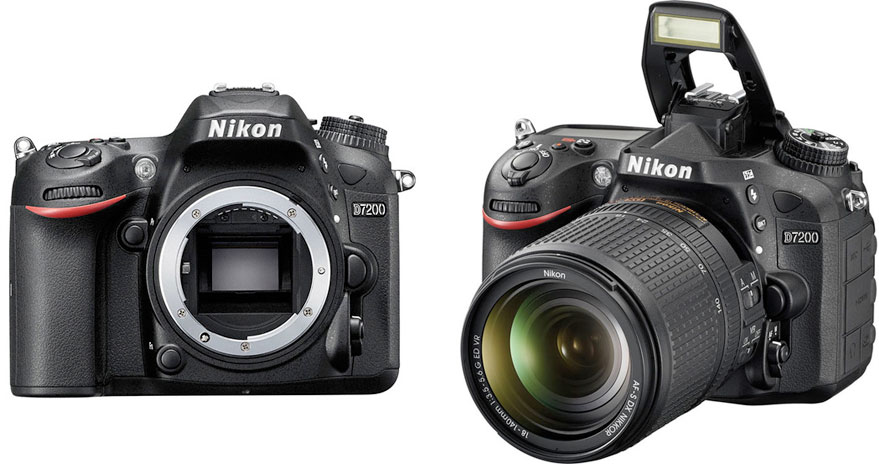
The Nikon D7200 is a great camera—comfortable, durable, easy to navigate, with fast focus and processing speeds and 24 megapixels of impeccable image quality without an optical low pass filter. Compared to its predecessor, the D7100, it offers significant, if not momentous upgrades, including a new processor with a larger buffer and faster performance, improved autofocus in low light and built-in Wi-Fi connectivity with NFC. Additionally, it has an enhanced intervalometer, refined adjustments, Clarity Control, and a Flat option in Picture Control, more frames when bracketing exposures, and its ISO sensitivity expands to 102400—but only for black-and-white shooting. These are the parts, but it’s the sum of these parts that makes for a wonderful and comprehensive shooting experience for hobbyists, travelers, and seasoned photographers.
The D7200 is the best APS-C (DX) format camera from Nikon and maybe the best crop-sensor DSLR currently available. If you are deciding whether to update your D7000 or D7100, that will depend on the state of your current model, your budget, and what it is you tend to photograph. If you often shoot in fast-paced bursts or in dim light or at telephoto lengths, I would recommend it. And, of course, if having a built-in Wi-Fi connection improves your workflow or remote capabilities, then it might be worth the update as well. For the hobbyist, traveler, or family shooter who wants a complete camera that is versatile and easy to use, the D7200 with 18-140mm f/3.5-5.6G ED VR lens is an ideal option for advanced photography without venturing into the higher-priced “pro” models.


Of course, many pro shooters will use the D7200 with great results, but as a camera to start a “system” it is ideal—you can go big or small with it. The camera can grow with you as your abilities develop and you add lenses and accessories, or you can simply use it with its scene and auto settings and a basic lens to capture stellar photos and videos. If you do decide to advance your gear set, you can be confident with Nikon’s family of DX lenses or explore the unparalleled selection of high-end FX lenses. Remember that the D7200 has a camera-based autofocus motor, enabling AF operation with almost all AF NIKKOR lenses.
Now, let’s get back to our stroll. When B&H opened in its new location in 1997, there was no way for anyone to predict the huge explosion of growth this area would experience 18 years later. With the opening of the Highline Park, and several huge tower complexes under construction, as well as the transformation of the Farley Post Office into the new Penn Station, this corner of town will be a fashionable hub of activity for many years to come. Using the D7200 and the 18-140mm kit lens that is offered with it, I captured shots of the many iconic buildings nearby, as well as a few of the construction sites, demonstrating the versatility of such a compact lens and the low-light focusing and image quality of the D7200.

From our doorstep, it’s just a block to the monumental Farley Post Office Building, the “main” post office, designed by a McKim, Mead and White, the prominent turn-of-the-20th-Century architects, and bearing the famous (though unofficial) Post Office motto, “Neither snow nor rain nor heat nor gloom of night stays these couriers from the swift completion of their appointed rounds,” on its façade. The building is undergoing a massive renovation to transform it into the expanded Penn Station, to better serve railroads and commuter trains.
Directly across the street is the “world’s most famous arena,” Madison Square Garden. Old, in terms of active arenas, it was built in 1968 but seems as modern as ever. The Garden may itself be moving to a nearby location in years to come but, in the meantime, it’s home to concerts and sporting events year round. Continue eastward one block and you begin to see the real bustle for which Manhattan is noted—thousands of pedestrians hustling across streets where shops, including the famous Macy’s Department store are located.
 |
 |
Here I was able to put the D7200’s EXPEED 4 Image Processor to the test by shooting bursts of images capturing the varied faces of humanity as they made their way to the next appointment or train. The camera worked as specified, capturing six images per second in RAW+JPEG quality. Furthermore, I could rattle off 12 shots before the buffer would pause, but that pause was just a moment before I was back shooting continuously, albeit at a slightly slower rate. In straight RAW, I shot 18 frames before there was a slowdown and, in JPEG Fine, I could keep shooting at 6 fps until I got tired of counting.
 |
 |
The next block finds you at Herald Square with a view directly downtown to the new One World Trade Center, the tallest skyscraper in the Western Hemisphere and the principal structure on the site of the original World Trade Center—the “Twin Towers.” Note how the D7200, exposing for the light on the distant building, provides sufficient dynamic range to capture the information in the shadowy foreground.
 |
 |
From Herald Square, it is just one block to the Empire State Building, and having purchased an express ticket to the viewing deck, I was 86 floors (then later 102 floors!) above New York City in just five minutes. The D7200 with 18-140mm captured spectacular views, whether at its widest focal length or “zoomed-in” to capture boats traversing the city’s rivers, the chaos of 34th Street from 1200' up, or the beautiful Flatiron building anchoring Madison Square Park and the newly coined “Flatiron District.” Remember that on a DX format camera, the focal length of an 18-140mm lens is comparably equivalent to a 27-210mm lens in the full-frame 35mm format.

 |
 |
 |
 |
With golden hour passed and the lights of Manhattan changing the cityscape to sparkle mode, I hurried back to B&H, grabbed my briefcase and walked the four blocks to the northern end of the Highline Park to meet my family for an evening constitutional. The Highline is a walking park built on an old elevated railroad track that winds its way through the Greenwich Village and Chelsea neighborhoods and ends just west of the B&H SuperStore, at 34th Street. Opened in 2009, the Highline is an incredibly popular park, filled with tourists and New Yorkers, and has spurred real estate development along its path. My feeling is that as time passes and the surrounding developments become active workplaces and homes, this park will become more of a pedestrian “street” than park, used as a pleasant alternative to the car-choked avenues.
In the meantime, with people from all over the world enjoying it, the Highline is, among other things, a great place to survey the state of the camera business, as almost every single person is taking shots of its unique vistas or taking shots of themselves in front of its unique vistas. Needless to say, smartphones dominated the count, but many people were using compact DSLRs and mirrorless cameras, indicating people’s desire, at least when on vacation, to capture images of a quality that smartphones cannot yet supply. The D7200 is the most robust of this type of camera—not so big or expensive to ward off the average consumer, yet offering the image quality and feature set to create the best of images, whether in auto or scene modes or fully manual. Its durability will keep it shooting for years and its features are such that you can grow with it, continuing to use it when your skills are top notch.
 |
 |
As evening purpled into night, I had an opportunity to test the D7200’s high-ISO noise and low-light focusing. The autofocus on the D7200 with 18-140mm lens was fast and accurate and so smooth, that at times I had to double-check its accuracy, because I did not hear the normal sounds that often accompany the AF actuation. Focusing at night proved ideal. And even without bright spots to use, the autofocus, with a detection range of -3 EV, performed superbly, exemplified by shots of people’s faces barely recognizable in the darkness that came out perfectly in focus. Even the shot of my son, below, taken quickly and blindly from waist-level with built-in flash and without the AF-assist illuminator, was captured in focus. One drawback when using the built-in flash is that you can only shoot in S mode, eliminating burst-shooting possibilities. Like its predecessor, the D7200’s built-in flash provides Commander Mode for firing other off-camera flashes wirelessly.

The ISO range of the D7200 makes a noticeable leap in comparison the D7100. Its maximum native ISO is 25600, compared to 6400 on the D7100, and it expands to 102400—but only for black-and-white JPEG shots. While the increased ISO did allow me to shoot at faster shutter speeds at night, enabling handheld imaging, I still find the noise too much to justify shooting at any sensitivity higher than 6400. Not that it doesn’t create usable images at a high ISO; they are just too noisy for my tastes. However, a very practical update on the D7200 is that it now allows Auto ISO in manual shooting mode.
 |
 |
 |
 |
 |
For those familiar with Nikon DSLRs, there is not much new to the form factor and handling of the D7200. It is an extremely well-built camera with a magnesium-alloy chassis, weather sealing, and textured rubber grips. It feels solid in the hand and it can withstand a good battering. The top-side LCD is plenty big to show pertinent info, even though some setting info is no longer displayed on the top LCD, reserved only for the rear LCD.
A major improvement on the D7200 is its battery life, perhaps due to the new processor. The Nikon specs indicate that it can shoot 1,110 shots on a typical charge and I found that number accurate. More so, I used my camera over the course of 5 days without recharging, taking a total of 900 shots, regularly viewing them on the LCD and, when I checked battery info in the menu, I still had 35% power, plenty to make it to the manufacturer’s specification.
I put two other features briefly through their paces and found that they both worked satisfactorily and should be a benefit to D7200 users. First was the built-in Wi-Fi connectivity, which I used with an iOS device. While NFC capability should make it even easier to link your camera to an Android phone or tablet, setting it up on my iPhone was hassle-free. Once connected, I was able to use the Nikon Wireless Mobile Utility app to fire the camera remotely from my smartphone. This process was simple but I had limited control over camera settings. With this connection, it is also simple to transfer images wirelessly from your camera’s memory to any email address or social media site. I found this Wi-Fi functionality easy to use, but limited in its practical applications. However, if you can integrate it into your workflow for backup or image transfer, it is a serious convenience and the remote control will certainly serve a purpose if you need to shoot without touching or being near the camera.
Interval shooting and time-lapse functions on the D7200 have been improved a great deal and can easily create beautiful time-lapse images. Compared to the D7100, the number of intervals in time lapse has been increased from 999 to 9,999 for longer or more detailed sequences, and a time lapse exposure-smoothing algorithm enables subtle adjustments in exposure to correspond with the changes in light during a long capture. Exposure smoothing is supported in both interval shooting mode and time-lapse video mode and shows its mettle in even this short clip of day turning into night over Chelsea.
Finally, video capture mode has added a 1080/60p frame rate for smoother capture. However, this is available only in the 1.3x crop mode. Otherwise, the video specs remain the same as in the D7100, but a dedicated video menu is now supported. If video is your thing, the DX format may not be the ideal, but the D7200 does provide HDMI out, as well as both a microphone and headphone jack. It is certainly more than sufficient for recording quality videos and for pro still photographers, serious amateurs, and especially for those looking to have the best of tools to capture the life around them: the D7200 is the perfect camera.