Search results for: pro audio tips solutions microphone polar patterns
About 13 filtered results
by Luke Rollins · Posted
Content creation has exploded into a multi-billion-dollar industry with no signs of slowing down. While it’s true that anyone with a smartphone can become a content creator, the shift toward polished productions might have you browsing some more professional gadgets. Luckily, affordable, easy-to-use gear is widely available for every kind of content creator. Let’s explore some options you might consider snagging for your new hobby or upcoming project.
Best vlogging cameras for content creators

by Steven Esposito · Posted
If you have found yourself moving, downsizing, or going away to school, you might be dealt a desk area that is drastically smaller than that to which you are accustomed. If this is you, or will be you sometime soon, a small workspace is no reason to panic. With some intention and a bit of finessing, you can cultivate a sleek and functional small desk setup without compromising on quality. I am going to share some helpful pointers with supplementary products to consider while you transition into a new, smaller workspace.
Lose the Monitor Base
by Freddy Gerngross · Posted
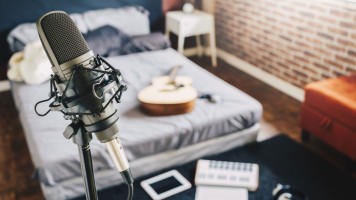
As the democratization of music production continues to propagate, many people have been innovating new production techniques, creating entirely new genres of music, and recording literal chart-topping hits—all from the comfort of their bedrooms. But if you’re just getting started, you might soon realize that the vocal recordings you capture in your bedroom are … less than ideal.
Getting a tight and professional sound from a small bedroom is possible—but it takes planning, preparation, constant rearrangements, and maybe a few bucks here and

by Freddy Gerngross · Posted
Since its founding in 1992, DPA Microphones has gained a prestigious reputation in the audio industry for their mics' exceptional quality, crystalline transparency, and rugged and reliable build quality. And while DPA's microphones have found their way onto the stage with Beyonce, onto the sets of Game of Thrones, and into the concert halls of the world's greatest orchestras, what's perhaps most impactful to our world is the contributions they've made to the scientific community: DPA's microphones have enabled advancements in medicine,

by Gabby Bloch · Posted
If you’re just starting out on your podcasting journey, it may be helpful to refer to our podcasting glossary. It provides common terminology pertaining to everything podcast related, from equipment to recording and mixing, distribution and more. We have also divided the terms into various categories to simplify your search.
Table of Contents:
Audio Terms
Podcast Equipment
Podcast Recording & Production

Posted
In part one, Shure Sales Development Specialist Russ Helfman helps demystify the popular terms and common audio jargon you may have heard, but not fully understand. Learn about the different kinds of microphones and the ideal use for each, best practices for great sound and much more!
Audio 101 is a four-part series designed to help you understand and learn to produce better audio, whether you're new to the game or looking to level up on what you already know. Join Shure as they break down the fundamentals, from audio terminology to essential

by Gabby Bloch · Posted
If you’re in the market for a studio microphone, the first type of mic you’ll likely come across is a large-diaphragm condenser mic. These mics are often used for studio recording, especially with respect to vocals and many acoustic instruments. Why? Condenser mics are more sensitive and more accurate than dynamic microphones, making them better able to pick up nuances in tone and timbre. They also tend to provide a wider frequency response than dynamic mics can, giving them the ability to capture a broader range of sound.
How Does a Large

by Gabby Bloch · Posted
Whether you’re a freelance journalist, interviewer, director, or vlogger, a lavalier mic (also known as a lapel mic) can be a powerful tool in the right situation. In this guide we’ll explore what lavalier mics are, how they work, the different types, as well as some recommendations and tips on how to use them effectively.
What Is a Lavalier Mic?
A lavalier mic is a small clip-on mic that is meant to be attached to clothing, typically around the collarbone or upper chest area. They're designed to capture vocals in proximity and make recording

by Gabby Bloch · Posted
Although they typically don't get as much attention as conventional dynamic and condenser microphones, ribbon mics can do a lot for your sound—especially when used wisely and for the right application. In this article, we'll be discussing the unique design and sound characteristics of this oft-forgotten mic, as well as suitable applications for its use and product recommendations.
What Is a Ribbon Microphone?
Although a ribbon mic is technically categorized as a type

by Greg Johnson · Posted
One of the top microphone myths that many people believe is that all shotgun microphones have very tight pickup patterns and can capture audio over a long distance. This misconception is addressed by Shure microphones as follows: “The reality is that microphones do not reach out and grab the sound from a distance. They merely measure pressure variations right at the diaphragm itself.” This leads us to understand that the one specification of a microphone that loosely corresponds to the concept of reach or distance is directionality or the

by Phillip Nichol… · Posted
Some microphones look the same, some look wildly different. Reading each manufacturer’s product description leaves you with the impression that every mic is the best for everything. Microphones in the sub-$100 range are often described the same way as mics in the territory of several thousand dollars. So, how do you determine what sets them apart? You can get your first clue in those ultra-boring and seemingly pointless specifications. I know it would be much more fun to just try all the mics, but that’s not possible, is it? As you dive into

by Nicholas Messitte · Posted
Let’s begin with what you won’t see in this article: You won’t find the customary list of mics, their governing attributes, or a list of instruments they flatter; mics age differently, making that kind of list largely moot. Also, it wouldn’t necessarily help if you didn’t have those microphones, many of which are quite expensive.
Likewise, you won’t see a right-brained crystallization of concepts you’d come across in a book such as, “Mixing with Your Mind.” Michael Stavrou does that better than I could ever hope to.
Instead, we’re going to

by Nicholas Messitte · Posted
You’ve written the parts, tuned your axe, and informed your neighbors that things are going to get loud. Now it’s time to record some electric guitars at home. But a question tugs at you: How can you, with your home setup, ever approach the sound of a top-notch studio?
We’re here to suggest some tips and tricks on how to do just that. If you’ve ever wanted a compendium of everything from gear options to recording tips, read on:
DI and software
If you’re reading this, most likely you’ve already got an interface, anything from the Apogee