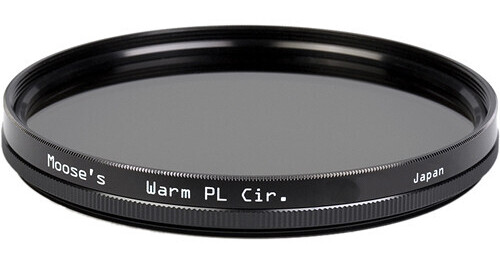
Light rays which are reflected become polarized. Polarizing filters are used to select which light rays enter your camera lens. They can remove unwanted reflections from non-metallic surfaces such as water or glass and also saturate colors providing better contrast. The effect can be seen through the viewfinder and changed by rotating the filter. The filter factor varies according to how the filter is rotated and its orientation to the sun. Filter factor is between 2.3 and 2.8 (approx. +1.3 stops).
This unique filter is the result of a collaboration between Hoya and respected wildlife photographer, B. Moose Peterson. It combines the advantages of a polarizer with the warming effect of an 81A filter.
Circular polarizers are specifically designed for use with auto-focus SLR cameras (They will also work on manual systems without problems).
REVIEW SNAPSHOT®
by PowerReviewsPros
Cons
Best Uses
Most Liked Positive Review
Required Equipment for Landscape Photos
This warming polarizer designed by Moose Peterson should be required equipment for all Landscapes Photographers. This is extremely well made polarizer that gives beautiful results. It is also a great value. I have a...Read complete review
This warming polarizer designed by Moose Peterson should be required equipment for all Landscapes Photographers. This is extremely well made polarizer that gives beautiful results. It is also a great value. I have a "moose" for every size lens I own. A polarizer is the one filter that you cannot do without, and fix it in photoshop. I have been using the "moose" since 2001 - in Alaska, Canada, California and Arkansas and love the pleasing results. You get the best results if you get the foreground the right shade and the sky takes care of itself. I also use several singh ray filter but they cost 2 to 3 times as much. I have never had a problem with a "moose".
VS
Most Liked Negative Review
A Poor Choice
No anti-reflective coating on it's back side to prevent ghosting and lens flare.
Since it's a circular polarizer, it means it's made for digital cameras.
Anyone who has use...Read complete review
No anti-reflective coating on it's back side to prevent ghosting and lens flare.
Since it's a circular polarizer, it means it's made for digital cameras.
Anyone who has used any raw image file will tell you that you can get the same effect of an 81A filter being changing warming the color temperature in your editing software.
A couple waste of money.
REVIEWS
Reviewed by 20 customers
Sort by
Displaying reviews 1-20
Pros
Cons
Best Uses
Comments about Hoya 77mm (Moose) Warm Circular Polarizer Glass Filter:
Great Circ Pol.. Works great on my Canon 17-40. Very little vignetting at 17mm.
Pros
Cons
Best Uses
Comments about Hoya 77mm (Moose) Warm Circular Polarizer Glass Filter:
I use this filter for landscape shots, water shots and any situation where reflection of light is a problem. The filter will take the gray cast off of water shot in dim light also.It makes colors pop.
Pros
Cons
Best Uses
Comments about Hoya 77mm (Moose) Warm Circular Polarizer Glass Filter:
I use this with my Canon 5D Mark II and take 1080P videos at the beach. I get beautiful blue sky and lushes green leaves.
Pros
Cons
Best Uses
Comments about Hoya 77mm (Moose) Warm Circular Polarizer Glass Filter:
This filter got extensive use in Santa Fe New Mexico 2 weeks ago. My images popped with beautiful colors and vibrant skys. It is a great addition to my filter arsenal.
Pros
Cons
Best Uses
Comments about Hoya 77mm (Moose) Warm Circular Polarizer Glass Filter:
High quality Circular Polarizer with a touch of warmth. You'll love the ability this filter has to reduce reflections found everywhere.
Pros
Cons
Best Uses
Comments about Hoya 77mm (Moose) Warm Circular Polarizer Glass Filter:
I have used this filter at several ball games and on many outdoor shoots. I have been pleased with the end results and how easy it is to rotate the filter.
Pros
Cons
Best Uses
Comments about Hoya 77mm (Moose) Warm Circular Polarizer Glass Filter:
This is fantastic! I love to shoot with my wide angle lens and am able to capture such amazing color depth. Not too warm at all (skys still look blue but skin on people is creamy and warm.)It saves me time in post processing. Wonderful for reducing glare and easy to adjust. It takes a little practice when using a lens hood, you have to be careful to grab the outside of the filter and not rub a finger on the lens surface. Be careful not to over tighten as it is difficult to get off if you do. I love it!
Pros
Cons
Best Uses
Comments about Hoya 77mm (Moose) Warm Circular Polarizer Glass Filter:
i would'nt leave house without this filter
Pros
Cons
Best Uses
Comments about Hoya 77mm (Moose) Warm Circular Polarizer Glass Filter:
I needed this for a long distance shot I want to make of the hill country near our home. It does a nice job of blueing the sky and improving wash out.
Pros
Cons
Best Uses
Comments about Hoya 77mm (Moose) Warm Circular Polarizer Glass Filter:
I bought this to go on the Nikkor 70-200mm f/2.8 lens. It's a nice polarizer. Seems well made. Crystal clear. I'm very pleased.
Pros
Cons
Best Uses
Comments about Hoya 77mm (Moose) Warm Circular Polarizer Glass Filter:
This is a very nice combination of the two filters I use most often. I shoot film mostly. While it is possible to add the warming part of this combination later in photoshop the polarizer is still needed. It is a whole lot easier to just use this filter.
Pros
Cons
Best Uses
Comments about Hoya 77mm (Moose) Warm Circular Polarizer Glass Filter:
A very useful tool when taking shots in tropical locations.
Pros
Cons
Best Uses
Comments about Hoya 77mm (Moose) Warm Circular Polarizer Glass Filter:
I tried this to improve the appearance of the clouds and blue sky. I was very pleased with the initial results. Be careful that you don't screw it on too tight!
Pros
Cons
Best Uses
Comments about Hoya 77mm (Moose) Warm Circular Polarizer Glass Filter:
[...] pleased with results. Can get better exposures on brighter days or more inclement weather.
Pros
Cons
Best Uses
Comments about Hoya 77mm (Moose) Warm Circular Polarizer Glass Filter:
I purchased this filter at the recommendation of two friends whose photographs I much admire (one of whom leaves it on her SLR camera all the time). It is great for enhancing warm colors, and like my friend, I'm thinking about leaving it on my camera -- rotating it when I don't need the color enhancement. I like it so much that I purchased step-up rings for my other cameras so I can use it with them as well.
Pros
Cons
Best Uses
Comments about Hoya 77mm (Moose) Warm Circular Polarizer Glass Filter:
Create a warmer feeling to any candid shot.
A must for those glaring sunny days.
Pros
Cons
Best Uses
Comments about Hoya 77mm (Moose) Warm Circular Polarizer Glass Filter:
Bought this before going to the Great Sand Dunes in Southern Colorado. Worked amazing well in very bright and harsh lighting.
Pros
Cons
Best Uses
Comments about Hoya 77mm (Moose) Warm Circular Polarizer Glass Filter:
This warming polarizer designed by Moose Peterson should be required equipment for all Landscapes Photographers. This is extremely well made polarizer that gives beautiful results. It is also a great value. I have a "moose" for every size lens I own. A polarizer is the one filter that you cannot do without, and fix it in photoshop. I have been using the "moose" since 2001 - in Alaska, Canada, California and Arkansas and love the pleasing results. You get the best results if you get the foreground the right shade and the sky takes care of itself. I also use several singh ray filter but they cost 2 to 3 times as much. I have never had a problem with a "moose".
Pros
Cons
Best Uses
Comments about Hoya 77mm (Moose) Warm Circular Polarizer Glass Filter:
No anti-reflective coating on it's back side to prevent ghosting and lens flare.
Since it's a circular polarizer, it means it's made for digital cameras.
Anyone who has used any raw image file will tell you that you can get the same effect of an 81A filter being changing warming the color temperature in your editing software.
A couple waste of money.
Pros
Cons
Best Uses
Comments about Hoya 77mm (Moose) Warm Circular Polarizer Glass Filter:
The Moose filter is especially helpful with digital photography because it lowers contrast yet retains rich color. The Moose is a bit pricey but well worth the investment. If you love a polarizer but not the intense blue, this is for you. An additional benefit is the Moose will allow you to shoot during the middle of the day and even the highlights detail in chrome will be retained.
Displaying reviews 1-20