
Aperture is one of the most significant settings in photography and also one of the first we should learn. It’s also one of the three settings collectively referred to as the exposure triangle that help to determine an image’s exposure.
Much like the iris of the human eye, a lens’s aperture opens and closes to control the amount of light reaching a light-sensitive imaging area. For this reason, the setting is sometimes referred to as the “iris.” The only difference is the very brain that automatically corrects its own vision for the light must compute and select the aperture on the fly.
What Is Aperture?
A lens’s aperture is a physical opening in the lens which controls the amount of light that enters the camera. It is usually controlled by a series of blades known as the diaphragm. The term aperture refers to the physical opening, while the diaphragm is the mechanism itself.

Thinking in F-Stops
As the diaphragm opens and closes, the size of the aperture needs to be quantified in some way. While some lenses offer smooth transitions of aperture values, most photo centric optics will have clicks to aid photographers in fine tuning their exposures. These clicks represent set aperture values known as f-stops.
An f-stop denotes aperture measurements on a lens. These values appear as fractions like f/2.8, f/4, f/5.6, etc., and represent a size relationship between elements in an optical system, but the key concept to remember is that the larger the opening, the smaller the numerical value associated with it. For instance, f/2.8 represents a larger opening than f/8.

The range of f-stops at your disposal will depend entirely on the lens you’re using. The widest f-stop a lens can shoot with is known as its maximum aperture, and not all lenses are created equal. Prime lenses tend to have wider maximum apertures. This is part due to them having fewer moving parts, whereas zooms extend, lengthening and narrowing the path light must travel to reach the back of the lens.
Aperture in the Exposure Triangle
As one of the settings in our trifecta of exposure, aperture must be balanced with other settings such as shutter speed and ISO in order to produce a good exposure. In the last section, we mentioned shutter speed. This setting controls the duration of our exposure and the amount of time light has to reach our imagined area. It is aperture that dictates how much light we allow in.
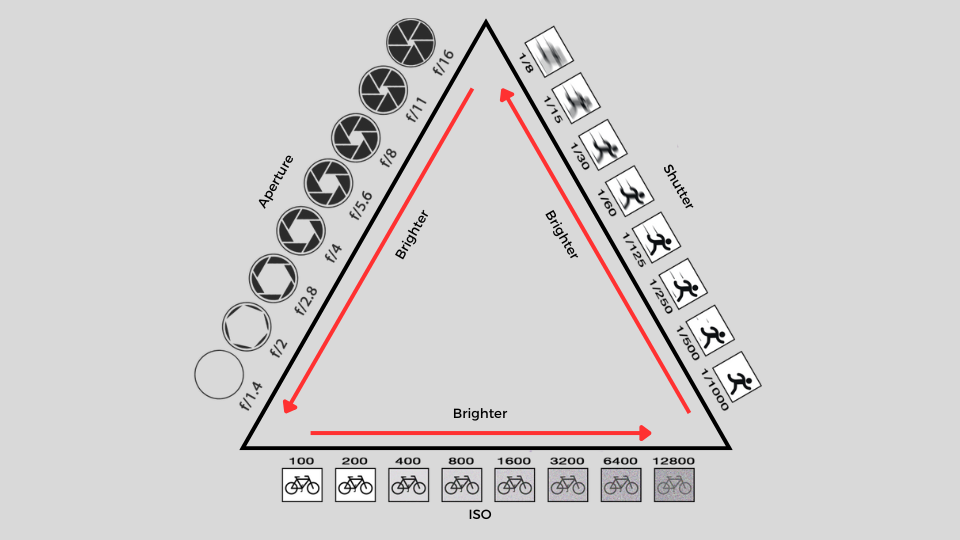
Larger apertures let more light into the camera, which is ideal for low-light shooting or fast action. Indoor events, late evenings, or dimly lit spaces benefit greatly from large apertures, also called “fast” apertures. When a lens is referred to as fast, it’s because it has a large maximum aperture. Likewise, a slow lens is one with a smaller maximum aperture. For example, when comparing two 50mm lenses, the one with an f/1.4 maximum aperture will be faster than the one with an f/4 maximum aperture.

Larger apertures are fast because they allow a camera to shoot at a faster shutter speed with the same exposure as compared to a slower shutter speed when using a slower aperture. What makes an aperture “slow?” General consensus is that an aperture of f/2.8 and wider is fast while anything smaller is slow.
Aperture can greatly alter the look of our image, altering backgrounds and how much of our image appears sharp or in focus. For that reason, the aperture we use will not only depend on what we’re photographing, but also our artistic intent. We now understand how aperture impacts our exposure, but that’s not all it does. The size of our aperture doesn’t only affect the amount of light passing through the lens, it also affects our depth of field.
Depth of Field
Depth of field is the area of apparent focus in our image and is partially a function of aperture size. It is the sharp area of an exposure that can vary from a few centimeters in depth to many meters. A shallow depth of field is ideal for isolating our subject and blurring the background. In the same vein, a greater or larger depth of field is better for landscapes and scenic shots.
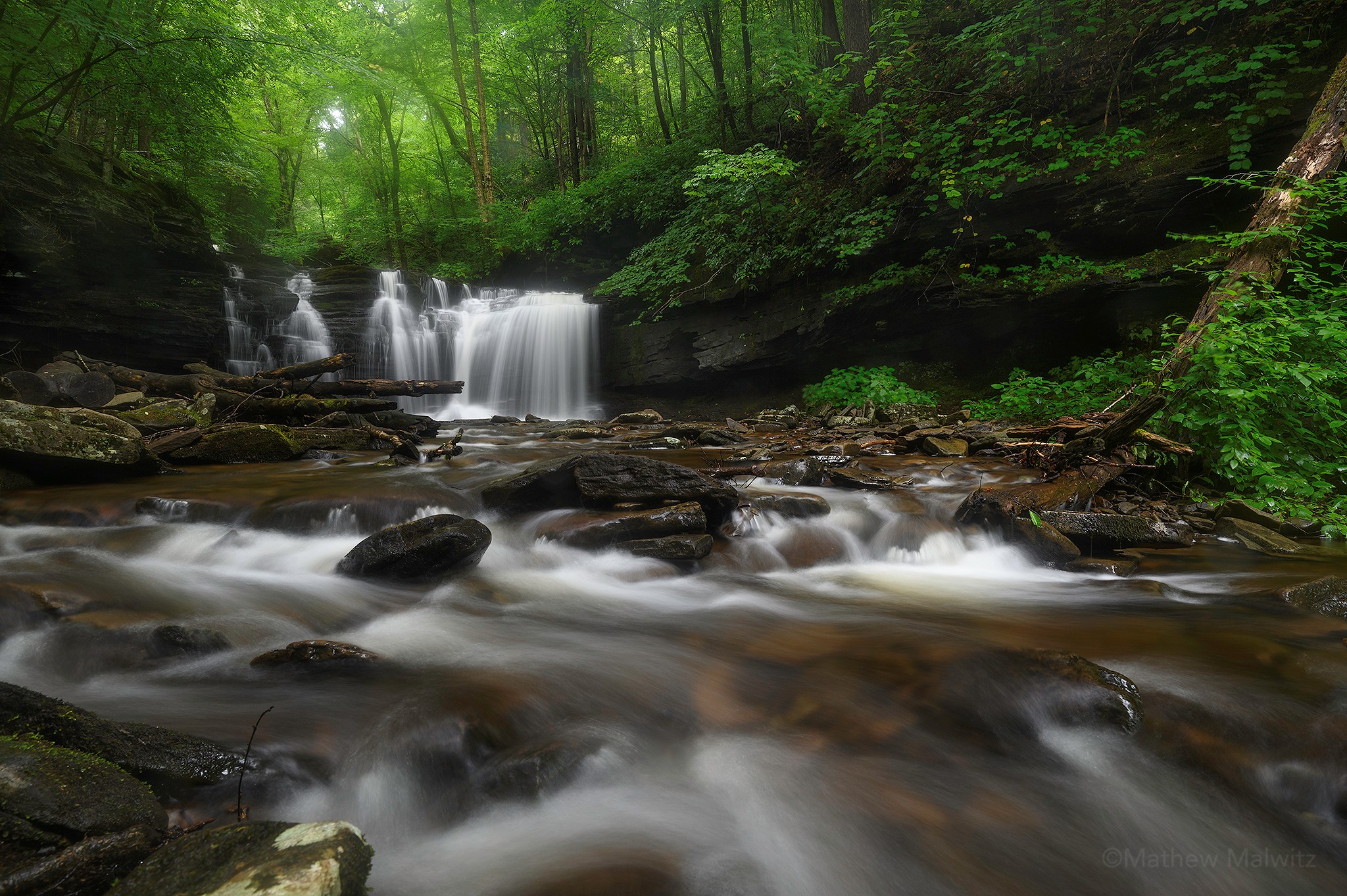
Like all aspects of photography, depth of field is a spectrum. Aperture plays a role in its appearance, and changing our aperture will show some variations in our depth of field, but it’s not the only factor. In fact, it’s one of three, just like in the exposure triangle. To master the blurring of our backgrounds, there’s more to learn.
Learning More
Aperture could arguably be the most significant of the three settings in our exposure triangle. It all depends on what you photograph and your artistic intent. With a better understanding of how it works, we can not only capture more consistent exposures but also take creative control of our depth of field. If you want to take a deeper dive into aperture, and a bit of math, be sure to read our advanced guide on the subject.
If you’re looking to take your photography to the next level, taking control of your exposure is the first step. We even have other intro guides on shutter speed and ISO to further your understanding of the subject. To learn even more about photography, check out our other guides on the B&H Explora page!
