
Does the space in which you work affect the photography you create? This is one question at the heart of our “Inspiration to Process” series and the first question we asked artist David Brandon Geeting when we arrived at his Greenpoint studio. It seemed a fitting question, given the quantity of work he has produced from this subterranean space and that his most recent series, “Neighborhood Stroll,” was created on walks around the adjacent blocks.
Above photograph © Cory Rice
The studio itself is located in the basement of an old industrial complex in a remote corner of this Brooklyn neighborhood, and getting there took Cory Rice and me from the glass towers of Hudson Yards, in Manhattan, to a rain-slicked bridge connecting Queens to Brooklyn (would Profoto mind that we repurposed its umbrella?), and finally, to this picturesque building, which still houses a blend of machine shops, catering outfits, and artist spaces.


Although his current series is shot in the streets with natural light, and a Canon 5D, it is his in-studio still life practice that first caught the eye of gallerists and soon after, editorial, fashion, and commercial art directors.
How do you create in a windowless space with harsh fluorescent lighting? I asked. The simple answer: “I like harsh light. But also, I light everything with strobes, so this interior space affords me complete control over the lighting. It’s true that this space has probably made my work ‘x10’, even more artificial, even more fantasy.
“Also, I never know what time it is, so I work more and because I can’t look outside, I’ve looked ‘inside’ for much of my still-life work, I know that sounds cheesy, but it resonates.”

His work has been described as “shining a spotlight on things that are otherwise insignificant,” and common objects take on a new facade when re-photographed, re-assembled, or juxtaposed together in colorful, surprising and humorous combinations.
I asked if still life isn’t about exacting control and an imposed harmony between the items photographed, and Geeting countered: “People equate Cartier-Bresson’s ‘decisive moment’ to street photography, but I’m always wondering how it applies to still life, how to bring life to still life.”
Sensing my apprehension, he continued, “I don’t know, sometimes there’s just energy there at a certain moment… hard to say why. I work pretty fast in the studio, which surprises people because I do still life, but I often work without a tripod and tell my assistant to throw that light over there or there or I wait until something falls off.”

Humor is a big part of his imagery and in his advertising work, which leaves no doubt about the strength of his vision—it seems an even more subversive, biting wit. Perhaps this is because this aesthetic is more familiar in the fine-art sphere, or because the personal work seems to have a more playful, less acerbic vibe. Maybe it’s all a bit of a joke on photography because a great deal of the commercial work could be right at home on the wall of a gallery or in one of his books. I also like the pop painterly touches, the balance within the frame, the command of color and the confidence shown when blending in day-to-day visual by-products and advertising interactions. But with the Cartier-Bresson comment in my head, I ask about his “Neighborhood Stroll” series, which is abstraction and documentary and a version of street photography, captured on walks throughout the neighborhood. He mentioned it as a departure from recent work, but with threads to his earliest photo influences.
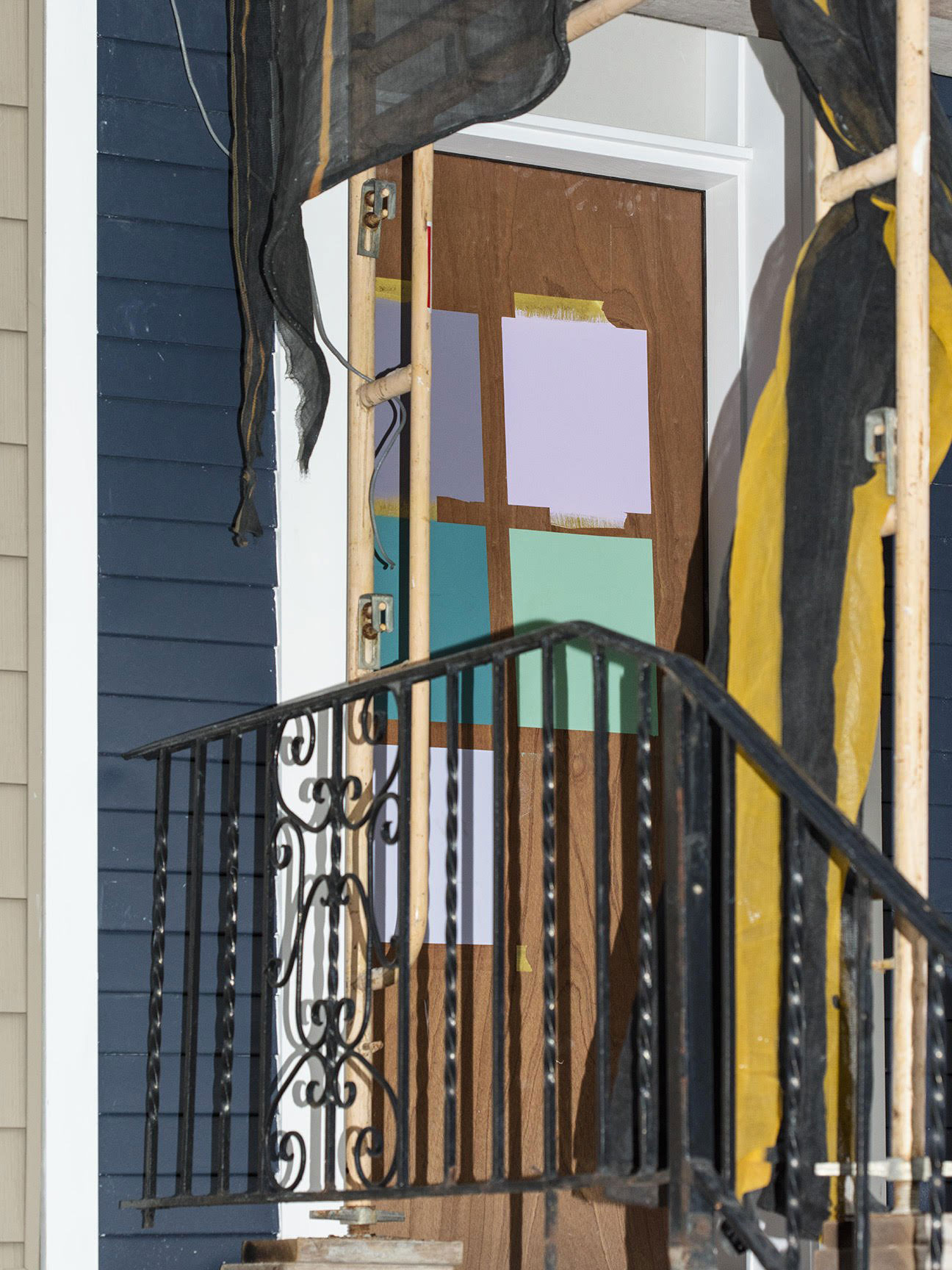
“William Eggleston and Stephen Shore are guys that walked around and pulled amazing images out of thin air, essentially. My work went in a different direction but what stuck with me is the bright palette and their way of elevating inanimate objects. So, for a while I was doing that, but in the studio, and doing it outside is kind of getting back to something and seeing if it still fits.”
To me, the intense focus on details and garish colors are even more disturbing than the often wry or serene scenes of these masters. Geeting is not averse to cropping if it better suits the idea, and he explained that this series did evolve from the still life work. “When I was short on ideas for scenes in the studio, I would go for a walk and take notes with the camera, thinking the creation moment would happen back in the studio, but I came to realize that it was this visual walking diary that was where I wanted to go.”


I asked about the insight to have that realization, and the confidence to know it is an idea worth pursuing. Geeting seems very confident about his vision, trusting his work. He reflected back to his school days. “I think I started making the kind of images that came naturally and was lucky enough to have, actually, some folks liking it on social media, reinforcing an idea enough to keep going. Before Instagram, I was putting stuff on Tumblr and some editors responded, asking if I’d do work for them. And that, of course, helps.”
“Is it necessary to have some validation to go forward?” I asked.
“I strike a balance between what I like and what others say they like. I did accept critique but also had a kind of confidence to know that certain comments, although valid, would not forward my practice. Later, to some degree, I just put on blinders and followed my vision.”

Referring to an image that is a poster folded into his book, Neighborhood Stroll, I asked, “When you’re in the streets and you come across this ice-vending machine in front of a deli, you’re drawn to it, but what drives you to photograph just this small section?”
“Sometimes I feel like I need to cover all bases and decide later, but with the (ice machine) it was this part that interested me, so I wanted to just present that.”
“Isn’t this the moment, not unlike Cartier-Bresson, Eggleston and Shore, when nothing is turned into something?” Geeting pauses. “But I may have two of those ah-ha moments, one when I’m shooting, and I know it’s going to be successful but also when I recognize that there’s potential in what I’ve captured and am excited to get home to edit.”
A description of Geeting’s recent work reads “daily observations of his personal environment,” “and glimpses of the spontaneous,” but I see it as something much more focused and obsessive, as controlled as a commercial still life or fashion piece, almost freakish, but redeemed by the confidence and consistency of his vision. Giving something importance because I say it is. I like that.

Hinting at some of the disquiet I felt in his photography, Geeting offers, “Even if it’s outside with bright colors and kind of fun to look at, I feel like the message is a bit eerie, almost post-apocalyptic. I don’t want to make light of the situation, but if anything, it has a Trojan horse effect. There are no humans in the pictures, but all of this stuff came from somewhere and has to go somewhere.”
David Brandon Geeting is represented by the Janet Borden Gallery and his latest book, Neighborhood Stroll, is available here.
Original images for this article were taken with the FUJIFILM GFX 100 Medium Format Mirrorless Camera.
