OM SYSTEM Breathes New Life into the PEN Series

OM Systems Breathes New Life into the Pen Series

Building upon a long history of rangefinders, OM SYSTEM has introduced their latest iteration of the classic camera with the OM SYSTEM PEN. This portable, user-friendly camera combines the simple design of its predecessors with the accuracy and intelligence of newer mirrorless technology.

We had the opportunity to take the new PEN into the field to see how it performs, and how it stacks up in an ever-evolving world of retro-style cameras. How does it compare, and who is the PEN for? Let’s find out.

First Impressions

At first glance, this camera is pretty slick with a timeless rangefinder design. Like many OM SYSTEM cameras, the PEN is available in both black and silver with matching kit lenses. Surprisingly, the PEN arguably looks more like the original PEN-F from 1963 than the 2016 digital reimagining.

OM Systems PEN 2 Lens Kit in Silver
OM SYSTEM PEN Camera with 14-42mm F3.5-5.6 III KIT

Upon picking the camera up, the first thing I noticed was its weight. At just 12.1 ounces, it’s the lightest camera of OM SYSTEM's current lineup. This came as a surprise, as its footprint isn’t all that much smaller than the OM-5 Mark II, though it does lack the large prism style viewfinder. Another area where OM SYSTEM appears to have saved weight was in the cameras construction.

Build Quality and Handling

I’ll be honest and say that the PEN’s weight was initially a point of contention for me. This was partially due to my only previous experience with a similar camera, the PEN F, a relatively hefty camera by comparison with a magnesium-alloy build.

The new iteration sticks with polycarbonate, opting for a lighter weight and more travel-friendly design. That said, it remains durable and reliable with IPX1-certified weather sealing, allowing users to shoot rain or shine. It’s not as robust as OM SYSTEM other offerings, but it’s a welcome feature that should give users some peace of mind.
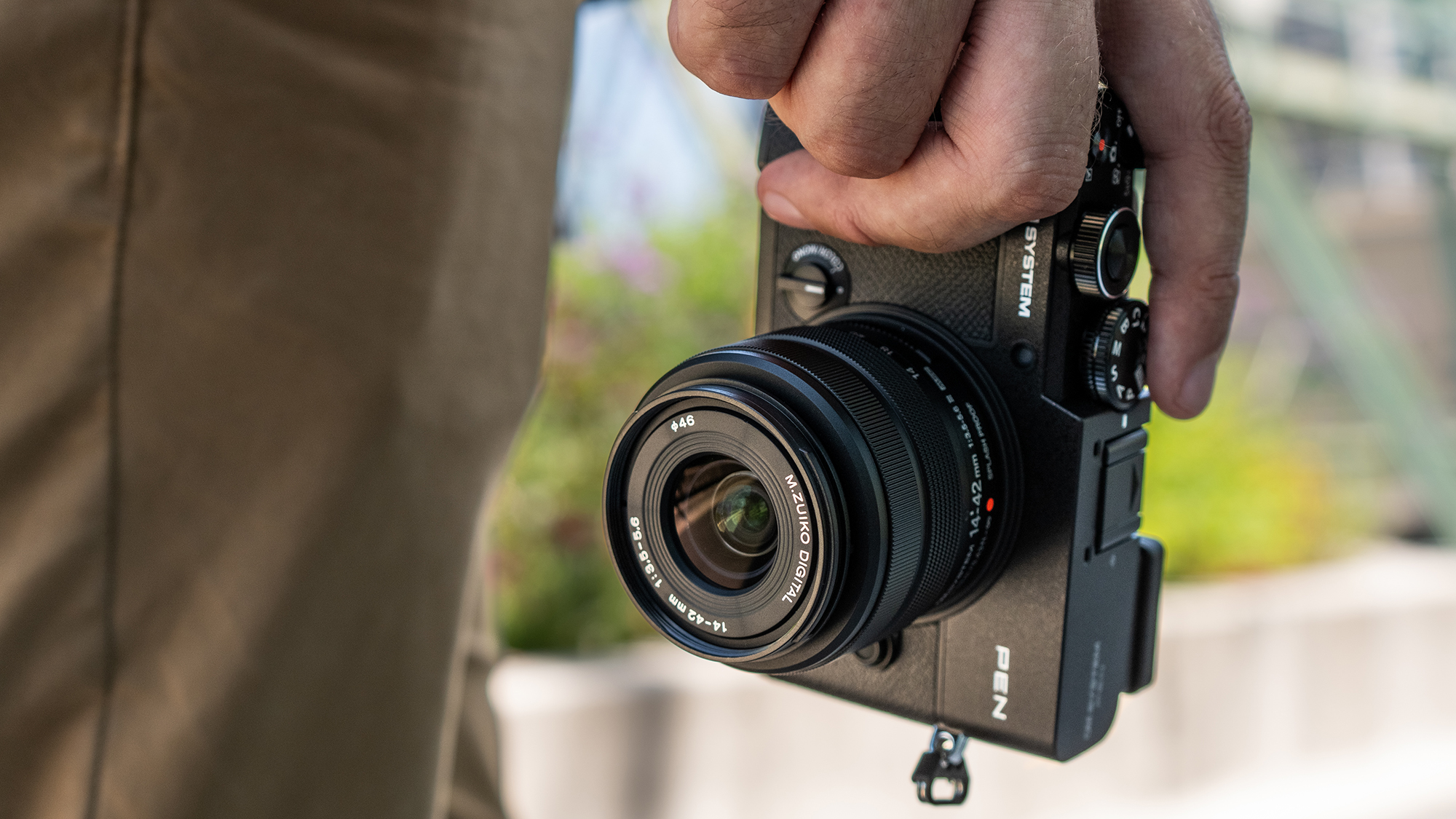
OM SYSTEM PEN Camera being held

Now, I need to mention the grip. Many smaller and retro-styled cameras have come to the market in recent years, and many have either shrunk or simply eliminated any form of grip. Of course, you could buy a third-party grip to attach to these cameras, but it would be nice to comfortably hold one out of the box. Luckily, the PEN doesn’t completely forgo the traditional grip, and the material used is grippy enough on its own to make your hold feel secure.

By the end of my time with this camera, I will say that may reservations on build quality were proven quite wrong. Though I would put a hand grip on the camera for prolonged shoots or travel.

Performance

Inside the camera is where things start to really look interesting. At the heart of the OM SYSTEM PEN is an updated version of the 20.4-megapixel sensor found in the OM-5 Mark II, which is then stabilized up to 5.5 steps of shake compensation via 5-axis in-body-stabilization. This is crucial for low-light shooting, allowing users to capture sharp images at relatively low shutter speeds.

We put this to the test, exclusively shooting the camera handheld as we imagine many of you will when you get your hands on this fun rangefinder. On day one, I took the camera down along the Hudson Waterfront for a bit just to see how it felt and to get familiar. Mounted on the front was the newly updated kit lens, the OM SYSTEM M.Zuiko 14-42mm f/3.5-5.6 III.

Chelsea Pier ~ OM system PEN and the M.Zuiko Digital 14-42mm f/3.5-5.6 III, f/10, 1/500, ISO 200
Chelsea Pier ~ OM SYSTEM PEN and the M.Zuiko Digital 14-42mm f/3.5-5.6 III, f/10, 1/500, ISO 200 Mathew Malwitz

This pairing is ridiculously lightweight. So much so that for much of the remainder of my time with the camera, I opted to use the M.Zuiko Digital ED 40-150mm f/4-5.6 R, giving me an effective focal range of 80-300mm. This was especially beneficial at my next stop, which would also be the testing ground for this cameras autofocus system.

With both lenses, autofocus is snappy, and with real-time subject recognition, it’ll find and focus on humans and pets alike with ease. Even for subject matter it wasn’t necessarily intended for, the camera did a decent job at finding animal heads, though it did jump around a bit. This problem came up when photographing unusual subject matter, such as the deceptively named prairie dog.

Building upon a long history of rangefinders, OM System has introduced their latest iteration of the classic camera with the OM System PEN. This portable, user-friendly camera combines the simple design of its predecessors with the accuracy and intelligence of newer mirrorless technology.  We had the opportunity to take the new PEN into the field to see how it performs, and how it stacks up in an ever-evolving world of retro-style cameras. How does it compare, and who is the PEN for? Let’s find out.  First Impressions  At first glance, this camera is pretty slick with a timeless rangefinder design. Like many OM system cameras, the PEN is available in both black and silver with matching kit lenses. Surprisingly, the PEN arguably looks more like the original PEN-F from 1963 than the 2016 digital reimagining.  Upon picking the camera up, the first thing I noticed was its weight. At just 12.1 ounces, it’s the lightest camera of OM Systems current line-up. This came as a surprise, as its footprint isn’t all that much smaller than the OM-5 Mark II, though it does lack the large prism style viewfinder. Another area where OM Systems appears to have saved weight was in the cameras construction.  Build Quality and Handling  I’ll be honest and say that the PEN’s weight was initially a point of contention for me. This was partially due to my only previous experience with a similar camera being with the PEN F, a relatively hefty camera by comparison with a magnesium-alloy build.  The new iteration sticks with polycarbonate, opting for a lighter weight and more travel-friendly design. That said, it remains durable and reliable with IPX1-certified weather sealing, allowing users to shoot rain or shine. It’s not as robust as OM systems other offerings, but it’s a welcome feature that should give users some peace of mind.  Now, I need to mention the grip. Many smaller and retro styled cameras have come to the market in recent years, and many have either shrunk or simply eliminated any form of grip. Of course, you could buy a third-party grip to attach to these cameras, but it would be nice to comfortably hold one out of the box. Luckily, the PEN doesn’t completely forgo the traditional grip, and the material used is grippy enough on its own to make your hold feel secure.  By the end of my time with this camera, I will say that may reservations on build quality were proven quite wrong. Though I would put a hand grip on the camera for prolonged shoots or travel.  Performance  Inside the camera is where things start to really look interesting. At the heart of the OM System PEN is an updated version of the 20.4-megapixel sensor found in the OM-5 Mark II, which is then stabilized up to 5.5 steps of shake compensation via 5-axis in-body-stabilization. This is crucial for low-light shooting, allowing users to capture sharp images at relatively low shutter speeds.  We put this to the test, exclusively shooting the camera handheld as we imagine many of you will when you get your hands on this fun rangefinder. Now, for our first test. On day one, I took the camera down along the Hudson Waterfront for a bit just to see how it felt and to get familiar. Mounted on the front was the newly updated kit lens, the OM System M.Zuiko 14-42mm f/3.5-5.6 III.  Chelsea Pier ~ OM system PEN and the M.Zuiko Digital 14-42mm f/3.5-5.6 III, f/10, 1/500, ISO 200 Chelsea Pier ~ OM system PEN and the M.Zuiko Digital 14-42mm f/3.5-5.6 III, f/10, 1/500, ISO 200 Mathew Malwitz  This pairing is ridiculously lightweight. So much so that for much of the remainder of my time with the camera, I opted to use the M.Zuiko Digital ED 40-150mm f/4-5.6 R, giving me an effective focal range of 80-300mm. This was especially beneficial at my next stop, which would also be the testing ground for this cameras autofocus system.  With both lenses, autofocus is snappy, and with real time subject recognition, it’ll find and focus on humans and pets alike with ease. Even for subject matter it wasn’t necessarily intended for, the camera did a decent job at finding animal heads, though it did jump around a bit. This problem came up when photographing unusual subject matter, such as the deceptively named prairie dog.   Prairie Dog looking down the barrel ~ OM system PEN and the M.Zuiko Digital ED 40-150mm f/4-5.6 R, f/5.2, 1/500, ISO 400  Another oddity I noticed was its tendency to jump to the background on occasion. This is not unique to the PEN though. It’s been a recurring issue across mirrorless brands from the start, and it doesn’t appear to be going anywhere anytime soon. That said, the PEN nailed focus more often than not, and when it did, the results were tack sharp.    Sharpness aside, the image quality out of the PEN is nothing to sneeze at, with stellar low light performance. To test this out, I took the camera into the reptile house, a notoriously dark and dingey location. Note that the following example was taken through glass, and you can begin to appreciate just how well this pair performs.  Coiled up python ~ OM system PEN and the M.Zuiko Digital ED 40-150mm f/4-5.6 R, f/5.6, 1/640, ISO 6400 Coiled up python ~ OM system PEN and the M.Zuiko Digital ED 40-150mm f/4-5.6 R, f/5.6, 1/640, ISO 6400 Mathew Malwitz  Creative Capabilties  Like other offerings from OM System, the PEN offers numerous color filters and film-like simulations for added creativity, many of which carry over from the retro styled PEN-F. These features include the Computational Photography (CP) button, which allows for quick and easy access to most of the cameras of the computational features, as well as the creative dial returns as well, albeit in a slightly simplified form. I didn’t feel that the zoo was the right place for the task of testing filters, so I knew I had to return once more to our Superstore’s neighborhood.  Back in NYC, this time on an overcast morning, I swapped out the zooms for the compact M.Zuiko Digital 17mm f/1.8 II, a likely pairing for street and travel photographers. While the light was dingey, I came to a stop near the old gate of the White Star/Cunard Line pier, which would have been the destination of the ill-fated ocean liner Titanic back in 1912, just seven years before the founding of OM Systems predecessor, Olympus. (LINK TO CTV-9073 when complete)  Pigeons desecrating Titanic’s Memory on Pier 54 ~ OM system PEN and the M.Zuiko Digital 17mm f/1.8 II, f/16, 1/500, ISO 200 Pigeons desecrating Titanic’s Memory on Pier 54 ~ OM system PEN and the M.Zuiko Digital 17mm f/1.8 II, f/16, 1/500, ISO 200 Mathew Malwitz  Battery Life  Throughout my testing, not once did I run into any issues with battery life. Even when the camera was left on at my hip for hours on end, there was little drain, and I credit this to the new BS-7 battery. In fact, the battery life is rated up to 410 shots compared to the OM-5 Mark II’s 310.  Of course, this new battery charges in-camera via the USB-C port, the new standard of charging across the photo industry. Available separately will be the new BCS-7 charger, which is useful if you intend on being able to shoot with one battery while charging another.  Connectivity  Speaking of ports, it’s worth noting that this camera offers just three ports, including the aforementioned USB-C, as well as a 3.5mm microphone port and a micro-HDMI port. Again, simplicity is the name of the game, and this camera excels in this area whether you’re a beginner who doesn’t need all that many connection points or a pro looking to have fun.  As you can imagine, the PEN is also fully equipped with Wi-Fi and Bluetooth connectivity, allowing users to send photos directly to their smartphones through the OM Image Share (OI.Share) app. The app can also be used to add GPS coordinates to your images, so long as the app is kept running in the background while you shoot.  How Does It Compare?  When looking at the OM system PEN, it’s easy to see why this rangefinder stands out in its class. It’s all in the 2.36M-dot viewfinder. Similarly priced offerings from other brand shave done away with this feature, promoting an LCD only shooting experience. While certainly a popular technique among some users out there, the ability to shoot through an electronic viewfinder (EVF) can be a game changer, especially when contending with harsh glare.  Who is the OM System PEN for?  Who is this camera for? It actually fits the bill for a wide audience, starting with those looking to take their smartphone photography to the next level. Its size and weight advantages make stepping into the world of interchangeable lens cameras a breeze, and with the many filter and color controls available, its creative potential feels limitless.  Mid-Town ~ OM system PEN and the M.Zuiko Digital 14-42mm f/3.5-5.6 III, f/8, 1/160, ISO 200 Mid-Town ~ OM system PEN and the M.Zuiko Digital 14-42mm f/3.5-5.6 III, f/8, 1/160, ISO 200  Even established OM users looking for a small walk around camera may find the PEN to be a fun offering. Not only will it allow them to shoot with a unified lens mount, but the menus will be familiar and easy to manage.  The OM System PEN is an affordable, worthy successor to the legendary PEN F, and the perfect everyday-carry camera. While it makes compromises to achieve a new, portable form-factor, the advancements it introduces make it a great imaging tool for beginners and enthusiasts alike. To learn more about the PEN, check out the detailed product page below.
Prairie dog looking down the barrel ~ OM SYSTEM PEN and the M.Zuiko Digital ED 40-150mm f/4-5.6 R, f/5.2, 1/500, ISO 400 Mathew Malwitz

Another oddity I noticed was its tendency to jump to the background on occasion. This is not unique to the PEN though. It’s been a recurring issue across mirrorless brands from the start, and it doesn’t appear to be going anywhere anytime soon. That said, the PEN nailed focus more often than not, and when it did, the results were tack sharp.  

Sharpness aside, the image quality out of the PEN is nothing to sneeze at, with stellar low light performance. To test this out, I took the camera into the reptile house, a notoriously dark and dingey location. Note that the following example was taken through glass, and you can begin to appreciate just how well this pair performs.

Coiled up python ~ OM system PEN and the M.Zuiko Digital ED 40-150mm f/4-5.6 R, f/5.6, 1/640, ISO 6400
Coiled-up python ~ OM SYSTEM PEN and the M.Zuiko Digital ED 40-150mm f/4-5.6 R, f/5.6, 1/640, ISO 6400 Mathew Malwitz

Creative Capabilties

Like other offerings from OM SYSTEM, the PEN offers numerous color filters and film-like simulations for added creativity, many of which carry over from the retro-styled PEN-F. These features include the Computational Photography (CP) button, which allows for quick and easy access to most of the cameras of the computational features, as well as the creative dial, which returns albeit in a slightly simplified form. I didn’t feel that the zoo was the right place for the task of testing filters, so I knew I had to return once more to our SuperStore’s neighborhood.

Back in NYC, this time on an overcast morning, I swapped out the zooms for the compact M.Zuiko Digital 17mm f/1.8 II, a likely pairing for street and travel photographers. While the light was dingy, I came to a stop near the old gate of the White Star/Cunard Line pier, which would have been the destination of the ill-fated ocean liner Titanic back in 1912, just seven years before the founding of OM SYSTEM predecessor, Olympus.

Pigeons desecrating Titanic’s Memory on Pier 54 ~ OM system PEN and the M.Zuiko Digital 17mm f/1.8 II, f/16, 1/500, ISO 200
Pigeons desecrating Titanic’s memory on Pier 54 ~ OM SYSTEM PEN and the M.Zuiko Digital 17mm f/1.8 II, f/16, 1/500, ISO 200 Mathew Malwitz

Battery Life

Throughout my testing, not once did I run into any issues with battery life. Even when the camera was left on at my hip for hours on end, there was little drain, and I credit this to the new BS-7 battery. In fact, the battery life is rated up to 410 shots compared to the OM-5 Mark II’s 310.

Of course, this new battery charges in camera via the USB-C port, the new standard of charging across the photo industry. Available separately will be the new BCS-7 charger, which is useful if you intend on being able to shoot with one battery while charging another.

Connectivity

Speaking of ports, it’s worth noting that this camera offers just three ports, including the aforementioned USB-C, as well as a 3.5mm microphone port and a micro-HDMI port. Again, simplicity is the name of the game, and this camera excels in this area whether you’re a beginner who doesn’t need all that many connection points or a pro looking to have fun.
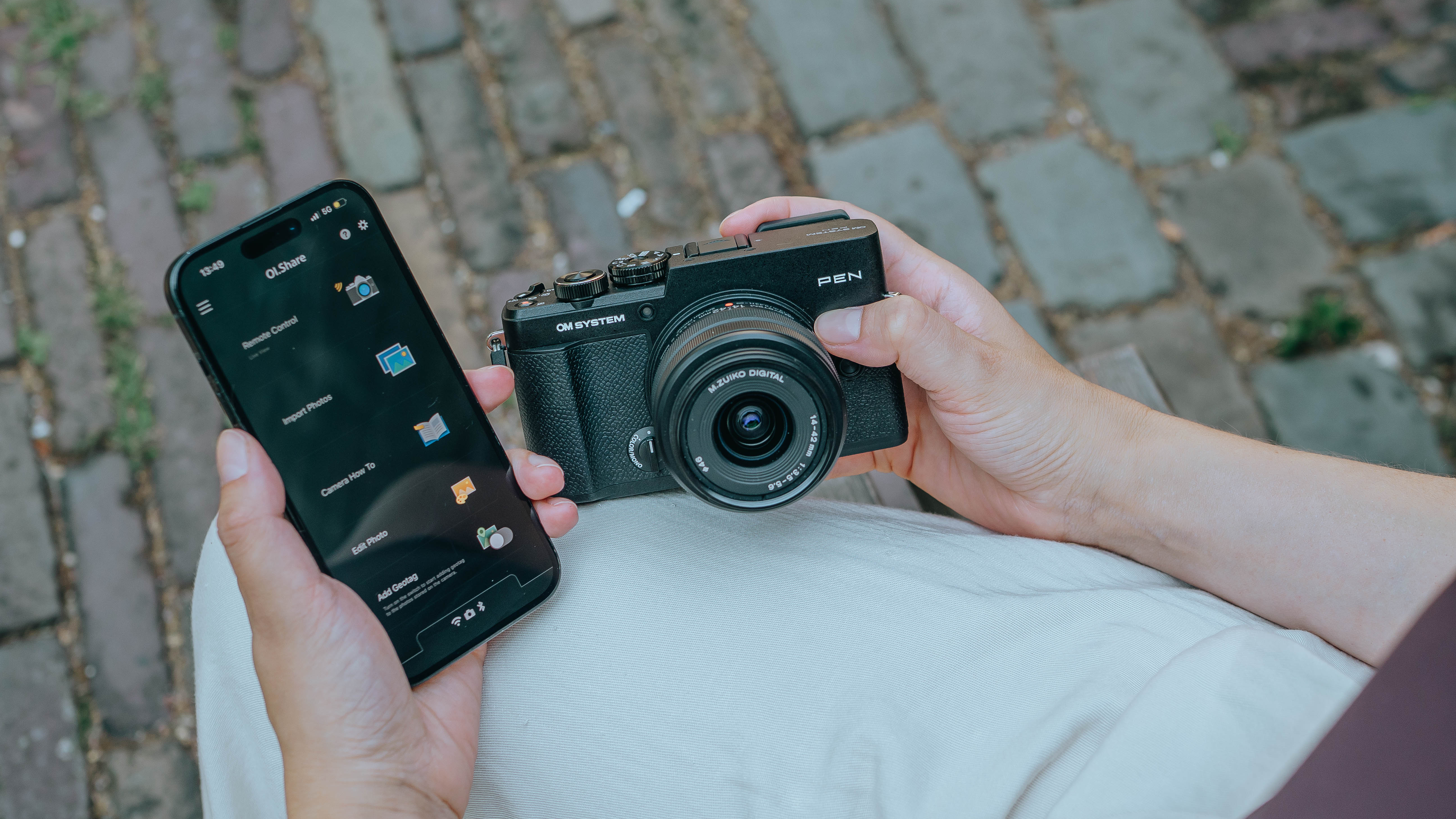
OiShare App

As you can imagine, the PEN is also fully equipped with Wi-Fi and Bluetooth connectivity, allowing users to send photos directly to their smartphones through the OM Image Share (OI.Share) app. The app can also be used to add GPS coordinates to your images, so long as the app is kept running in the background while you shoot.

How Does It Compare?

When looking at the OM SYSTEM PEN, it’s easy to see why this rangefinder stands out in its class. It’s all in the 2.36M-dot viewfinder. Similarly priced offerings from other brand shave done away with this feature, promoting an LCD only shooting experience. While certainly a popular technique among some users out there, the ability to shoot through an electronic viewfinder (EVF) can be a game changer, especially when contending with harsh glare.

Who Is the OM SYSTEM PEN For?

Who is this camera for? It actually fits the bill for a wide audience, starting with those looking to take their smartphone photography to the next level. Its size and weight advantages make stepping into the world of interchangeable lens cameras a breeze, and with the many filter and color controls available, its creative potential feels limitless.

Mid-Town ~ OM system PEN and the M.Zuiko Digital 14-42mm f/3.5-5.6 III, f/8, 1/160, ISO 200
Mid-Town ~ OM SYSTEM PEN and the M.Zuiko Digital 14-42mm f/3.5-5.6 III, f/8, 1/160, ISO 200 Mathew Malwitz

Even established OM users looking for a small walk around camera may find the PEN to be a fun offering. Not only will it allow them to shoot with a unified lens mount, but the menus will be familiar and easy to manage.

The OM SYSTEM PEN is an affordable, worthy successor to the legendary PEN-F, and the perfect everyday-carry camera. While it makes compromises to achieve a new, portable form factor, the advancements it introduces make it a great imaging tool for beginners and enthusiasts alike. To learn more about the PEN, check out the detailed product page.
