
When 35mm reflex cameras (SLRs) began arriving on our shores 70-odd years ago, the widest focal length lenses available at the time were 35mm (about 60° AoV). Wider-angle non-retrofocus lenses existed, but because their rear elements back-focused to within 5 to 10mm from the focus plane (film or camera sensor), they proved impractical for use in SLRs, which require 35-40mm of back focus to accommodate the mirror box.
Mirror boxes aside, non-retrofocus lenses have a lot going for them. These mushroom-shaped lenses are simple in design, contain fewer lens elements, are smaller, and weigh less than their retrofocus counterparts. Nonetheless, a new design formula was needed to fill the need for wider-angle SLR lenses.
Pierre Angenieux, a French cinema lens designer, nullified the problem in 1950 when he formulated the first retrofocus design wide-angle lens. Unlike the focal planes of non-retrofocus lenses, which are located close to the front of the lens, retrofocus lenses incorporate additional lens elements stacked together in a formula that shifts the focal plane farther back toward the rear of the lens, allowing space for SLR mirror housings.
Though intended for cinema use (motion picture camera shutters require the same amount of space requirements as SLR mirror boxes), the design advantages of Angenieux’s new retrofocus design were quickly realized by Nikon, Zeiss, Canon, and others. The newer retrofocus lenses were larger, heavier, and required more lens elements than their non-retrofocus counterparts—but that was the price to be paid if you wanted wider-angle lenses for (D)SLRs.
In the meantime, lens and camera manufacturers began adapting old school non-retrofocus wide-angle lenses for SLR use while feverishly designing newer retrofocus wide-angle lenses to take their place.
Retrofocus lenses are also referred to as “reverse telephoto” lenses. If you’ve ever peered through a pair of binoculars or a telephoto lens backwards you’d understand why. Non-retrofocus wide-angle lenses are alternately referred to as “true wide-angle” lenses.
Photographs © Allan Weitz, 2017

In 1959, the same year Nikon introduced its first SLR, the original Nikon F, the company also introduced the 2.1cm f/4 Nikkor-O ultra-wide-angle lens. Originally designed for use with Nikon’s earlier S-mount rangefinder cameras, Nikon’s “new” 21mm ultra-wide was retrofitted with a Nikon F-mount so it could be used with the F body, as well as the Nikon F2, Nikkormats, and other Nikon SLRs with a mirror lock-up mode. Because the mirror remained in the locked-up position when using these lenses, each lens came with a 21mm optical viewfinder that slipped over the camera’s film rewind knob, for image composition.
Other camera manufacturers also began producing non-retrofocus lenses for their own SLR camera systems. Included among them are the Leica Super Angulon-R 21mm f/3.4; Canon FL 19mm f/3.5; Minolta 21mm f/4 W. Rokkor; the Yashinon DX 21mm/f3.3; Yashica 21mm f/4; and the Zeiss 15mm and 16mm f/8 Hologons.

If there’s a downside to non-retrofocus lenses, it would have to be vignetting, which depending on the lens, can be 1 to 2 stops of light falloff toward the corners of the frame. When coupled to digital cameras, these issues can become exaggerated because, ideally, light shouldn’t strike the sensor at angles greater than 90°, which is the case when it comes to non-retrofocus lenses.
The Zeiss 16mm f/8 Hologon, which loses about 2 stops of light toward the edges of the frame, comes with a dedicated center-weighted graduated neutral density filter to compensate for the falloff.
Truth be told, most photographers don’t bother with these ND grads and allow the corners to go dark. Aesthetically, it invariably adds a healthy dose of drama to the photograph.
Depending on the camera and your subject matter, photographs captured using non-retrofocus wide-angle lenses adapted to digital cameras often (but not always) display cyan or magenta color shifts, color smearing, chromatic aberrations, and poor image quality, most notably toward the corners. This problem is limited to digital cameras—film cameras aren’t an issue. My personal experience shooting with these lenses has been positive, though it’s a common issue when shooting color. (Monochrome is invariably a safer workspace with these lenses).
It’s worth noting that many of the abovementioned image-quality issues become non-issues when using these lenses on APS-C of MFT-format cameras, simply because the edges of the frame are cropped from view.
One of the quirky—and for me, fun—aspects of shooting with non-retrofocus lenses on SLRs is that when you lock the mirror out of the way you effectively turn your reflex camera into a rangefinder camera, which has its pluses and minuses. On the downside, since the mirror is locked up out of the way, you no longer have through-the-lens viewing—you must compose images using an optical viewfinder.
On the upside, because you no longer have a mirror bouncing up and down every time you press the shutter you now have a quieter, more vibration-free camera. Your camera can now be used in (some, but not all) theaters and similar quiet zones, and because the mirror is in its locked position is easier to handhold at slower shutter speeds.
For me, the most welcome challenge of shooting with non-retrofocus wide-angle lenses mounted on SLRs is that because I no longer have the exacting visual assurances afforded by a reflex viewing system, it forces me to slow down a bit to be more diligent when composing my photographs.
Non-retrofocus wide-angle lenses were manufactured for a relatively short period before newer retrofocus design wide-angle and ultra-wide-angle lenses began coming to market. Today, you can purchase distortion-free retrofocus ultra wide-angle lenses as wide as 14mm (114° AoV) and as fast as f/2.8 for full-frame DSLRs and mirrorless cameras.
Gallery: Non-Retrofocus Wide-Angle Lenses and Photographs


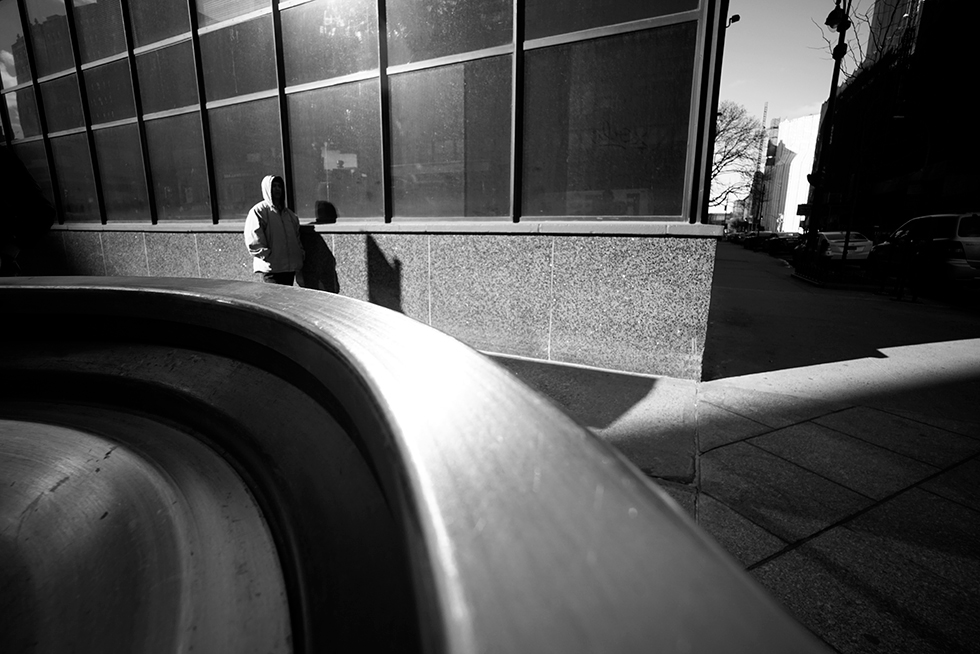


The curtain on non-retrofocus ultra-wide angle lenses began its descent during the late 1960s, with the arrival of the first modern retrofocus wide-angle lenses, including the Nikon 20mm f/3.5 UD (1967) followed by the wider Nikkor 15mm f/5.6 (1973) and Nikon 18mm f/4 (1974). Zeiss Distagon lenses also began arriving on our shores along with newer and wider retrofocus offerings from other camera and lens manufacturers. By 2005, the last of the non-retrofocus ultra-wide angle lenses—the Voigtländer 12mm Super-Wide Heliar SL ASPH and 15mm SL Ultra-Heliar ASPH in Nikon F mount, ceased production along with all their quirky quirks.

With the advent of mirrorless cameras and lens adapters, these unique optics have been experiencing a comeback, as I’ve seen a number of them come and go through the B&H Used Department.

Do you have any experiences with non-retrofocus wide-angle lenses? Which ones and which cameras have you used them with? We’d love to read your comments and anecdotes.