

![Pittsburgh Modular Cell [48] - Desktop Eurorack Modular Synthesizer Case](https://static.bhphoto.com/images/smallimages/1447667110_1198532.jpg)
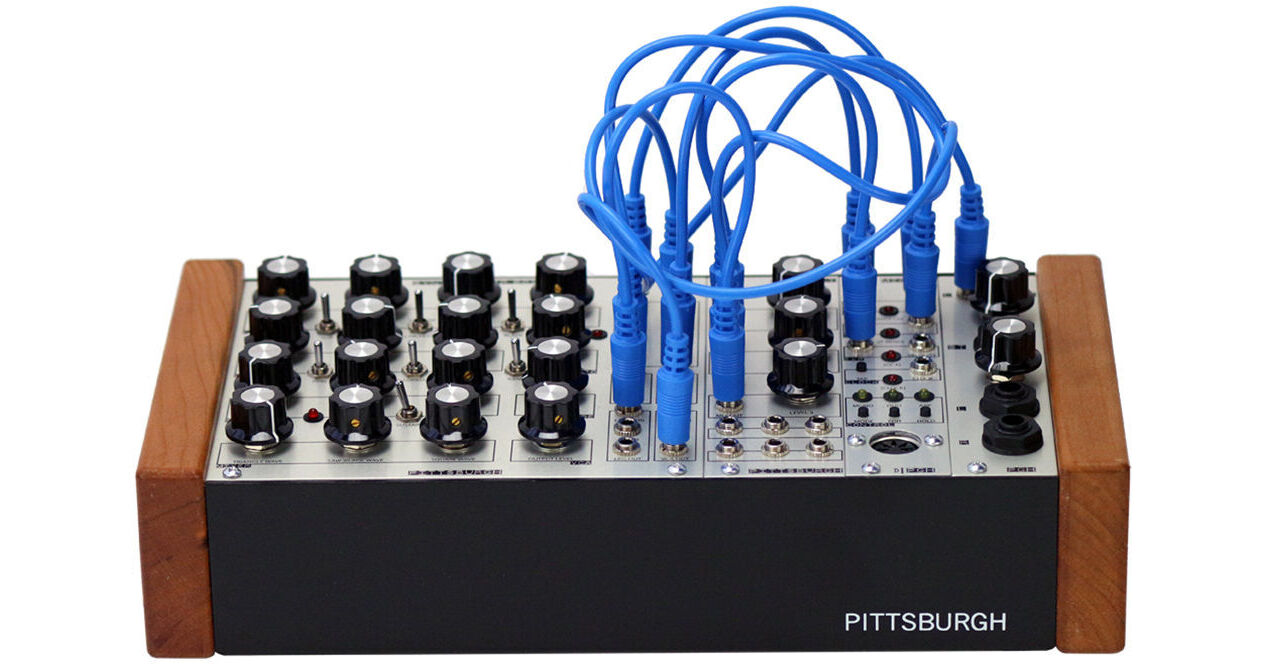
The System 10.1 from Pittsburgh Modular is a stand-alone, semi-modular synthesizer which offers a hardwired signal path, allowing for sound generation without the need for a single patch cable. The heart of the system is comprised of the Synthesizer Box, a complete synthesizer voice featuring several components including a complex waveform oscillator, a voltage-controlled lopass gate, an LFO, an ADSR envelope generator, glide circuit for portamento effects, a waveform mixer, and a high-quality, linear voltage-controlled amplifier (VCA). The Synthesizer Box offers a complete set of patch points able to override the internal audio and CV signal paths, and each component can be split apart and used like stand-alone modules. The System 10.1 also features additional modules including a Mix Mult, a MIDI-to-CV Converter, and an Output module with stereo headphone and dual mono outputs.
The System 10.1 is housed in the Cell [48] desktop case. The case offers an integrated power supply and Eurorack bus system. The System 10.1 is compatible with all Eurorack-format modules and ships with six 1/8" / 3.5mm patch cables.
The Synthesizer Box from Pittsburgh Modular is complete semi-modular monophonic synthesizer module that is wired for instant access to classic tones without needing a single patch cable. The module is compatible with all Eurorack modules and systems and features a complete set of patch points able to override the internal audio and CV signal paths.
The Synthesizer Box offers several components conveniently housed in one module including a full-range, complex oscillator, an oscillator-waveform mixer, a voltage-controlled multi-mode low-pass gate, a wide-range low-frequency oscillator (LFO), a glide control for portamento effects, an ADSR envelope generator, and a high-quality, linear-response voltage-controlled amplifier (VCA). Each component is fully patchable and functions independently of the rest of the module, allowing each circuit to be split apart and used like stand-alone modules. The Synthesizer Box is 88hp wide, 1.4" / 36.5mm deep, and requires 120mA of power. The module ships with a ribbon cable.
Waveforms Controls
- Coarse- and Fine-Tune Frequency Controls
- Sub Oscillator: Square wave pitched one octave below the core oscillator creates a huge bottom-end for the Synthesizer Box. Switch adjusts between low volume / off / full volume
- Frequency Modulation (FM): Used to modulate the pitch of the oscillator, the attenuated FM input can be switched between exponential and linear response. The FM input is internally patched to the LFO triangle output. This routing can be bypassed by patching into the FM CV IN input jack
- Saw/Blade Switch: Selects the type of saw wave sent to the mixer. The SAW wave is the core wave of the oscillator and is not affected by the MOD CV input. The BLADE wave is a unique, complex saw wave that can be modulated using the MOD CV input. Additional manipulation of the blade wave can be achieved using the BLADE IN jack
- Waveform Modulation (MOD CV): Attenuated MOD CV input controls the amount of waveform modulation. Waveform modulation effects the square wave and blade wave. The modulation effects each wave type differently. Pulse-width modulation of the square wave and wave-shape morphing of the blade wave. The MOD CV input is internally patched to the LFO triangle output. This routing can be bypassed by patching into the MOD CV IN input jack
Oscillator Patch Points
- 1V/O IN: One volt per octave input
- BLADE IN: Blade wave-manipulation input
- FM CV IN: Frequency-modulation input overrides internal routing to allow for external modulation
- MOD CV IN: Waveform-modulation input overrides internal routing to allow for external modulation
- TRI OUT: Post-mixer triangle-wave output
- S/B OUT: Post-mixer saw- or blade-wave output
- SQR OUT: Post-mixer square-wave output
- MIX OUT: Mixer output includes triangle, saw/blade, square, and sub-oscillator waveforms
LPG Controls
- Frequency Modulation (MOD CV): Attenuated MOD CV input controls the amount of low-pass gate frequency modulation
- Mod / Ping Switch: Determines how the low-pass gate responds to frequency modulation. In MOD mode, the MOD CV is used to sweep the frequency range of the low-pass gate. In PING mode, the MOD CV is converted to a short trigger used to ping or strike the low-pass gate. The PING mode takes advantage of the low-pass gate's fast attack and slow decay to create organic percussive sounds with a natural decay. The MOD CV input is internally patched to the envelope generator output. This routing can be bypassed by patching into the LPG CV IN input jack
- Frequency Control: In filter mode, the frequency knob controls the center frequency of the filter. In VCA mode, the frequency knob controls the pass-through signal level. In low-pass gate mode, the frequency knob controls both the center frequency of the filter and the pass-through signal level
- Resonance Control: In filter mode, the resonance knob controls the amount of resonance. In VCA mode and low-pass gate mode, the resonance knob is not active
- LPG Mode Switch: Switch between the 3 modes of the low-pass gate. VCA position (up) enables VCA mode, LPG position (center) enables low-pass gate mode, and low-pass position (down) enables low-pass filter mode
LPG Patch Points
- LPG CV IN: Frequency-modulation input overrides internal routing to allow for external modulation
- LPG IN: Signal input overrides internal routing
- LFP OUT: Signal output
LFO Controls
- Rate Knob: Selects the frequency of the low-frequency oscillator
- Range Switch: Determines the range of the rate knob. Switches between low range and high range
LFO Patch Points
- TRI OUT: Triangle-wave output
- SQR OUT: Square-wave output
Envelope Controls
- Attack Knob: The first stage of the envelope generator. The attack knob adjusts the rise time of the envelope
- Decay Knob: The second stage of the envelope generator. The decay knob adjusts amount of time the envelope remains at the maximum level while the envelope input contains a signal
- Sustain Switch: The third stage of the envelope generator. The sustain knob sets the maximum output level of the envelope once the decay stage has completed
- Release Knob: The fourth stage of the envelope generator. The release knob adjusts the amount of time it takes for the envelope to turn off once the decay stage has completed
Envelope Patch Points
- ENV IN: Envelope input
- ENV OUT: Envelope output
Glide Controls
- Time Knob: Adjusts the amount of time it takes to shift from one frequency to another
Mixer Controls
- Triangle-Wave Attenuator: Adjust the level of the triangle wave sent to the TRI OUT and MIX OUT
- Saw/Blade-Wave Attenuator: Adjust the level of the saw/blade wave sent to the S/B OUT and MIX OUT
- Square-Wave Attenuator: Adjust the level of the square wave sent to the SQR OUT and MIX OUT
Mixer Patch Points
- MIX OUT (in waveforms section): Mixer output includes triangle, saw/blade, square, and sub oscillator waveforms
VCA Controls
- CV Input Attenuator Knob: Adjusts the output level of the VCA
VCA Patch Points
- VCA CV IN: CV input. The VCA CV IN input is internally patched to the ENV OUT output. This routing can be bypassed by patching into the VCA CV IN input jack
- VCA IN: VCA signal input The VCA IN input is internally patched to the LPG OUT output. This routing can be bypassed by patching into the VCA IN input jack
- VCA OUT: Signal output
The Mix Mult from Pittsburgh Modular is a multi-function utility module that combines three functions into a single module, including a high-quality three-channel mixer and/or attenuator and two sets of passive multiples. The mixer/attenuator section functions as a flexible, low-noise three-channel mixer and/or attenuator for audio and CV. Patching into the output of channel 1 or 2 will remove that channel from the mixer circuit and turn the channel into an independent passive-signal attenuator. Channel 3 cannot be removed from the mixer circuit. However, if channel 1 and 2 are all being used as attenuators, channel 3 can be used as a buffered attenuator. The mixer knobs utilize a logarithmic volume curve that is tuned for use with audio, but it will work with CV as well.
The bottom of the module contains two sets of passive mults or multiples. Patching a signal into one of the multiple jacks will split the signal to the remaining two jacks, allowing a single audio or CV signal to be used in two places at once. The Mix-Mult module is 8hp wide, 1.0" / 25mm deep, and requires 20mA of power. The module ships with a ribbon cable.
- 3-Channel Mixer
- 2 Passive Multiples
The MIDI 3 from Pittsburgh Modular is a 3rd generation MIDI-to-CV converter compatible with the Eurorack format and is designed to convert MIDI note messages into the analog control voltages used by modular and other analog synthesizers, allowing synthesizers to be controlled by a MIDI keyboard, sequencer or DAW. The MIDI 3 has a robust feature set including monophonic and duophonic MIDI response modes, assignable CC and dedicated velocity outputs. Additionally, the module offers a feature-rich clock source with tap tempo, MIDI and external gate-clock dividers, and multiple arpeggiator responses.
The two CV outputs can be used to control the pitch of an oscillator, cutoff frequency of a filter, or any other voltage-controlled function. The two gate outputs can be used to trigger envelope generators or any module expecting a gate or clock source. The MIDI 3 is 6hp wide, 1.4" / 35mm deep, and uses 50mA of power. The module ships with a ribbon cable.
- Monophonic: Monophonic mode works great when using a modular as a single-voice synthesizer patch. Channel 2 Gate and CV outputs mirror the outputs of Channel 1. Monophonic mode has several keyboard responses to choose from. Last-note priority, low-note priority, and high-note priority. Each response is available with and without gate retriggering
- Duophonic: The MIDI 3 module uses the two sets of Gate and CV outputs to allow two notes to be played simultaneously. The first MIDI note is sent to Channel 1 Gate and CV outputs and the second is sent to Channel 2 Gate and CV outputs. Duophonic mode has three keyboard response modes to choose from. Unused channel and new-note priority, unused channel and low-note priority, and split-keyboard priority. Duophonic mode is perfect when working with a two-voice modular-synthesizer patch
- Arpeggiator: The MIDI 3 module includes a robust arpeggiator mode with multiple mono and duophonic responses to choose from. Available responses are monophonic response as played, double-triggered monophonic response as played, random monophonic response, random monophonic with a random Channel-2 gate, and random duophonic response with dual random gates. The arpeggiator can be clocked using tap tempo, MIDI clock, or external gate
- Internal Clock: The internal MIDI 3 clock utilizes the tap tempo button to modify the rate of the internal clock. The internal clock is used to clock the arpeggiator and is also output to the CLOCK jack
- External MIDI Clock: The external MIDI clock responds to MIDI start/stop messages and MIDI tempo from an external MIDI clock source. The external MIDI clock is used to clock the arpeggiator and is also output to the CLOCK jack. In external MIDI-clock mode, the tap tempo button cycles through five available clock divisions
- External Gate Clock: The external gate clock responds to gate signals patched into the CLOCK jack. The external gate clock is used to clock the arpeggiator. In external-gate clock mode, the tap tempo button cycles through six available clock divisions
- Assignable MIDI Channel: The MIDI 3 can be assigned to respond to all channels or any individual MIDI channel
- Assignable Pitch-Bend Range: The range of pitch bend can be set to +/- 2 notes, +/- 5th, +/- 1 octave, +/- 2 octaves
- Control Change Output: CC response of 0-5v
- Assignable Control-Change Channel Assign: Assign the MIDI CC channel the MIDI 3 responds to
- Velocity Output: Velocity response of 0-5v based on active note
The Outs from Pittsburgh Modular is a stereo headphone amplifier and line-output module offering dual independent level controls. The module offers stereo 1/8" / 3.5 mm inputs for left and right. The left input works with a mono input and will send the same signal to both left and right headphone- and line-level outputs. The stereo TRS 1/4" headphone output features a level control, while the dual mono 1/4" outputs have their own independent level control. The Outs module is 6hp wide, 1.5" / 39.0mm deep, and requires 30mA of power. The module ships with a ribbon cable.
The Cell [48] from Pittsburgh Modular is a Eurorack modular synthesizer case designed for desktop and studio applications to hold up to 9 Eurorack modules. The case is constructed from heavy 16-gauge black powder-coated steel and includes two single-row hardwood sides. The enclosure features two rails, each with 9 sliding square nuts and 20x 4-40-sized screws for mounting modules. The case can be configured as a single- or double-row system and is compatible with optional double-row hardwood sides.
The included DC power supply provides +12V @ 900mA, -12v @ 900mA, +5V @ 500mA of power. A single power rail delivers a full complement of power and the Eurorack bus system for up to 8 modules using standard 16-pin keyed power headers. The power board uses an external 15V 2.6A DC power adapter.
- Width (48hp): 9.5" / 242.0 mm
- Available depth for modules: 2.0" / 52.0 mm
- Available depth for modules (above Power Supply): 1.4" / 36.0 mm
- 9 sliding square nuts per rail
- 4-40-size panel screws included
- Rear-mounted on/off switch
- Powered bus-board supplies +12v / -12v / +5v
- Custom DC-powered bus board with standard 16-pin keyed-module power headers
- Eurorack bus-compatible bus board
- Side-mounted 0.1" / 2.1mm universal power adapter jack
- Universal DC power adapter