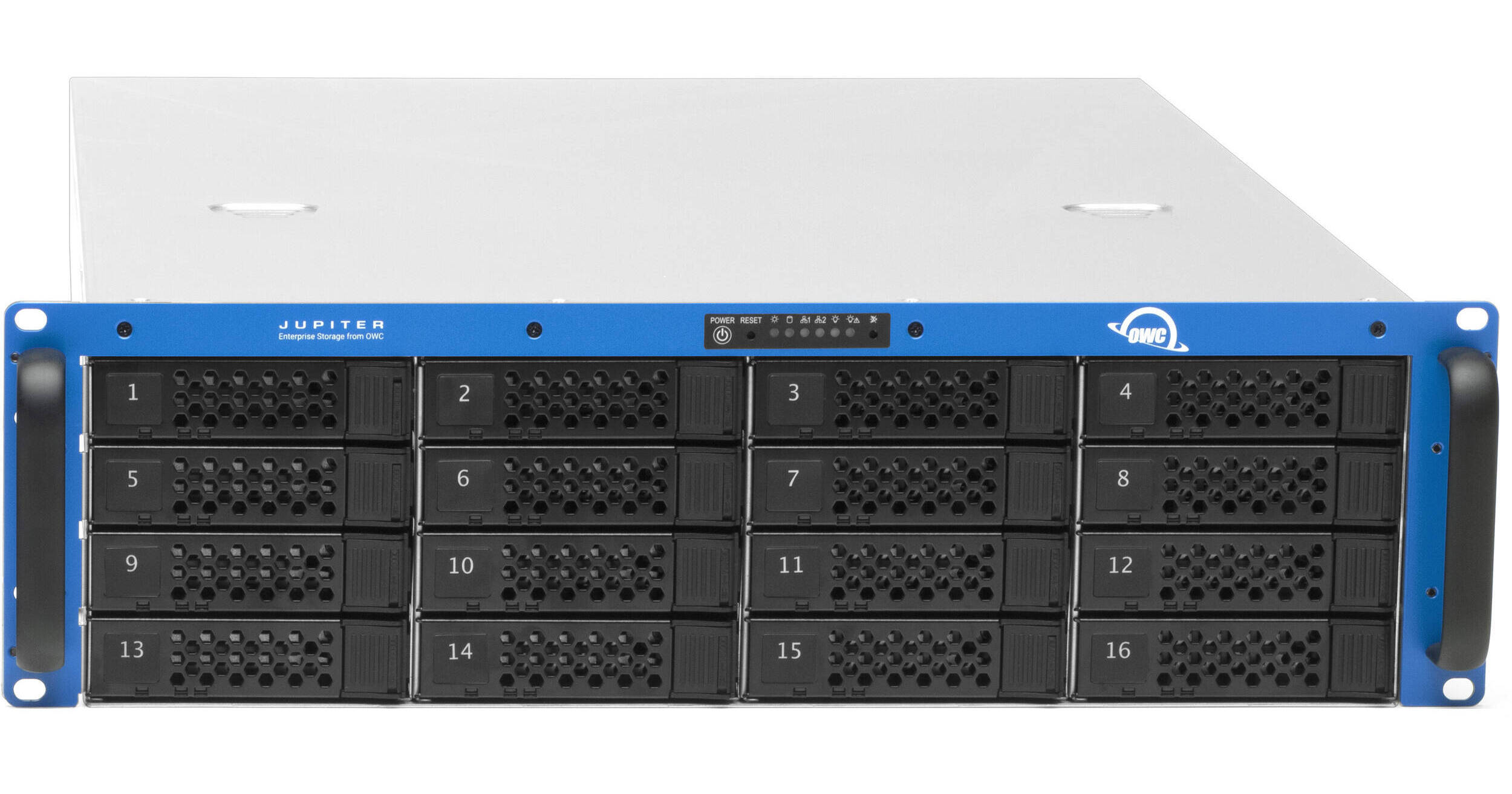
As a unified storage system, the Jupiter Callisto 32TB 8-Bay NAS Server from OWC / Other World Computing can function both as a NAS (network attached storage) and as a SAN (storage area network) at the same time. Tackle most any data need from general document storage to video production with Ethernet speeds up to 10 Gb/s coupled with advanced data protection, optimization, and flexibility via Callisto's ZFS-based storage architecture. Mini-SAS expansion supports up to seven OWC Jupiter Kore storage racks and can be expanded into petabytes of managed storage from a single Callisto box.
OWC's Jupiter Castillo features a 2 RU form factor and is equipped with eight drive bays that support 3.5 and 2.5" SATA or SAS drives, although this model has 32TB of storage that is configured as 8 x 4TB SATA III 3.5" HDDs. It is driven by a 2.2 GHz Intel Xeon Silver 4210 10-Core processor and 128GB of 2666 MHz DDR4 ECC Registered RAM in an 8x 16GB configuration, which may be upgraded to 512GB. Network connectivity is achieved using dual 10GbE ports, while storage expansion is accomplished using two 12 Gb/s Mini-SAS 8644 ports that allow for four SAS-3 compliant channels. Additional connectivity includes 2 two USB-A 3.2 Gen 1 (3.1 Gen 1/3.0) ports and two USB-A 2.0 ports for direct/local system updating and mouse/keyboard support, a serial port, and IPMI 1GbE RJ45 port, and a VGA port for accessing Console Setup to determine the unit's management IP address if you're using a DHCP assigned IP address. For users who need RAID capabilities, the Jupiter Castillo comes configured as RAID Z1, but may be reconfigured as RAID Z2 or Z3.
OWC's Jupiter Callisto 8-Bay NAS Server operates using dual redundant 380W power supplies and the TrueNAS SCALE OS. It is compatible with systems running Windows 10 or later, macOS 10.15 or later, and Linux. Included are two power cables, two slide rails, two rail extensions, eight M5 pan head screws, twelve M5 cage nuts, and four M5 enclosure securing screws.
- Storage pools to ensure easy future expansion and optimal data usage
- Caching to provide additional speed
- Automatic data integrity management to prevent data loss
- A robust set of RAID level options to ensure the best balance of speed and redundancy
- Snapshots, replication, and clones for easy backup and recovery
- Compression and data deduplication so data takes up less space