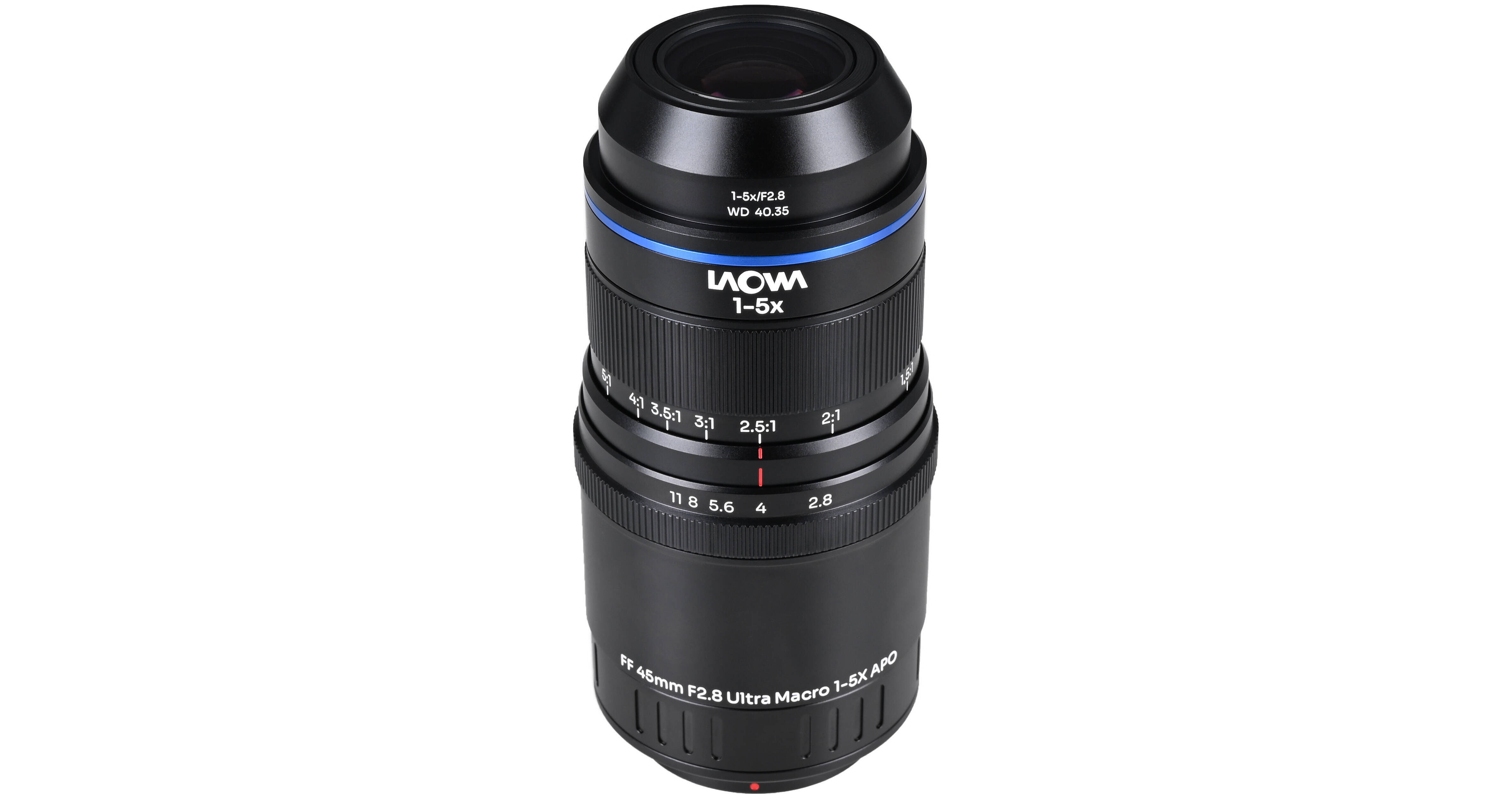
- Eleven-blade diaphragm contributes to a pleasing focus falloff when using shallow depth of field.
- Standard focal length benefits the high magnification design by providing greater depth of field compared to telephoto or long lens designs.
- When adapting the Aksen to medium format cameras, there will be varying levels of vignetting depending on the magnification.
- Lightweight physical design makes the lens easier to use handheld and offers more room for illuminating subjects.
- Full-Frame | f/2.8 to f/11
- 1:1 to 5:1 Magnification
- Fixed 1.6" Working Distance
- Internal Parfocal Zoom
Venus Optics Laowa Aksen 45mm f/2.8 Overview
Venus Optics Laowa Aksen 45mm f/2.8 Specs
| Focal Length | |
| Aperture | |
| Lens Mount | |
| Lens Format Coverage | |
| Minimum Focus Distance | |
| Magnification | |
| Optical Design | |
| Aperture/Iris Blades | |
| Focus Type | |
| Image Stabilization | |
| Dimensions | |
| Weight |
| Package Weight | |
| Box Dimensions (LxWxH) |
Venus Optics Laowa Aksen 45mm f/2.8 Reviews
Laowa Aksen 1-5x has been a blast to use!
I have thoroughly enjoyed taking macro photos with this lens. Images are super sharp with amazing detail. I've been really enjoying it at f/5.6 no matter how far I zoom in. Even at max zoom, it takes beautiful images!
My PB-4 can finally retire
For years, I've been doing all my larger than 1X work with a Nikon PB-4 bellows and reversed 50mm lens. It's a venerable combo, but it's too unwieldy to use outdoors, and the sharpest tool in the shed, it is not. I considered upgrading from time to time, but Laowa ultimately successfully tempted me with the new Aksen series. The Laowa 45mm Ultra Macro's image quality is significantly better than what I was getting from a reversed vintage manual focus 50mm prime lens on a bellows. Between 1X through 3X, in the middle of its aperture range and with proper technique, it's reliably produced razor sharp images at 45MP on a full frame sensor. In the 4X to 5X range, results are still very good, but I try to keep the aperture at f/5.6 or below to avoid too much softness from diffraction, and depth of field is so narrow that focus stacking is effectively mandatory. Physically, the lens feels reassuringly solid, with controls that move smoothly but with enough firmness that I don't worry about changing them accidentally. The weight of the lens is enough that it will tip my Nikon Z9 forward if I leave it unsupported on a table, but it's not so heavy that I feel it's out of balance without a tripod collar. Since I use it on top of a focusing rail on top of a geared head on top of full size tripod, mounting the rig by the base of the camera works for me. However, if I had a small and light camera and/or a lightweight ball head, I could easily find myself wanting a tripod collar. The aperture being entirely manual might be a shock if you're accustomed to modern autofocus macro lenses, but I've always had this limitation with my ultra macro setup. As long as I have a reasonably bright room or some kind of modeling light, leaving the lens stopped down and composing on live view is totally serviceable. So in practice, once I dial in the desired aperture, I don’t end up touching the aperture ring much while working with one composition. The lack of any other electronic communication means that there's no data on aperture or magnification, so that's up to the photographer to document as they see fit (in a fantasy world, it would be cool if it did have communication for the sake of EXIF data, but as it stands, if I really care, I just snap a cell phone photo of my setup in situ so I can refer to the lens markings later). In summary, for what this lens delivers in image quality and usability at its price point, I have no complaints, and am looking forward to enjoying it for years to come.
