Convergent Design

Free your computer-based recording or livestreaming rig from the constraints of cables and complicated setup with the Convergent Design Erika, a USB wireless microphone system that's ultracompact, extremely simple, and cost effective, making it ideal for content creators, podcasters, mobile journalists, and educators, as well as corporate meeting hosts and participants. Available as a complete system in one-, two-, and four-person setups, or as individual
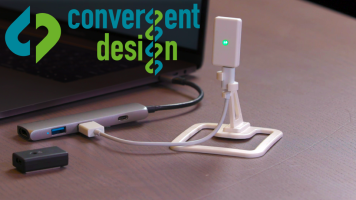
Free your computer-based recording or livestreaming rig from the constraints of cables and complicated setup with the Convergent Design Erika, a wireless USB microphone system that's ultracompact, extremely simple, and cost-effective, making it ideal for content creators, podcasters, mobile journalists, educators, and more. The system comprises a miniature USB receiver with a stand and an equally tiny transmitter with a

Impress your video-shooting loved one, or treat yourself to the gift of an on-board monitor. Mirrorless cameras, DSLRs, and action cameras are popular, compact choices for capturing video, but most lack a good-sized, high-resolution display screen. Look to "on-board" or "on-camera" monitors to fill the gap—most offer 5 to 7" display screens, with some also doing double duty as recording devices.
These compact monitors also provide a crucial window into your shot for a camera assistant, director, dolly grip, sound mixer, crane operator, or

Once upon a time, compression was a dirty word, but the reality is that compression is occurring throughout the image taking process. Your lens compresses the image, unless you are shooting 1:1 macro. You could consider the Bayer filter on your sensor a form of compression, (referred to as Color Sampling Ratio) and, of course, there is the codec (compressor/decompressor), format, and bit-rate you choose. All this happens before your images even get to the recording media. So, compression is hidden throughout your image and, by itself,

Mirrorless cameras are small, light, and can get into spaces traditional cinema and ENG cameras just can't. However, mirrorless cameras are not meant to work on a film set all day long—it just isn't in their ergonomics. This is especially true if you are planning on handholding a camera all day, or working with accessories such as follow focus units, zoom motors, or external monitors.
Build Your Own or Pre-Made
You can build your own support rig, if you like. Head out to your machine shop and have at it. But, most likely, you lack the milling

Whenever I think of professional video cameras, my mind is drawn to those ubiquitous shoulder-mounted beasts on news sets, and hundred-pound 35mm film camera setups in movie studios. Romanticizing the idea of the iconic professional camera is easy to do. Generally speaking, the content that most people consume is created with gear that fits into that stereotype. In most cases, the cost, storage space, and maintenance required by that equipment is more than a single person can bear. Hence, those cameras are, more often than not, the property of

Whether you’re a student or a seasoned veteran, selecting the right camera can make your head spin with questions. Does sensor size matter? What’s the difference between 4:2:0 and 4:2:2? Do I really need a camera that can record 8K? What about raw? We’ll explain the key components that help a camera produce cinematic images, and in doing so, hopefully help you make that all-important decision.
Evaluate Your Needs and Your Budget
Before considering certain cameras, you must know your needs and your budget. And be realistic. If you are a student