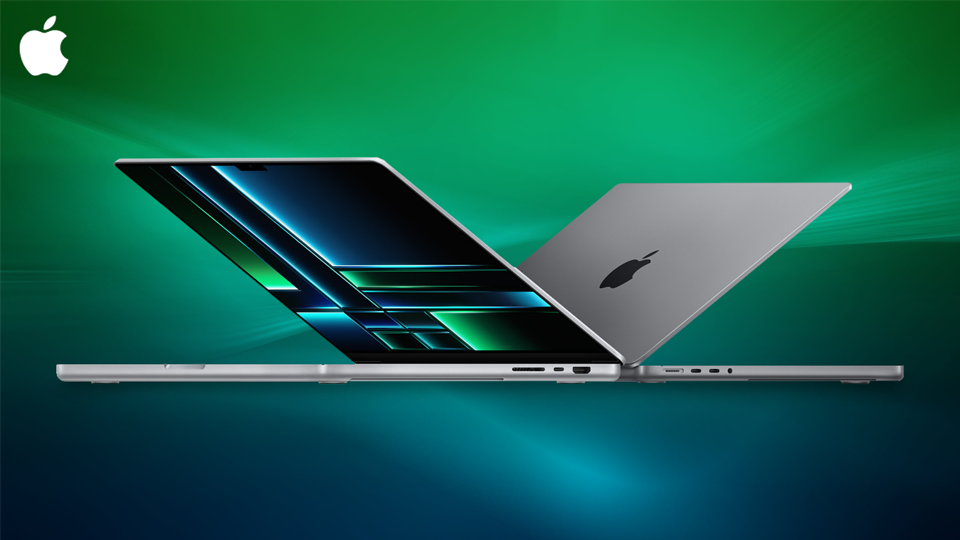
Announced in a press release during the early hours of January 17, 2023, Apple introduced two next-gen SoCs (system on a chip), the M2 Pro and M2 Max. Building on the M2 architecture found on the MacBook Air, these two SoCs push the performance of Apple Silicon to new frontiers. The M2 Pro and M2 Max chips can be found on the 14" and 16" MacBook Pro models while Apple updated the Mac mini with M2 and M2 Pro chips.

M2 Pro
Built using second-generation 5nm process technology, the M2 Pro consists of 40 billion transistors, which is almost 20 percent more than the M1 Pro and double the amount in the M2. It features 200 GB/s of unified memory bandwidth, which is twice that of M2, and up to 32GB of low-latency unified memory. The next-gen 10- or 12-core CPU consists of up to eight high-performance cores and four high-efficiency cores, resulting in multithreaded CPU performance that is up to 20 percent faster than the 10-Core CPU in M1 Pro. This means apps like Adobe Photoshop can run heavy workloads faster than ever. The GPU can come in either a 16-Core or 19-Core variant. The 19-Core GPU includes a larger L2 cache and can be up to 30 percent faster than that of M1 Pro, resulting in huge increases in image processing performance and enables console-quality gaming.

M2 Max
The M2 Max pushes the performance and capabilities of Apple Silicon even further with 67 billion transistors, which is 10 billion more than the M1 Max and more than three times that of the M2. Its 400 GB/s of unified memory bandwidth is twice that of the M2 Pro and four times that of the M2. The M2 Max also supports up to 96GB of fast unified memory. The M2 Max features the same 12-Core CPU as the M2 Pro but can come with either a 30-Core or 38-Core GPU. Graphics speeds climb up to 30 percent faster than the M1 Max, allowing the MacBook Pro with M2 Max to tackle graphics-intensive projects with ease. From powering visual effects to stitching together gigapixel images, the M2 Max provides fast performance whether plugged in or running on battery power.
MacBook Pro
Both the 14" and 16" MacBook Pro models can be configured with the M2 Pro or the M2 Max chip. The GPU can be 16-Core or 19-Core with the M2 Pro and 30-Core or 38-Core with the M2 Max. Apple states that battery life has been improved, lasting up to 22 hours. The M2 Pro/Max MacBook Pro also gets improved connectivity with Wi-Fi 6E (802.11ax). The advanced HDMI port now supports 8K displays. With up to 96GB of unified memory on the M2 Max model, creative professionals can work on scenes so large that other PC laptops will not be able to handle. The fan favorite features are still available on the MacBook Pro, such as the Liquid Retina XDR display, Full HD 1080p FaceTime HD camera, six-speaker system, and studio-quality mics.

Mac mini
The updated Mac mini will be available with a M2 or M2 Pro chip. The M2 Pro model brings pro-level performance to the Mac mini for the first time, enabling users to run CPU-intensive workflows. The Mac mini with M2 and M2 Pro delivers more unified memory and advanced connectivity, including support for up to two displays on the M2 model and up to three displays on the M2 Pro model. When paired with the Studio Display and Magic accessories (sold separately), the Mac mini can provide an optimal desktop experience for creative professionals, all from a compact design.

Apple says the MacBook Pro with M2 Pro or M2 Max, as well as the Mac mini with M2 or M2 Pro, will be available for order today, January 17, in 27 countries and regions, including the United States. Customers, Apple Stores, and Apple Authorized Retailers are expected to start receiving them starting Tuesday, January 24.
The Creative Edge
Thanks to their silicon upgrades, the new MacBook Pro and Mac mini now deliver unprecedented levels of power and performance, allowing users to push their creative vision further than ever before.
For creative professionals working on a MacBook Pro, that dramatic boost in performance means apps like Adobe Photoshop or Xcode run heavy workloads faster than ever. Photoshop users coming from an M1-based system should see 40 percent faster speeds, and that goes up double for users coming from an Intel® Core™ i9-based system. Xcode, on the other hand, is up to 2.5x faster than on the fastest Intel®-based MacBook Pro.
The GPU in M2 Pro can be configured with up to 19 cores―three more than the GPU in M1 Pro — and includes a larger L2 cache. M2 Max brings incredible performance upgrades, whether plugged in or running on battery power, from powering visual effects, to training machine learning models, or stitching together gigapixel images. Massive files open instantaneously and working across multiple pro apps is incredibly quick and seamless.
The M2 Max chip inside the new Pro has the same 12-core CPU as the M2 Pro, but much like the M1 Max, it really pushes the GPU power more. Apple claims the M2 Max is up to 30 percent faster than the M1 Max in graphics and according to Apple can reportedly handle graphics-intensive scenes so large that “PC setups can’t even run them,” thanks to the 96GB of unified memory in the chip.
Mac Mini users also have plenty to be excited about, as well, thanks to M2. This marks the first time that Apple is bringing its Pro-level chips to the Mini, with the previous iteration only containing the base-level M1 chip. Apple claims the new M2 Pro Mac Mini is faster than its M1-powered predecessor in categories like graphical performance with apps like Affinity Photo running 2.5x faster and rendering a complex timeline in Final Cut Pro up to 4.2x faster. Those coming from an Intel®-based Mac Mini can expect performance up to 14 faster.
M2 Pro has an immensely powerful and efficient media engine, including hardware-accelerated H.264, HEVC, and ProRes video encoding and decoding. It’s capable of speeding through the most popular video codecs and can simultaneously play up to five streams of 8K ProRes 422 video at 30 fps, or up to 23 streams of 4K ProRes 422 video at 30 fps.
Mac mini users can run high-performance workflows that were previously inconceivable in such a compact form factor. Musicians can produce music with loads of powerful plug-ins and effects without performance drops while photographers can adjust huge images in an instant. It’s a fantastic entry point for would-be creators or streamers.
Excited to try the updated MacBook Pro and Mac mini for yourself? Let us know in the Comments section, below.
