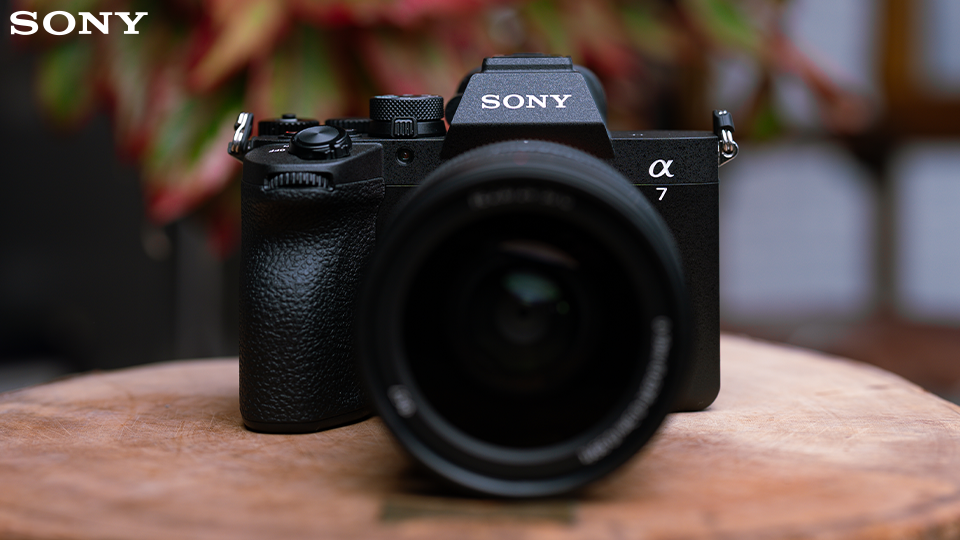
Sony announces its first new midrange mirrorless camera in four years, the α7 V, bringing with it the company's first partially stacked sensor and a new BIONZ XR2 processor featuring an integrated AI unit. The new guts unlock substantial gains in speed, intelligence, and versatility first introduced in 2024's flagship α1 II, making the α7 V an elite all-in-one option for hybrid shooters.

Sony is also debuting a new kit lens, the FE 28-70mm f/3.5-5.6 OSS II, alongside the new camera.
The camera's new 33MP Exmor RS CMOS sensor is Sony's first to feature a partially stacked design, delivering faster readout speeds that allow the α7 V blackout-free continuous shooting at up to 30 fps with full autofocus and auto-exposure tracking. It's the highest-resolution sensor to feature the partially stacked design available on the market, bringing with it an extra stop of dynamic range above its predecessor (for a total of 16), an extra stop of low-light autofocus sensitivity, a low-noise native ISO of 100-51200, and a new max shutter speed of 1/16000s.
Image stabilization is also improved over the α7 IV, with the V rated for 7.5 stops at the center and 6.5 stops at the edges.
Another first for a Sony Alpha-series camera, the new BIONZ XR2 processor integrates the camera's AI unit into a single, powerful engine driving many of the α7 V's new capabilities. Inherited from the α1 II are blackout-free continuous shooting, eight modes of AI subject recognition, Pre-Capture recording up to a second before shutter press at 30 fps, Speed Boost function for in-the-moment burst rate bumps, and Dynamic Active for improved stabilization when shooting video.

The new engine also delivers gains in autofocus. Real-time Tracking leverages AI for improved subject detection and framing, and the camera's autofocus features 759 phase-detection points across 94% of the frame. Focus areas have additional customization options, with new XS (extra small) and XL (extra large) spot sizes available.
Speaking of video, the α7 V shoots 4K60p oversampled from the full 7K frame, 4K 120p at a Super35/APS-C crop, and 240p at Full HD. In addition to AI auto-framing and Dynamic Active stabilization, the camera supports focus breathing compensation, 4-channel 24-bit audio recording, Sony's standard S-Log3 and S-Cinetone profile sets, Flexible ISO for ISO-agnostic workflows, and User LUT imports. A unique Sigma-shaped graphite heatsink improves runtimes for extended 4K60 recording, and the camera can be used for live-streaming both wired and wirelessly.

The body and interface design get upgrades as well. The camera, whose magnesium-alloy construction keeps similar dimensions to the α7 IV but is about an ounce heavier, receives the α7R V's combination tilting vari-angle 2.1M-dot rear touchscreen LCD. Menu layouts are touch-enabled, as is focus selection. The camera gets a second USB-C port, with one rated at 10 Gbps for data transfer and the other optimized for power delivery. Battery life is also improved at more than 20% over the α7 IV to a maximum 750 shots per charge.











The α7 V also gets a connectivity upgrade with Wi-Fi 6 using both 5 and 6 GHz bands. Returning from the α7 IV are the dust and moisture-resistant build and 3.68M-dot OLED EVF.
Sony's latest kit lens, the FE 28-70mm f/3.5-5.6 OSS II, was designed to take advantage of the α7 V's improvements. The fully electronic lens boasts linear autofocus and a 7-blade diaphragm and supports AF/AE at up to 120 fps.
With an expansive feature set and robust body built for heavy and extended use, Sony exits the year with an enticing camera equipped equally for action, portraiture, landscapes, documentary work, and video production.
For more information, including additional features, specs, and highlights, be sure to check out the detailed product pages for the α7 V Mirrorless Camera and the FE 28-70mm f/3.5-5.6 OSS II lens.
