
Among the many tools audio engineers use to sculpt and shape raw audio into a final work, most would say that compressors are in the top two most ubiquitous and useful. In concept, compressors are simple tools: they make the loud parts of sound quieter and the quiet parts louder, reducing dynamic range so that everything can be heard more clearly. They were first developed out of necessity, designed to solve critical technical problems in the early days of AM radio broadcasts—loud signals would distort, and quiet signals would be lost behind the static of the airwaves. The release of the first compressor in 1937 represented a major leap forward in audio technology.
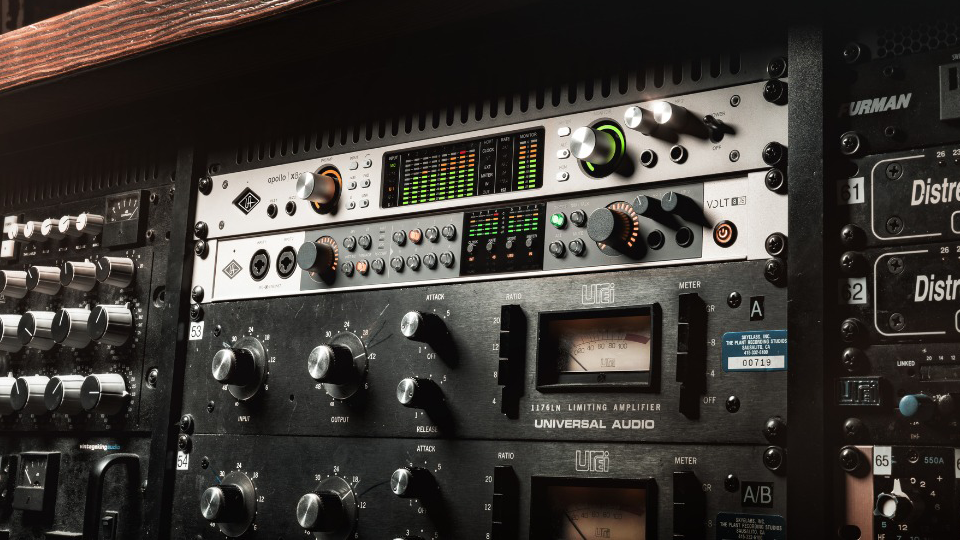
Engineers soon discovered that compressors could be more than a corrective tool—that they added warmth and color to sounds, allowed sounds previously buried in a mix to be present, and present sounds to become exciting. Later still, music producers found ways to use the compressor as a compositional tool, its sonic footprint forever imprinted in modern dance music’s ducking effect—Daft Punk’s “One More Time” is a prime example of this phenomenon making an entire track percussive.
Compressors have evolved into fascinating, diverse tools—while they all achieve the same goal, the technology used to do so varies wildly, each using different methods that impart unique and distinctive character. Understanding how these different technologies work is key to understanding why each one has its own sound and will help you determine best practice choosing which to use and when (don’t worry, it won’t get too technical).
In this guide, we’ll take a look at some of the most iconic compressors used in countless famous recordings and chart-topping hits through decades of recorded music history, as well as their software emulation counterparts—and they’re all available for sale at B&H.
Universal Audio 1176 Limiting Amplifier – FET Compression
The 1176 Limiting Amplifier is a field-effect transistor (FET) compressor designed by Bill Putnam and released by UREI (now Universal Audio) in 1967. Perhaps one of the most iconic and cloned compressors of all time, the 1176 marked the transition from vacuum tubes to solid-state technology while maintaining many of the sonic characteristics of tube compressors.

FET compressors make use of a circuit that detects how much an audio signal exceeds a set decibel threshold and immediately sends a non-linearly proportionate amount of voltage to the FET (a variable resistor), which in turn increases its resistance. The louder the signal is, the more voltage is sent to the FET. More voltage to the FET means more the compressor reduces gain.
This process takes place at the speed of electricity and is why the 1176 is known for its fast, aggressive, and colorful characteristics. It’s vaunted for its near instantaneous attack, hard-edged punchiness, and rich harmonic saturation, adding grit, warmth, and density—even at moderate settings. The over-the-top “British mode” was originally an unintended engineering oversight, but now is a feature, making it the first analog compressor that could create a hyper-aggressive, program-dependent (around 12:1-20:1) ratio of input to output.
Engineers love having the 1176 in their arsenal because it potentially can be used for anything, but most common use cases are adding punch and bite to drums, presence to vocals, saturation to bass, and dynamic control and coloration to guitars.
Teletronix LA-2A Leveling Amplifier – Opto Compression
The Teletronix LA-2A is a vacuum tube optical (opto) compressor whose construction and design could be the yin to the 1176’s yang. They are equally iconic, both debuting within three years of each other, both massively important to the mid-century broadcast industry and current audio industry, and both associated with Bill Putnam (though the LA-2A was designed by James F. Lawence, whose company was acquired by UREI). However, their internal circuitry and design philosophy couldn’t be more disparate.
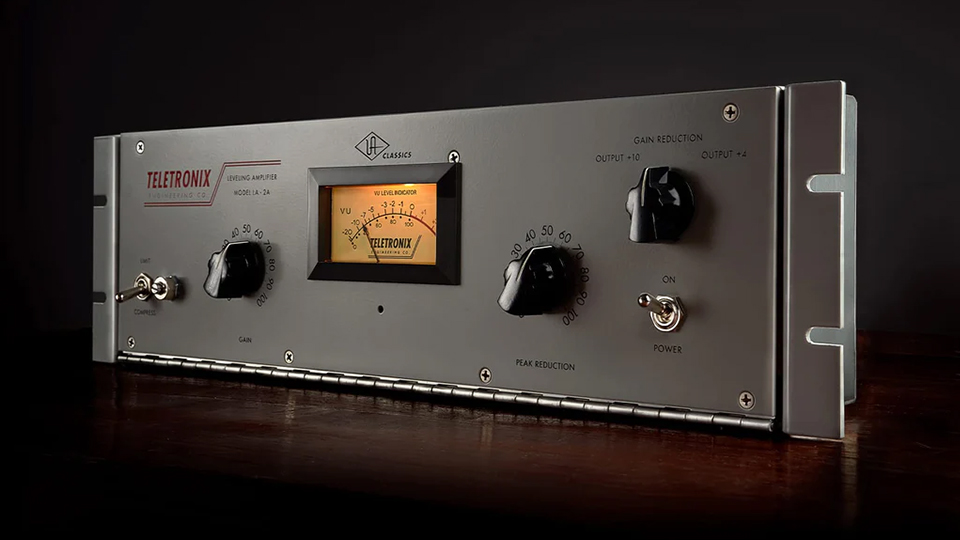
The LA-2A is a tube-based optical compressor. Simply put, it uses the voltage of a signal input to turn on a light, which triggers a light-dependent resistor (LDR). This LDR causes gain reduction in the output signal proportional to the brightness of the light, resulting in a much slower acting compression.
Think about when you turn a traditional lightbulb on and off. It happens quickly, but not instantaneously. It takes a split-second to reach maximum brightness but comparatively much longer for the filament to transition from luminescent, to glowing red, to off. The brighter the filament burns, the longer this red glow will last. This is the pillar of the design philosophy of the opto compressor—program-dependent release. This is why you cannot set the parameters of attack and release on a true opto compressor.
The LA-2A’s design creates gentle, natural, and warm compression characteristics—because its attack and release are parametrically married to the signal, the LA-2A is symbiotic to its input. It is common for engineers to route signal to an LA-2A and not even engage compression, as its tubes and transformers add character innately. It is often used in series with faster compressors like the 1176, where the 1176 handles initial peaks and transients to create punch while the LA-2A smooths out the sustain and release while adding richness and warmth.
The LA-2A is a versatile compressor but is most notable for its use on vocal chains. Alannis Morrisette’s “Jagged Little Pill” uses the LA-2A to extract a distinctive, dynamic, and up-front character to her vocals, while Jack White’s engineer overloaded it to add aggressive distortion and edge to his vocals while avoiding ear-splitting shrillness and maintaining warmth and richness. It’s often used on bass guitars for thickness and dynamic consistency, such as Paul McCartney’s sound on most of his work with the Beatles. It can add body and width to guitars, keyboards, and wind instruments (this is an example of when you’d route a signal into the LA-2A and not engage compression), and be used at the end of a chain to “glue” together drum mixes adding cohesion and polish.
API 2500+ – Feature-Rich VCA Compression
The API 2500+ is a rack-mountable stereo bus VCA (voltage-controlled amplifier) compressor and considered by many to be a modern classic. Its dual-channel design combines the features of modern and classic compression philosophies, making it an incredibly versatile machine that excels with low-end content and master track mixing.
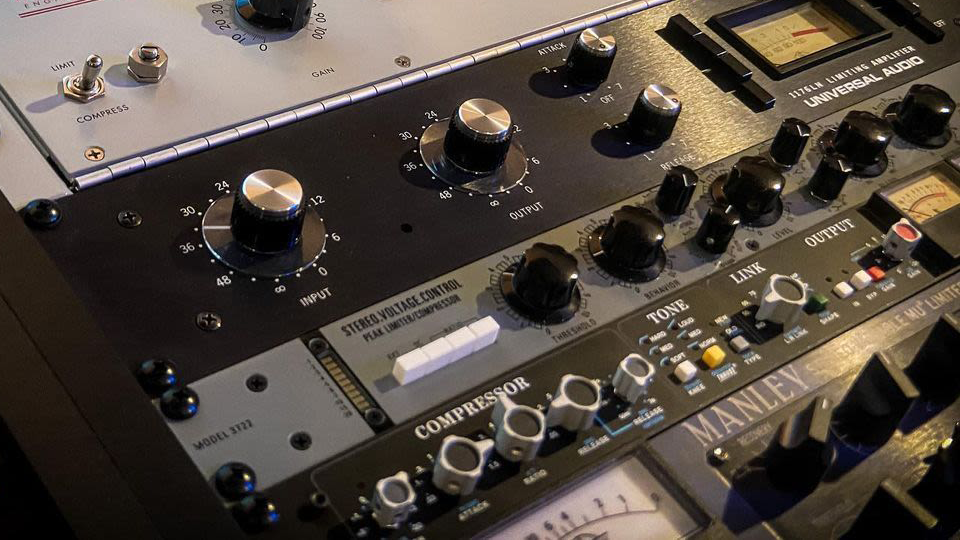
VCA compressors are commonly used in the modern recording industry due to their precision, speed, clarity, and versatility. They are quite simple to understand conceptually: the VCA is essentially an automated volume knob, and the level of the input (or control voltage) moves the audio volume up or down in direct proportion (as opposed to FET compression’s non-linear proportion).
The API 2500+ takes full advantage of its dual-channel VCA design—you can use it as a stereo bus compressor to mix your master track or sub-group without fear of shifting the stereo image, but you can also run it in crossfade and parallel modes. In crossfade mode, you can crossfade between a dry and wet signal. In parallel mode, the dry signal remains at a constant volume, and the mix knob adds the wet signal on top. This makes parallel compression easy.
The old/new toggle switches between feedback and feedforward modes. In old (feedback), a detector “listens” to the output amplitude and tells the compressor to adjust gain reduction based on the compressed signal, resulting in a gentle, transparent sound. In new (feedforward), the detector “anticipates” the input signal’s amplitude and tells the compressor to apply gain reduction immediately—this results in a more aggressive and punchier sound.
Humans do not perceive loudness equally across all frequencies, and lower frequencies need more energy to be equally as loud as mid-range and high frequencies (check out the equal loudness curve). Compressors are often overdriven by bass heavy content, creating an undesirable, muddy effect. API’s proprietary THRUST (registered trademark) circuit prevents low frequencies from dominating the compressor’s action and is why the 2500+ is so great with bass heavy signals.
All these features give the API 2500+ punchy, thick, and colorful sound characteristics, particularly effective for low-end heavy content, or for heavily saturating a mix with saccharine harmonic distortion. The 2500+ is often used to crush and glue drums—with slow attack, fast release, and THRUST enabled, it can seriously emphasize transients and pull aggressive saturated overtones out of a kit while and adding cohesion, thickness, and high-end clarity. As such, it’s great for bass guitars and synths, adding presence and thickness while glueing to a kick. And it’s a fantastic mix bus compressor to stack on your master chain.
SSL G-Series Bus Compressor – Glue without the Sparkles
The SSL G series stereo bus compressor was originally featured in the original SSL 4000 G-series console from the 1980s. It was not an individual piece of outboard gear, but a key component of the console’s signal flow, positioned directly on the center section of the console before the master fader. This design enabled engineers to “mix into the compressor”—creating a cohesive “glued” sound. As this style of workflow grew in popularity, SSL released a standalone rackmount and a 500-series version for use without a full SSL console.
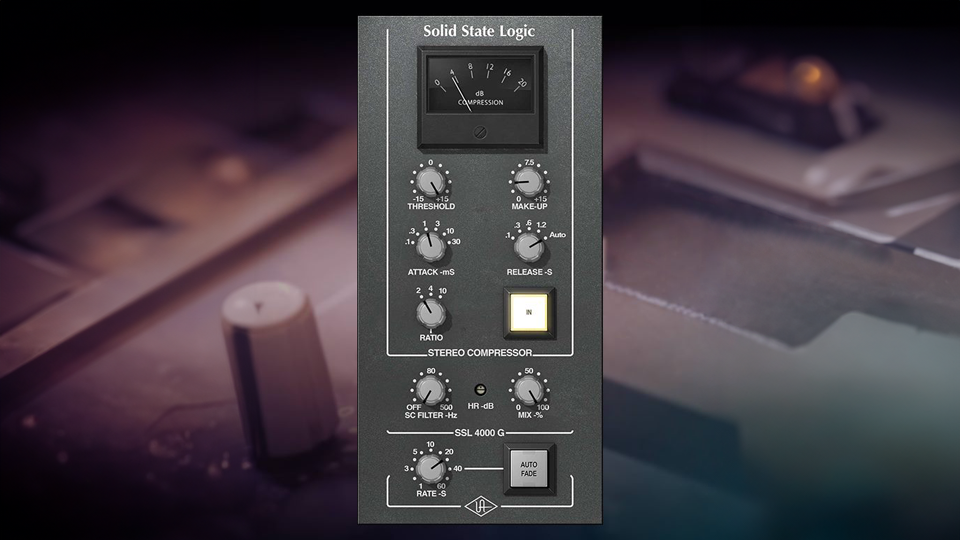
The SSL G-series, like the API 2500, is a VCA stereo bus compressor, best suited for use on a mix bus or drum bus—or anything where a group of inputs gets summed together in stereo. Unlike the 2500, the SSL G compressor relies on simplicity and ease of use, having few special features and relying on its reputation and transparent sound characteristic to stand out.
The SSL G has standard compressor controls, 6 ratio settings, an “auto release” function that adjusts release time according to the input signal envelope (achieving program-dependent release), and a high-pass filter, which is a simpler method to achieve the same concept as API’s THRUST. This compressor does most of its heavy lifting at the end of a chain, gluing the mix sum together and injecting punch and drive while adding subtle coloration, leaving you with a very clean, transparent, and cohesive output.
Empirical Labs Distressor – Analog Sound Meets Digital Control
The Empirical Labs’ Distressor is a single-channel VCA digitally controlled analog compressor, meaning that audio input stays in the analog domain entirely, and is never converted into digital data. A small digital component manages internal functions and switching, giving the Distressor the sonic characteristics of analog processing with the functionality and versatility of digital control. This makes the Distressor a favorite among audio engineers, as it can mimic classic compression characteristics from FET, opto, and Tube based machines, while offering its own distinct character as well.
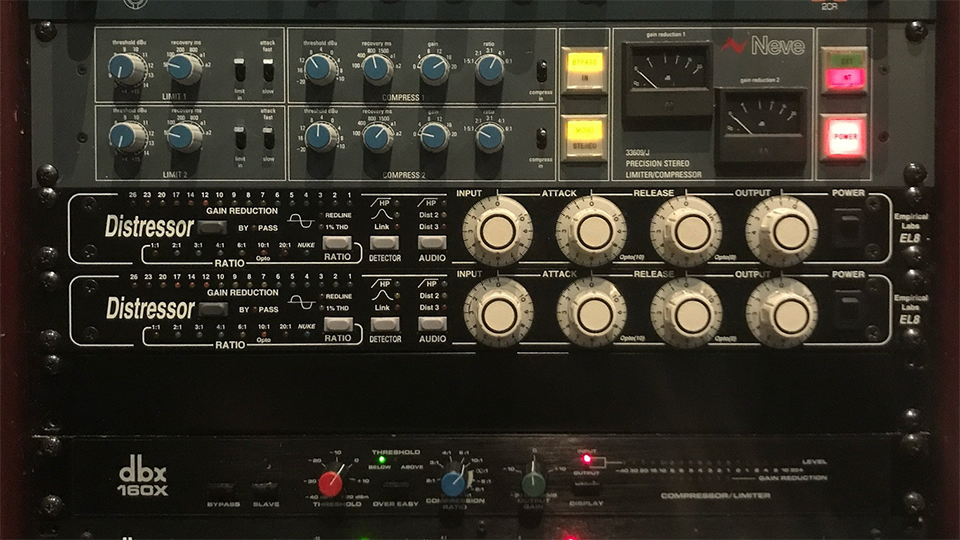
The Distressor’s notable features include eight selectable ratios including 10:1 “Opto” for emulation of the LA-2A and “Nuke,” which is a brick-wall limiter meant for smashing signals into oblivion—a defining characteristic of the Distressor and often used for room mics, especially for drums. Two “distort” modes add harmonic distortion and coloration; The second distord emphasizes second-order harmonics resembling warm and gentle tube-like saturation, where the third distort pulls out third-order harmonics, mimicking tape saturation. It includes a high-pass filter to get rid of muddy frequencies overwhelming the compressor similar to the 2500 and the SSL G bus, and on the EL8X version, features a British-mode button reminiscent of the aforementioned UREI 1176 as well as an image link function for using a pair of Distressors together for stereo compression while avoiding stereo-imaging issues (The EL8 has a stereo link function that’s phase based and more suited for creative effects rather than for a mix bus).
The Distressor is often sold in pairs and is a fantastically versatile machine. Its notable uses are for aggressive squashing and crushing with its Nuke, distortion, and British-mode functions – great for drums, bass, and aggressive blown-out vocals—for subtle addition of harmonics to synths and horns when used 1:1 without compression, or with middle ratios and opto mode for gentle leveling and warmth for guitars, acoustic instruments, and natural vocals.
Manley Variable-MU Compressor—Clean, Old School Tube Compression
The legendary Manley Labs Stereo Variable MU Limiter/Compressor is a dynamic signal processor that uses a series of triode or pentode tubes to compress audio. In the pro-audio space, the Greek letter MU refers to gain, or the amount of input signal there is entering a system—a variable MU compressor uses vacuum tubes to change the amount of gain in a signal.

In audio electronics, vacuum tubes are typically used for amplification in a microphone or in the makeup gain state (think classic tube mics), but with Vari-MU compressors, they’re used as attenuators (the opposite of an amplifier). As the input signal entering a Vari-Mu compressor increases, the current sent to the vacuum tube decreases, reducing the gain of the output signal and introducing compression.
Like the LA-2A opto compression, Vari-MU compression is program-dependent—unlike the LA-2A, the program-dependent parameter is the ratio of the output vs. input of the signal, which increases as the input amplitude increases; it does not affect the compression’s attack and release. While the attack and release (or “recovery” on the Manley Vari-MU) can be manipulated, Vari-MU compressors have a naturally slow attack and release, making for a fantastic “glue” compressor celebrated for their clarity and pleasant harmonic saturation from the tubes, especially when driven hard.
The Manley Vari-Mu comes in a variety of editions from the standard stereo compressor version to one outfitted with mid-side and “T-bar” dynamic processing capabilities. There is also a mastering version (also with optional m/s and T-bar mods) with reworked internal circuity, rotary step switches (as opposed to pan pots) for perfect recall, and extended attack time.

Tube-Tech CL1B—Best of Many Worlds
The Tube-Tech CL1B is an iconic, optical tube-based compressor known for generating the thickness and presence found on the vocal performances of countless rap/hip-hop hits. It has extremely flexible modern routing and processing capabilities despite being a tube-opto compressor, with the ability adjust ratio, attack, release and program dependency modes and the ability selected between two different sidechains on the front panel.

The most commonly used scenario for tube-opto compression is smooth vocal leveling. The combination of the smoothness offered by the opto circuit combined with the clarity and even-order harmonic distortion created by the tubes makes for a compressor that handles the volume fluctuations found in most vocal performances flawlessly, making levels sound great without squashing or over-processing the sound. Outside of its main purpose, you can use tube-opto compression on just about anything, from acoustic or electric instruments, bass guitars and synths, and as a glue compressor on full or sub mixes.
B&H no longer has the CL1B in stock for sale (though some of our competitors might), and the product itself is quite rare and expensive (especially for a vintage one with original tubes)—if you’re looking to get the classic CL1B sound but have a reasonable budget, Warm Audio offers the WA-1B, an excellent and faithful clone of the original Tube-Tech compressor at less than half the price!

Hardware vs. Software Emulation
Modern discourse of the hardware vs. software debate has gone through quite an evolution, especially with the massive power modern computation has reached, allowing for complex recreations of hardware processes with little-to-no latency—something that had plagued emulation until recently. While hardware will offer distinct coloration and sonic character, zero latency, and tactile workflow, it’s hard to argue with the advantages of software’s affordability, convenience, and perfect total recall.
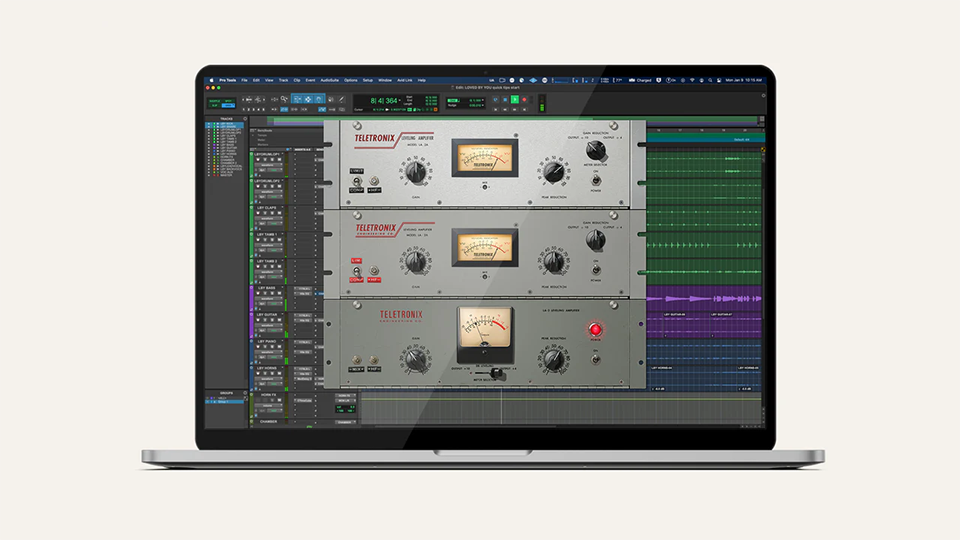
You could pull a rack of ten real LA-2A compressors and shoot out ten one-to-one comparisons with an oscilloscope—none of them will be the same. Small differences, age of hardware, and the physical nonlinearity of components make every machine unique. Not to mention this experiment will cost you more than $50,000. Put ten instances of the UAD LA-2A plugin through plugin-doctor and it will result in ten identical output signals—this \experiment will cost you about $60 for the plug in and the analyzer software. It comes down to your preference for the naturalistic inconsistency of hardware or for the mathematical precision of computation, as well as your budget and available space—but both hardware and software have their place and are often used together in hybrid workflows.
FabFilter Pro C 3
One of the most popular and industry standard compression plugins is the FabFilter Pro C 3, an incredibly powerful and versatile program with fourteen kinds of compression and a multiband compressor built into the system.

The great thing about Pro C 3 (and plenty of other powerful compression plug-ins) is that you have the characteristics of more than a dozen separate outboard compressors all in one (relatively affordable) package. What once would cost tens or hundreds of thousands of dollars can now be attained with a couple hundred dollars and a powerful-enough computer.
Final Thoughts
An oft-used hybrid workflow will have hardware outboard gear used in the tracking stage, ensuring an unmixed session will have natural harmonic saturation and character baked into the audio prior to the editing phase. A DAW and software plugins are then used for the editing, mixing, and mastering stages, allowing for precise sound editing, total recall for future sessions, and complete consistency of the audio throughout the session. But there is no best practice for how and when to use hardware or software tools—it’s up to you to find what works best for your project.
Limitation breeds creativity, and often software plug-ins will offer advanced digital features that can lead to choice paralysis, or whose functions aren’t conveyed properly and have no indication of what processing they introduce (but sometimes an inexplicable “sound good button” can add that special sauce *cough*Soundgoodizer*cough*). We’d recommend using hardware outboard gear only if you have access to it, while being careful to note your workflow and signal flow, especially if you’re going full analog. However, there are many highly acclaimed and Grammy award-winning producers, sound engineers, and mastering engineers that work entirely in-the-box using no hardware gear at all. It’s the way you use your tools, not what the tools themselves are.
