You see a flutter of color outside of your kitchen window. You rush over, only to see this mystery critter as a distant speck working its way through the dense shrubs of your yard—it's just too far and too obscure to make it out. What do you do? Do you shrug it off and go about your day, or do you grab a pair of binoculars to get a closer view?
We know what our answer would be, and we feel that nearly every household could use a trusty pair of binoculars, also called "bins" for short. Whether it's for bird watching, sporting events, the opera, or just to check out random distant objects while out and about in our daily life, a pair of binoculars is an essential tool.
Despite their popularity, the way binoculars work, what makes one better (or different) than another, and what all the numbers mean, are still rather mysterious to many prospective buyers. Read on and find out all you need to know about the ubiquitous binocular before making your choice so you can be sure you're choosing the right one for whatever you're planning on viewing.
The Basics
Simply stated, binoculars use a series of lenses, elements, and prisms to produce a magnified view of distant people, places, or things. Using two parallel optical tubes allows you to observe with both eyes open, which is more comfortable and natural than using a spotting scope or telescope—which requires you to keep one eye closed. Additionally, having both eyes open maintains your depth of field and provides you with a rich and immersive experience where the scene takes on a more lifelike, 3-D appearance.
What Are Those Numbers, and What Do They Mean?
Magnification
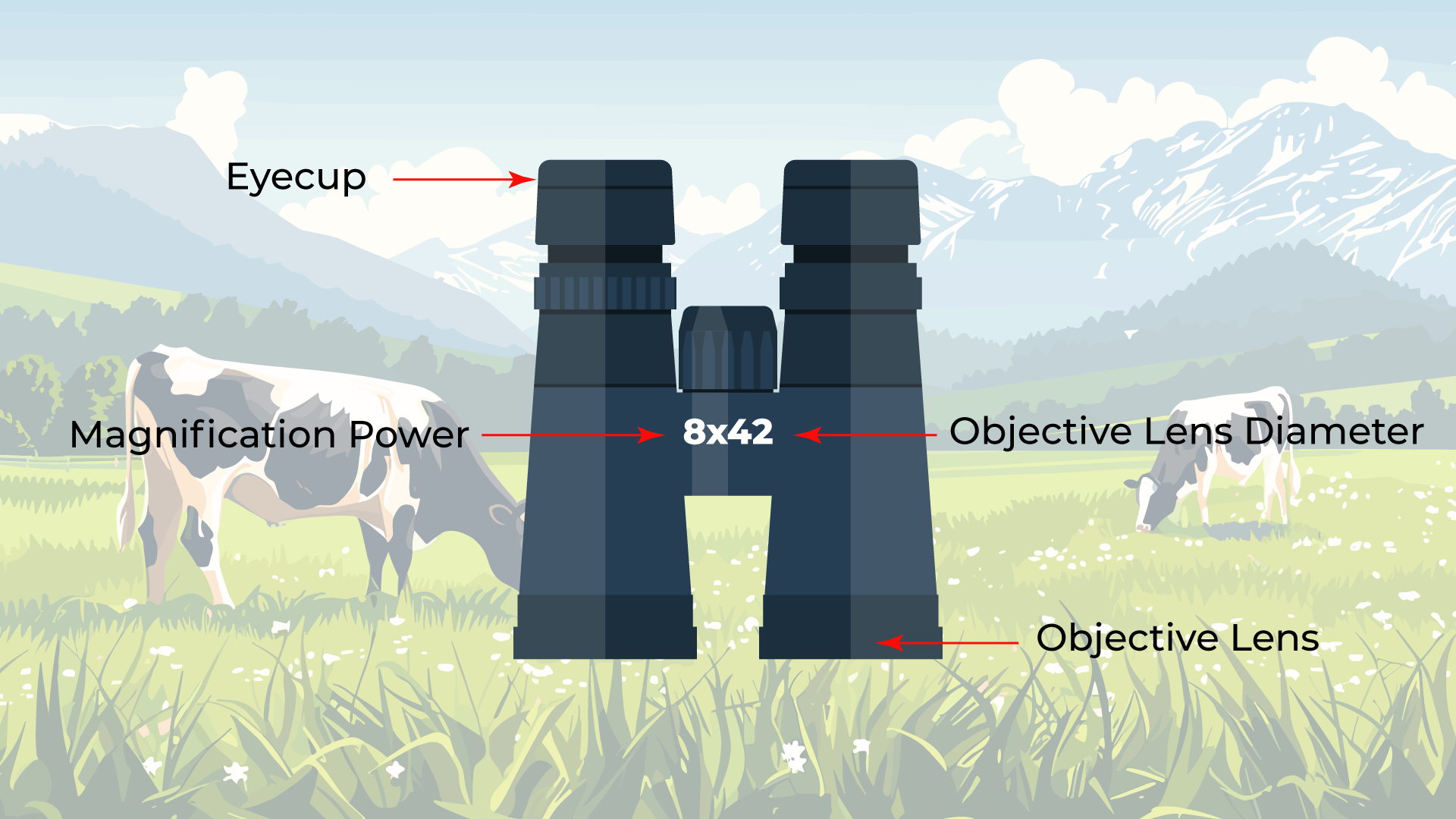
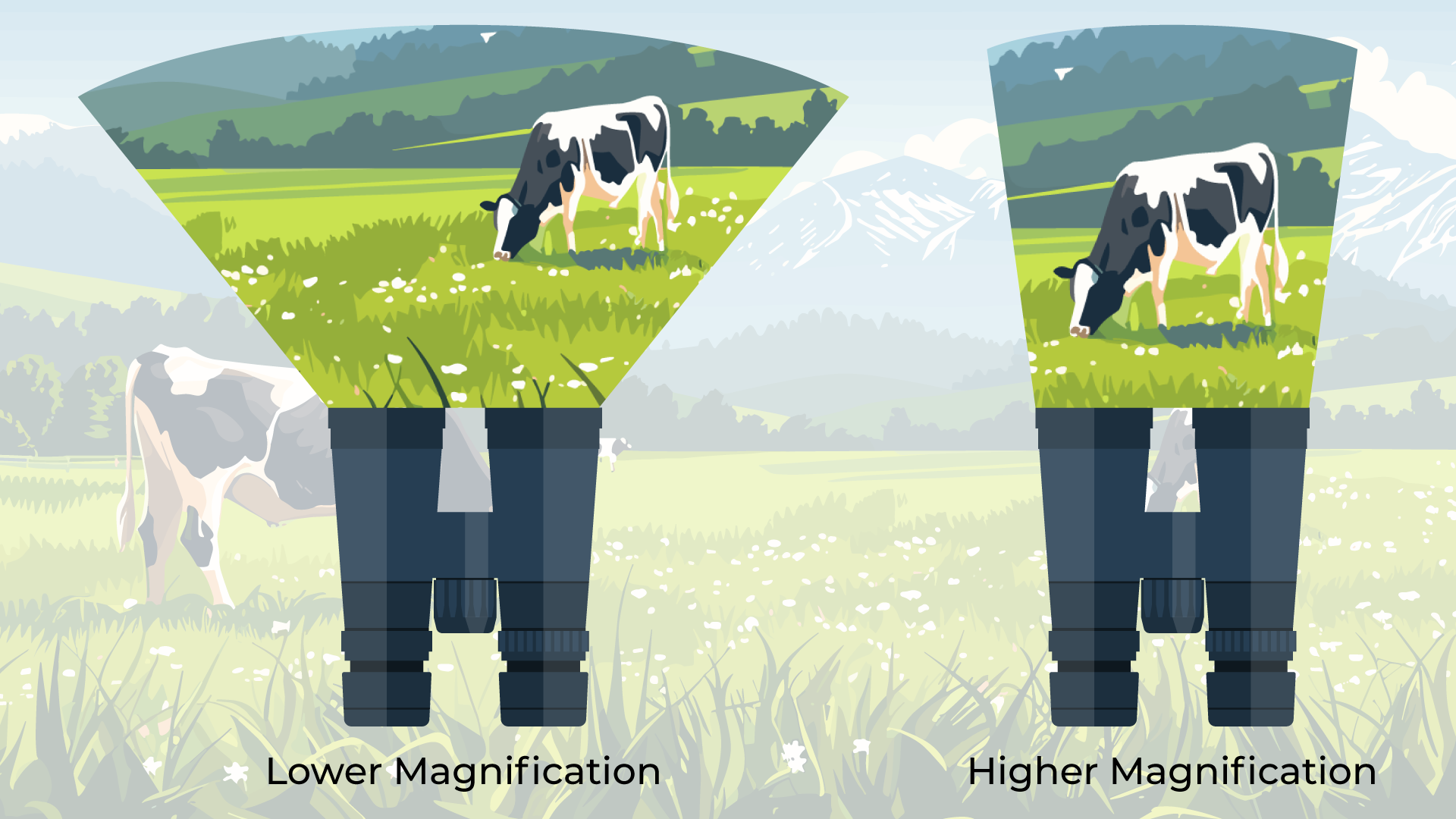
All binoculars are identified by a set of numbers, such as 10x42 and 7x20, which refer to their magnification and objective lens diameter, respectively. Using 10x42 as an example, the 10x means that the binoculars have 10x magnification power, making the view through them appear 10 times closer than it appears to the naked eye. The greater our magnification, the narrower the field of view generally appears.
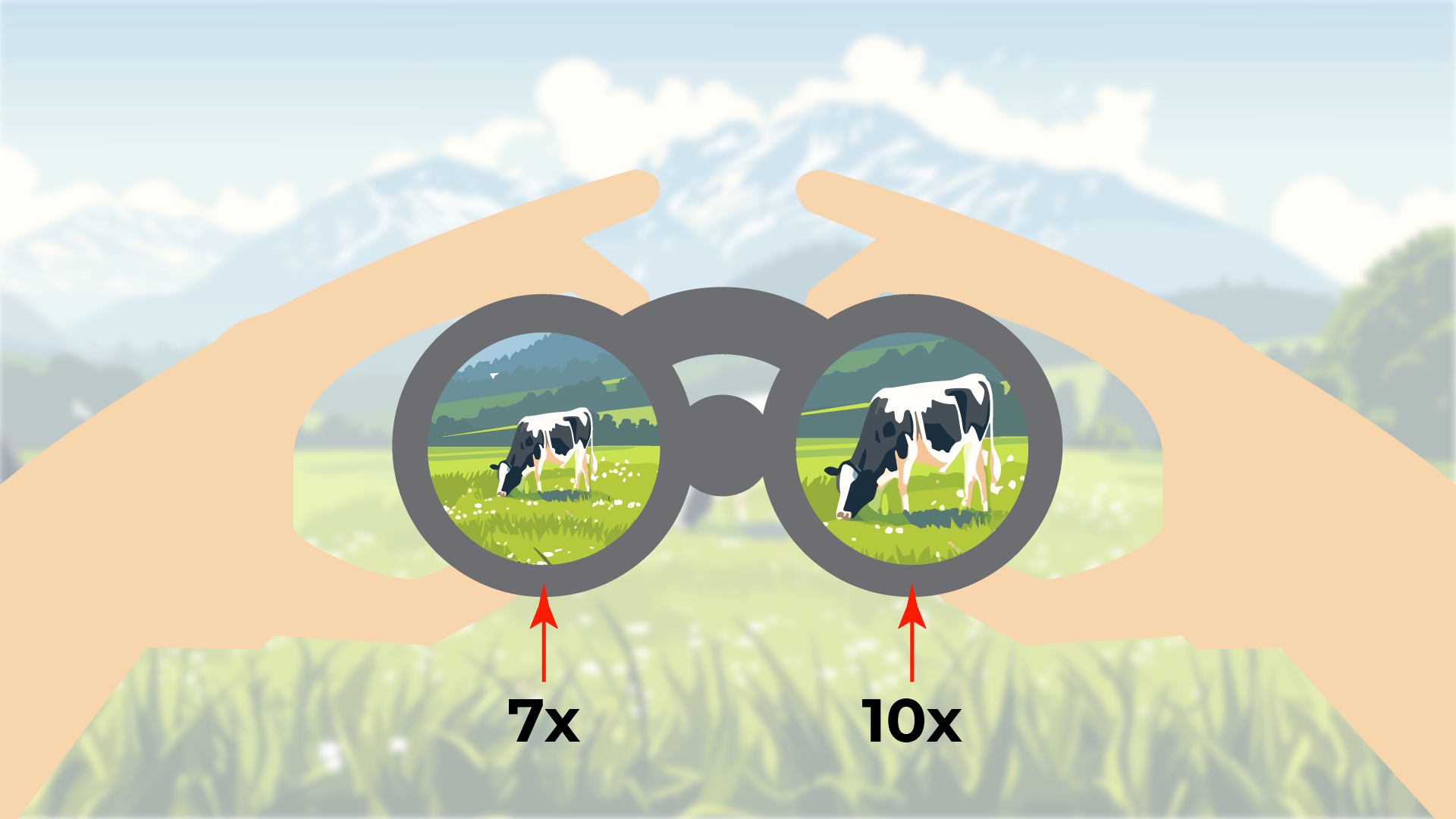
Bird watching? 8x or 10x magnifications will be plenty for your needs. Heading to the opera? A compact 3.5x pairs should suffice. There's truly an option for every need, though for most situations, users should look for binoculars from 7x to 10x power. We'll touch upon different binoculars for different use cases later but remember these basics.
Keep in mind that for many users, holding binoculars greater than 10x42 steady for long periods may present some difficulty, so a tripod should be considered if you are looking at models with higher magnifications or larger objectives. If you consistently need even higher magnifications, consider a spotting scope.
Field of View
As mentioned above, magnification has a direct effect on a binoculars field of view or angle of view. Generally speaking, the lower our magnification, the wider our visible field of view and vice versa. This is why many bird watchers prefer an 8x optic, as the wider field of view makes it easier to locate that tiny brown sparrow among a sea of brown grasses. That said, it's important to note that not all binoculars with the same specs will produce the same field of view, so always check that detail before buying a pair.
Objective Lens Diameter
The "42" in our 10x42 binocular refers to the diameter of the objective (front) lens in millimeters. Since the objectives will often be the largest portion of the optic, it will affect the overall size and weight of the binocular, and how much light it can gather. In basic terms: larger objectives allow more light to pass through them than smaller lenses, which means images will appear brighter, sharper, and clearer. However, this does come at a cost to size and weight.
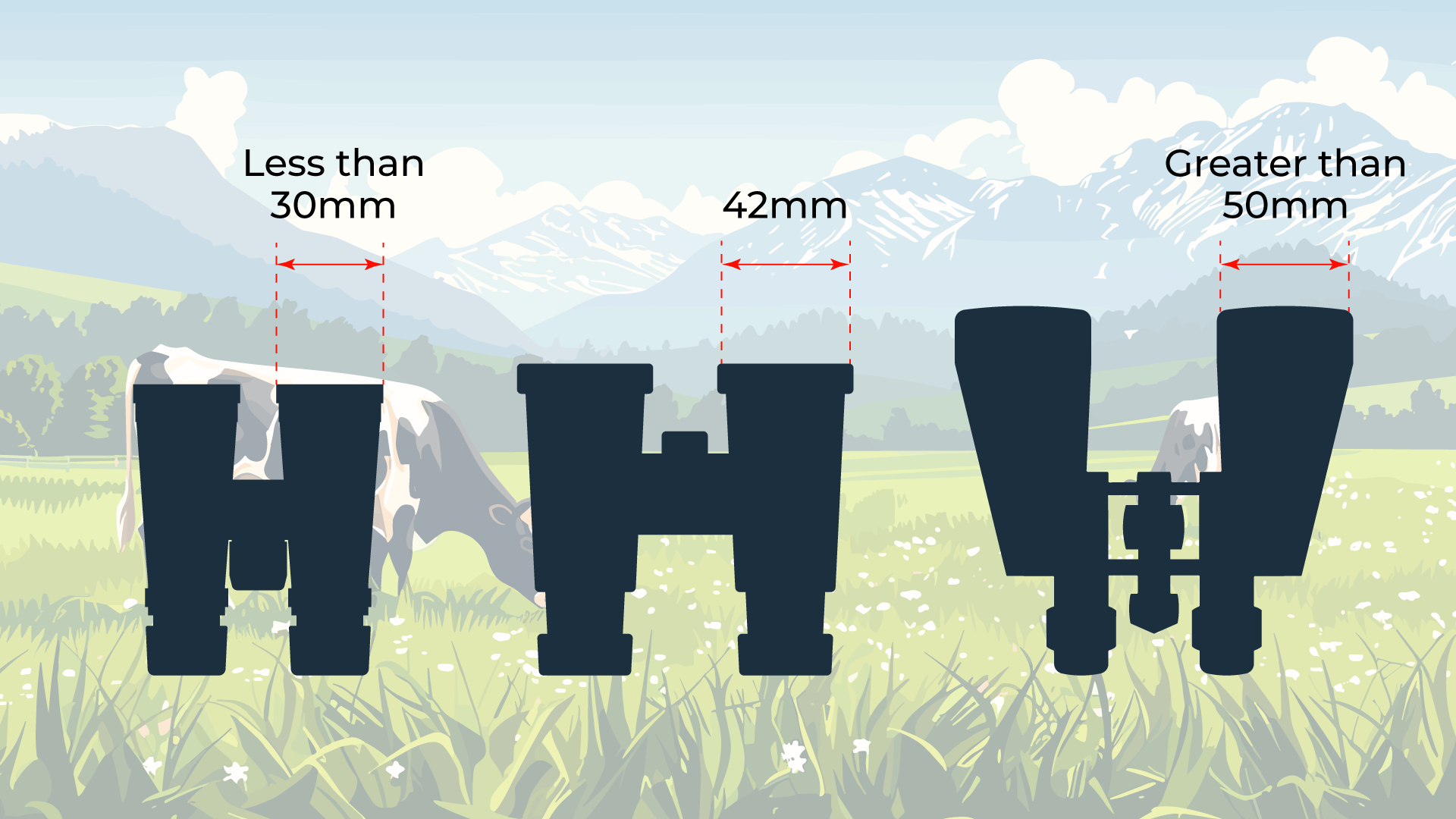
Magnification and our objective lens diameter do not exist in a vacuum. You can't have one without it affecting the other, and they do so in a way that it very tangible. When you look through the back of your binoculars, the brightness and clarity you see are directly the result of how these two elements function together. This brightness and clarity are the result of our binoculars exit pupil.
Exit Pupil
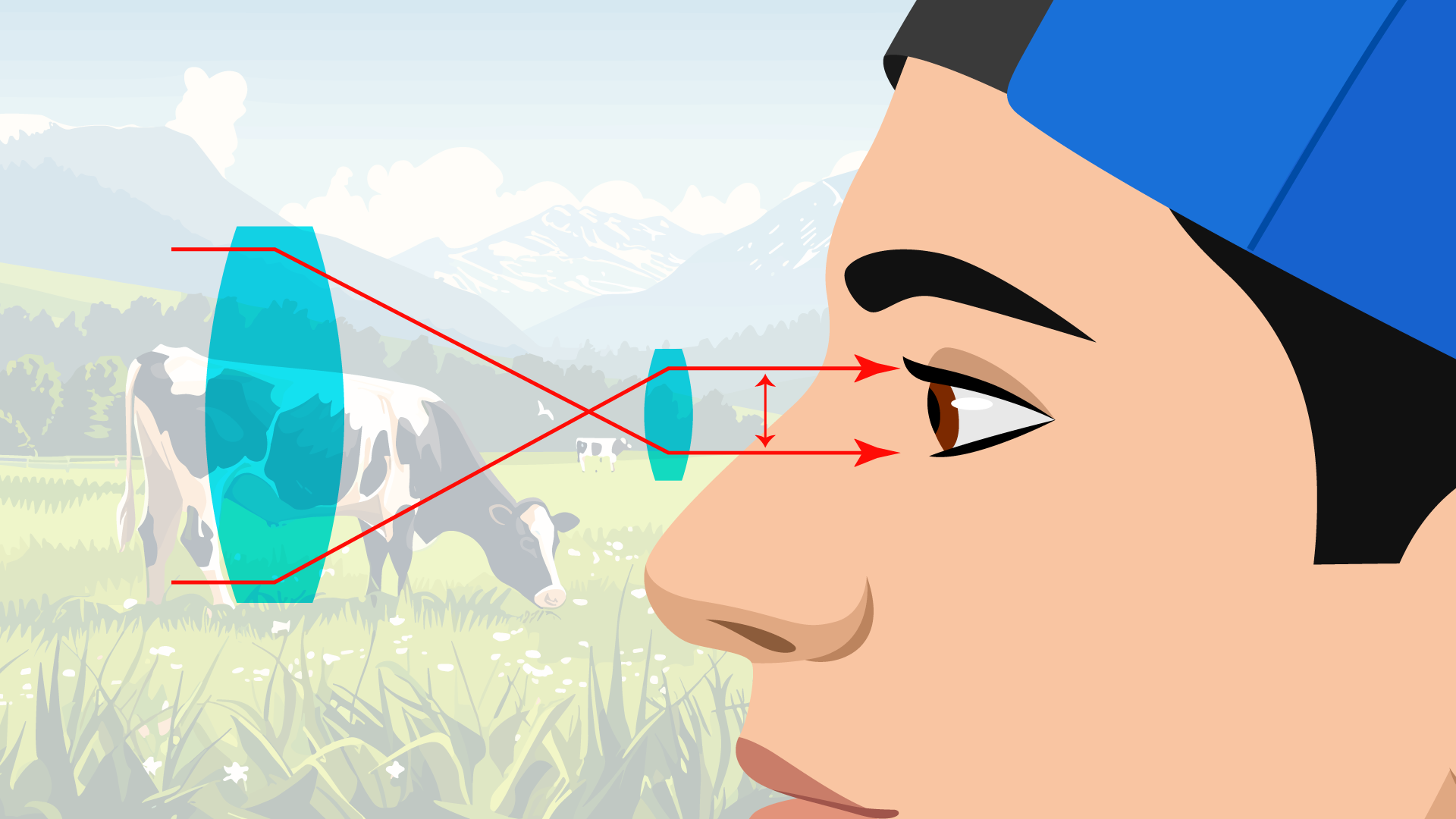
What's an exit pupil? Simply put, a binoculars' exit pupil diameter is what determines how bright our image is. The larger our exit pupil, the brighter the image. This is determined by dividing the objective by the magnification: so, a 10x42 binocular has a 4.2mm exit pupil diameter. That's a generous size, and larger than the pupil of the eye most of the time. But a 10x25 pair of binoculars has an exit pupil of just 2.5mm, which is smaller than the average pupil dilation and will be harder to see through clearly.
Zoom binoculars offer variable magnification and are shown as 10-30x60. In this example, 10x magnification is at the low end and 30x magnification at the high end. This is incredibly convenient, but this too comes at a cost. Zooming binoculars might have a perfectly acceptable exit pupil diameter under low magnification but one that's somewhat small under high magnification. For example, this 10-30x60 binocular has 10x magnification at the low end and 30x magnification at the high end. At 10x, the exit pupil diameter is a respectable 6mm, but at 30x, it's only 2mm.
Eye Relief
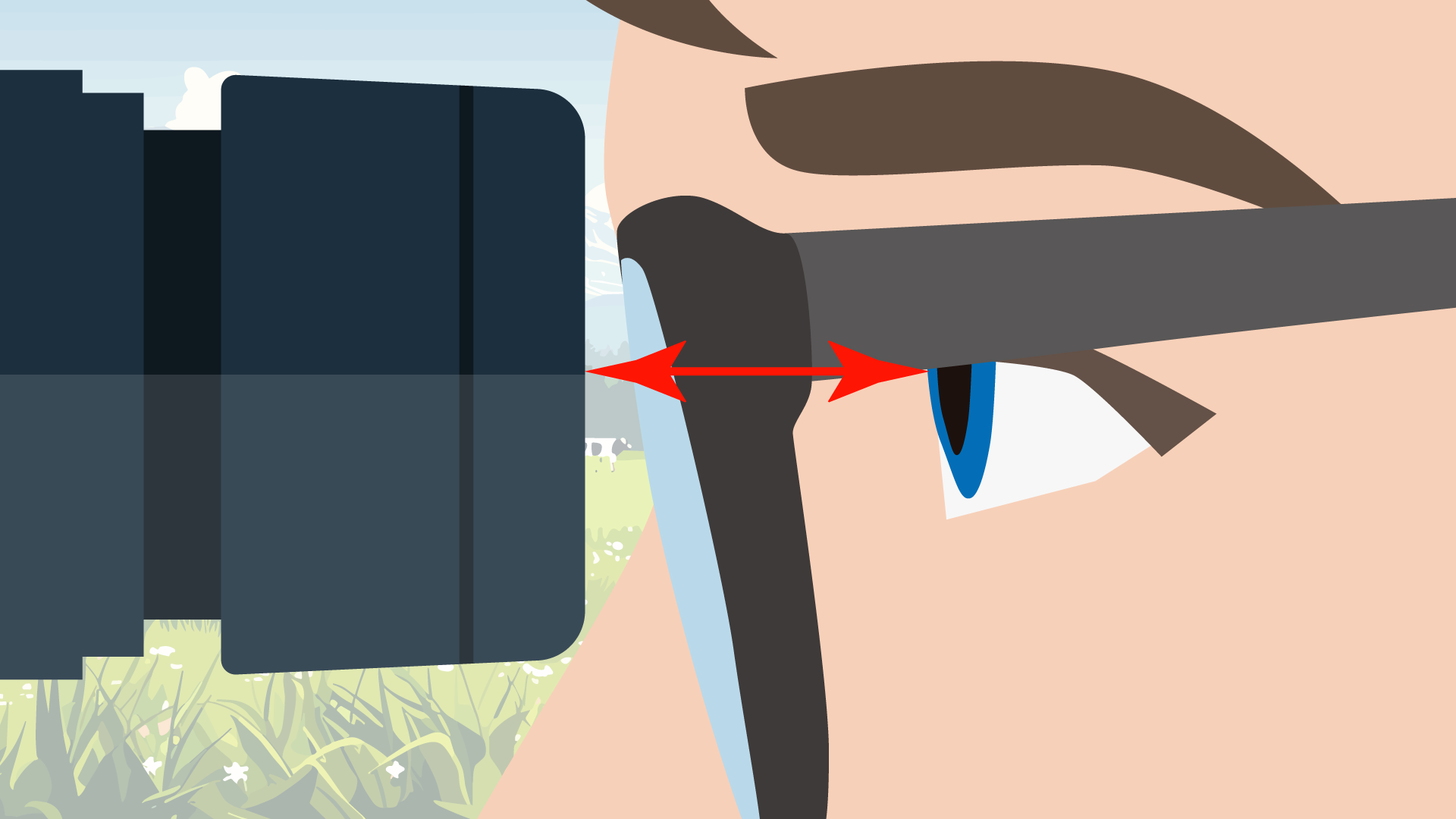
Eye relief is the distance between the binoculars eye piece and the eye looking through it. This is especially important to consider if you wear glasses, as the additional space they introduce can hinder your viewing experience. Luckily, most binoculars have adjustable eyepieces, so users can set them to their comfort level.
We've covered exit pupil and eye relief in greater detail, but the key take away is that the bigger our exit pupil, the brighter the viewing experience. For low light situations, the larger the better, whereas bright daylight viewing is less worrisome, so long as our exit pupil is just as big if not bigger than our own pupil size.
Why Are Binoculars with Similar Specs More Expensive Than Others?
There can be a huge range in price between apparently similar pairs of binoculars. For example, B&H sells 10x42 binoculars ranging in price from less than $30 to nearly $3,000. The main reasons for such a large price range are the quality of the glass optics, the types of coatings applied to the lenses, and other features that might be added, such as the housing material.
Aside from price, these factors can also alter the appearance of the binoculars. If you've been shopping for binoculars, you will have noticed that some look very streamlined while others look chunkier. This is because the physical appearance and size of a binocular is determined by the type of prism it uses. Additionally, the prism type can be (and often is) a factor in determining price.
Prism Type
Prisms are used to correct the orientation of the view horizontally and vertically so the scene looks natural; without a prism, binoculars would make things look upside down and flopped. There are two principal types of prisms: roof and Porro. The glass elements in a roof prism are in line with one another, making roof-prism binoculars more streamlined and easier to hold. Porro prisms have the glass elements offset from one another and can provide greater depth of field and a wider field of view compared to similar roof prism models. This is accomplished by folding the light path, which shortens the length, spreading the objectives farther apart.
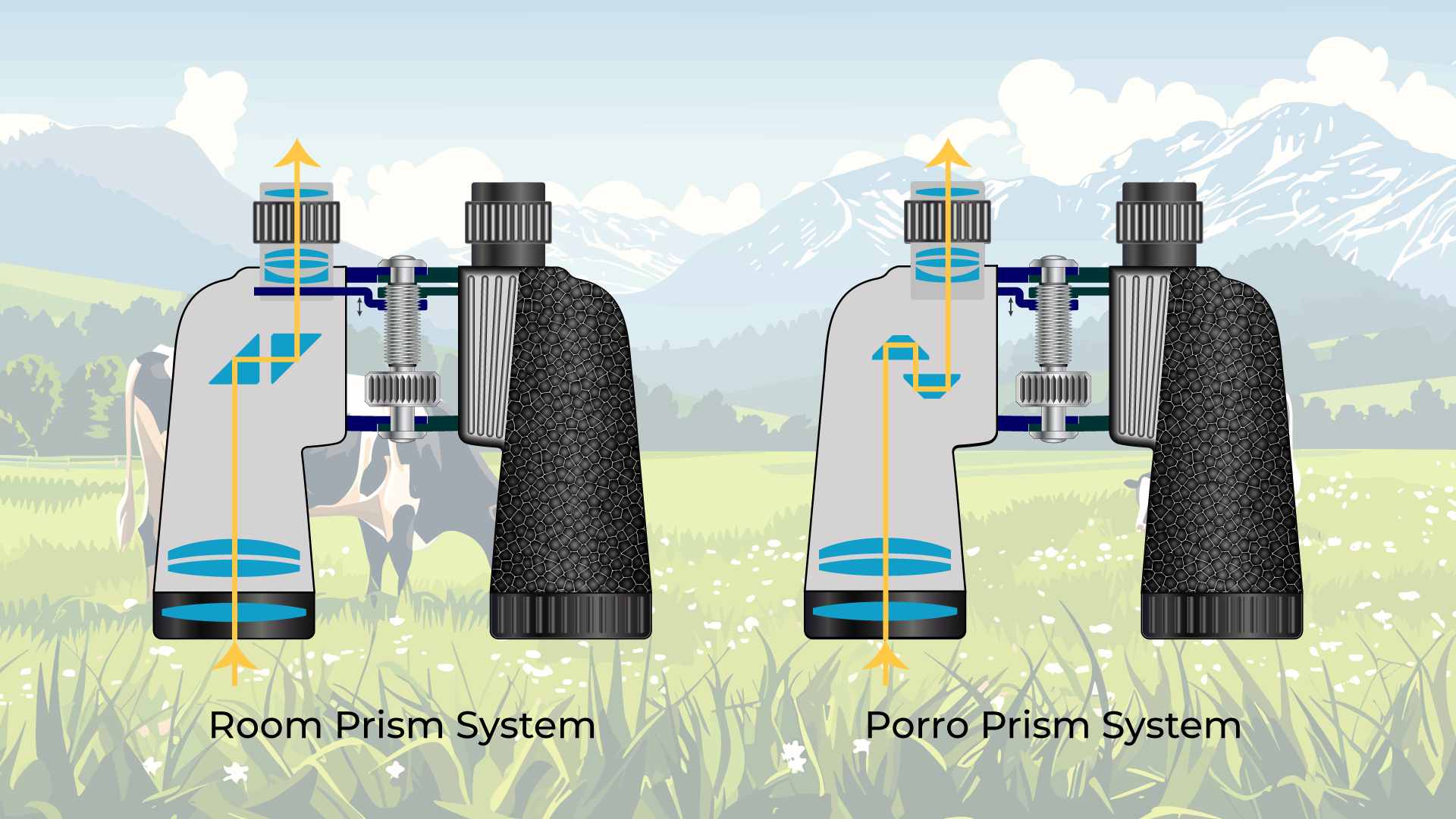
Because of the physics involved in designing and manufacturing the compact roof prism form factor, you can have a pair of roof and Porro binoculars that seem identical as far as quality and performance, but the roof prism version will often be more expensive. The good news is that if the form factor isn't an issue, many people find that they can upgrade the quality of their binocular by choosing a Porro-prism without reevaluating their budget.
Technically, the type of prism utilized in binoculars is a double-Porro prism, but is always shortened to just "Porro." It is also always capitalized because it is the last name of the inventor, Ignazio Porro, who designed this prism system around 1850. This most basic of prism configurations is defined by the folded light path, which displaces the point where the light enters and exits the prism, which results in the familiar look of a "traditional" or "old-school" binocular.
Because Porro prism binoculars are typically more cost effective to produce than roof prisms, you will often be able to get a higher-quality and/or larger-objective Porro model for about the same price as a comparable roof prism one, just at the cost of some extra bulk.
Glass
The type and quality of the glass used for the lenses and prisms matter. Generic optical glass may have imperfections, and if it isn't ground and polished correctly, it could bend light oddly, causing colors to look skewed or prevent its ability to achieve tack-sharp focusing, or you may notice distortion at the edges. Specialized glass, such as low dispersion or extra low dispersion, is engineered to have virtually no distortion and transmit light better without bending it. The resulting images are generally clearer, sharper, with true color rendition and higher contrast.
For instance, optics from brands like Zeiss occasionally use a specialized SCHOTT glass—not to be confused with a shot glass. SCHOTT AG is a German manufacturer of specialty glass, primarily used in high precision instruments from medical and aerospace applications to medical and optical ones. Every brand has their own approach, and each is designed to deliver the clarity, color accuracy, and distortion control the manufacturer desires.

You may also see some binoculars made with "Eco-glass." This general term refers to ecologically friendly glass that doesn't use lead or arsenic. While this may or may not affect the image quality, if your lenses break or you need to dispose of your binocular, you can feel confident that you're not adding to chemical pollution.
BAK4, BK7, and SK15 Prisms
Earlier, we touched upon the two main types of prism configurations, but beyond that, the materials that the prisms are made of greatly impact image quality. BAK4, or Barium Crown glass, is considered the best type of prism material. It has a high refractive index and lower critical angle than other materials, which means it transmits light better with less light being lost due to internal reflection—such as from internal bubbles trapped during the manufacturing process.
BK7 glass is arguably the most widely used material for binoculars. While it may be of slightly lower quality than BAK4, it is still optical glass, which means it has excellent light-transmission properties and a limited number of internal imperfections.
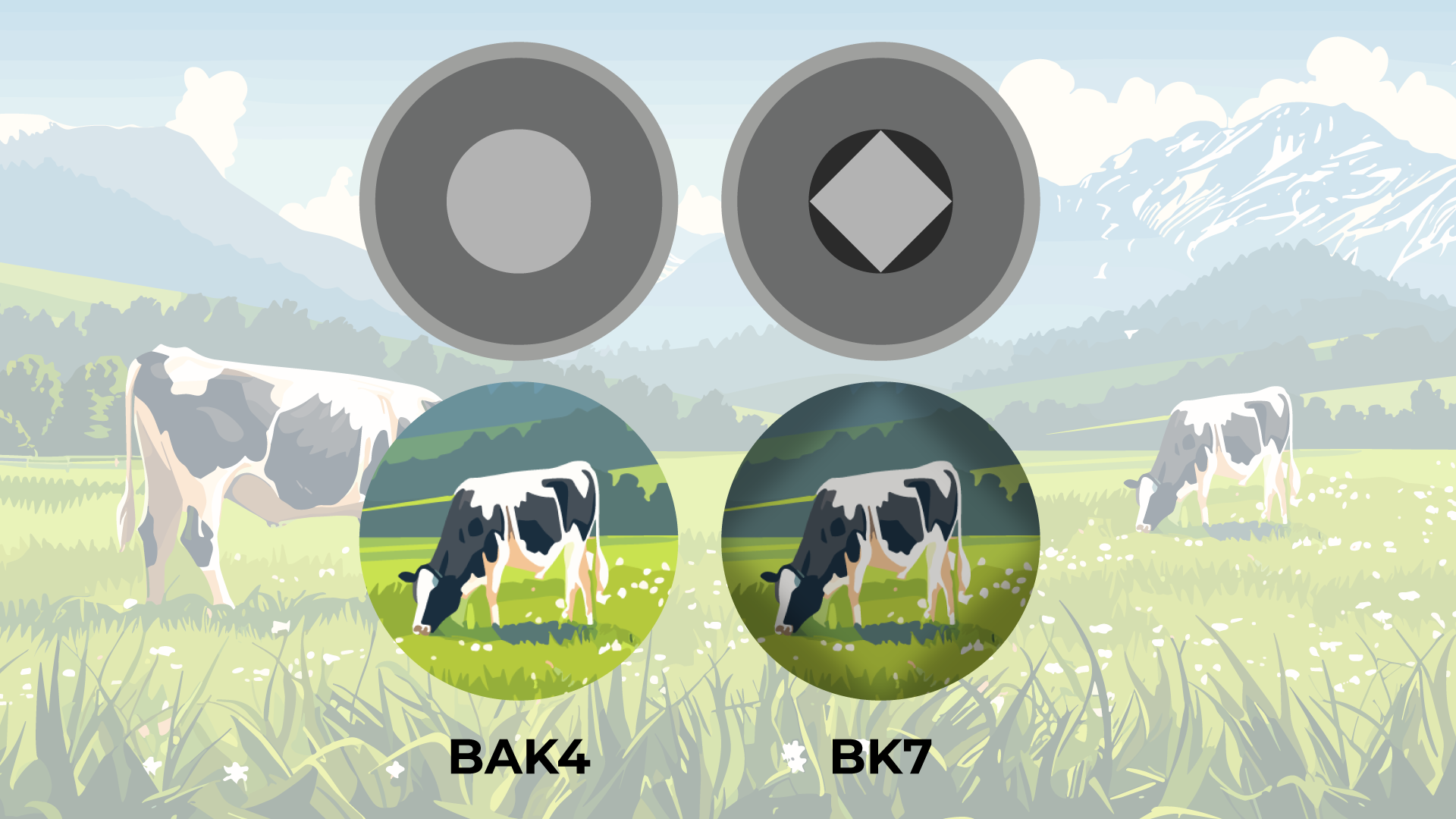
The easiest way to tell if your binocular employs BAK4 or BK7 is to turn it around, hold it 6 to 8" away from you and look down the objective and observe the exit pupil. If you can see a squared-off side to the general roundness of the image, the binoculars have BK7 prisms. BAK4 prisms show a truer round exit pupil, which translates to better light transmission and edge-to-edge sharpness.
SK15 glass is an atypical material that strikes a middle ground between the previous two. It has a higher refractive index than both yet has a dispersion (measured on the Abbe scale) that falls between BAK4 and BK7. Images that are seen through SK15 prisms are very clear, with high contrast.
Coatings
Lens Coatings
Lens coatings are films applied to lens surfaces to reduce glare and reflections, prevent dirt and grime from sticking, increase light transmission and contrast, and help make colors look more vivid. Any light reflected is light that never reaches the viewer's eyes, so by eliminating reflections, the image ends up being brighter and sharper.
Coatings, in general, are good, provided that the coatings do something. It's easy to put a cheap coating on a lens to give it a cool-looking orange tint, but the coating might not do anything to improve image quality. You want substance, whether it be in image clarity or easier cleanings. If you aren't able to test a pair of binoculars before buying, the best you can do is research the brand, look for user reviews, and ask questions before you buy.

Terms such as coated, multi-coated and fully multi-coated refer to the location and type of coating processes used. Coated lenses are the most basic and denote that at least one lens surface has at least one layer of coating on it. Multi-coated means that multiple surfaces are coated and/or multiple layers of coatings have been applied to each surface. Fully multi-coated means that all surfaces—inner and outer—of the lenses have multiple layers applied to them. This treatment offers the highest level of light transmission, clarity, contrast, and color rendition. At the pinnacle is broadband fully multi-coated. These coatings are engineered to be effective across a wide spectrum of wavelengths and provide the best performance.
Prism Coatings
Complementing lens coatings are prism coatings, which increase light reflection and improve image brightness and contrast. While many manufacturers may use standard reflective coatings, the upper echelon of prism coatings is called dielectric coatings, which allow almost 100% of the light through the prism, resulting in brighter high-contrast images.
Another type of prism coating, only used on roof prisms, is called "phase-correcting" coating. Because of the way roof prims reflect light, after it moves through the objective lens, it gets split into two separate beams that travel through the prism system independently. The beams experience a "phase shift" as one beam strikes the eyepiece lens a fraction of a second before the second beam. When the two beams are recombined in the eyepiece lens they are slightly out of phase with each other, which can affect color balance and rendition.
By applying special coatings on the prism, the faster light beam is slowed to match the slower beam, bringing them back into phase when they hit the eyepiece lens—greatly improving color, clarity, and contrast versus non-phase-corrected prism binoculars. Under normal circumstances, most users won't notice the difference, but pro users and avid birdwatchers may require it to be able to pick out important details at a distance or in challenging light. Since Porro prisms don't suffer from phase shift, these coatings are not used on them.
Construction
How a binocular feels, both in weight and ergonomics, is an often-overlooked consideration. Nearly all binoculars are coated in a rubberized grip, and each has its supporters and detractors. This is ultimately a highly personal choice, so we'll save you the time. What we will talk about, first and foremost, is the chassis, or framework, of the binocular. After all, a sturdy chassis is essential to a durable, long-lasting optic.

Most binoculars today are constructed out of either aluminum or a magnesium alloy, providing strength while maintaining a lightweight build and without breaking the bank. This alone doesn't necessarily add weight, but when paired with high end glass, and lots of it, you end up with a sturdy feeling pair. Now, you may hear terms like "aerospace grade" thrown around on occasion, but don't let these terms fool you. Both the braces that support the wings and the brackets that hold up the snack tray fit this description. All you need to know is that the aforementioned alloys are strong and lightweight.
Next comes the bridge of the optic. This is the hinge joint that connects each side of the optic to one another. Most binoculars feature a thick single, or closed, bridge towards the center/rear of the optic. When holding a pair of binoculars with this feature, the fingers tend to rest atop the bridge, which is by design, as manufacturers tend to put important controls such as our focus ring on the back of the bridge for easy access. Some higher end optics split the bridge into two smaller components in what is known as an open bridge design. This opens the center of the optic to a better one-handed grip. If you find yourself recording field notes while struggling to simultaneously make observations with binoculars, this is the style for you.
Focusing
The clear majority of binoculars use the aforementioned center focus system. The main focus wheel is set on the bridge between the two oculars and moves them both individual oculars symmetrically. With center focusing, many manufacturers will have a dioptric adjustment dial on one of the eyepieces to fine-tune the focus to match individual optical prescriptions. The dioptric correction amount is decided by each manufacturer, usually by model, and can be on the left or right eye, or both. Certain models have the dioptric correction integrated into the center focusing mechanism.

There are two other focusing types that need to be addressed: individual and focus-free. The individual focus models eliminate the center-focusing mechanism to give each eyepiece the ability to focus independently. While this allows for extremely fine and precise focusing, they are often frustrating to use when sharing and should only be considered if there will only be one primary user. Many marine and astronomical models feature this system.
Focus-free binoculars don't have any focusing mechanisms. They rely on your eyes to focus the image, allowing you to concentrate on the scenery and enjoy the views. Some users with exceptionally poor eyesight or weak eyes should probably steer clear of focus-free models because they put a lot of stress on the eye and can cause discomfort such as eye strain or headaches.
Minimum Focus Distance
This might seem like an odd thing to consider, since the whole idea of a binocular is to look at things that are far away; and for most users this is absolutely true. However, there are a fair number of enthusiasts who use their binocular for bird watching or insect observation. Many bird watchers like to have a close minimum focus distance that can allow them to see minute detail of birds—like wing bars, beak shape, or crown markings—while birds are feeding. A close focus of less than 6' for a full-size binocular is noteworthy. Typically, as magnification is increased, the minimum focus distance also increases. For users interested in a short close-focus distance, they should look at larger objectives and keep the magnification at around 8x.

Weather Resistant, Waterproof, Fog Proof
There was a time when many binoculars had no weatherproofing, whereas some were waterproof and others waterproof and fog proof. Luckily, most binoculars on the market today offer some form of weather resistance or water proofing. Some optics are measured using the IPX Waterproof rating guide. This rating will determine under what conditions the optic should or can be used, but there's variation.
Other optics use general terminology like "weather resistant" or "waterproof" to describe their instruments, which is certainly straightforward. If you intend on using your binoculars outdoors in any capacity, some form of resistance is essential to ensuring their longevity and your peace of mind.

No Rating
Binoculars that have no weatherproofing should not be used in the rain or at sea, because moisture can get inside them. When water gets into the optical tubes, it can condense on the inside of the lens (called "fogging"), which interferes with your view, and eventually leads to internal rust and corrosion.
Weather Resistant
Often, but not always, the optic will employ some type of seal—an O-ring or gasket—to keep moisture, such as from general humidity or a light mist, from getting into the optical tubes. You can take a weather-resistant binocular out in moist conditions without causing damage. The air inside the optical tube will probably be just ambient air from the factory where they were assembled, and due to air conditioning and other factors, will usually have an extremely low moisture content. What this means is that under most normal conditions, a binocular right out of the box shouldn't have fogging issues, even if it is O-ring or gasket sealed.

Waterproof
These binoculars are sealed with O-rings to prevent moisture from getting inside; but they can still fog up on you. Depending on the construction and the seals, some waterproof binoculars are also submersible for various amounts of time. Certain manufacturers rate their binoculars for limited depths for limited amounts of time; others will adhere to military standard specifications and rate them for much greater depths.

Fog Proof
Fogging occurs when the air inside the optical tubes contains moisture. If you go from a warm cabin to frigid conditions outside, the moisture can condense on the inside of lenses, causing them to fog. Fog-proof binoculars are filled with inert gases such as nitrogen or argon, or a combination of the two, to prevent fogging. The inert gas is dry and is pumped into the optical tubes under pressure, keeping the gaskets and O-rings firmly in place.

How to Choose a Pair for Your Purposes
Once we know what we're looking at, we're ready to pick up a pair of binoculars. When selecting a pair for a specific purpose, like bird watching or sporting events, it's important to consider how magnification, brightness, and build quality will impact your usage of them. Below, we've put together some guidelines to get you started. Magnification may be the base, but we should take all aspects of the optics into consideration.
Birding/Wildlife Observation: If it's birds you're after, consider an 8x42 or 10x42 pair as they offer the perfect mix of magnification, light gathering capabilities and of course, field of view. Some birders prefer 8x as they offer a little extra breathing room to scan a scene and find the bird, whereas others benefit from the additional reach of a 10x pair for observing finer details. Of course, if you're going to be outside, a little weather resistance never hurts anyone. Waterproof is best, as some of the greatest birding occurs during rainfall in an event known as fallout.

Hiking/Backpacking: If you're planning on covering any distance, either on foot, horseback, or by kayaking, weight is of utmost importance. For that reason, we're going to sacrifice our objective lens diameter for a compact form factor, opting for a smaller 8x32 pair. Weather resistance is still essential, as is a durable chassis to protect against bumps and drops.

Sporting Events: Luckily, we don't need to be as picky when choosing a pair for some light sports viewing, as most games will be cancelled or postponed when the weather turns. What we do want is a 7-10x magnification and a wider field of view. A pair of 7x25, 8x25, or 10x30 are ideal as they're fairly portable and give you plenty of power to get a close-up view of the field below.

Opera glasses: These are small, sometimes ornate binoculars with an average magnification of 3x to 5x. These allow you to see the entire stage in all its detailed glory. Why do we want such a short magnification? Any more introduces increases image shaking, and we're not looking to count eye lashes on the performer.

Astronomy: High magnifications and wide objective lens diameters are a must for star gazing, and for that reason we recommend 10x50 or 12x50 binoculars to get those bright, up-close views we desire. If you need even greater magnification, a tripod will be needed. After that, it's probably best to start looking at spotting scopes or even telescopes.

Final Thoughts on the Long View
The world of binoculars is vast and constantly evolving. No matter what you're using them for—from a night at the opera to hunting on the tundra to comet watching—there is something for everyone at every price. This article has offered a basic introduction to the terms and technologies that will affect your buying decision and the overall performance of the optic. After making your selection, don't forget about the accessories that can enhance your viewing experience and turn a good view into a great view.

If you'd like to learn more about optics, from binoculars and spotting scopes to even rifle and telescopes, check out our other articles and guides on the B&H Explora Page!