
Optic size is measured by what it can do, but when you’re new to the hobby, this can be confusing. Pick up a spotting scope or any pair of binoculars and you’ll see them adorned with a set of numbers like 8x42, 7x32, or 20-60x80. What exactly do those numbers mean and what do they tell us about an optic?
At the most basic level, the purpose of any sport optic is to magnify our view of distant objects, making them appear closer and larger. It’s safe to assume that the most important thing to know about any optic is how much it magnifies our view. But magnification alone doesn’t make an optic great, we must also consider brightness and comfort, as a highly magnified pair of binoculars are only great if the resulting image is bright enough and clear enough to truly appreciate.

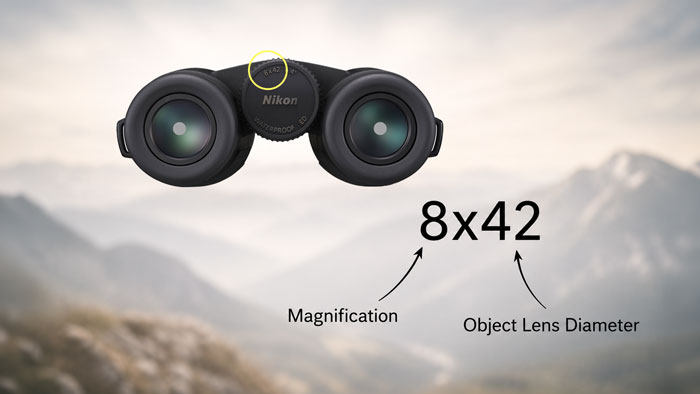
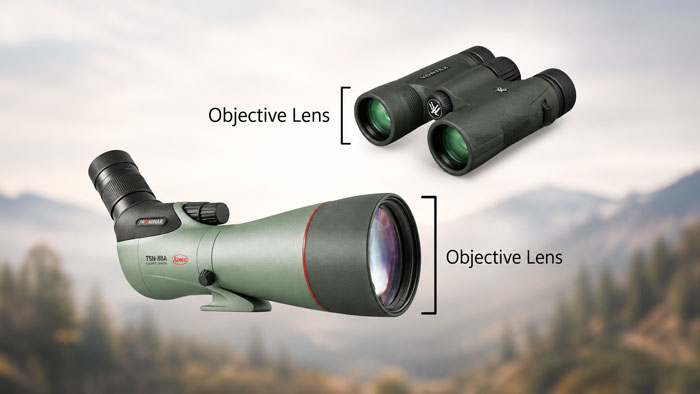
When looking at the naming conventions of any sport optic, you’ll see that aforementioned set of numbers displayed as follows. If you see 8x42 on a pair of binoculars, the 8 before the “x” represents our magnification. So, in this example, this optic has an 8x magnification. How about that second number? The second number, 42 in this case, represents the physical diameter of the front element in millimeters, better known as the objective lens. Let’s take a closer look.
Magnification
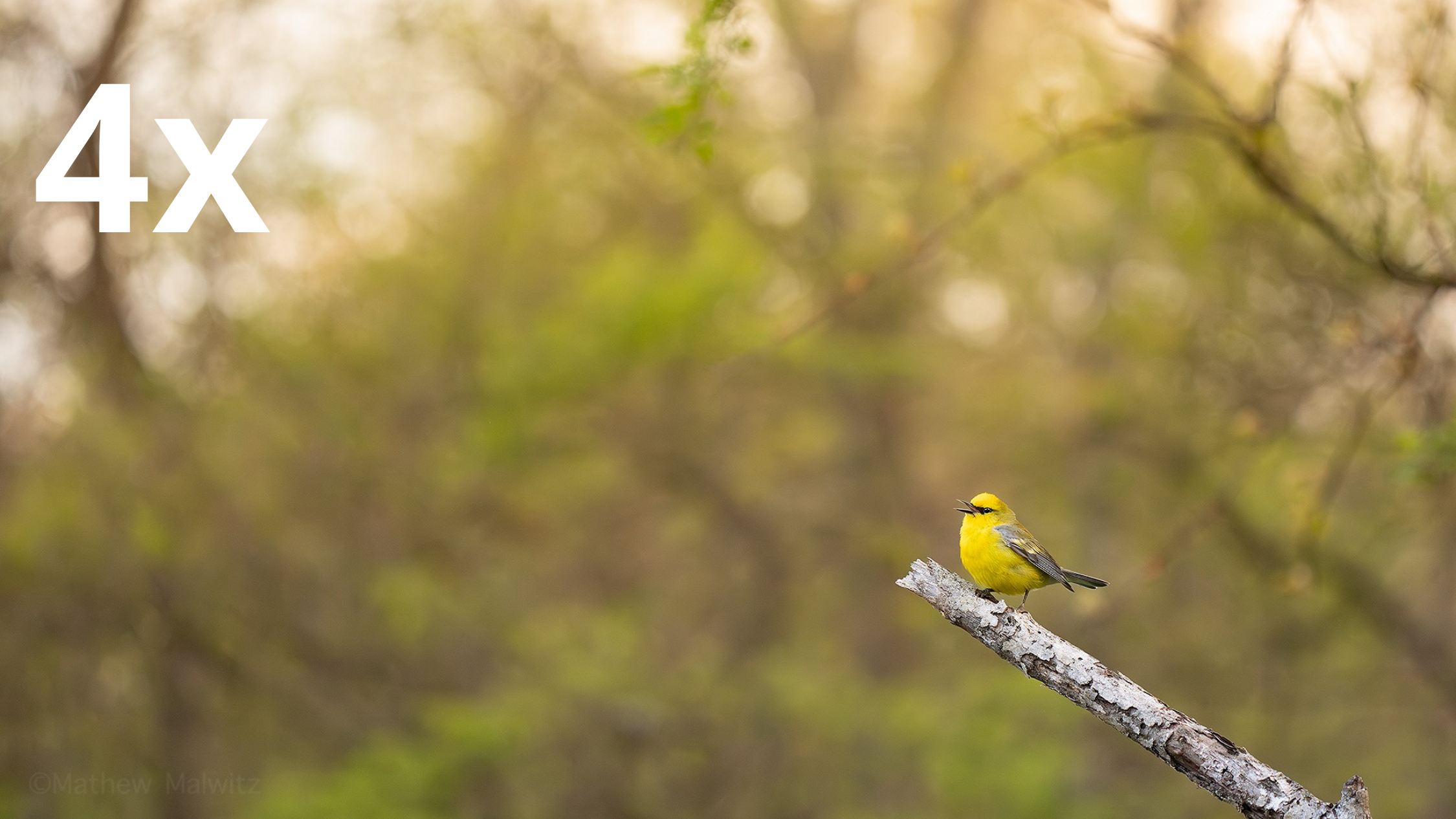
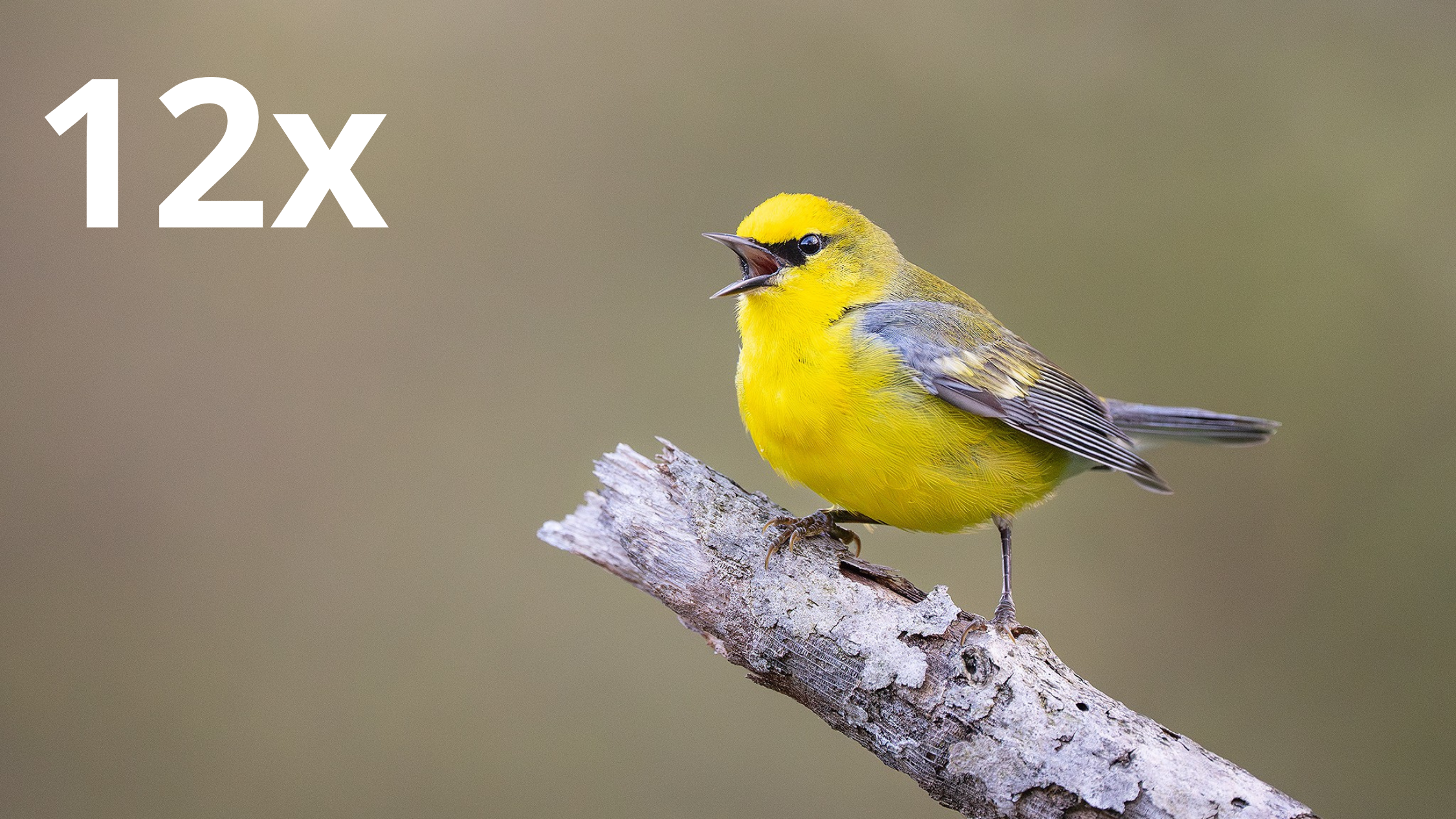
Magnification in optics is the degree to which the subject being viewed is enlarged. As mentioned above, this is referred to by a numerical value such as 8x, 10x, 12x, etc. At 8x magnification, an image will appear effectively eight times the size it would be when viewed with the naked eye. A 10x optic would produce a view ten times larger, 12x would be twelve times larger and so on.
Fixed vs. Variable Magnification
Magnification in most optics is fixed, meaning it had one value that cannot be changed. However, various zoom binoculars and spotting scopes allow you to choose which magnification you would like to use. A variable magnification will be referred to with both ends of its zoom range such as 10-22x50 in binoculars or 20-60x80 for larger scopes.
There are trade offs to increasing our magnification, whether it be via zoom or buying an entirely new pair of binoculars to get us a little more power in the field. Some of these caveats are more a hinderance than we may bargain for, such as decreased brightness, increased shake, and of course, a narrower field of view.
Field of View and Angle of View
Closely tied to magnification, field of view (FoV) simply refers to how much of a scene we can see at any given time through our scope. As we covered above, the higher our magnification, the narrower our field of view, but there are a few ways of measuring this metric. First, is the linear or real field of view. This is typically measured in meters and/or feet at a certain distance, typically 1000m or 1000 yards.
For example, let’s say we have an 8x42 binoculars with a real field of view of 409’ at 1000 yards (135.8m at 1000m). When standing 1000 yards from the subject we’re observing, our apparent field of view will be 409’ across. Easy enough, right? Let’s take a look at angle of view next.

Angle of view (AoV) is simply the actual angle of scene measured in degrees instead of distance values. For instance, the binocular above has an angle of view of 7.8-degrees. Imagine standing in the middle of a giant pizza pie; binoculars with that same 7.8-degree angle of view would show the viewer a 7.8-degree “slice” of the 360-degree pie, looking outward.
Another way to express the viewing angle is the Apparent Angle of View (AAoV). This is roughly calculated by taking the AoV and multiplying it by the magnification. So, if that 8x42 binocular from the earlier example has a 7.8-degree AoV, its apparent angle of view is 62.4 degrees. The AAoV is the angle of the magnified field when you look through binoculars; so the larger the apparent field of view is, the wider the field of view you can see even at high magnifications.

If there’s one thing to remember about field of view, it’s this. When you see a degree specification without a label, just remember that if it’s a low number like 6.3 or 7.8, this will be the actual angle of view, since it’s referring to the angle at the objective lens. If it’s a large number like 55 or 68 it refers to the apparent angle of view.
Objective Lens Diameter
Magnification and field of view may be what draws us to a certain model, but there’s more to consider when shopping for spotting scopes. The objective lens of an optic is the front element or lens. Its diameter, measured in millimeters, is the second number describing an optic, and determines the instruments light gathering capabilities.
The larger our objective lens, the more light that it allows into the instrument, resulting in a brighter viewing experience. For instance, a 10x42 binocular has an objective lens diameter of 42mm whereas a 10x50 pair has a 50mm diameter. The 10x50 pair will translate into greater detail and clarity and reduce eye strain during longer periods of use.
A 50mm objective lens is perfect for a pair of binoculars, as it offers great light gathering capabilities while keeping the size and weight of the optic down. There are a lot of compromises to be made in the world of optics, so consider your usage and if you’ll be setting up right along the car or hiking great distances.
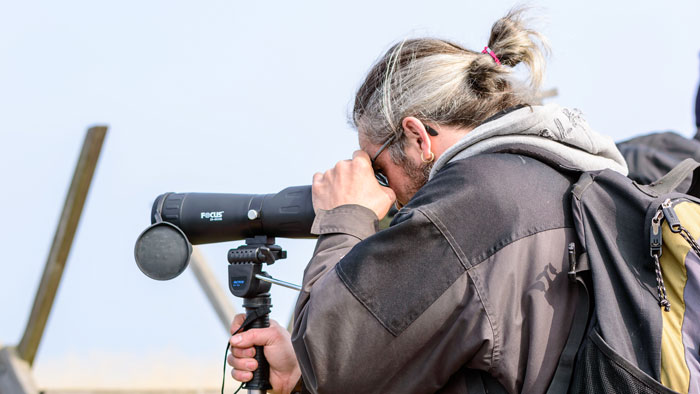
Scopes can see objective lenses reaching anywhere from 80mm to 100mm, offering even brighter viewing experiences, though at a cost to size. There’s a good reason we see scope users mounting these beasts atop sturdy tripods.
Ultimately, we need to consider what we’re willing to lug around as well as our use case. Scopes are often used early in the am, where light levels are low and contrast hard to make out. They’re also popular for refines searches, where binoculars did the dirty work of locating the action, and now we’ve shifted gears into telling a semipalmated sandpiper from a pectoral sandpiper across a lake. True story!
Exit Pupil and Eye Relief
Together, magnification and the objective lens diameter determine how bright our overall viewing experience is via the exit pupil. This refers to the size of the focused light that reaches your eye and greatly impacts how much of a scene you can see depending on lighting conditions and the distance from your eyes to the rear element of the optics.
Your exit pupil should always be larger than the pupil of your eye. It's important to note that the pupil of the human eye ranges from 1.5mm in bright light to 8mm in the dark. Why is this important? If the exit pupil is smaller than your pupil, it'll appear as if you're looking through peepholes. To learn more about exit pupil, check out our guide explaining it in further detail here.
What’s Right for Me?
Whether you’re birding, hiking, or heading to a sports event, there are a variety of uses for optics of all magnifications and sizes. If you’re birding or just looking for the optimal outdoor binocular. we recommend the 8x42, 10x42, or 10x50 range. These optics offer the perfect marriage of reach, light gathering capabilities, and portability, often without breaking the bank.
While binoculars are great for finding a bird at great distance, they lack the power we need to get a detailed look at something so far away. For more serious observations at greater distance, a spotting scope is essential. Scopes with a magnification of 20x and higher are ideal for detailed bird watching, sea watching, and hunting. Not to mention some lightweight astronomical viewing.
No matter what you’re using them for, from a night at the opera to birding on the open tundra, there is something for everyone at every price. This article has offered a basic introduction to the terms and numbers that will affect your buying decision and the overall performance of the optic. To learn more about scopes, binoculars and other optics, check out our other guides and articles on the B&H Explora page!
