Search results for: photography buying guide a guide to choosing umbrellas soft
About 4 filtered results
by Mathew Malwitz · Posted
One of the most effective ways to improve your portraiture is by controlling the light, and one of the most effective ways to control your light is to move it. Seems like a simple enough concept, but it can be daunting at first, especially if you're using a speedlight or an on-camera flash. Despite its misleading name, an on-camera flash can, very easily, be used off the camera. The "on-camera" part simply refers to its form factor

by Bjorn Petersen · Posted
When working with flash lighting, it is rarely the case that bare-bulb flash is the ideal choice for lighting subjects, especially when those subjects are wedding participants and your objective is to create inviting, flattering light. Flash can be modified in several ways, which all effectively diffuse and redirect the initial light source into a broader, more aesthetically pleasing source that is ideally suited for creating interesting and controllable illumination.
Softboxes and umbrellas are two of the most frequently used light modifiers,

by Allan Weitz · Posted
As a working photographer, the center of the universe is your camera bag and its contents. Your cameras and lenses are the tools of your trade. As you may have noted, both are mentioned in plural because just as you wouldn’t jump out of an airplane without a backup parachute, you shouldn’t attempt to photograph an emotionally spiked, non-repeatable event armed with only one camera. The same applies to lenses, too. The many aspects that comprise shooting weddings—portraits, the ceremony, dimly lit environs, tight, crowded quarters and bright
by tom kirkman · Posted
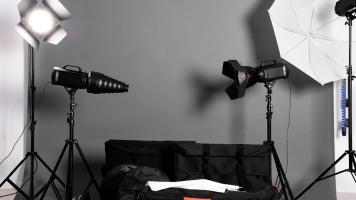
Everyone who has ever lugged around heavy gear has a soft spot for the breakdown studio. They all have in common the barest you'll need to get the job done, are fast to set up and break down, and are lightweight. Of course, there are choices to be made—flash or constant light, for instance. Flash has the benefit of stopping action, while constant sources allow you to see exactly what you'll get in the finished product. Constant light sources include tungsten-halogen (hot lights) that live up to their name, fluorescent, and the current