
As we begin to wrap up the year, we’d like to look back at some of our favorite product launches and moments in the photo industry. As it turns out, this has been quite the year for Nikon. Today, we’re looking at some of the best releases Nikon saw in 2025, from upgrades of existing models to integration of the RED cinema camera technology.
Nikon Z5 II Mirrorless Camera
In April, Nikon delivered a much-needed update to their entry level full-frame camera. The original Z5 was never the fastest camera in its class, but it had a larger battery than its competitors, dual SD card slots, and those famous Nikon ergonomics. The Z5 II retains these features while taking on a more Z6 III style. This includes a fully articulating touchscreen rear LCD as opposed to the tilting screen on the original. Internally, there’s a lot more going on. Powered by the same Expeed 7 processor found in the Z9, this camera delivers blisteringly fast autofocus and continuous shooting speeds up to 30 fps.

For creators, Nikon added a picture control button atop the camera to make easy access to its 31 color presets. These presets can be overlaid on the rear LCD so the user can see what they’re shooting before they press the shutter. Another updated trait is the Z5 IIs compatibility with the MB-14N Power Battery Pack. Although the Z5 II has a smaller footprint than the Z6 III, the choice by Nikon to make the Battery Pack interchangeable between models is certainly advantageous for shooters with both.
NIKKOR Z 24-70mm f/2.8 S II
How can you improve upon such an iconic lens? Easy, just look at the NIKKOR Z 24-70mm f/2.8 S II. Nikon latest iteration of their workhorse standard zoom lens is the first full-frame 24-70mm f/2.8 lens to feature an internal zoom. Without the extending barrel, this feature contributes to its improved weather resistance, and its hybrid shooting capabilities. As you zoom, not only does the length of the lens go unchanged, so does the center of gravity. This means the user gets zoom versatility with the handling of a prime. Nikon also implemented their Silky Swift Voice Coil Motor (SSVCM) and high-performance actuator to boost AF speed beyond the abilities of any Nikon lens before. Tracking performances is enhanced, and autofocus vibrations have been practically eliminated, ensuring noisy AF never disrupts important moments on video.
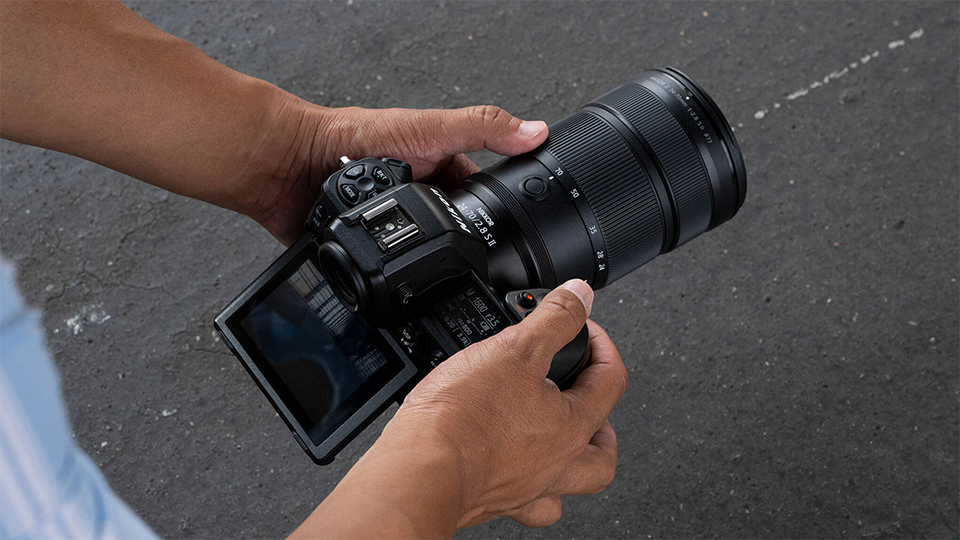
Speaking of video, focus breathing, a common headache among filmmakers, has been suppressed significantly. The lens shows less than half the amount of focus breathing of the previous generation 24-70mm f/2.8 S lens. Another improvement over its predecessor is its weight savings of 130g. That’s 15% lighter than the first Z iteration. Nikon also reduced the physical size of the lens, returning to a 77mm front filter thread after nearly a decade. Why is this important? One set of filters can be used between this and its fellow workhorse, the Z 70-200mm f/2.8 S VR without the need of stepping rings.
Nikon ZR 6K Cinema Camera
Long have we waited to see “Nikon” and “Cinema” in the same sentence together. Nikon drew quite a bit of attention when it acquired RED Digital Cinema, though no one was quite sure how they’d go about implementing that tech into their Z mirrorless system. Now, we have our answer. The ZR 6K Cinema Camera is Nikon’s response to the class leading, and previously unopposed Sony FX3, and it comes with an impressive set of features. First and foremost, is the fusion of RED and Nikon Cinema Technology, including REDCODE RAW R3D and N-RAW recording as well as other appreciated additions like built-in 3D LUTs, 32-bit Float Audio, and a 4” vari-angle touchscreen display in a DCI-P3 color gamut.

The camera also features 10 slots for custom LUTs with real-time preview when shooting. You can also adjust shutter angle to one of 15 steps between 5.6 and 360° for greater exposure and blur control. For current Nikon users, the ability to interchangeably use their existing Nikon Z glass is a huge bonus and just like any other Z series camera, you can extend the ecosystem with the FTZ II adapter. The CF Express Type-B card slot and EN-EL15c battery allows seamless use in tandem with other full-frame Nikon Z cameras.
NIKKOR Z 28-135mm f/4 PZ
Sticking with the filmmaking theme, we come to the NIKKOR Z 28-135mm f/4 PZ, a powerful zoom adept for professional video shoots of all calibers. As Nikon’s first full-frame power zoom lens, it had a lot of expectations to meet. With the ability to select one of up to eleven zoom speeds, users can achieve whatever look they desire. When used with compatible camera bodies, Hi-Res Zoom can be implemented, reaching up to an equivalent focal length of 270mm with 4K video recording.
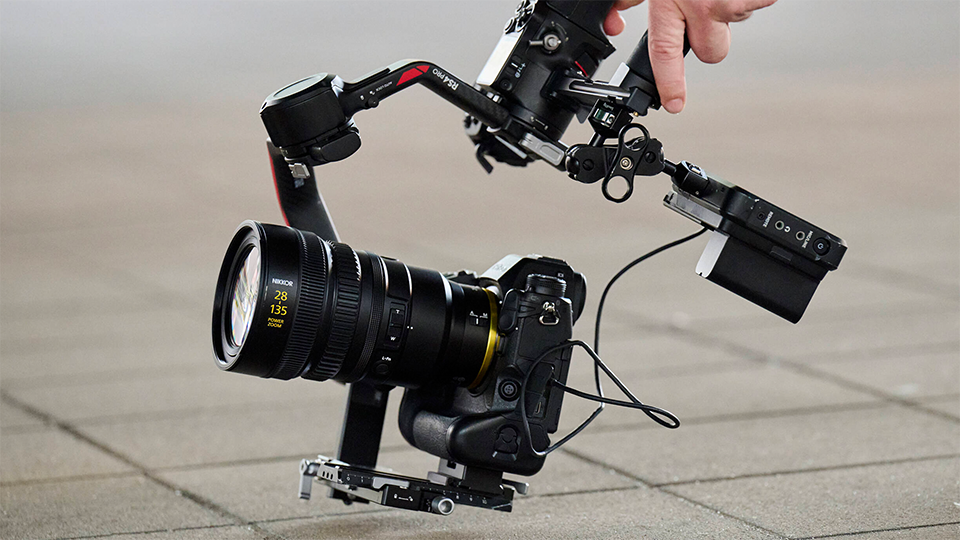
The lens uses a stepping motor for quick and quiet autofocus performance, which is perfect for run and gun videographers, and at 2.66 lb, there’s no better choice for the Nikon Z system. The physical length of the lens remains constant throughout its zoom range with a minimal change in center of gravity, making the lenses ideal for mounting on gimbal stabilizers and drones. For more creative scenarios where manual focus is preferred, the focus and zoom rings are designed with deeper ridges for compatibility with a follow focus system.
NIKKOR Z 35mm f/1.2 S
The 35mm focal length is almost as classic as the nifty fifty. For the first time in the brand’s history, Nikon packed the stellar f/1.2 aperture into one of their most popular focal lengths. The NIKKOR Z 35mm f/1.2 S is a key player for portraits, events, and documentary shooters. The addition of the 35mm focal length completes the trio of f/1.2 primes that is now comprised of 35mm, 50mm, and 85mm focal lengths. In fact, the three primes share the same 82mm filter thread for added convenience when working with filters like a polarizer or ND.

As with most lenses in the Z lineup, the 35mm f/1.2 features weather resistance providing confidence when shooting in any situation. While this lens is a still photography powerhouse, the prime is optimized for video and filmmaking thanks to a click less control ring, focus breathing suppression, and silent autofocus operation driven by dual STM motors.
Nikon Zf Silver Edition
Initially released in October of 2023, the Nikon Zf on its own is nothing new. With that said, the camera’s timeless design lends itself to new and improved additions. Two years later, Nikon did just that with the Silver Zf. There’s no difference between the standard black version and the silver in terms of specs. This is strictly an aesthetic change. If you wanted your Zf in silver before, you’d need to customize it with a skin. What more can we say about the Zf that hasn’t already been said?

For a retro outfit, look no further than the Nikon Zf. Whether you plan on using the latest and greatest S series Z glass or wish to adapt classic manual focus Nikon lenses from the days of olde, this camera looks good doing it. Like the standard color version, the Silver Zf is available with a number of grip color variations.
Z6 III (Firmware Update 2.0)
Years ago, you’d need to buy a dedicated camera with the “S” moniker—like the D300S, for example—for incremental updates. Today, we receive those same incremental updates which deliver game changing features in a matter of minutes via firmware updates. Firmware is embedded software that a device like a camera uses to control certain hardware elements. Updates to firmware can fix issues like bugs or deliver added functionality to users like new features or added compatibility with new products such as lenses and memory cards.

Earlier this year, the Nikon Z6 III received Firmware Update 2.0 delivered much requested dedicated bird tracking autofocus. Additionally, an in-camera focus limiter enhances the speed and accuracy of the already incredible autofocus system. Simply set a near and far point you’re your lens will ignore anything outside that range. Nikon also added features from the Z9 and Z8 like Auto Capture, which allows the camera to remotely capture images and videos on its own after capture parameters are set. Nikon also released Firmware Version 3.0 for the Z8, which saw many of the same features mentioned above, with the exception of bird detection, which the Z8 gained at an earlier date.

Nikon pulled no punches in 2025, and we can only imagine what stellar new image making tools they’ll unveil in 2026. We hope you enjoyed hearing about their best releases of the year. If you’d like to learn more about any of these stellar Nikon products, be sure to check out the detailed product pages. For similar articles and informational pieces, be sure to check out the B&H Explora Blog.
