
When assembling a kit of lenses for photographing a wedding, one should take into consideration the location in which the wedding is taking place, the number of guests and, of course, the type of imagery you are seeking to create. To best represent a wedding in a dynamic manner, it is often preferable to have a range of lenses to achieve different perspectives of the event, rather than maintaining a constant perspective of your subject matter. A wide-angle lens, specifically, is a highly effective tool for capturing many of the scenes that commonly take place at a wedding. Its wide angle of view takes in more of a room than a normal perspective, and its potential to produce sharp focus easily with great depth of field makes it an ideal choice for shooting quickly.
Wide-Angle Perspective
A wide-angle lens is a lens with a focal length that's shorter and, as such, wider than normal. This translates to focal lengths of 35mm or shorter, when working in 35mm or full-frame format, that produce an angle of view that is greater than that of natural human vision. A wide-angle lens allows you to include more of the scene within the frame and provides greater depth of field at small apertures, when compared to normal or telephoto lenses. This wide appearance also affects how the subject matter in the frame is rendered—often being exaggerated or slightly distorted, the closer the subject matter is to the camera position. But, if you keep the wide-angle lens square to your subjects to minimize distortion, this unique perspective lends itself especially well to photographing groups of people and the environments at weddings and will enable faster shooting due to the short focus throw of most wide-angle lenses.

Wide-Angle Lenses with APS-C and Smaller Sensors
As previously mentioned, a traditional wide-angle focal length ends at around 35mm, and begins at shorter focal lengths such as 28-, 24-, 21-, 18mm and so on; the smaller the number, the wider the angle of view. These numbers represent recognized wide-angle perspectives when working with a 35mm film camera and, more recently, with a full-frame sensor digital camera. This frame size is, on average, about 36 x 24mm, which gives a diagonal measurement of approximately 43mm, representing what is considered “normal” for that format. This diagonal is rounded up to 50mm, which is the de facto measurement for a standard normal-length lens. When a lens with a shorter focal length is used, the angle of view is greater, and more of the scene can be projected onto the film or sensor.
Due to the historical popularity and prevalence of 35mm film cameras, lens focal lengths and their angle-of-view associations are the most common way of determining what a wide lens is, or what a long lens is. Currently, many cameras use image sensors that are smaller than full frame, and are categorized by size standards such as DX, APS-C, or Micro Four Thirds. Since these sensors are smaller than full-frame sensors, their diagonal measurements are also smaller and as such, the normal perspective for these formats is also embodied in a shorter focal length lens. Since 35mm or full-frame focal-length-to-perspective relationships are widely understood, lenses used with these smaller sensors are given a 35mm equivalent focal length to help put into context the perspective they will capture. These equivalent angles of view are determined by multiplying the focal length of the lens by a "crop factor." Common crop factors are determined by sensor size: 1.5x for DX and other APS-C sensors (average size about 23.6 x 15.6mm), 1.6x for Canon APS-C sensors (22.3 x 14.9mm), and 2x for Micro Four Thirds sensors (17.3 x 13mm).
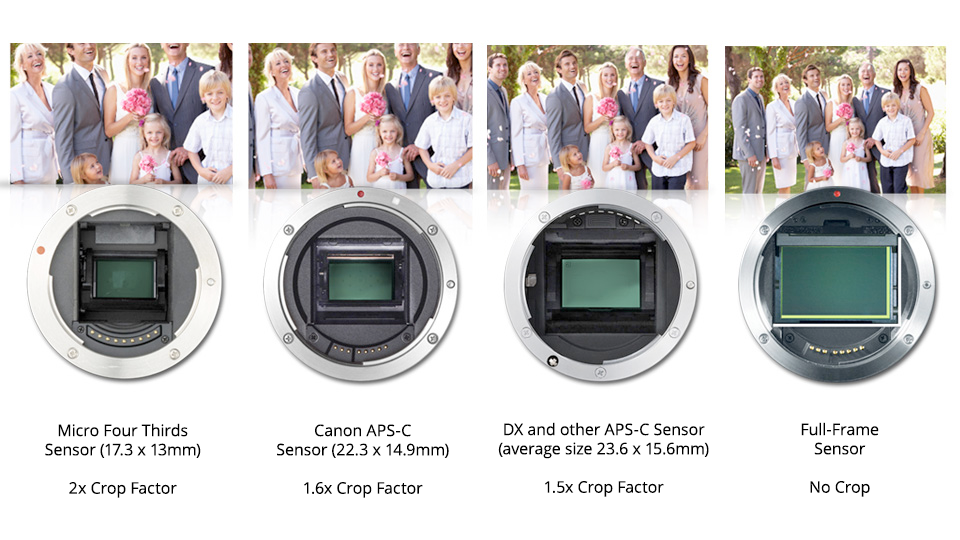
Using these factors to calculate, a 35mm lens on a DX-format sensor will have the equivalent field of view of a 52.5mm lens on a full-frame sensor; a 35mm lens on a Canon APS-C sensor will be equivalent to a 56mm lens on a full-frame sensor; and a 35mm lens on a Micro Four Thirds sensor will be equivalent to a 70mm lens on a full-frame camera. So, a lens that is commonly perceived as being wide-angle at 35mm functions more like a normal or portrait lens when paired with these smaller sensors. Because of this effective increase in focal lengths, shorter focal length lenses that emulate full frame wide-angle focal lengths for these smaller sensor cameras range from approximately 8-20mm.
Wide-Angle Lens Benefits and Effects
The exaggerated perspective of a wide-angle lens visually extends the scene and is also capable of maintaining focus on subjects that are both closer to and farther from the camera. This is the opposite effect of telephoto lenses, which tend to compress the visual space and can produce shallower depth of field and greater separation more easily between a subject and the background. Regarding photographing weddings, a wide-angle lens is a good choice when photographing the reception or other events that are happening at a faster pace.

A wide-angle lens will aid in ensuring that special moments are captured and recognizable, and will maintain respectable depth of field, even when photographing from the hip or without precisely composing an image. These lenses are also very well suited to working in tighter locations where physical space is limited and you just can't back away. Wide-angle lenses can also capture the space around the wedding party when you wish to include architectural elements, beyond the usual three-quarter shots. For environmental portraits, these lenses are ideal.
Fixed Focal Length versus Zoom Lenses
As with all lenses, there are choices available when selecting either a fixed focal length lens (prime lens) or a zoom lens that will provide multiple focal lengths in one lens. Both types have their pros and cons, and depending on the type of imagery you're capturing and the amount of time you have to switch lenses, they should be selected accordingly. Prime lenses provide a single focal length, and force you to physically move to modify your composition. One of the largest benefits of working with prime lenses is their tendency to have larger maximum apertures than zoom lenses of the same focal length. Prime lenses commonly have maximum apertures as wide as f/1.2, f/1.4 and f/1.8, whereas it is rare to find zoom lenses with apertures greater than f/2.8. Regarding wide-angle lenses, the larger aperture is a benefit because it provides an additional stop or two of light for photographing in dimly lit situations with faster shutter speeds. When working with longer lenses, a wider maximum aperture will also enable greater potential to utilize shallow depth-of-field techniques.
Zoom lenses, on the other hand, can sometimes be a more efficient choice due to their inclusion of several magnifications within the same lens. This will allow you to photograph one image at a wide-angle perspective, and then quickly change to working at telephoto magnifications.

In short, wide-angle lenses can be viewed as a necessary component to any lens kit, and they will certainly function as one of your go-to lens types for event photography, such as weddings. Their wide angle of view is unlike other lenses and their efficiency when photographing in fast-moving or spontaneous situations is paramount. When photographing larger weddings, or during the subsequent celebrations, a wide-angle lens works to ensure that the crucial images are captured successfully, especially when working with other, longer lenses is not possible. Additionally, their ability to depict subject matter with a grander-than-normal scale, and give prominence to near subjects while maintaining the clarity of distant subjects, is especially useful for working in most situations.
To learn more about wedding photography gear, strategies, and concepts, check out our other articles and guides on the B&H Explora page.
