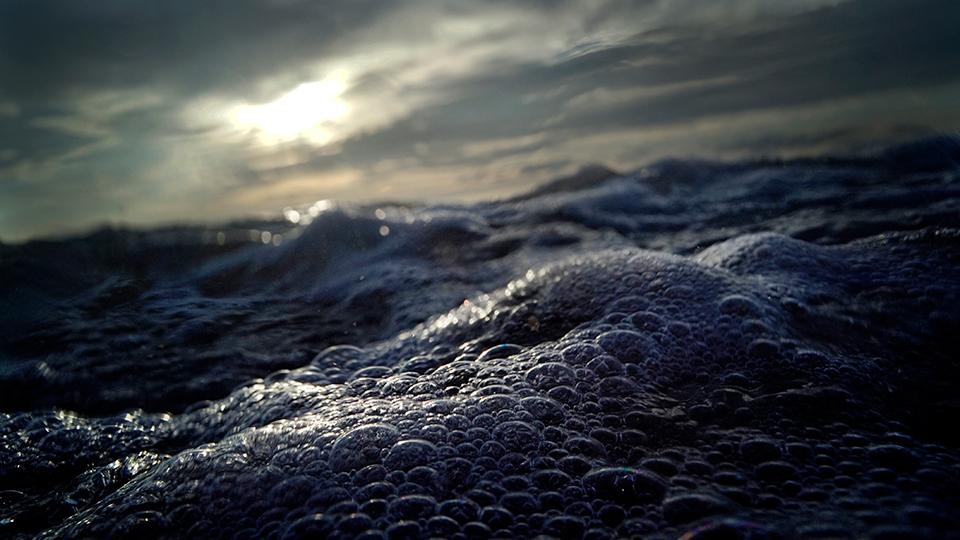
Close-ups taken with wider-angle lenses also expose subtle detail, but by framing your subject in its surroundings, you also create a narrative to go along with the visual detail. “Normal” macro photographs expose detail, ultra-wide-angle close-ups tell stories.
Macro photography is fascinating in the way it enables us to focus on the kind of subtle details we seldom notice otherwise. Sometimes the most mundane subjects can become fascinating when viewed at life size or greater.
Photographs © Allan Weitz

Something I’ve long been fascinated by is the way small items can appear monumental when captured close-up through ultra-wide-angle lenses. In my book, the ultra-wide threshold begins with lenses with angles of view of 90°, which on a full-frame 35mm camera is about 21mm.

What I’ve always found visually jolting about photographs taken at such close range with these lenses is how visually dynamic the main subject becomes when viewed against its surroundings. Midrange and longer focal length macro lenses expose the finer details of your subject, but they limit your perspective solely to the subject itself.

The accompanying photographs aren’t true macro images, i.e., life size. Most are closer to approximately 1:4. Nonetheless, the magnification ratios of these photographs are much greater than the native close-focusing distances of the lenses.
1. Get Low and Get Close
Wide-angle lenses demand strong foregrounds or backgrounds—without them, your eye wanders aimlessly across the viewing field. For this reason, I often resort to shooting wider-angle close-ups at ground level or, depending on the photograph, by positioning the camera against a wall, tree, or other surface. Needless to say, the tilt-screen on my Sony A7R II comes in extremely handy when shooting in this manner.

2. Alignment Matters
Camera alignment is crucial for macro photography. Depth of field is exceptionally shallow even when stopped down to smaller f-stops, and even the slightest tilt up, down, right, or left can dramatically alter the perspective and composition of the picture. When shooting extreme wide-angle close-ups, I strongly advise playing around with camera position because even the slightest changes in POV can dramatically change the visual dynamics of the photograph.
3. Support Needed
Of course, use a tripod of similar camera support whenever possible. Tabletop tripods are great for this type of photography.

These photographs were taken with Sony A7-series cameras and a Zeiss 21mm f/4.5 C Biogon T* ZM (90° AoV), a Voigtländer Super Wide-Heliar 15mm f/4.5 Asph III (110° AoV), and a Zeiss 16mm/f8 Hologon T* lens. To focus closer than the native close focusing distances of these lenses (12-18”), I used a Voigtländer VM-E Close-Focus Adapter, which incorporates a 4mm close-focusing helicoid that enables notably closer focusing when using Leica M-mount lenses on Sony E-mount cameras.

Over the past few years, numerous wider (and faster) ultra wide-angle lenses have come to market, and many of these lenses are from companies that pros and enthusiasts never really took seriously, or in some cases, had never previously heard of.
Voigtländer, a camera and lens manufacturer that had its original heydays in the early and mid-20th Century, was revitalized by Cosina as an alternative to pricier Leica M-mount lenses (and they’re darn good!). Today Voigtländer also produces exceptional 15mm (110° AoV), 12mm (121° AoV), and 10mm (130° AoV) ultra-wide lenses for Sony E-mount cameras.

Rokinon and Samyang (identical twins under the skin) produce very affordable 10mm and 12mm lenses in lens mounts for Fujifilm X-mount, Sony E-mount, Micro Four Thirds, Canon EF-M, and Samsung NX lens mounts.
One of the newer kids on the block, Venus Optics Laowa, offers both 12mm f/2.8 and 15mm f/4 Macro ultra-wides for Sony E-mount cameras. The company also offers an interesting twist on ultra-wides: the Venus Optics Laowa 12mm f/2.8 Zero-D lens in Canon mount with a Magic Shift converter MSC lens that converts the lens to a 17mm equivalent tilt/shift lens (+/- 10mm Shift) with 360° rotation that fits Sony E-mount cameras.

If you own an APS-C format camera, the Zeiss Touit 12mm f/2.8 (18mm equivalent) is available in Sony-E and Fujifilm X-mounts.

Have you used ultra-wide-angle lenses for extreme close-ups? If you have, we’d like to hear about your experiences, and maybe send us a picture or two!