Search results for: photography tips solutions how prepare your images print
About 12 filtered results
by Mathew Malwitz · Posted
When it comes to improving your wedding photography, you're likely to hear a lot about gear. We've done our fair share of these gear guides from using fast lenses to complicated lighting set ups. Now, we want to talk about techniques you can use to up your wedding photography game.
Let's take a step back and return to the basics. In this guide, we're going to look at five simple things you can do to up your wedding photography game. These tricks will aid us in both our understanding of the job, marketing ourselves, and client relations.
Be

Posted
Sony Alpha Ambassador Autumn Schrock shares her tips and tricks on how to process and prepare night sky photos for print. Learn how to print on different surfaces and materials to make your astro shots truly stand out.
0:00 - Intro
3:06 - Camera gear tips for printing
6:10 - Printing labs
8:03 - Calibrate your monitor
9:56 - Setting up Photoshop color settings
11:42 - Adding a tad of brightness
14:30 - Soft/Color proofing
19:49 - Print ratio
21:46 - Exporting your image for printing
24:47 - Autumn's favorite printing materials
39:17 - Selling

by Zack Young · Posted
Any photographer worth their salt should be familiar with portrait photography, but they’re likely less familiar with high-volume photography, an offshoot of traditional portraiture that focuses on providing large quantities of professional-level headshots. The most common clients for this type of work include schools, sports teams, large corporations, government-run entities, and basically any other organization that needs a sizeable amount of quality headshots in a short amount of time. Because of the economies of scale, high-volume

by Todd Vorenkamp · Posted
When the moon passes directly between Earth and the sun, those on Earth are treated to one of nature’s greatest spectacles—a total solar eclipse. It is a phenomenon that almost every observer would like to capture in a photograph.
Due to the rarity of the event, the short duration in which to capture it, and the dynamic nature of the subject, it is one of those photographic opportunities that requires the proper gear, setup, planning, and practice.
Eclipse and solar

by Linda LeNoir · Posted
Have you ever pictured yourself photographing in Africa among lions, giraffes, and elephants? The best way to realize this vision is on a photographic safari. Photographic safaris are for amateurs and professional photographers alike. There is no need to be intimidated by your skill level or camera equipment. It is a one-of-a-kind experience that cannot be obtained on a mainstream non-photocentric safari. You are also guaranteed to be in the company of like-minded travelers who all want the same thing—great pictures, videos, and experiences.

by Shawn C. Steiner · Posted
Even when you’re photographing distant landscapes with wide-angle lenses, you may notice that the image doesn’t look as sharp as you thought it would. Or perhaps some objects are tack sharp, but as you look farther into the foreground or background, it loses some of that detail. One solution is to use a technique known as focus stacking to ensure your images are as sharp as possible throughout the entire image.
What Is Focus Stacking?
A popular technique for macro and product photography, focus stacking is a technique in which multiple images

by Cory Rice · Posted
Portraiture is a collaborative process. Mastering the technical skills necessary to make a successful photo is only half of the job for the portrait photographer. The other half is managing and working with people. The best portraits offer more than just a record of how a person looked on a particular day; they provide a glimpse inside of that person. The challenge for the portrait photographer is in creating an environment and establishing a rapport that can accomplish this goal, often in a very short amount of time. The tips below should

by Jill Waterman · Posted
The photo community has a unique advantage over other art forms. As the most democratic of the arts, photographs, by their very nature, are among the most easily shared and viewed. This has given rise to an abundance of photographic portfolio reviews. In recent years, the portfolio review has become ubiquitous in the field of photography, providing a venue for photographers of all levels, from students to enthusiasts to accomplished professionals. Opportunities for critique, feedback, and professional connection are also available within a
by Todd Vorenkamp · Posted
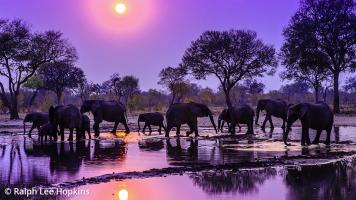
Ralph Lee Hopkins, founder and director of the Expedition Photography program for Lindblad Expeditions and National Geographic, is a formally trained geologist and nature photographer based in Santa Fe, New Mexico. He has written several books on the American Southwest, been featured in countless magazines, and teaches at photography workshops around the world for National Geographic, Santa Fe Workshops, and Arizona Highways. We spoke to Hopkins, just back from the Galapagos Islands, about wildlife and nature photography.
1. Planning
Todd

by Susan Seubert · Posted
As an assignment photographer for National Geographic Traveler for the last 10 years, I’ve learned that being prepared prior to leaving is the most important thing.
Research, Research, and More Research
The Internet has become my essential tool. I use a Google image search to help identify good locations for making iconic images. I also use it to find locales for an insider’s perspective. Locating a good paper map is also critical, particularly if you are heading to a place where satellite connectivity might be an issue. I also look at as many

by John Harris · Posted
And I’m not a pioneer of any style: I am just taking the kind of photos I like to take, using the principles of composition embraced by Cartier-Bresson and the street photography style forwarded by Klein and Winogrand, and applying them to a wedding.”
Some may beg to differ—after all, the “Ascough style” is a phrase often thrown around, referring to his black-and-white documentary wedding photography, and he is often mentioned as being one of the best wedding photographers in world. He is one of the

by Bjorn Petersen · Posted
With much of photography’s attention being devoted to the sole creation of the image, and more recently the virtual and instant sharing of those images, the art and practice of physically producing prints is becoming less of a requirement than in the past. This scarcity of physical prints does have immense benefits, though, as it is still the best and most revered method of owning a photograph. Printing photographs also grounds your work and allows for a bit more separation from the image itself, since it is being turned into a tangible object