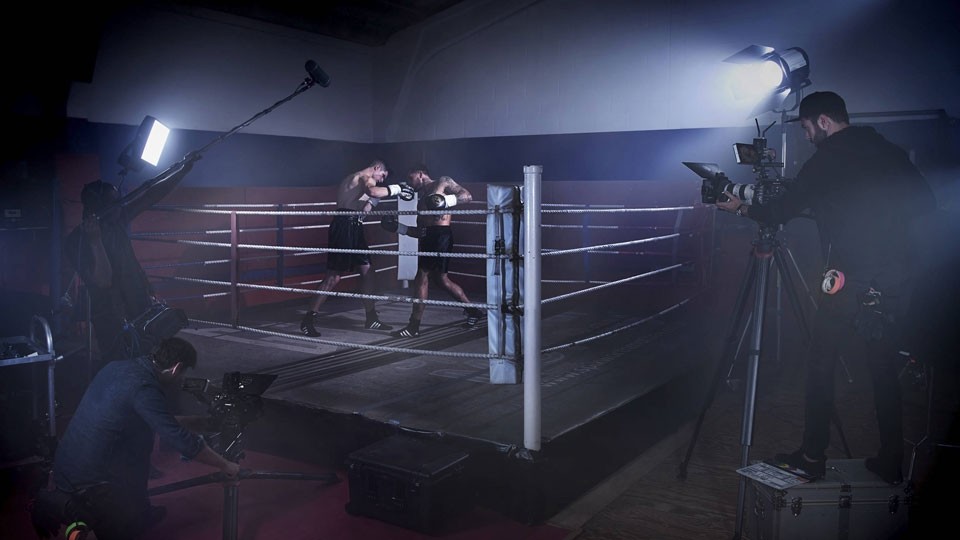
In the second part of our series on how to Accessorize Your Gear for Your Shoot, we’re going to be talking about music videos/location work, narrative single camera shooting, and full-blown studio work.
Music Videos/Location
Light, fast, and mobile are the key elements here, making camcorders an excellent choice. Mirrorless cameras and interchangeable lenses are also an enticing option.
Batteries
Batteries are a marvel, and if you are shooting a music video, or out on location, you are going to need a lot of them. It is a terrible feeling to run out of power when you still have more to shoot. To avoid this, plan on bringing at least twice as much battery power as you think you need. For example, on long days when I’m covering sports tournaments, I like to use two Core SWX Powerbase Edge Light Batteries to get me through the day. The Core SWX Powerbase Edge Link is also an attractive option, as it is camera agnostic and supports USB-C Power Delivery. As many Mirrorless/DSLR cameras can be powered via USB-C, a USB-C power bank with PD also makes a great option.

Cage/Handgrips/Gimbals/Monopods
Music videos are all about camera movement, and a cage and handgrips are a tremendous advantage. At this stage, a cage is a must have. It protects your camera and provides numerous mounting points for accessories and hand grips, wireless receivers, all without stressing your camera’s body. I’m not really a Steadicam or gimbal guy, but if you are into that, then find a system you like, and practice with it as much as possible (or hire an operator). Just for fun, I like bringing a monopod with me. The SmallRig Carbon Fiber Monopod Lite is pretty neat and features built-in feet and a built-in ball head; it really adds some versatility to your shooting without weighing a lot or needing an extra operator. Plus, monopods are great for getting low- and high-angle shots, especially low-angle tracking shots with a camera/cage that has a cold shoe on top.

Wide-Angle Adapter
I love wide angle lenses and the “warpier” the better. I have the Meike 3.5mm lens for my mirrorless camera. But if you don’t want a dedicated wide-angle lens, or are using a camcorder, then consider getting a wide-angle adapter/converter. The converter allows you to zoom without losing focus, while with an adapter, focus will shift as you move through the zoom range. These all tend to be specific to your camcorder, so best bet is to search for your camcorder on our site and check out the accessories.

On-Board Monitor
Nice to have and extremely useful. Check out these articles for detailed information about on-board monitors: Choosing an On-Board Monitor and 10 Different On-Board Monitors.
Narrative Single Camera Production
For single camera narrative productions, a solid tripod and head, lightweight matte box, follow focus unit, and a production monitor are the order of the day.
Tripod Head and Legs
While I have and use a variety of tripods for production, depending on the needs of the jobs, I tend to use my flowtech legs with 75mm bowl. I would like an aktiv 10T head with a set of 100mm flowtech legs, as that would allow me to handle larger cameras with longer lenses, but my current setup with an Ace XL head handles my needs. Though honestly, I lust after an O’Connor Ultimate 1040 fluid head. I know, way overkill for DSLRs, mirrorless, and camcorders, but with this I could build up whatever accessories I want and not have to worry about overloading the head.

Rods/Matte Box/Follow Focus Unit
For this level of production, I tend to feel that lightweight rods are preferable. Mostly we are discussing DSLR, mirrorless, and digital cinema cameras here, as most camcorders sport a lens hood, and focus and zoom are servo controlled. Truth is to use a set of support rods, which support a variety of lens accessories, from follow focus units, zoom motors, lens supports, and matte boxes, you are going to need a base plate with rod clamps. The industry standard for these accessories is 85mm from rod center to lens mount center, which allows you to pick and choose from our wide selection of lens accessories. Baseplates for DSLR/mirrorless tend to have adjustable risers, that allow you to raise your camera to the 85mm height, take this into account when shopping for a baseplate. 15mm rods are available in aluminum, stainless steel, carbon fiber, and titanium. Rods come in varying lengths, some rods can be joined to increase their length, with the longer the length naturally showing more flex. Flexing on your lens support rods is not a good thing. Bright Tangerine has made their Drumstix line of Sterling Titanium support rods. These are extremely lightweight and rigid, and the 12” length is a good all-around support rod size.

Matte boxes are either rod-mounted or clip-on. Clip-ons can be nice, lightweight, and easy to use; however, they will require precise sized lens rings and that your lens has a non-rotating front. Rod-mounted matte boxes have a little more flexibility and will often come with “Nun’s Knickers”—a fabric baffle with either elastic or a draw string for tightening around your lens to prevent light leaks from reflecting off your filter. Foam or rubber donuts can also be used, though those often only work for specific front diameters. Rod-mounted matte boxes do allow you to work with non-standard sized lenses, and those with rotating fronts. A top mounted flag is a bonus, though often a necessity.
A lightweight follow focus is usually a single knob on the operator’s side of the camera. These units tend to work with lenses that have a standard 32 -pitch/0.8 MOD gear rings. The ARRI Mini Follow Focus MFF-2 Cine Set clamps onto two rods, making it extremely stable, while being compatible with ARRI accessories such as focus whips and cranks. The Edelkrone FocusONE v2 Follow Focus Unit, on the other hand clamps on only one rod, and is a great option for the operator that will be pulling their own focus.

Studio Production
For full-sized Digital Cinema cameras, studio production is an entirely different animal, more gear, more people. In addition to many of the accessories mentioned above, the following accessories will round out your Digital Cinema package. Heavier duty tripods, more camera movement technology as opposed to hand-held, Move up to 19mm rods for even more rigidity and support for longer and heavier lenses. With the larger lenses, you will likely need a larger matte box, and that leads to the ARRI LMB 6 x 6 Pro 19mm Studio Set, which features a top flag, side flags, and front mattes to keep your lens clear from glare for a pristine image. You can take advantage of the space afforded by shooting in a studio, as opposed to a location, you can enjoy a larger monitor for better image evaluation on set. The Sony PVM-X3200 4K HDR Trimaster High-Grade Picture Monitor is a 32”-sized monitor. This doesn’t preclude the use of an onboard monitor, rather it provides a high-resolution off-camera screen that is plenty big for critical in-studio image evaluation, which is what you are looking for when shooting in studio.

I hope this exploration of the needs of different styles of production makes a good starting point as you tailor your gear to meet your needs.
