Search results for: video stabilization what is a gimbal how does it work
About 12 filtered results
by Mathew Malwitz · Posted
Lens selection is a highly personal choice for the professional photographer. Your shooting style, client needs, and cost all factor into how you choose to build your kit. Wedding photographers require a greater variety of lenses as they must cover a diverse assortment of compositions in various environments and lighting conditions. As working professionals, it’s only natural to begin investing in high-quality professional glass. For Canon users, this is the L series.
Easily identified by a thin red line circling the lens barrel, L glass is

by Jabari Holder · Posted
The original WEEBILL LAB featured some of my favorite innovations in the world of gimbals. When the industry focused on providing the most compact gimbal, or the smoothest stabilization, Zhiyun-Tech offered an option focused on being the most intuitive to set up and comfortable to operate. The WEEBILL-2 has doubled down on the innovations that made the WEEBILL LAB and

Posted
Today, after months of anticipation, DJI unveiled its first-ever FPV drone: the DJI FPV. The official reveal comes almost a year after the rumors about the alleged first-person flyer began circulating through the Internet. Based on today's announcement, the wait appears to have been worth it. Not only is DJI's newest drone a high-speed, low-latency FPV racer, it also functions as a conventional flyer and aerial imager capable of shooting

by Jill Waterman · Posted
Hybrid creator Jason Vong credits friends from school with helping him cultivate the storytelling abilities that are the driving force behind his thriving YouTube channel, as well as his talent for wedding videos. Vong’s insightful reviews of the latest gear and his expertise with Sony cameras have earned him a devoted audience of nearly 250,000 followers to date, leading us to connect with him as our next B&H Creator of the Week.
In our conversation below, Vong reminisces about his
by Shawn C. Steiner and Alec Kubas-Meyer · Posted
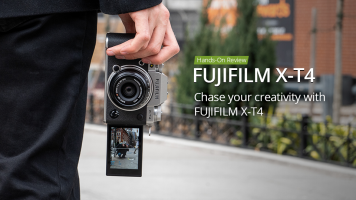
FUJIFILM has continually refined its APS-C mirrorless line, making it arguably the most complete system on the market. The recently revealed X-T4 elevates this manufacturer’s standing once again by implementing in-body image stabilization, using a larger battery, and making many improvements to overall speed. Another easy-to-see change is the rear display—now it flips out and works wonderfully for vlogging and for selfies.
by Alec Kubas-Meyer · Posted
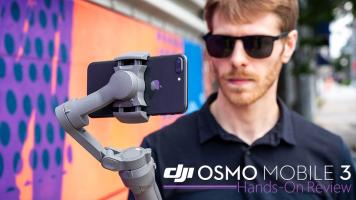
The newly announced DJI Osmo Mobile 3 is the first smartphone-specific gimbal I’ve spent more than 93 seconds with, and that experience has made it clear just how far this technology has come. It's 2013. I'm in my college dorm room staring at some filmmaking blog when, suddenly, I see an all-caps headline about The Next Big Thing. Accompanying that and its fifteen exclamation points was a jaw-droppingly smooth video that

by Shawn C. Steiner · Posted
Simply put, the DJI Mavic 2 is the best drone in its class. From top to tail, it excels in nearly every category of performance and design. In fact, the closest the Mavic comes to a true rivalry is between its two subclasses, the Pro and the Zoom. This

by Justin Dise and Val Lazarev · Posted
Although the idea of a wearable POV camera dates back several decades, the first action camera to be offered on the consumer market was a GoPro.
The Story Behind GoPro
A young man was off on a surfing trip somewhere far off, and wanted to capture quality photos of all the action, but found there was no way to get close-up angles. This same young man also very badly wanted to invent something. That was in 2002, and that same year, Nicholas “Nick” Woodman founded GoPro. Two years of work later, the first GoPro was introduced, the

by Steven Gladstone · Posted
Cameras continue to get smaller and lighter, without necessarily being designed with better ergonomics. Media costs drop, resulting in increased improvisation and on-the-fly filmmaking and, of course, you are always balancing quality with getting as much done as possible. So, unless you are making yet another Blair Witch Project, or reviving the shooting style of the TV series Hill Street Blues, smooth is the word when it comes to camera movement. In this article, I'm going to go over many of the available choices for stabilizing your camera

by Peter Ward_1 · Posted
What are they and who uses them? Some call them drones, some apply the label “quadcopters” as a blanket term—though they can have any number of rotors or even be planes—the FAA calls them “unmanned aerial systems” (UAS). I prefer to call them “unmanned aerial vehicles” (UAVs), a neutral term broad enough to safely include pretty much the whole gamut, from Hubsan nano drones up to commercial and military aircraft weighing hundreds of pounds and basically the size of small manned planes.

by Todd Vorenkamp · Posted
Someone, somewhere, recently decided to bid a fond farewell to one of the most legendary telephoto lenses ever made, the Canon EF 1200mm f/5.6 L USM and, now that it is at the B&H SuperStore, a group of photographers from B&H were given the opportunity to take this optical giant out for a unique shooting experience. Not only is it legendary, it is rare and mysterious. Our friends at Canon cannot even tell us how many of these lenses were made, with any certainty. There is speculation around the Web, but most experts seem to think that

by Peter Ward_1 · Posted
At the 2013 NAB trade show, Freefly Systems introduced the world to a new concept in camera stabilization—the motorized gimbal. A device giving operators the ability to capture dolly-smooth shots while enjoying something close to the freedom of handheld shooting has been around since 1976; of course, I’m referring to the “arm-and-vest” stabilizer. Amazingly, it took 37 years for a serious competitor to this classic-design stabilizer to emerge. This competitor is the MōVI.
Arguably, the arm-and-vest design works so well there was little reason