RAID Hard Drive Arrays

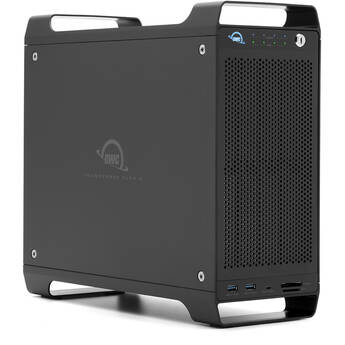
OWC ThunderBay Flex 8 128TB 8-Bay Thunderbolt 3 RAID Array (4 x 8TB NVMe SSDs, 4 x 24TB HDDs)
- 128TB (4 x 8TB NVMe SSDs, 4 x 24TB HDDs)
- 8 x 2.5/3.5" Drive Bays
- NVMe and SATA III Drive Interfaces
- Supports RAID 0, 1, 0+1, 4, 5, and JBOD
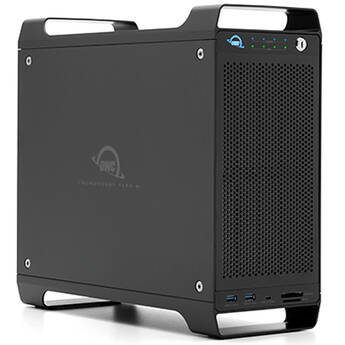
OWC ThunderBay Flex 8 144TB 8-Bay RAID Array (4 x 8TB NVMe SSDs, 7 x 16TB HDDs)
- 144TB Raw Storage Capacity
- 4 x 8TB NVMe SSDs
- 7 x 16TB HDDs
- Supports RAID 0, 0+1, 1, 4, 5 & JBOD
LaCie 8big Pro5 256TB 8-Bay Thunderbolt 5 RAID Array (8 x 32TB)
- Eight 32TB SATA III 3.5" HDDs
- Eight 3.5" SATA III 6 Gb/s Drive Bays
- Three Thunderbolt 5 Ports
- USB-C 3.2 Gen 2x2 Port
iodyne 24TB Pro Data Thunderbolt SSD RAID (Dark Space Gray)
- 24TB Storage Capacity
- 12 x NVMe SSDs
- 8 x 40 Gb/s Thunderbolt 3 Ports
- 5 Gb/s Bandwidth
Promise Technology Pegasus M4 SATA 16TB (SSD 4 x 4TB)
OWC ThunderBay Flex 8 172TB 8-Bay Thunderbolt 3 RAID Array (4 x 8TB NVMe SSDs, 7 x 20TB HDDs)
- 172TB (4 x 8TB NVMe SSDs, 7 x 20TB HDDs)
- 8 x 2.5/3.5" Drive Bays
- NVMe and SATA III Drive Interfaces
- Supports RAID 0, 1, 0+1, 4, 5, and JBOD
iodyne 24TB Pro Data Fly Kit (Dark Space Gray, Yellow)
- 24TB Storage Capacity
- 12 x NVMe SSDs
- 8 x 40 Gb/s Thunderbolt 3 Ports
- Included Yellow Hard Case
iodyne 24TB Pro Data Fly Kit (Dark Space Gray, Black)
- 24TB Storage Capacity
- 12 x NVMe SSDs
- 8 x 40 Gb/s Thunderbolt 3 Ports
- Included Black Hard Case
Promise Technology PegasusPro R8 144TB 8x18TB HDD
OWC ThunderBay Flex 8 200TB 8-Bay Thunderbolt 3 RAID Array (4 x 8TB NVMe SSDs, 7 x 24TB HDDs)
- 200TB (4 x 8TB NVMe SSDs, 7 x 24TB HDDs)
- 8 x 2.5/3.5" Drive Bays
- NVMe and SATA III Drive Interfaces
- Supports RAID 0, 1, 0+1, 4, 5, and JBOD
Promise Technology Vess A8600 160TB 16x10TB WS2022 CPU
Promise Technology VTrak N1616 128TB CPU/8TB HDD
Promise Technology PegasusPro R8 32TB 8-Bay Thunderbolt 3 RAID Array (8 x 4TB)
- 8 x 4TB SATA III 2.5" SSDs
- 8 x 2.5/3.5" SATA III 6 Gb/s Drive Bays
- Thunderbolt 3 | USB-A 3.2 Gen 2 & 2.0
- 10GbE RJ45 | 1GbE RJ45 | HDMI | VGA
Promise Technology Vess A8600 288TB 16x18TB WS2022 CPU
Promise Technology VTrak N1616 25G SFP28 128TB CPU/8TB HDD
Promise Technology VTrak N1616 SFP 12TB CPU/8TB HDD
Promise Technology VTrak N1616 12TB CPU/8TB HDD
Promise Technology VTrak N1616 SFP 288TB CPU/18TB HDD
Promise Technology VTrak N1616 25G SFP28 12TB CPU/8TB HDD
Everything You Need to Know about RAID Hard Drives (RAID Arrays)
Faster performance, data protection, and duplication of drives are the primary benefits of RAID arrays. They help protect individuals and companies from losing important data in the event of operating-system or hard-drive malfunction. A number of hard drive array accessories further guard against damage to your system. Popular accessories include hard drive enclosures and docks and storage cases for transportation.
What Is a RAID Array?
RAID stands for redundant array of independent disks, but not every RAID array level provides redundancy. Three forms of RAIDs protect hard drive contents:
- Hardware-based RAID: A physical controller manages the array; the array may or may not be part of the motherboard.
- Software-based RAID: Hardware system resources operate the controllers.
- Firmware or driver-based RAID: The firmware controller chip is part of the motherboard, and the CPU manages the functions.
Use internal hard drive cages to protect hard drives from jostling and from damage due to overheating during failure.
How Does a RAID Array Work?
RAID arrays distribute data across multiple disks, allowing processes or operations to evenly overlap. Using multiple disks increases mean time between failure, thereby increasing fault tolerance. Hard drive arrays trick an operating system into believing it's operating on one logical hard disk. Arrays can perform disk striping, mirroring, or a combination of both depending on the level of RAID hard drives being implemented.
Different Types of RAID Arrays
Some RAID systems are more useful than others because of their specific benefits and features. The five main levels of arrays commonly used in business are:
- RAID 0: Minimum two disks, striping, no redundancy, not for critical systems
- RAID 1: Minimum two disks, mirroring, redundancy
- RAID 5: Minimum three disks, redundancy, for read-oriented databases
- RAID 6: All functions of RAID 5, can operate with two failed discs, difficult to set up RAID controller
- RAID 10: Minimum four disks, striping and mirroring, best performance and redundancy, most expensive
Most types are available for both hardware and software, and finding a RAID system for Mac is just as easy as finding for one for a PC.
How to Choose a RAID Array
To choose a RAID array for personal or business use, keep the following information in mind. If critical drive recovery is important to your level of data, RAID 0 or 1 isn't going to provide required functions. If you have a read-oriented database and need a distributed parity, RAID 5 is best. RAID 6 and 10 are more suitable options for large businesses because they each work well for critical drives.
Find a wide range of RAID arrays at B&H Photo and Video and use them alongside wireless storage devices to extend company options for data protection and recovery after critical failures.