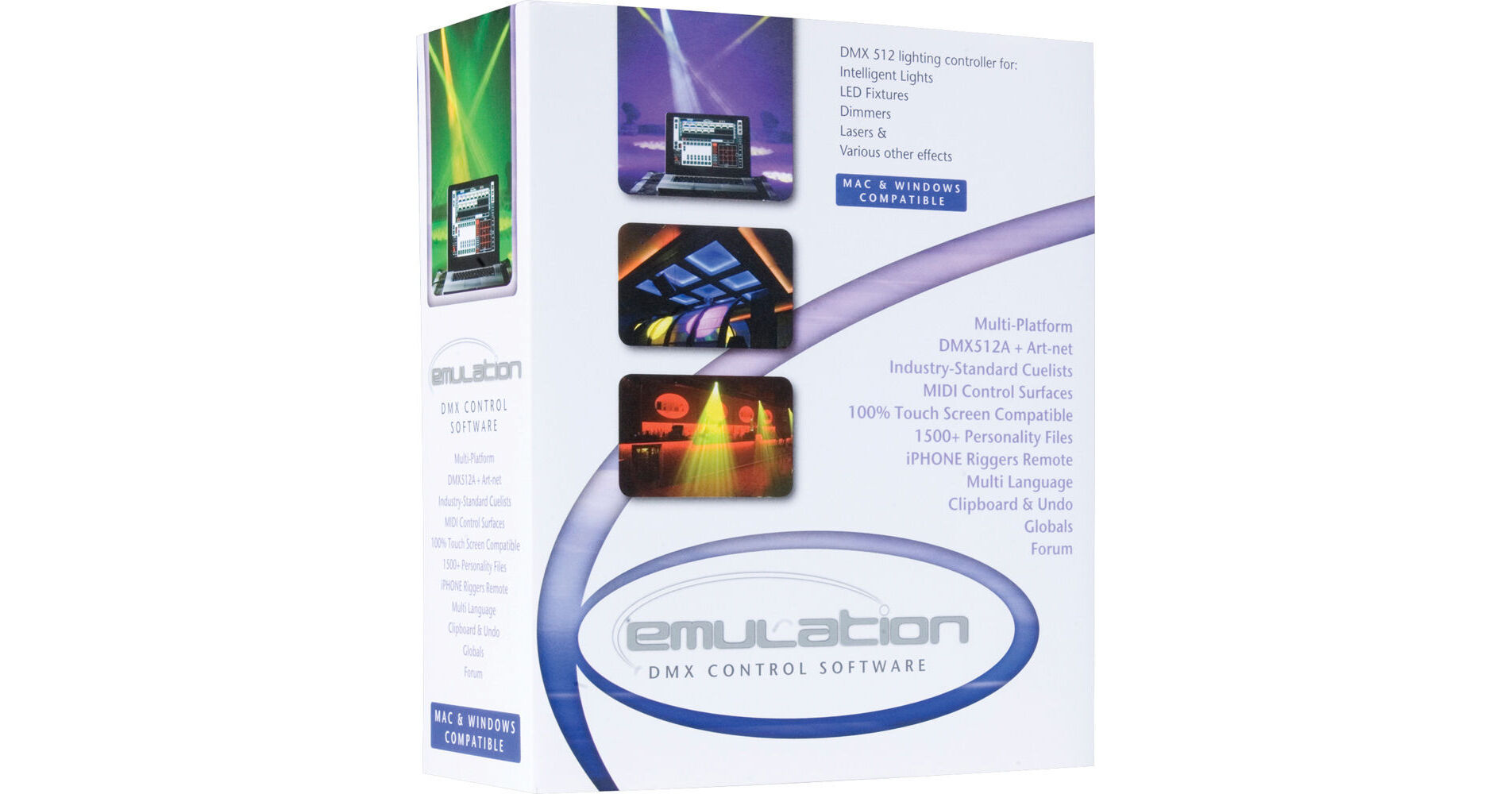
Emulation is a DMX 512 lighting controller for intelligent lights, LED, dimmers, lasers and various other effects. The program is platform-independent and available on Mac OS X, Linux and Microsoft Windows. It's shipped with a USB-to-DMX adapter cable, compliant with the new DMX512-A standard. Key to the design of EmuLATION is its intuitive graphical user-interface. It is specifically designed to reduce the amount of time required to learn how to operate the software. EmuLATION is ideal for pro lighting users who seek easy-to-use, powerful lighting control software.
Multi-platform
You can use EmuLATION on your preferred platform; it is available on Mac OS X, Linux and Windows.
DMX512A + Art-Net
EmuLATION software is shipped with a USB to DMX interface. The interface sends out 512 channels through an ESD-protected DMX512-A port. Once the hardware interface is plugged into your computer the DMX data is duplicated over Art-Net. This is also useful for connecting to 3rd party visualizers.
Industry-Standard Cue List System
The system used for programming light sequences is based on the systems used on larger lighting consoles. It features separate Delay, Fade in and Fade out timing and comes with a shape generator and programmer window.
iPhone Rigger's Remote
EmuLATION comes with a Rigger's remote application that runs on your iPhone and other mobile devices with a modern Internet browser. This web-application currently offers two features: a patch list and a playback button page. The patch list in the Rigger's Remote displays, in real-time, all fixtures in the EmuLATION patch and their settings like mode and starting address. The address is shown in decimal and dip switch manner. The patch list feature allows the EmuLATION operator to go on stage and conveniently set the address on each fixture having all the information shown on the iPhone. The Rigger's remote also features a playback button page that can trigger cue lists.
Sub-Fixtures
The concept: Some fixtures consist of multiple sub-fixtures. A 10-channel dimmer rack is in terms of the concept, just one fixture with 10 sub-fixtures. This also works for LED fixtures with multiple segments/pixels. In this manner the maximum of 48 will not be reached that quickly (you can add 48 x 10 = 480 dimmer channels). The reason for the concept of sub-fixtures is that it makes patching easier; you only add the physical fixtures to your patch and you don't have to worry about setting starting addresses per dimmer channel, or per LED segment.