The m920 High Resolution Monitoring System from Grace Designs is a monitor control system designed to provide highly accurate monitoring to your speakers via either analog or digital sources. It features an integrated digital to analog converter capable of handling PCM resolutions up to 32-bit/384 kHz as well as DSD 128 files. The unit provides a variety of digital input options, including AES, S/PDIF, TOSLink, and USB inputs. The m920 also provides both balanced analog XLR inputs.
For accurate playback, the m920's output is adjustable in 0.05dB steps. The unit also supports a variety of outputs, including 2 stereo sets of unbalanced RCA outs, 2 balanced 1/4" outputs, and 2 front-panel 1/4" headphone outputs with volume control independent of your main outs.
Ask Our Experts800-606-6969
Hello, Log InAccount & Orders
Video Chat with a Pro Audio Expert - Live
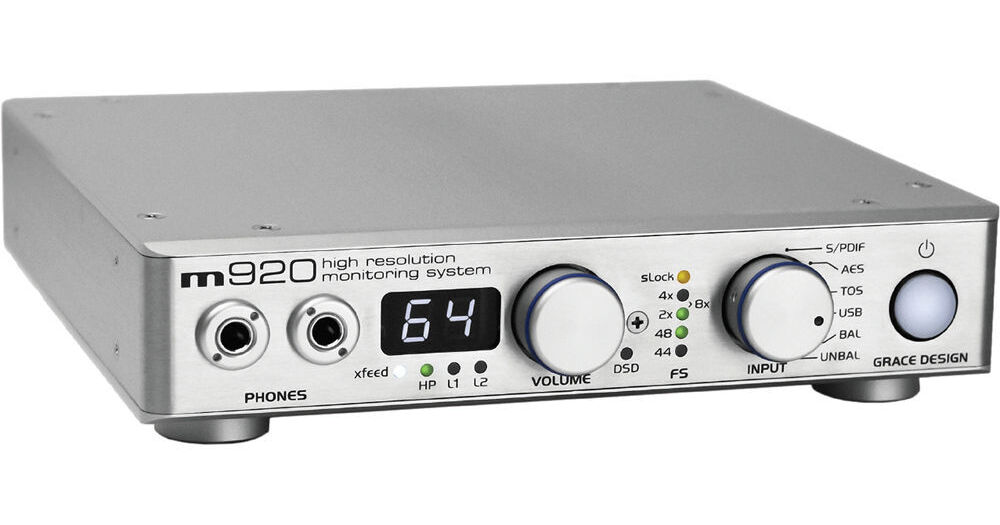
Key Features
- Analog & Digital Inputs
- Balanced & Unbalanced Inputs & Outputs
- D/A Conversion up to 32-bit/384 kHz
- Supports DSD 128 Playback
The m920 High Resolution Monitoring System from Grace Designs is a monitor control system designed to provide highly accurate monitoring to your speakers via either analog or digital sources. It features an integrated digital to analog converter capable of handling PCM resolutions up to 32-bit/384 kHz as well as DSD 128 files. The unit provides a variety of digital input options, including AES, S/PDIF, TOSLink, and USB inputs. The m920 also provides both balanced analog XLR inputs.
More DetailsNo Longer Available
Grace Design A920 Overview
Stereo analog inputs - balanced (+4dBu) XLR and unbalanced (-10dBv) RCA.
Ultra low distortion 32-bit /384 kHz Sabre DAC accepts stereo digital input sources in AES3, S/PDIF, TOSLINK (optical) and USB formats with auto sample rate detection and digital de-emphasis filter
User configurable DAC filter response for PCM and DSD playback
USB for playback of up to 384 kHz / 32-bit PCM as well as DSD 64 and DSD 128 playback via DoP
AES and S/PDIF playback of up to 192 kHz / 24-bit PCM as well as DSD 64 playback via DoP
Dual-stage wide lock range PLL for jitter rejection on non s-locked sources
Third generation s-Lock dual stage PLL (phase lock loop) circuitry for low jitter clocking and sonic integrity
Two sets of line level outputs provided via RCA (unbalanced) and 1/4" TRS jacks (balanced) for connection to stereo monitors
RCA line outputs can be configured for variable or fixed DAC output mode for operation as a standalone digital to analog converter
Front panel rotary encoder provides level control of both headphone and the line output levels. Level adjustments are made in 0.5dB steps within a 95dB range
0.05dB channel level matching to ensure true stereo balance at any monitoring level
White 7-segment display is used to show headphone and stereo main output levels
X-feed (cross feed) simulates the acoustics of a loudspeaker listening environment which can improve imaging while reducing listening fatigue when using headphones. This feature employs a designed signal cross-feed, filtering and delay circuits to simulate HRTF (head related transfer functions)
High current transimpedance output amplifier design drives 8Ω loads. The m920 was specifically designed with low impedance headphones in mind
0.5% metal film resistors are used throughout and there are no electrolytic capacitors in the signal path. Sealed gold contact relays are used for all signal switching
Infrared remote control for level control, left/right balance, mute and more when using the optional remote control unit
Apple IR remote control is supported with optional pairing
USB firmware upgradability
Grace Design A920 Specs
Analog Input
| Gain | |
| Frequency Response | |
| Maximum Input Level | |
| Maximum Output Level | |
| Impedance | |
| Dynamic Range |
THD + N, Balanced Input
| Gain | |
| Attenuator | |
| Volume Settings for Unity Gain |
D/A Converter
| Input Formats | |
| THD + N | |
| Output Level |
General
| Power Requirements | |
| Dimensions | |
| Weight |
Packaging Info
| Package Weight | |
| Box Dimensions (LxWxH) |
Grace Design A920 Reviews
See any errors on this page?