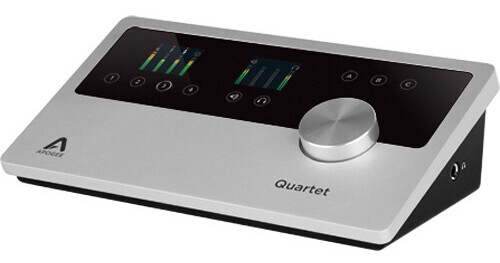
Designed to be the audiophile-quality centerpiece of a project studio, the Apogee Electronics Quartet is a 12x8 USB audio/MIDI interface bringing Apogee's legendary sonic performance to a sleek desktop form factor for musicians, producers, and songwriters in pursuit of their best sound.
It features four world-class microphone preamps with phantom power, XLR-1/4" combo inputs for connecting microphones, instruments, or line-level signals, and up to 75 dB of gain to ensure robust amplification even for low-output ribbons and classic dynamics such as the Shure SM7B. Enable the Quartet's integral per-channel Soft Limit technology to gently prevent clipping the A/D converters and open up more headroom.
Expansion for more inputs is possible via the two TOSLINK optical input ports, which allow for eight more input channels at up to 96 kHz—perfect for hooking up an ADAT-equipped outboard multichannel mic preamp or A/D converter. The Quartet's BNC word clock output gives it the added functionality as a stable clock source for other digital devices.
With six balanced analog 1/4" TRS line/monitor outputs and an independent 1/4" headphone output, the Quartet can feed three separate sets of monitors and your favorite cans. Three QuickTouch pads with LED highlight rings above the main controller knob can be assigned to functions such as mute and sum-to-mono. They can also be used to switch the analog outputs on or off, facilitating sound comparison on multiple pairs of speakers.
On the Quartet's rear panel, there are dual USB ports—one for connection to your Mac/Windows computer or iOS mobile device, while the other supports MIDI input and output over USB. Apogee Maestro software is available for three operating systems (Mac, Windows, and iOS) to provide low-latency monitoring and comprehensive control of Quartet in a user-friendly, single-window interface.
- Ergonomic, angular design and intuitive user interface make the unit a perfect studio control center for a Mac computer, a PC sporting Windows 10, or an iOS device
- Two full-color, high-resolution OLED screens for critical input and output detail
- QuickTouch pads for easy I/O selection
- Single, large controller knob
- Connect up to four microphones, instruments, keyboards, or line inputs
- Plug in a MIDI controller or keyboard
- Expand with up to eight digital inputs via ADAT Lightpipe
- Monitor and mix in stereo with up to three sets of speakers, or in 5.1 surround
- Seamless click-free transitions as the gain increases and decreases throughout the 0 to 75 dB gain range
- Allows for dialing in the perfect level, either with the controller knob or from within software
- Ultralow noise and smooth, crisp detail
- Suitable for all dynamic, condenser, and ribbon microphones
- Converters designed to deliver unadulterated recordings and a stellar listening experience
- Efficient circuitry and state-of-the-art components provide a simplified signal path that results in transparent recordings
- Utilizes an ESS Sabre32 32-bit hyperstream DAC with circuitry to eliminate time domain jitter and provide ample dynamic range and low-distortion conversion
- Six balanced 1/4" TRS outputs allow for listening and comparing stereo mixes on up to three sets of speakers
- Mix audio or Final Cut video projects in 5.1 surround
- In live situations, use all three stereo sets on stage, sending signal to the performer, the monitor mixer, and front-of-house
- Studio-quality 1/4" headphone output independently adjusts headphone levels separate from the main outputs
- Prevents digital clipping that causes distortion by instantaneously rounding off transient peaks before they hit the analog-to-digital converter
- Allows for several more decibels of apparent level to be recorded while subtly providing an analog-like warmth to the sound
- Eight channels of digital input via two ADAT optical connectors
- Connect an additional analog-to-digital converter with microphone preamps for additional inputs
- SMUX support for higher sample rate digital audio
- Word clock output for synching an external A/D converter to Apogee's stable clock
- Dedicated USB MIDI I/O connection for connecting a CoreMIDI compatible keyboard, synthesizer, or DJ controller
- Leaves a USB port available on a Mac for external hard drives and other devices, eliminating the need for an external MIDI interface
- Two high-resolution OLEDs deliver all the visual feedback critical for recording and monitoring
- Without looking at a computer, Quartet displays metering, levels, grouping, phase, muting, phantom power, and Soft Limit for all inputs and outputs
- Easily access all important recording and monitoring functions
- Tap a QuickTouch Pad on the top panel to select an input or output and easily adjust level with the controller knob
- All input and output touchpads feature an LED highlight ring (the ring of the active touchpad is brighter)
- Three additional configurable touchpads (labeled A, B, C) allow for quick access to output functions such as mute, dim, sum to mono, clear meters, or engage speaker set
- Each function can be assigned to a touchpad using a drop-down menu within Apogee's Maestro application
- A, B, C selectors can be configured in Apogee's Maestro software to switch between up to three pairs of speakers allowing the Quartet to function like a standard monitor controller
- Input type selection and level control
- Microphone preamp level control
- Speaker, headphone selection, and volume control
- Low-latency monitoring
- Clock source, sample rate setting
- Minimized tool bar view with System Status, volume controls, mute and clear meters buttons
- Comprehensive metering
- Intuitive audio routing
- Soft Limit and phase invert on each input
- USB 2.0 high-speed connectivity
- With advances in the Apple's Core Audio driver, USB 2.0 performs faster and with lower latency than FireWire 400
- While USB 3.0 offers approximately 10 times the bandwidth of USB 2.0, USB 2.0 far exceeds the bandwidth Quartet requires for its potential 12 inputs and eight outputs
- Quartet users can add more channels of Apogee conversion to their existing setups by adding a Duet 2 (available separately)
- Connect both Quartet and Duet 2 to a Mac's USB ports and aggregate the two devices for a combined total of six analog inputs and 12 analog outputs
- Designed in California
- Built in the USA