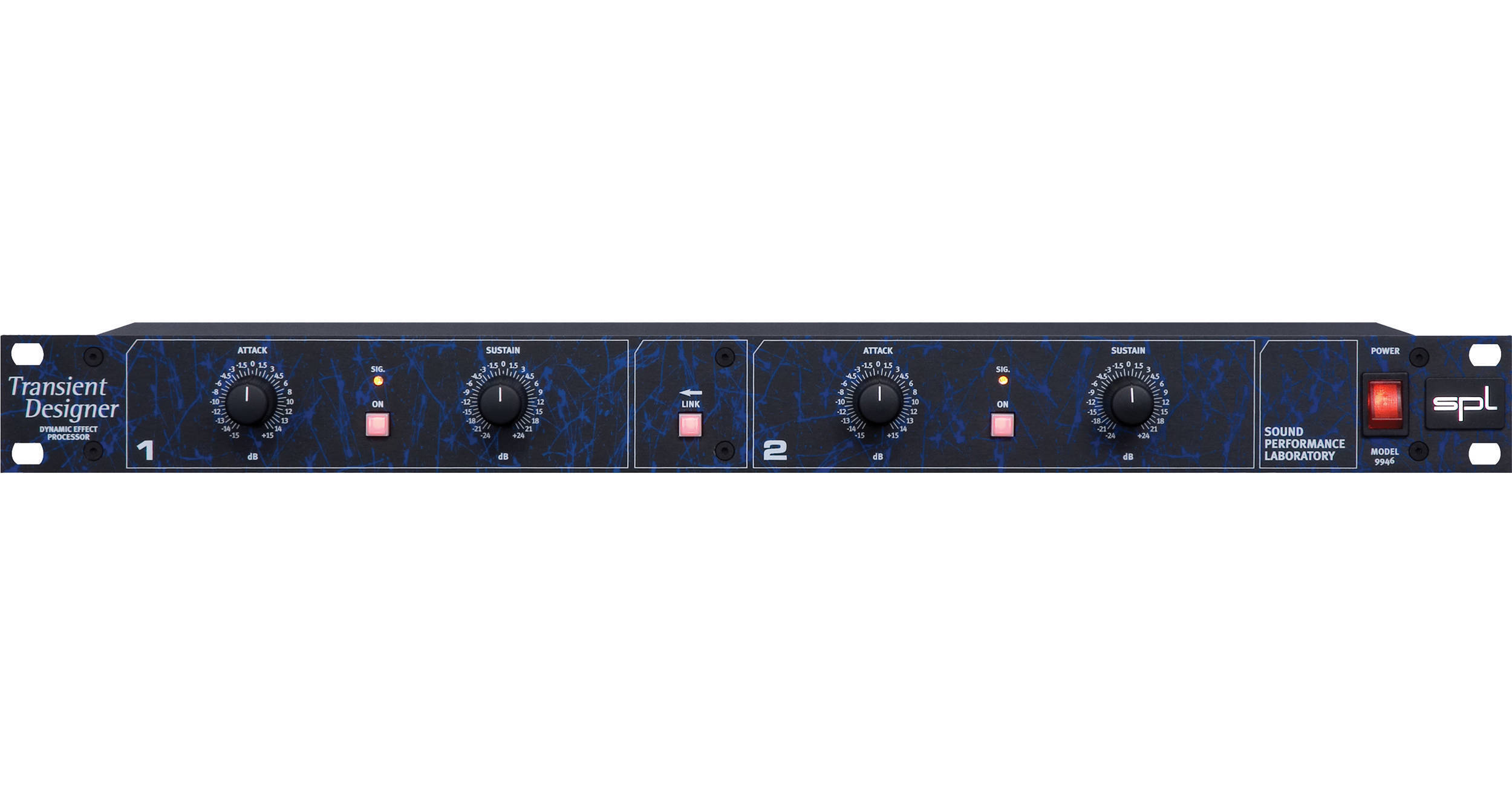
The Model 9946 Transient Designer 2 from SPL is a two channel dynamic processing device that offers a different take on level-independent shaping of the dynamic response of a sound. With the Transient Designer, it is possible to control the attack and sustain behavior of a signal in a simplified way. Unlike other dynamic devices, the processing is not governed by the signal level but rather by its dynamic envelope, so all signals (loud and soft) are processed equally.
Only one pair of controls per channel allows you to emphasize or smooth the attack and extend or shorten the sustain of a sound event. It is possible to shape the dynamic path of a signal as you want, as if for example you were changing the microphone distance and position after the recording has been made.
With little effort, you can shorten or lengthen the attack of all kinds of percussive signals, such as the bass drum, snare, toms, congas etc. to give them more kick, or to flatten the signals. It's almost like being able to change the amount of drum damping after the recording. The same applies to many other signals: Amplify or reduce the picking sound of an acoustic guitar, hold the sound of the strings longer, reduce the reverb time of a choir, compress solo vocals, increase intelligibility, actuate the piano pedal "electronically", turn down the slap-bass a notch or give it even more attack, etc.
The Transient Designer provides a different concept for dynamic processing, rendering controls such as Threshold, Ratio and Gain superfluous, and provides a very elaborated automation. So, while the processing going on inside the box may be very complex, the user has to deal with only a pair of intuitive controls per channel.
Differential Envelope Technology
SPL's Differential Envelope Technology is an SPL analog solution for level-independent shaping of envelopes, allowing transients to be accelerated or slowed down and sustained, prolonged or shortened. The degree of dynamic processing required to do this couldn't be duplicated even using a chain of several conventional compressors, yet only two controls per channel are required to allow the user to completely reshape the attack and sustain characteristics of a sound. Attack can be amplified or attenuated by up to 15 dB while Sustain can be amplified or attenuated by up to 24 dB, enabling weak drum sounds to be made much more percussive and powerful, or for over-percussive transients to be softened. All necessary time constants (Attack, Decay and Release) are automated and optimized adaptively in a musical manner according to the characteristics of the input signal. This results in natural-sounding signal processing and fast operation.
The Transient Designer circuitry uses envelope followers to track the curve of the natural signal so that optimum results are guaranteed regardless of the input signal's dynamics. Because of the level-independent processing inherent in Differential Envelope Technology (DET), manual threshold adjustments are not required.
For stereo operation, the Link function connects a channel pair. Linked channels are controlled by the same side-chain voltage so as to maintain a coherent and stable stereo image. When operating in Link-mode, the control elements of the first channel, including the Active switch, control the second channel, too.
Each channel is equipped with a relay hard-bypass circuit to ensure a minimum signal path when the process is bypassed and to provide power-fail safety. The Signal-LEDs allow the user to quickly monitor the signal flow, which is particularly important if the two channels are connected to a patch-bay. The Transient Designer 2 is fitted with unbalanced TS sockets.