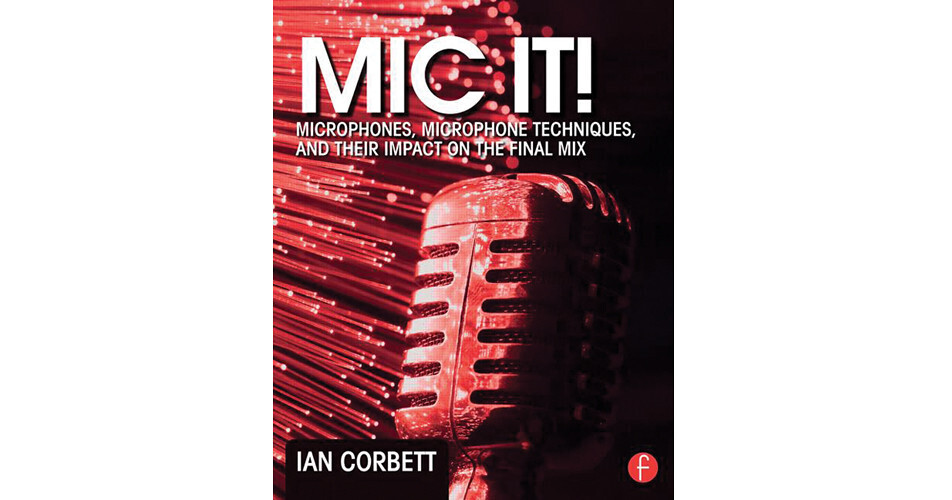
Author Ian Corbett's book, Mic It! Microphones, Microphone Techniques, and Their Impact on the Final Mix from Focal Press offers expert guidance on how to quickly understand essential audio concepts as they relate to microphones and mic techniques, and teaches you how to apply them to your recording situation. Whether you only ever buy one microphone, are equipping a studio on a budget, or have a vast selection of great mics to use, this book gives you the background to design and discover your own solutions to record the best sound possible.
Beginning with essential audio theory, then discussing the desirable characteristics of good sound and the elements of a good stereo recording, the book covers microphones, mono and stereo mic techniques, the effect of the recording space or room, and large classical and jazz ensemble recording. A variety of mic techniques for vocals and instruments (both individual and groups) are presented, ranging from vital knowledge that no novice should be without, to advanced techniques that more experienced engineers can explore to benefit and vary the sound of their recordings.
1.1 It's Not Always About The Gear!
1.2 What Is Sound?
1.3 The Decibel
1.4 Power Relationships
1.5 Decibel Scales
1.6 Dynamic Range
1.7 Signal To Noise Ratio
1.8 Frequency
1.9 Frequency Response
1.10 Waveforms, Fundamentals, And Harmonics
1.11 Wavelength, Velocity, Phase
1.12 Amplitude Summation
1.13 Human Hearing
1.14 Signal Flow And Audio Level Standards
1.15 Gain Structure
1.16 Analog Audio Connectors
1.17 Digital Audio Connectors
1.18 Digital Audio Basics
Chapter 2: "Good Sound"
2.1 Recognizing Good Sound
2.2 Sound Reproduction Formats
2.3 Monitoring Options - Loudspeakers, Headphones and Earbuds
2.4 Compressed Audio Formats
2.5 Dynamic Range
2.6 What About Distortion?
2.7 What Is A Good Recording?
2.8 Accuracy
2.9 Non-Natural Sounds And Balances
2.10 What Are The Elements Of A Good Mix?
2.11 Frequency Balance
2.12 Clarity And Intelligibility
2.13 Musical Arrangement
2.14 The Stereo Image
2.15 Focus And Amplitude Balance
2.16 Processing And Effects
2.17 Song Structure And Orchestration
2.18 Making A Great Record
Chapter 3: About Microphones…..
3.1 The Microphone
3.2 End Address Or Side Address?
3.3 Directionality And Pickup Patterns
3.4 Dynamic Microphones
3.5 Condenser Microphones
3.6 Ribbon Microphones
3.7 Tube (Valve) Microphones3.8 Other Microphone Technologies3.9 Phantom Power
3.10 Proximity Effect
3.11 Frequency Response
3.12 Off-Axis Response
3.13 Flat Microphones VS Vocal Microphones
3.14 Low Frequency Response
3.15 Low Frequency Instrument Microphones
3.16 Sensitivity
3.17 Self-Noise And Equivalent Noise Rating (ENR)
3.18 Signal To Noise Ratio
3.19 Maximum SPL
3.20 Dynamic Range
3.21 Transient Response
3.22 Pop Filters, Windscreens, And Dead Cats
3.23 Shock Mounts
3.24 Mic Preamps
3.25 What Mic To Use?
3.26 There's More To It Than Specifications!
Chapter 4: EQ Basics
4.1 What Is EQ?
4.2 Last Resort, And Creative Mix Tool
4.3 Can You EQ Spill?
4.4 EQ Filter Types
4.5 Analog VS. Digital EQ
4.6 Additive VS. Subtractive EQ
4.7 The Fewer Filters The Better
4.8 How Much To EQ?
4.9 When To EQ?
4.10 Golden Rules Of EQ